
How Important Is Psi for Air Compressor: A Practical Guide
How important is psi for air compressor use? Learn how pressure, airflow, and tank capacity affect tool choice for November 2026.
 By Glenda Taylor
Updated November 22, 2026


A compressor’s PSI number can look impressive, yet still tell you too little about whether it can run a particular tool. How important is psi for air compressor decisions depends on the tool’s required pressure, the compressor’s delivered airflow, and how long the tool draws air. Those details matter whether you’re inflating a tire, using a blow gun, or powering a pneumatic nailer.
Maximum PSI describes the pressure the compressor can store, not the amount of air it can deliver continuously. A larger tank can provide a useful reserve, but it doesn’t make a pump produce more air per minute. For more context on matching equipment to pneumatic tasks, see our portable compressors for air tools guide and our air compressor accessories overview.
The products listed below illustrate why PSI should be read alongside other specifications. They include a 6-gallon, 150 PSI pancake compressor, a cordless tire inflator with a listed 150 PSI maximum, and accessories such as a pressure regulator and a hose kit. Their ratings and intended uses differ, so a maximum-pressure figure alone shouldn’t decide which option suits your work.
| Award | Product | ACR Score About ACR ScoreThe ACR Score is our own rating from 0 to 10, based on performance, design and build, ease of use, and value. It reflects independent research and is never influenced by manufacturers, retailers, or affiliate commissions. Learn more › | |
|---|---|---|---|
| Best Overall |
YOTOO 20-Piece Air Compressor Accessories Kit
|
9.1/10 | Buy |
| Best Budget |
 PEVALON 150 PSI Cordless Tire Inflator |
8.9/10 | Buy |
| Best Premium |
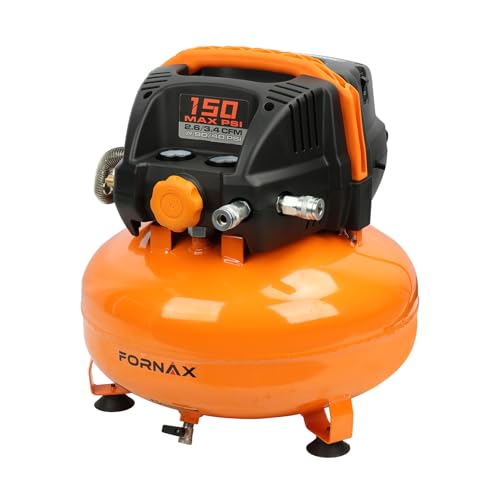 FORNAX 6-Gallon Pancake Air Compressor |
8.4/10 | Buy |
 CNRAQR 150 PSI 1.6-Gallon Air Compressor |
8.3/10 | Buy | |
 Preciva 175 PSI 4-Way Air Regulator |
8.0/10 | Buy |
YOTOO 20-Piece Air Compressor Accessories Kit
The YOTOO 20-piece air compressor accessory kit pairs a 25-foot hybrid rubber-PVC hose with a 100 PSI tire inflator, blow gun, and hardened steel fittings. It offers an all-in-one pneumatic connection setup for DIY homeowners, garage hobbyists, and vehicle maintenance tasks.
Pros
- Flexible 3/8-inch hybrid rubber-PVC hose resists kinking with integrated bend restrictors
- Versatile tire inflator combines an air chuck, gauge, and trigger in one die-cast aluminum unit
- Comprehensive 20-piece bundle eliminates the need to buy basic 1/4-inch NPT plugs, couplers, and nozzles separately
- High hose pressure tolerance with 300 PSI working pressure and 1,200 PSI burst rating
Cons
- The 25-foot hose length may limit reach in larger workshops or multi-bay garages without adding an extension
- The 100 PSI maximum tire gauge dial cannot accommodate heavy-duty commercial truck or RV tires that require higher pressures
- Included quick couplers and plugs are zinc-plated hardened steel rather than solid brass, which some users prefer for maximum corrosion resistance
PEVALON 150 PSI Cordless Tire Inflator
Compact enough to stash in a glove box, this portable compressor handles roadside top-offs using either its internal 6000mAh battery or a 12V car socket. It is an ideal travel backup for drivers and cyclists seeking automatic shut-off pressure control and emergency device charging.
Pros
- Dual-power support runs on battery or vehicle cord
- Auto shut-off prevents accidental over-inflation
- Extremely compact and lightweight at 1.1 pounds
- Doubles as a backup USB phone charger
- Multi-mode LED light assists with nighttime emergencies
Cons
- Takes up to 6 minutes for routine tire top-offs
- 90W motor is limited to small-scale inflatables
FORNAX 6-Gallon Pancake Air Compressor
The FORNAX 6-Gallon Pancake Air Compressor delivers 2.6 CFM at 90 PSI and up to 150 PSI of maximum pressure, featuring dual couplers and a lightweight 28.8-pound portable footprint. It is a practical pneumatic power source for DIY homeowners, finish carpenters, and garage hobbyists driving nailers or managing tire inflation.
Pros
- Dual quick-connect couplers allow two nailers to operate simultaneously without adding an external splitter manifold
- Generous 6-gallon air tank capacity with a 150 PSI maximum pressure ceiling provides a dependable air reserve
- Lightweight 28.8-pound profile simplifies one-handed carrying up stairs and transport into work vans
- Maintenance-free oil-free pump eliminates oil checks, oil changes, and mess around finished work surfaces
Cons
- Operating sound output rated at 95 dBA is loud and makes hearing protection necessary, especially in closed rooms
- Airflow output of 2.6 CFM at 90 PSI cannot support continuous-demand tools like sanders, grinders, or paint sprayers
- Supplied as a bare-tool compressor without an included air hose, tire inflator chuck, or pneumatic nailers
CNRAQR 150 PSI 1.6-Gallon Air Compressor
Built for onboard vehicle setups, this 12V system pairs a 150 PSI compressor with a 1.6-gallon aluminum tank to power air horns, suspension lifts, and tire inflation. Its IP54 weather rating and compact footprint make it a practical fit for trucks, trailers, and cars.
Pros
- Durable aluminum tank resists rust and corrosion
- Delivers up to 150 PSI working pressure
- IP54 rating shields against splashes and dust
- Compact design fits confined vehicle compartments
- Standard 1/4-inch NPT connection for versatility
Cons
- Small 1.6-gallon tank limits sustained air tool use
- IP54 rating provides splash resistance only, not submersion
- Adds over 12 pounds of onboard vehicle weight
Preciva 175 PSI 4-Way Air Regulator
Designed for workshop air compressors and pneumatic setups, this Preciva regulator manages operating pressures up to 175 PSI. It features a four-way valve layout with an integrated analog dial gauge and an adjustment knob for steady airflow control.
Pros
- High pressure capacity up to 175 PSI
- Comes with essential installation fittings and tape
- Multi-port design supports multiple tool attachments
- Simple knob mechanism for pressure regulation
Cons
- Port sizes restricted to 1/4-inch and 1/8-inch connections
- Maximum current capacity is limited to 15 amps
What PSI Tells You, and What It Leaves Out
PSI, or pounds per square inch, measures air pressure. On a compressor, the maximum PSI generally describes the pressure the tank is designed to reach during normal operation. A pneumatic tool also has a required operating pressure, often specified by its manufacturer. Those figures help determine whether the compressor can supply the pressure the tool needs, but they do not show how much air the pump can deliver while the tool is running.
For that, check the compressor’s delivered airflow rating, commonly stated as SCFM at a specified pressure, and compare it with the tool’s air consumption at the same pressure. A compressor may reach a high tank pressure while still delivering too little airflow for a tool that consumes air continuously. The product details supplied for these options do not provide SCFM output for the pancake compressor, so its maximum pressure alone cannot establish which air tools it can sustain.
Pressure and airflow work together, but they answer different questions. Pressure helps determine whether air can operate the tool at its specified setting; airflow indicates whether the pump can keep supplying air as the tool uses it. A tool that receives adequate pressure briefly may still cause the compressor to cycle frequently or struggle to keep up if its air demand exceeds the pump’s delivery.
Maximum tank pressure is not tool pressure
The compressor’s maximum PSI is not necessarily the pressure that should reach a tool. A regulator lets the operator set the downstream pressure for the application, while the tank gauge and regulated outlet gauge, if both are present, serve different purposes. Follow the tool’s stated operating-pressure range and the compressor manufacturer’s instructions rather than setting the outlet to the tank’s maximum rating.
The Preciva Air Compressor Pressure Regulator is listed with a dial gauge and an adjustment knob, with a maximum pressure rating of 175 PSI. That describes the regulator’s stated limit, not a recommendation to run every connected tool at that pressure. Before installation, confirm the regulator’s port sizes, connections, pressure limits, and placement are suitable for the compressor and intended air system.
Tank reserve and pump delivery are separate
A tank stores compressed air that can cover short bursts of demand. Its usable reserve depends on factors such as tank volume, starting pressure, the pressure the tool needs, and the compressor’s operating cut-in and cut-out points. A larger reserve can delay a pressure drop during brief use, but the pump must still replenish the air the tool consumes.
This distinction explains why gallons and PSI don’t replace an airflow rating. Two compressors with the same maximum PSI can differ in pump output and recovery behavior. Without published delivery and recovery specifications, don’t infer that one will keep up with a high-demand tool just because its tank is larger or its maximum PSI is higher.
Match the Pressure and Airflow to the Task
Start with the tool’s manufacturer specifications. Find its operating-pressure range and air consumption, then identify the compressor’s delivered airflow at the matching pressure. A comparison is only useful when the pressure conditions are comparable: an airflow figure at 40 PSI cannot automatically be treated as the figure available at 90 PSI.
For tools that are used intermittently, such as many nailers, air use happens in brief bursts rather than as an uninterrupted draw. Tank reserve may help cover those bursts, but the pump still needs adequate output and recovery for the pace of work. The listed FORNAX pancake compressor has a 6-gallon tank, a 150 PSI maximum, two couplers, and manufacturer-listed air consumption of 2.6 CFM at 90 PSI and 3.4 CFM at 40 PSI.
Those listed figures give a buyer more information than maximum PSI alone, but they should be checked against the specific tool’s needs and the compressor’s full manufacturer documentation. Two couplers show that the compressor is designed to connect two air tools or nailers; they don’t prove that the pump can support both tools at their maximum demand indefinitely. If simultaneous use matters, compare each tool’s consumption and consider whether both could operate at the same time.
Continuous air demand changes the calculation
Sanders, grinders, and many spray tools can draw air for sustained periods. That makes delivered airflow and the compressor’s permitted duty cycle especially important. A small tank can empty quickly under a steady draw, and a motor that runs continuously may reach a limit specified by its manufacturer. Do not assume a tool is suitable just because the compressor can briefly reach its required pressure.
For a sustained-use tool, compare its stated consumption with the compressor’s delivery at the required pressure, then check the pump’s duty-cycle guidance. If the manufacturer doesn’t publish enough information to make that comparison, ask for the missing specifications or consider a different compressor with clearly documented output. Avoid relying on tank size as a substitute for a verified airflow match.
Pressure can also change while a tool is operating. A regulator may be set correctly at rest, but the pressure at the tool can fall if airflow through the hose, fittings, regulator, or coupler is restricted, or if the pump cannot meet demand. A drop under load therefore doesn’t automatically mean the compressor’s maximum PSI is too low. Check the tool’s pressure requirements and the complete air path before drawing a conclusion.
How PSI Applies to Tire Inflation and Portable Accessories
Tire inflation is a different task from powering an air tool continuously. The required pressure depends on the tire and vehicle guidance, while the inflator must be rated for the intended application and capable of reaching that pressure. Never use the tire sidewall’s maximum as a substitute for the vehicle or tire manufacturer’s recommended cold inflation pressure.
The PEVALON Portable Tire Inflator 150 PSI Cordless is listed with a 150 PSI maximum and automatic shutoff based on a user-selected target. Its description also lists a built-in battery and a 12V vehicle power cord. Those features may suit portable tire maintenance, but the maximum PSI does not state how quickly it will inflate every tire or how long it can run before needing a break.
Check the inflator’s manual for the suitable tire types, operating limits, and any rest periods. Set the target according to the vehicle or tire maker’s recommendation, verify the reading with an appropriate gauge, and stop if the unit behaves abnormally or becomes excessively hot. Don’t assume that a high-pressure rating means a portable pump is suitable for large truck, RV, or off-road tires without specific manufacturer guidance for that use.
Accessories also have their own pressure limits. The YOTOO Air Compressor Accessories Kit includes a 25-foot hybrid hose listed with a maximum working pressure of 300 PSI and a tire inflator gauge described as 100 PSI. The hose’s rating does not raise the compressor’s pressure capability, and the kit’s gauge rating does not establish that every connected component is suitable for every application.
Before connecting a hose, regulator, gauge, or tool, check the pressure rating of each component and the connection type. The lowest applicable rating in the setup limits the safe operating range. Inspect fittings for damage and leaks, use the specified couplers, and follow the manufacturers’ instructions for assembly and operation.
Use the Product Specifications as a Whole
The FORNAX pancake compressor is a useful example of why multiple listed details matter: it combines a 6-gallon tank and a 150 PSI maximum with airflow figures at two pressures, two couplers, an oil-free pump, a listed weight of 28.8 pounds, and a stated noise level of 95 dB(A). Each specification answers a different buyer question. The noise figure is not a reason to assume the unit will be quiet indoors, and the two-coupler setup is not evidence of unlimited simultaneous airflow.
Power source and intended use matter as well. The FORNAX model is an electric pancake compressor, while the PEVALON is a cordless tire inflator with a vehicle-power option, and the CNRAQR is a 12V compressor kit listed with a 1.6-gallon tank and 150 PSI maximum working pressure. These are different product types. Compare each one’s manufacturer-stated application and operating limits instead of treating all PSI ratings as directly interchangeable.
Product listings may omit details that determine suitability, including delivered SCFM at a tool’s working pressure, pump duty cycle, and recovery behavior. Ask the manufacturer or seller for those figures when a task depends on sustained airflow. A maximum pressure rating cannot fill that information gap, and neither an accessory bundle nor a high tank rating guarantees compatibility with a particular tool.
For a broader comparison of tank configurations and portable setups, our portable compressors with tanks guide can help put stored capacity in context. Buyers comparing a small pancake unit with another portable format should still check the same core facts: delivered airflow at the required pressure, tank volume, maximum pressure, recovery guidance, and power requirements.
Read Pressure Safely and Avoid Common Sizing Errors
One common mistake is buying by the largest PSI number on a box. That can leave a buyer with enough maximum pressure for a task but insufficient documented airflow to maintain operation. Another is confusing the compressor’s tank pressure with the regulated outlet pressure, which can lead to an incorrect tool setting. Use each gauge for the pressure it measures and observe the manufacturer’s specified limits.
Also avoid comparing a tool’s air consumption at one pressure with a compressor’s output at another as if the numbers were equivalent. Ask for airflow at the tool’s working pressure, and check whether the tool’s stated demand describes intermittent or continuous use. If the listing provides only maximum PSI and tank size, treat that as incomplete information for assessing air-tool compatibility.
Keep the pressure vessel within its specified limits and do not modify the pressure switch or safety relief valve. Before maintenance or transport, follow the compressor manual’s instructions for depressurizing and disconnecting power. Wear appropriate eye protection around compressed air, and never direct air at people or use compressed air to clean skin or clothing.
Routine moisture management matters because compressed air can leave condensation in a tank. Drain the tank according to the manufacturer’s instructions, with the unit safely positioned and depressurized as directed, and use the specified drain method. Check the tank, hose, couplers, and fittings for visible damage, and stop using equipment that appears compromised until it has been assessed or serviced appropriately.
A practical decision sequence
First, identify the task and the pressure range specified for the tool, tire, or accessory. Next, find the compressor’s airflow output at that pressure and compare it with the demand, allowing for the difference between intermittent bursts and sustained use. Then check tank volume, power source, duty-cycle guidance, and any component pressure limits that affect the setup.
If a listing lacks the information needed for that comparison, don’t fill in the gaps with assumptions based on its maximum PSI. Seek the manufacturer’s technical documentation or select an option with sufficient published specifications. That approach is more dependable than choosing by pressure alone, particularly when a tool must operate for more than brief bursts.
In short, PSI matters because equipment needs appropriate operating pressure, but pressure is only one part of compressor selection. Match the tool’s pressure and air consumption to the compressor’s documented airflow, then use tank capacity and duty-cycle information to understand how the system may handle the work. For these product options, compare the stated limits carefully and request missing output details before relying on a compressor for a demanding pneumatic task.
About the author
Glenda Taylor has extensive experience in residential construction, remodeling, home improvement, and tool use. Her practical approach to equipment evaluation focuses on usability, performance, safety, and value—helping DIYers and workshop users make better-informed decisions about compressors and related tools.