
How Long Does It Take to Charge a Portable Air Compressor
How long does it take to charge a portable air compressor depends on its battery and charger. Compare charging details and use tips for November 2026.
 By Bob Beacham
Updated November 20, 2026


A cordless tire inflator can be convenient in a glove box or roadside kit, but a depleted battery may not be ready when you need it. How long does it take to charge a portable air compressor has no single answer: charging time depends on the battery capacity, the charger and power source, the unit’s charging limits, and how much charge remains. The product information for the models featured here doesn’t provide a charge-time estimate, so it would be misleading to promise a number of minutes or hours.
Instead, check the manual or manufacturer product page for the exact model, and identify whether the device charges through USB-C, a supplied adapter, or a vehicle outlet. Those options are not necessarily interchangeable, and a cable alone doesn’t establish the charger’s output. The products below range from cordless rechargeable inflators to corded and dual-power designs. For a broader look at portable AC/DC compressor options or portable tire inflators, compare the power arrangements before deciding what belongs in your vehicle.
Portable Inflator Options
| Award | Product | ACR Score About ACR ScoreThe ACR Score is our own rating from 0 to 10, based on performance, design and build, ease of use, and value. It reflects independent research and is never influenced by manufacturers, retailers, or affiliate commissions. Learn more › | |
|---|---|---|---|
| Best Overall |
AUTOONE 7800mAh Cordless Tire Inflator
|
9.2/10 | Buy |
| Best Premium |
 DEWALT Cordless Tire Inflator Portable Air |
9.1/10 | Buy |
| Best Budget |
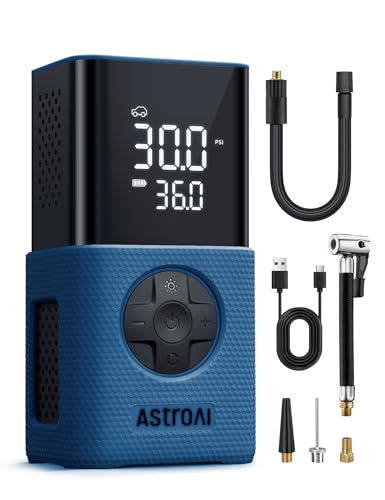 AstroAI L7S 150 PSI Cordless Tire Inflator |
8.9/10 | Buy |
| Best Value |
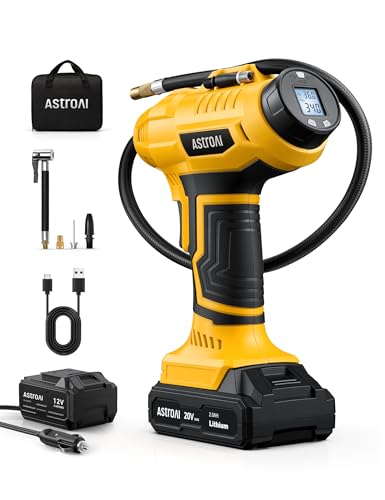 AstroAI Cordless Tire Inflator 160 PSI |
8.8/10 | Buy |
 AstroAI AIRUN H 12V DC Portable Air Compressor |
8.4/10 | Buy | |
 AIRSURE 150 PSI Portable Tire Inflator |
8.3/10 | Buy | |
 CARSUN Dual Power AC/DC Portable Tire Inflator |
8.3/10 | Buy | |
 Airmoto 120 PSI Portable Tire Inflator |
8.3/10 | Buy | |
 AstroAI L7 Cordless Tire Inflator Portable Air |
8.0/10 | Buy | |
 ROCGORLD R8 12V Portable Tire Inflator |
7.8/10 | Buy |
AUTOONE 7800mAh Cordless Tire Inflator
Packing a 7800mAh battery alongside a 12V car adapter, this handheld compressor inflates tires up to 150 PSI with automatic shut-off. Integrated emergency lighting and power bank ports make it a versatile backup tool for drivers and cyclists.
Pros
- Dual power options via battery or 12V adapter
- Automatic pressure detection and shut-off prevention
- Built-in emergency light and power bank functions
- Comprehensive accessory kit with nozzles and case
Cons
- Short 19.7-inch air hose limits placement options
- Relatively bulky footprint at over eight inches tall
DEWALT Cordless Tire Inflator Portable Air
This compact DEWALT portable tire inflator delivers up to 150 PSI with smart auto shut-off, powered by an internal rechargeable battery or an included 10-foot 12V car plug. It provides an efficient, pocket-sized solution for vehicle owners, cyclists, and DIYers wanting rapid roadside top-offs without hauling a bulky tank compressor.
Pros
- True cordless freedom with an internal rechargeable battery plus a 10-foot 12V DC vehicle plug backup
- Accurate digital pressure gauge with 5 smart presets and automatic shut-off to eliminate overinflation
- Ultra-compact handheld design weighing just 0.63 kg for easy storage in glove boxes or saddlebags
- Integrated LED work light and emergency USB power bank functionality for travel safety
- Generous accessory bundle backed by a 3-year limited warranty
Cons
- Engineered exclusively for high-pressure inflation rather than operating pneumatic air tools or nailers
- Does not include a 120V AC residential wall outlet power adapter
- Compact tankless pump requires periodic cooling breaks during heavy multi-tire inflation runs
AstroAI L7S 150 PSI Cordless Tire Inflator
Weighing barely a pound, the AstroAI L7S delivers portable inflation up to 150 PSI alongside a shock-absorbing silicone sleeve and power bank utility. Five smart presets and automatic shut-off make it a practical roadside companion for passenger cars, bicycles, and sports gear.
Pros
- Pocketable design weighing just 1.01 pounds
- Protective silicone sleeve dampens vibration and drops
- Hands-free operation with automatic shut-off
- Built-in power bank charges mobile devices
- Clear digital display with five smart presets
Cons
- Incompatible with heavy-duty truck and RV tires
- Not suitable for off-road vehicle tires or trailers
AstroAI Cordless Tire Inflator 160 PSI
The AstroAI Cordless Tire Inflator is a compact 160 PSI handheld air compressor featuring dual power via a 20V rechargeable battery and a 12V DC car adapter. Delivering digital auto shut-off and up to 20 minutes of continuous runtime, it is an ideal emergency tool for garage mechanics, commuters, and road-trippers.
Pros
- Dual-power versatility allows cordless battery operation at home or 12V DC vehicle plug-in on the road
- Reaches up to 160 PSI with automatic shut-off to prevent accidental tire over-pressurization
- Compact 2.54-pound footprint provides effortless trunk or glove-box storage for emergency readiness
- Backlit digital LCD screen provides clear readouts in PSI, BAR, and KPA units
- Integrated front LED light illuminates tire valve stems during dark roadside emergencies
Cons
- Includes a USB-C charging cable but requires an external USB power block to recharge the battery
- Designed specifically for tire and sports inflation rather than driving pneumatic workshop air tools
- Continuous runtime is limited to 20 minutes before requiring a cool-down pause
AstroAI AIRUN H 12V DC Portable Air Compressor
The AstroAI AIRUN H is a compact 12V DC tire inflator delivering up to 35 L/min airflow with automatic shut-off and digital pressure presets. It is an ideal portable emergency compressor for drivers, commuters, and garage hobbyists seeking fast tire top-offs.
Pros
- Automatic shut-off stops pumping reliably once target PSI is reached
- High-airflow 120W motor provides rapid top-offs for daily driver tires
- Long 9.84-foot power cord reaches all passenger vehicle wheels with ease
- Bright built-in LED flashlight and backlit display assist during night repairs
- Lightweight 2.2-pound form factor stores neatly in glove boxes and trunks
Cons
- Requires a 12V DC vehicle outlet and does not include a 120V AC household plug
- Mandates a 10-minute cool-down interval after 15 minutes of continuous operation
- Not intended for high-volume inflatables like large pool floats or air mattresses
AIRSURE 150 PSI Portable Tire Inflator
Measuring just over five inches tall, this compact inflator delivers up to 150 PSI with automatic shut-off and multiple preset modes. It also functions as a travel emergency tool, offering an integrated LED work light and a USB charging port for phones.
Pros
- Compact pocket-sized dimensions for easy storage
- Doubles as a backup USB power bank
- Clear digital display with four pressure units
- Built-in LED light aids nighttime use
- Auto shut-off prevents accidental over-inflation
Cons
- Requires short bursts when inflating smaller items
- Pressure reading has a tolerance of 1 PSI
- Sensor may occasionally need manual zero resets
CARSUN Dual Power AC/DC Portable Tire Inflator
The CARSUN Dual Power Tire Inflator delivers up to 150 PSI of high-pressure air running from either a 110V household outlet or a 12V vehicle socket. With digital pressure presets, automatic shutoff, and a lightweight 2.1-pound frame, it is an ideal maintenance pump for passenger vehicles, bicycles, and household inflatables.
Pros
- Versatile dual-voltage operation works seamlessly in the home garage or on the road without requiring an external converter
- Accurate auto-shutoff mechanism protects tires from accidental over-pressurization during routine top-offs
- Compact 2.1-pound build packs away easily in car trunks, under vehicle seats, or on garage shelving
- Clear digital display allows fast switching across four standard pressure measurement units
Cons
- Requires a mandatory 10-minute cooldown period after every 15 minutes of continuous operation
- Manufacturer explicitly states it does not support heavy truck tires, tractor tires, or stand-up paddleboards (SUP)
- Tankless inflator design cannot run standard workshop pneumatic air tools like brad nailers or paint sprayers
Airmoto 120 PSI Portable Tire Inflator
Weighing just 1.2 pounds, this compact cordless compressor delivers up to 120 PSI with automatic shutoff for routine top-offs on cars, bikes, and sports gear. Its pocket-sized form factor stores neatly in a glove box, serving as a convenient roadside backup.
Pros
- Extremely compact and lightweight design
- Auto shut-off prevents accidental over-inflation
- Clear digital LCD display with real-time pressure reading
- Integrated LED light aids night roadside repairs
- Internal hose storage keeps accessories organized
Cons
- Not suitable for heavy-load tires or large inflatables
- Cold temperatures and large tires drain battery quickly
- Requires frequent recharging before heavy usage
AstroAI L7 Cordless Tire Inflator Portable Air
The AstroAI L7 is a lightweight, handheld cordless air compressor delivering up to 150 PSI with an integrated 4000mAh rechargeable battery and precise auto-shutoff. It provides dependable, pocket-sized inflation performance for motorists, cyclists, and DIYers needing quick roadside tire top-offs.
Pros
- Weighs only 0.96 pounds for effortless storage in vehicle consoles, toolbags, or cycling packs
- High-speed digital sensor samples tire pressure at 200 times per second to prevent over-inflation
- Internal 4000mAh battery provides cordless freedom without tangling 12V cigarette lighter cords
- Versatile secondary utility as an emergency LED flashlight and portable USB power bank
Cons
- Not intended for heavy-duty truck tires or commercial tires larger than 25 inches in diameter
- Duty cycle requires allowing the unit to cool for 10 minutes after 15 minutes of continuous run time
- Tankless micro-compressor design cannot power workshop pneumatic air tools
ROCGORLD R8 12V Portable Tire Inflator
The ROCGORLD R8 is an ultra-compact 12V DC mobile tire inflator delivering up to 40 L/Min airflow and 150 PSI with an intuitive dual digital display and automatic shutoff. It is an exceptional, budget-friendly roadside emergency tool for everyday drivers, commuters, and cyclists who need quick, dependable tire top-offs.
Pros
- Fast 40L/Min rated cylinder tops off passenger car and EV tires in just 1 to 1.5 minutes
- Clear dual digital readout displays target PSI and actual tire pressure simultaneously
- Automatic shutoff with memory function prevents tire over-inflation and simplifies monthly checks
- Featherweight 2.16-pound design with included storage bag fits easily in any trunk emergency kit
- Backed by a two-year manufacturer warranty with included Presta and sports ball adapters
Cons
- Operates strictly on 12V DC vehicle power and cannot plug directly into standard 120V AC household wall outlets
- Does not include an internal rechargeable battery, requiring an active 12V vehicle connection for power
- Short 2-foot air hose requires resting the compressor on the ground or holding it close to the tire stem
What Determines Portable Compressor Charging Time
Charging time isn’t the same as inflation time. Charging replenishes an onboard battery; inflation is the time the compressor motor needs to add air to a tire or other item. A product’s maximum PSI and advertised inflation performance do not tell you how quickly its battery will recharge. For the models listed here, the supplied specifications don’t state a full-charge duration, so consult the manual for the specific model and charger.
Battery capacity and the charge remaining
A larger battery can store more energy, but capacity by itself doesn’t reveal an exact charging duration. The charger’s output, the battery’s charging circuitry, and the starting charge level all affect the time. A battery that is nearly empty generally has more energy to regain than one that is only partly depleted, while the device may also manage charging speed as it approaches full.
Some product descriptions provide battery capacity without providing a charge-time figure. For example, the AstroAI L7S listing identifies a 4000mAh built-in battery and says to use a 5V/1A USB power adapter. That information identifies a charging requirement, but it is not a manufacturer-stated duration. Don’t turn the capacity into a confident time estimate without the battery’s charging profile and the manufacturer’s guidance.
The Airmoto listing describes a 2000mAh rechargeable battery and a USB-C charging cable, but the supplied product details do not specify a charging duration or adapter output. Similarly, AUTOONE lists a 7800mAh battery and Type-C charging, without stating how long a full charge takes. These figures help distinguish the products’ stated battery capacities, but they don’t support a precise comparison of charging speeds.
Charger output, cable, and power source
Check the specified adapter output as well as the connector type. A USB-C port or cable describes a connection, not a guaranteed charging rate; the power adapter, cable, and inflator all need to support the intended charging arrangement. The AstroAI L7 product information specifically says to use a 5V/1A adapter. Follow that stated requirement rather than assuming a higher-output adapter will make charging faster.
Some inflators accept more than one power source, but a vehicle power cord is not automatically a battery charger. The DEWALT listing describes charging through a 5V USB power adapter or a 12V car accessory plug and also identifies a built-in rechargeable battery. The AUTOONE listing includes a 12V car power adapter as an option for inflation, in addition to its rechargeable battery. Read the manual to distinguish charging the battery from operating the pump from vehicle power.
The AstroAI Cordless Tire Inflator listing describes a 20V battery and USB-C cord but says the package does not include a charger. That makes the supplied cable alone insufficient information to determine charging time; a buyer should check the exact model’s instructions for the required power source. By contrast, the AstroAI AIRUN H and ROCGORLD R8 are described as corded inflators, and the supplied details do not identify an onboard rechargeable battery. A corded unit doesn’t need a battery recharge between uses, but it does need its specified power source during operation.
Temperature, battery condition, and charging interruptions
Temperature can affect rechargeable battery behavior. Airmoto’s product information notes that cold weather can reduce battery efficiency, and its instructions recommend fully charging the pump before each use for optimal battery performance. The AstroAI L7 listing also says that if overheat protection activates, charging must wait until the inflator cools for 10 minutes. These details are reasons to plan ahead, not grounds for assigning a universal charge duration.
Repeatedly stopping and restarting a charge, using an unsuitable adapter, or trying to charge a device while it is overheated can make preparation less predictable. Keep the inflator and charging equipment within the conditions specified in its manual. If the device reports an error, becomes unusually hot, has a damaged cable, or no longer charges as expected, stop and use the manufacturer’s troubleshooting and support guidance instead of improvising a repair.
How to find a reliable time estimate
Start with the exact model name and revision, because similar-looking products can have different batteries, included accessories, or charging instructions. Locate the manual or the manufacturer’s product page and search for a stated full-charge time, the required adapter rating, and any temperature or cooling restrictions. If the documentation gives only battery capacity and cable type, treat the charge duration as unlisted rather than calculating a precise promise from incomplete information.
Then note the conditions attached to any published estimate. A figure may apply to a particular adapter and a battery starting at a specified charge level, not every USB port, vehicle socket, or power bank. If those conditions aren’t clear, ask the manufacturer to confirm which adapter and charging method apply to your unit. Keep the model number and charger details together so you can check them later without guessing.
A simple readiness routine helps even when the manufacturer doesn’t publish a duration. Recharge after use, allow the device to cool if its instructions call for it, and check the displayed battery level before a trip rather than waiting until a tire is low. Don’t leave a battery charging in conditions that its manual prohibits. Store and charge it using the manufacturer’s stated temperature and handling guidance.
Charging time is separate from inflation capability
Battery charge duration doesn’t tell you how many tires a pump can inflate, how long a particular tire will take, or whether it suits a heavy vehicle. Those questions depend on the individual pump, the tire, the pressure change, and the product’s operating limits. The AstroAI L7S listing, for instance, states that a fully charged battery can refill up to eight 195/65R15 tires from 30 to 36 PSI, and cautions that the inflator isn’t for heavy-duty tires. That runtime claim doesn’t state how long recharging takes.
Other listings give inflation examples, but those aren’t charging specifications either. The DEWALT listing says it can inflate a 195/65 R15 tire from 30 to 36 PSI in under a minute, while the AstroAI L7 listing gives an estimate of 1.5 minutes for a similar pressure change. The listed conditions and models differ, and neither statement establishes the time needed to replenish a battery afterward. Use the manual for the pump’s use limits and the vehicle’s recommended tire pressure.
Maximum pressure figures also need context. A stated 150 PSI maximum is not a target for every tire and doesn’t indicate that the pump should inflate a tire to that pressure. Use the vehicle or tire manufacturer’s recommended pressure, and don’t exceed the tire’s stated limit. Check the inflator’s compatibility and operating instructions before using it on larger, high-load, truck, or trailer tires.
A cordless inflator may suit occasional top-ups when you can recharge it between uses. For a longer roadside session or repeated inflation, a model with an appropriate corded power option may reduce dependence on the onboard battery, provided the vehicle outlet and product instructions support that use. The CARSUN AC/DC model, for example, is listed for 110V/120V wall power and a 12V vehicle outlet. Its product information says it isn’t for truck or tractor tires, so dual power shouldn’t be taken as proof of universal tire suitability.
Choosing a setup around charging needs
For a glove-box emergency pump, compact size and a known charging routine may matter more than an unverified fast-charge assumption. The AstroAI L7 and L7S listings describe compact cordless designs, while the Airmoto is also presented as a compact rechargeable inflator. Compare the stated battery details, included cable or adapter, pressure controls, and exclusions in each product’s instructions. Don’t infer that one charges faster simply because its battery capacity is lower.
For buyers who prefer not to depend on a battery being charged, a corded model trades cordless convenience for access to a vehicle outlet or household power, depending on the product. The AstroAI AIRUN H is listed as a 12V DC unit, while the CARSUN supports both a household AC outlet and a 12V DC vehicle outlet. Confirm the outlet type and any run or cooling limits in the manual before use. The power cord’s presence doesn’t mean the product has a rechargeable battery.
Useful comparisons should distinguish the jobs each specification answers. Battery capacity and the permitted adapter relate to recharging; inflation rate and maximum PSI relate to pump operation; supported tire types and usage limits relate to suitability. None of those specifications should be substituted for another. A product can have a high maximum PSI without a published recharge time, and a stated inflation speed doesn’t demonstrate that it can operate continuously.
If you use the inflator for balls or bicycle tires as well as car tires, check the included attachments and the manual’s instructions for each use. The product listings describe adapters for different valves and inflatables, but attachment availability doesn’t mean every model is suitable for every large-volume item. Follow the product’s cooling guidance, especially during repeated inflation. This helps avoid confusing an occasional emergency tool with equipment designed for continuous air delivery.
Plan around actual documentation, not a guessed number
Before purchase, look for a manufacturer-stated recharge duration, the required adapter, whether the adapter is included, and any battery care restrictions. If those details are absent, treat charge time as unknown and decide whether the power arrangement still fits your routine. A replacement charger or cable should be selected only according to the manufacturer’s specifications. Product descriptions may omit details that the manual provides.
After buying, record the model and charger information and follow the supplied charging instructions. A displayed battery indicator can help you check readiness, but it doesn’t replace a stated charging procedure. Recharge before travel and after substantial use, leaving enough time for the device to cool when the instructions require it. If a full charge takes noticeably longer than the manual says or the device won’t hold charge, contact the manufacturer rather than opening the battery pack.
Portable tire pumps are not the same as tank-style shop compressors. The models in this product list are tire inflators, including cordless and vehicle-powered designs, not pancake or twin-stack compressors for pneumatic nailers. Their battery recharge question is therefore best answered from the exact inflator documentation, not from general assumptions about air compressor tank filling or tool recovery. For related compressor accessories and setup context, see the portable compressor accessories guide and the overview of portable compressors for pneumatic tools.
In short, use a manufacturer-published charge duration only when it applies to your exact model and approved power source. The supplied listings don’t establish a universal charging time for these products. Confirm the adapter and instructions, recharge before you need the inflator, and select a corded or dual-power option if waiting on a battery doesn’t suit your use.
About the author
Bob Beacham is an experienced tools and workshop writer with deep knowledge of power equipment, mechanical systems, and practical DIY applications. His coverage of air compressors, welding equipment, saws, and workshop tools helps translate technical specifications into useful guidance for homeowners and serious DIYers.