
Does Air Compressor Hose Size Matter? Practical Guide for 2026
Find out why does air compressor hose size matter for CFM delivery, line pressure drop, and pneumatic tool power in this October 2026 workshop guide.
 By Tony Carrick
Updated October 26, 2026
Pneumatic equipment relies on consistent airflow to deliver rated torque and cycling speed. When an impact wrench bogs down or an HVLP spray gun sputters mid-pass, many operators reflexively blame the compressor motor or tank capacity. In many workshops, the real bottleneck hides between the tank regulator and the air tool itself. The fundamental question of does air compressor hose size matter determines whether your pneumatic setup maintains steady line pressure or suffers from severe dynamic friction loss under load. Understanding how line diameter interacts with operating pressure can prevent unexpected tool stalling across your garage or jobsite.
Hose selection directly influences air volume, tool responsiveness, and daily handling ergonomics. Premium options from brands like Flexzilla, WYNNsky, and YOTOO demonstrate how varying materials, inside diameters, and lengths alter overall airflow efficiency. Whether you are setting up a stationary workshop line or replacing an air compressor hose on a portable jobsite rig, matching hose dimensions to your equipment requirements makes a dramatic difference. This guide explores the mechanical principles of pneumatic airflow to help you choose the right line configuration for your tools.
| Award | Product | ACR Score About ACR ScoreThe ACR Score is our own rating from 0 to 10, based on performance, design and build, ease of use, and value. It reflects independent research and is never influenced by manufacturers, retailers, or affiliate commissions. Learn more › | |
|---|---|---|---|
| Best Overall |
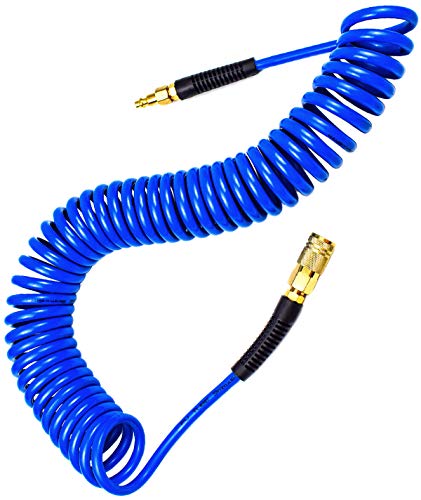
YOTOO 1/4-Inch x 25-Foot Polyurethane Recoil Air
|
9.2/10 | Buy |
| Best Budget |
 Flexzilla 1/4-Inch x 25-Foot Air Compressor Hose |
9.1/10 | Buy |
 Goodyear 6-Foot x 3/8-Inch Hybrid Air Hose |
8.6/10 | Buy | |
| Best Premium |
 Hromee 1/4-Inch x 25-Foot Hybrid Air Compressor |
8.6/10 | Buy |
 WYNNsky 3/8-Inch x 25ft PVC Air Hose Kit |
8.4/10 | Buy | |
| Best Value |
 RainBello 25-Ft 1/4-Inch Polyurethane Air Hose |
8.3/10 | Buy |
 FYCQER 25-Foot Coiled Air Hose (1/4 Inch) |
8.1/10 | Buy |
YOTOO 1/4-Inch x 25-Foot Polyurethane Recoil Air
The YOTOO 1/4-inch by 25-foot polyurethane recoil air hose provides a lightweight, tangle-resistant pneumatic connection rated for up to 150 PSI. Equipped with pre-installed 1/4-inch industrial quick-connect fittings and flexible operation down to -40 degrees Fahrenheit, it is a convenient, space-saving accessory for garage hobbyists, trim carpenters, and workbench setups.
Pros
- Self-retracting coil design eliminates manual hose winding and prevents messy shop floor clutter
- Comes ready to work with factory-installed 1/4-inch industrial quick-connect coupler and plug
- Retains pliability in freezing conditions down to -40 degrees Fahrenheit
- Durable bend restrictors protect high-wear junction points from premature cracking or kinking
- Lightweight polyurethane build significantly minimizes hand and wrist fatigue during detailed tool work
Cons
- 1/4-inch inner diameter restricts airflow volume required for continuous high-demand tools like dual-action sanders or spray guns
- Coil tension increases when stretched near the full 25-foot reach, which can pull back against lightweight pneumatic tools
- Not intended for severe rough-framing jobsite abuse where heavy-duty reinforced rubber hoses are typically preferred
Flexzilla 1/4-Inch x 25-Foot Air Compressor Hose
The Flexzilla 1/4-inch by 25-foot air hose features a premium hybrid polymer blend that stays pliable from -40 to 140 degrees Fahrenheit without kinking under pressure. Built with crush-resistant aircraft aluminum fittings and a 300 PSI working rating, it offers lightweight, zero-memory convenience for trim carpenters, tire inflation, and home workshops.
Pros
- Extreme all-weather flexibility keeps the hose manageable even in sub-freezing garages down to -40 degrees Fahrenheit
- Zero-memory material lays flat instantly and coils effortlessly for quick end-of-day cleanup
- Crush-resistant aircraft aluminum fittings include molded bend restrictors to prolong connection life
- Lightweight design dramatically reduces tool drag during overhead trim work and detailed finish carpentry
Cons
- 1/4-inch inner diameter creates friction loss that may restrict high-CFM continuous tools like rotary sanders or impact wrenches
- Signature high-visibility green color easily shows grease and grime in automotive shop environments
- 25-foot working length can feel short for expansive workspaces or outdoor vehicle maintenance without an extension line
Goodyear 6-Foot x 3/8-Inch Hybrid Air Hose
Built as a compact whip line, this 6-foot hybrid hose pairs heavy-duty polymer construction with solid brass fittings for tight workshop connections. It lays completely flat with zero memory and handles tough conditions ranging from -50 to 190 degrees Fahrenheit.
Pros
- Resists kinking under pressure with zero coil memory
- Wide operational range from -50 to 190 degrees F
- Durable solid brass 1/4-inch NPT connections
- Resistant to oil, solvents, and harsh weather
Cons
- Short 6-foot reach limits standalone workspace coverage
- Functions primarily as a whip or lead-in hose
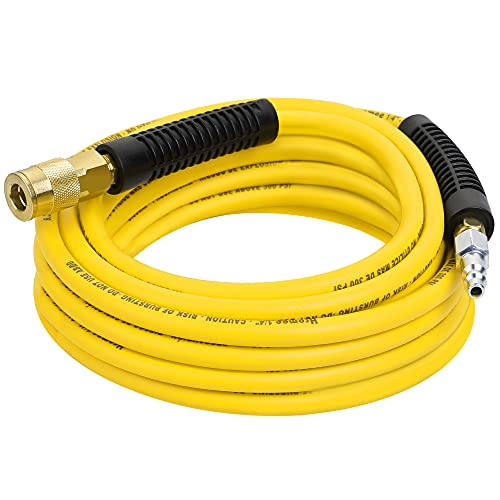
Hromee 1/4-Inch x 25-Foot Hybrid Air Compressor
The Hromee 1/4-Inch x 25-Foot Hybrid Air Compressor Hose provides a flexible, lightweight pneumatic connection with a 300 PSI working pressure, bend restrictors, and pre-attached industrial fittings. Rated for -40°F to 150°F, it is well-suited for trim carpenters, home mechanics, and DIYers seeking kink-resistant hose handling.
Pros
- Pliable hybrid polymer stays flexible in cold weather down to -40°F without severe memory coils
- Comes ready to use out of the box with pre-connected brass coupler and industrial steel plug
- Integrated bend restrictors minimize strain and kink points near the MNPT fittings
- Lightweight two-pound design makes overhead nailing and portable trim work easy on user arms
Cons
- The 25-foot length provides limited reach across larger garages or multi-room jobsite setups without an extension
- A 1/4-inch inner diameter creates higher airflow restriction than 3/8-inch hoses when supplying high-CFM continuous tools
- Bright yellow exterior easily shows garage grime, motor oil, and jobsite dirt over time
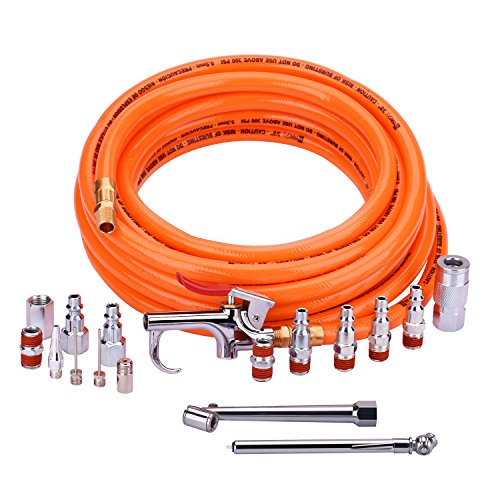
WYNNsky 3/8-Inch x 25ft PVC Air Hose Kit
Equipped with a lightweight PVC hose and a 17-piece accessory bundle, this package delivers the essential fittings needed for home workshop DIY projects. Solid brass connections ensure dependable seals, supported by a 300 PSI maximum working pressure.
Pros
- Solid brass fittings resist corrosion and seal reliably
- Complete accessory set provides essential starter fittings
- Lightweight hose design allows easy transport and handling
- Handles up to 300 PSI maximum working pressure
Cons
- 25-foot length provides limited reach across larger workshops
- PVC construction is typically less flexible than rubber hoses
RainBello 25-Ft 1/4-Inch Polyurethane Air Hose
The RainBello 25-foot 1/4-inch reinforced polyurethane air hose delivers high flexibility and a 300 PSI working pressure rating for garage workshops and trim jobs. Equipped with factory brass swivel fittings and quick-connect hardware, it provides a reliable, kink-resistant connection for DIYers and finish carpenters.
Pros
- Braided polyurethane outer jacket resists scuffing, kinking, and twisting
- Factory-installed 1/4-inch brass swivel fittings and quick-connect couplers save setup time
- Substantial 300 PSI working pressure rating handles common pneumatic tasks
- Remains pliable in sub-freezing temperatures down to -40°F
Cons
- A 1/4-inch internal diameter restricts airflow volume for continuous high-CFM tools like dual-action sanders
- The 25-foot length may limit reach across larger multi-bay automotive garages without an additional extension
FYCQER 25-Foot Coiled Air Hose (1/4 Inch)
Built from flexible polyurethane, this self-storing coiled hose extends your reach up to 25 feet without tangling. Its 300 PSI rating and pre-sealed brass fittings make it a dependable pick for light garage work and tire inflation.
Pros
- Pre-sealed brass fittings ensure secure, leak-resistant connections
- Compact coil profile snaps back quickly for easy storage
- Rated up to 300 PSI for high-pressure tools
- Wide operating temperature range prevents cold-weather kinking
Cons
- Coil tension may pull back when stretched near 25 feet
- 1/4-inch inner diameter limits high-CFM air tools
- 25-foot length may feel short for larger workshop layouts
The Mechanics of Pneumatic Airflow: Why Hose Dimensions Control Tool Output
Pneumatic air tools require both adequate pressure and sufficient air volume to operate at their rated mechanical specifications. Air compressors compress atmospheric air and store it inside a pressurized receiver tank, but that stored energy must travel through fittings, lines, and couplers before reaching the tool motor. If the inner diameter of the air line is too narrow or the hose run is excessively long, air molecules encounter substantial friction along the interior walls. This restriction creates dynamic pressure drop, starving the tool of the volume it needs while the compressor gauge falsely reads adequate static pressure.
The Core Mechanical Reality: Why Inner Diameter Dictates Air Volume
Pneumatic hose sizing centers primarily on internal diameter, commonly abbreviated as ID, rather than the outer hose thickness. A standard 1/4-inch inner diameter hose features an opening that measures exactly 0.25 inches across, while a 3/8-inch hose provides a 0.375-inch opening. Because the cross-sectional area of a cylinder scales with the square of its radius, a 3/8-inch hose provides more than double the internal cross-sectional area of a 1/4-inch line. This dramatic increase in volume capacity allows significantly more cubic feet per minute to pass through the line with far less resistance.
Standard tire inflation chucks and light-duty brad nailers require relatively modest airflow, often consuming less than one to two CFM at standard pressures. For these intermittent applications, a 1/4-inch line such as the Flexzilla Air Compressor Hose or the YOTOO Polyurethane Recoil Air Hose delivers adequate volume without noticeable restriction. However, continuous tools like dual-action rotary sanders, die grinders, and high-torque impact wrenches can easily demand six to twelve CFM. Feeding those high-consumption tools through a 1/4-inch line causes immediate velocity choke, dropping working pressure right at the tool inlet.
Operators often attempt to compensate for sluggish tool power by cranking up the tank regulator pressure. While raising the regulator from 90 PSI to 120 PSI increases the static pressure in the line, it fails to solve the underlying volumetric restriction. The moment the tool trigger opens, air rushes through the narrow orifice, and the dynamic friction rapidly dissipates that extra pressure as heat and turbulent resistance. Sizing the inner diameter correctly from the start ensures the tool receives its specified volume without over-pressurizing the hose construction.
Understanding Dynamic Pressure Drop Versus Static Tank Pressure
Static pressure represents the potential energy stored inside a closed pneumatic system when no air is actively flowing. When your compressor finishes its recovery cycle and shuts off at its cut-out threshold, the regulator gauge displays static line pressure. Many operators glance at a steady 90 PSI reading on their manifold gauge and assume their air tool receives plenty of power. That reading only reflects static equilibrium, which changes drastically the instant air begins moving through the line.
Dynamic pressure measures the actual operating pressure available at the tool inlet while air flows continuously through the system. As air molecules travel down a flexible hose, they collide with the interior hose lining and tumble against each other in turbulent vortices. This internal resistance converts kinetic energy into friction, causing line pressure to decrease progressively along the length of the run. When evaluating compressor CFM ratings, understanding this dynamic pressure drop is essential for diagnosing why a tool feels weak despite a fully pressurized tank.
A long, narrow hose can easily produce a dynamic drop of twenty to thirty PSI during heavy tool operation. If your pneumatic impact wrench requires 90 PSI at its inlet to break loose stubborn lug nuts, a twenty-pound dynamic drop reduces active pressure to just 70 PSI. At that reduced level, the tool loses substantial torque output and may stall entirely under heavy load. Selecting a larger internal diameter dramatically lowers friction velocity, maintaining effective working pressure right at the tool trigger.
The Compounding Effect of Hose Length on Pneumatic Resistance
Hose length acts as a direct multiplier for friction loss inside any compressed air delivery circuit. Every foot of hose adds internal surface area, giving air molecules more opportunity to drag against the tube walls. A short line, such as the Goodyear 6′ x 3/8″ Hybrid Air Hoses, introduces negligible flow restriction because air travels only a brief distance before reaching the pneumatic tool. In contrast, extending a line across fifty or one hundred feet compounds internal friction, resulting in substantial cumulative pressure losses.
Contractors on framing jobsites frequently string multiple fifty-foot hoses together to reach upper floors or distant roof decks. While this setup provides necessary physical reach, chaining multiple narrow 1/4-inch lines together creates massive flow resistance. If you must run lines beyond fifty feet, stepping up to a 3/8-inch hose becomes practically mandatory for maintaining tool recovery speed. The larger cross-sectional area dampens the cumulative friction penalty, preserving sufficient volume across extended distances.
Hose length also influences system responsiveness and storage buffer capacity inside the line itself. A longer hose contains a larger internal volume of compressed air, which can act as a minor secondary accumulator for brief, intermittent bursts. However, once that trapped volume vents during continuous operation, the compressor must push fresh air through the entire restricted run. Balancing physical reach against line length helps maintain consistent tool power without dragging unnecessary hose weight across the workspace.
Matching Specific Pneumatic Tools to the Right Hose Diameter
Different pneumatic tools exhibit radically different air consumption profiles, making tool matching a critical factor in hose selection. Fastening tools like brad nailers, finish nailers, and pin nailers consume air in brief, intermittent pulses rather than continuous streams. Because these tools fire a single piston stroke and pause between fasteners, the air line has ample time to equalize pressure before the next shot. A lightweight 1/4-inch line, such as the RainBello 25FT 1/4 Inch Air Hose Reinforced or the FYCQER Air Hose 1/4 NPT x 25 Feet, handles these tasks with outstanding maneuverability.
Automotive impact wrenches and air ratchets require brief but intense bursts of high CFM to generate maximum rotational torque. When a half-inch pneumatic impact hits a tight fastener, it demands an instantaneous surge of air volume that a 1/4-inch hose struggles to supply. Using a 3/8-inch line, such as the WYNNsky 3/8″ X 25ft PVC Air Compressor Hose Kit, ensures the tool motor receives the immediate volume necessary to deliver its rated foot-pounds of torque. Mechanics often pair a 3/8-inch main line with a flexible whip hose to retain maneuverability without sacrificing breaking power.
Continuous-use tools represent the most demanding category for any pneumatic delivery system. Equipment like random orbital sanders, pneumatic die grinders, sandblasters, and HVLP paint spray guns run continuously for minutes at a time. These continuous consumers quickly deplete local line pressure and require a constant, unimpeded stream of compressed air. Feeding an HVLP spray gun through an undersized 1/4-inch hose causes air pressure to fluctuate at the fluid nozzle, producing uneven atomization and ruined paint finishes.
Fitting Restrictions and Quick-Disconnect Coupler Bottlenecks
Choosing the correct hose diameter is only half the battle when optimizing a pneumatic air delivery system. Every fitting, threaded nipple, and quick-disconnect coupler installed along the line presents a potential restriction point. Most common workshop air lines utilize standard 1/4-inch NPT industrial couplers, known as I/M type fittings. While the exterior thread measures a quarter inch, the internal passage through the coupler body can choke down to less than three-sixteenths of an inch.
When air travels through a spacious 3/8-inch hose only to encounter a tiny coupler restriction at the tool inlet, velocity spikes and turbulence increases. Products like the Hromee Air Compressor Hose 1/4 Inch x 25 Feet equip heavy-duty brass couplers and steel plugs designed for durable sealing, but users must recognize these mechanical boundaries. For high-volume tools consuming over ten CFM, upgrading to high-flow style fittings with enlarged internal bores can yield noticeable performance improvements. High-flow couplers maintain the benefits of a 3/8-inch hose by eliminating restrictive choke points at the connection points.
Thread seal integrity and fitting durability also influence sustained pneumatic performance over time. Thread leaks around loose fittings allow continuous air bleeds that force the compressor pump to cycle more frequently, generating unnecessary heat and moisture inside the storage tank. Quality hoses often incorporate factory-installed bend restrictors and pre-applied thread sealant to minimize physical strain near the crimped fittings. Inspecting fittings regularly for air hissing ensures every pound of compressed air reaches the working end of your pneumatic tools.
Hose Material Engineering: Hybrid Polymer, Polyurethane, and PVC
The material composition of an air hose determines its flexibility, weight, kink resistance, and overall user fatigue. Traditional rubber air hoses offer excellent durability and lay flat easily, but their heavy weight makes overhead work and jobsite transit exhausting. In contrast, modern hybrid polymer formulations, featured on hoses like the Flexzilla and Hromee models, combine rubber flexibility with lightweight synthetic PVC polymers. These hybrid lines remain completely pliable in sub-freezing temperatures down to minus forty degrees Fahrenheit and resist curling under working pressures up to 300 PSI.
Polyurethane air lines offer an outstanding strength-to-weight ratio and exceptional resistance to exterior abrasion and shop chemicals. Self-coiling recoil lines, such as the YOTOO Polyurethane Recoil Air Hose and the FYCQER coiled hose, utilize memory-retaining polyurethane that snaps back into a compact footprint when unclipped. These coiled designs excel in dedicated workstation setups, assembly tables, and automotive lift bays where dragging a loose hose across the floor creates tripping hazards. However, recoil lines naturally increase overall line length due to their coil loops, so keeping them dedicated to lower-CFM tools prevents unwanted dynamic pressure drops.
Polyvinyl chloride, commonly known as PVC, provides an economical and rugged option for budget-conscious workshops. The WYNNsky 3/8-inch PVC hose illustrates the advantages of standard PVC construction, offering solid abrasion resistance and high working pressure ratings at an accessible entry point. The primary drawback of standard PVC involves temperature stiffness, as the material can become rigid and resistant to coiling when exposed to cold winter shop environments. Understanding these material characteristics helps operators select an air line that balances airflow capacity, daily physical handling, and environmental resilience.
System Integration: Compressors, Regulators, and Air Delivery Layouts
Integrating the right air hose into your workshop requires looking at the entire pneumatic supply chain from pump to tool. Compressor design plays an important role in how air is delivered to the primary line regulator. When comparing single-stage and two-stage compressor setups, two-stage systems typically store air at higher pressures up to 175 PSI, providing a larger stored buffer that can feed high-draw lines through secondary regulators. Single-stage compressors operate at lower maximum pressures, making efficient hose sizing even more critical to avoid depleting working reserves prematurely.
A common mistake among DIYers and jobsite contractors involves extending electrical extension cords instead of air hoses. Running a compressor on a long, light-gauge electrical extension cord causes electrical voltage drop, leading to high inrush amp spikes, motor hum, and tripped circuit breakers. The safest and most mechanically sound practice is to plug the compressor directly into a dedicated wall outlet and run longer air hoses to the work area. Air hoses experience dynamic pressure drops that are easily managed with proper diameter selection, whereas electrical voltage drops can permanently burn out motor windings and pressure switches.
Moisture management represents another critical consideration when designing your compressed air distribution layout. As warm compressed air travels away from the pump and cools inside the flexible hose, moisture naturally condenses along the internal walls. Draining the compressor receiver tank daily through its bottom drain valve removes bulk liquid, but running clean, dry air lines prevents water droplets from entering tool cylinders. Utilizing a short leader whip hose, such as the Goodyear six-foot hybrid line, can also isolate tool vibration from rigid supply plumbing while facilitating moisture traps near the point of use.
Practical Workshop Selection: Choosing the Right Hose Configuration
Selecting the ideal air hose diameter ultimately comes down to balancing tool air volume demands against physical maneuverability. If your daily tasks primarily involve finish carpentry, brad nailing, upholstery stapling, or seasonal tire inflation, a 1/4-inch hybrid or polyurethane hose is the superior choice. The smaller diameter significantly reduces hand and wrist fatigue, maneuvers effortlessly around delicate furniture or vehicle interiors, and stores in compact spaces without wrestling stiff coils.
If your projects include automotive repair, framing nailers, rotary die grinders, or paint spraying, investing in a 3/8-inch air hose is an absolute necessity. The increased internal diameter guarantees that your high-demand pneumatic tools receive the full volumetric flow required to achieve peak operating power. While a 3/8-inch line is marginally heavier and slightly bulkier to roll up, the performance benefits across continuous workloads far outweigh the slight increase in carry weight.
Many well-equipped workshops adopt a practical two-tier approach to pneumatic plumbing for maximum versatility. They install a durable 3/8-inch primary supply line to deliver unrestricted volume across the main shop floor, then attach a lightweight whip hose or 1/4-inch flexible line for handheld detail tools. By matching the internal diameter and line material to the specific mechanical requirements of each tool, you eliminate frustrating dynamic pressure drops and ensure your entire pneumatic setup operates at its full designed capability.
About the author
Tony Carrick is an experienced product researcher and writer specializing in tools, home improvement, automotive maintenance, and consumer equipment. With extensive experience reviewing tools and tackling hands-on renovation projects, he brings a buyer-focused perspective to compressor performance, usability, and overall value.