
Can You Use an Air Compressor With a Plasma Cutter: Practical Guide for 2026
Can You Use An Air Compressor With A Plasma Cutter? Learn air needs for November 2026, covering CFM flow, dry air filtration, and built-in compressor options.
 By Glenda Taylor
Updated October 26, 2026


Melting through plate steel requires an intense electric arc paired with a continuous blast of high-velocity gas. While industrial fabrication shops often rely on bottled nitrogen or specialized gas mixtures, standard workshop setups run directly on clean compressed shop air. Many metalworkers asking can you use an air compressor with a plasma cutter wonder whether an existing garage tank can handle the sustained pneumatic demands of thermal metal cutting. The answer is an absolute yes, provided your air delivery system supplies adequate volume and dry air to prevent torch sputtering. Choosing between dedicated single-stage and two-stage compressor options often dictates whether your cutting torch maintains a steady arc through thick stock or starves midway across the cut.
Operating a plasma torch demands consistent line pressure alongside proper air volume so the nozzle can blow molten kerf cleanly away from the base metal. Undersized air lines or restrictive fittings can trigger severe pressure drops that quickly burn out expensive electrodes and swirl rings. Upgrading your delivery line using proper air compressor hose installation techniques helps maintain steady regulated pressure straight to the rear air inlet. Meanwhile, modern inverter technology now offers portable cutting machines with built-in air pumps, giving mobile operators complete freedom from dragging bulky standalone compressors to remote jobsites. Understanding how pneumatic volume, operating pressure, and clean air filtration work together ensures you get smooth dross-free edges every time you pull the torch trigger.
| Award | Product | ACR Score About ACR ScoreThe ACR Score is our own rating from 0 to 10, based on performance, design and build, ease of use, and value. It reflects independent research and is never influenced by manufacturers, retailers, or affiliate commissions. Learn more › | |
|---|---|---|---|
| Best Overall |
Hansnoktech 45A Plasma Cutter with Compressor
|
8.9/10 | Buy |
| Best Premium |
 ANDELI 55A Non-HF Plasma Cutter & MMA Welder |
8.9/10 | Buy |
| Best Budget |
 FLARING 45A Built-In Air Plasma Cutter |
8.6/10 | Buy |
| Best Value |
 Reboot Plasma Cutter with Built-in Compressor |
8.4/10 | Buy |
 H HZXVOGEN 50A Pilot Arc Plasma Cutter |
8.3/10 | Buy | |
 Reboot 60A Dual-Voltage Plasma Cutter |
8.1/10 | Buy | |
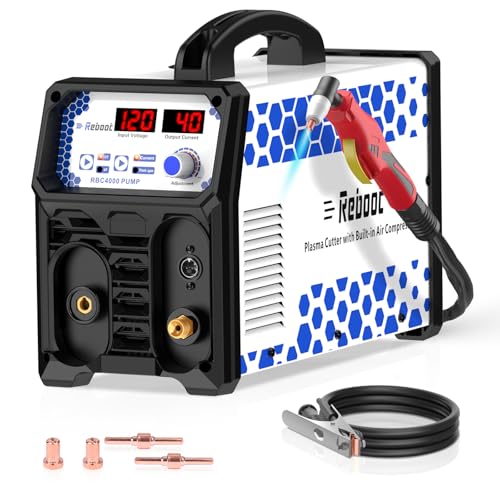 Reboot 40A Plasma Cutter with Air Compressor |
8.0/10 | Buy |
Hansnoktech 45A Plasma Cutter with Compressor
Equipped with an internal air pump, this compact 17-pound unit provides a portable metal cutting solution without requiring an external compressor. It runs on standard 120V power and handles clean cuts up to 3/8 inch on various conductive metals.
Pros
- Built-in compressor provides true plug-and-play operation
- Highly portable at only 17 pounds
- Supports 2T and 4T modes for user comfort
- Cleanly cuts through stainless steel, copper, and aluminum
Cons
- Single 120V input lacks 240V high-power capability
- Maximum clean cut is limited to 3/8 inch
ANDELI 55A Non-HF Plasma Cutter & MMA Welder
Combining a 55A non-HF plasma cutter with MMA stick welding, this versatile unit is built for metal fabrication and everyday shop repairs. Its non-contact pilot arc cuts cleanly through painted or rusted surfaces while reducing electromagnetic interference.
Pros
- Versatile dual plasma cutting and MMA welding capability
- Non-HF blowback start shields electronics from interference
- Non-contact pilot arc handles painted or rusted stock
- Includes comprehensive accessory bundle with helmet and consumables
- Informative LED display simplifies parameter tracking and troubleshooting
Cons
- Maximum cutting capacity requires external air supply
- Requires 220V input to reach peak output
- Fairly heavy chassis at over 26 pounds
FLARING 45A Built-In Air Plasma Cutter
Equipped with an internal air pump, this 45A unit eliminates the hassle of hauling a separate compressor to jobsites. It delivers 3/8-inch clean cuts across steel, stainless, and aluminum when connected to a 240V supply.
Pros
- Integrated air pump eliminates separate compressor setup
- Achieves clean cuts up to 3/8 inch
- Built-in overload protection enhances operational safety
- Includes replacement tips and electrodes out of the box
Cons
- Requires a dedicated 240V power connection
- Weighs nearly 30 pounds to transport
- Severance capacity is limited to 5/8 inch
Reboot Plasma Cutter with Built-in Compressor
Equipped with an internal air pump, this self-contained metal cutter eliminates bulky external hoses and tanks for straightforward workshop use. It offers a true plug-and-play setup for beginners, provided your space can supply the recommended 50A power breaker.
Pros
- Internal compressor eliminates external air line setups
- Highly portable self-contained design
- Beginner-friendly operation without pressure calibration
- Steady airflow delivers clean metal cuts
Cons
- Demands a 50A or larger circuit breaker
H HZXVOGEN 50A Pilot Arc Plasma Cutter
Featuring an integrated air compressor and non-touch pilot arc, this 50A unit enables standalone metal cutting without external air tanks. It is well suited for mobile metalworkers and shops needing clean cuts on stock up to 5/16 inches thick.
Pros
- Built-in compressor allows immediate plug-and-work operation
- Non-contact pilot arc extends consumable lifespan
- Solid 60 percent duty cycle for extended use
- Flexible support for both internal and external air supplies
Cons
- Requires high-voltage 220V or 240V power source
- Ideal clean cutting thickness is limited to 5/16 inch
- Two-year warranty coverage excludes consumable accessories
Reboot 60A Dual-Voltage Plasma Cutter
Engineered for portable repairs and shop work, this plasma cutter integrates an internal air pump for quick jobs without an external tank. Operating on 120V or 240V lines, it severs conductive metal up to 3/4-inch when paired with supplemental air.
Pros
- Integrated air pump enables fast, mobile cutting
- Flexible 120V and 240V dual-voltage capability
- Full severance up to 3/4-inch on 240V
- Clear digital error codes simplify troubleshooting
Cons
- Requires external compressor for optimal thick-metal cuts
- Needs a heavy-duty 50A breaker on 120V lines
Reboot 40A Plasma Cutter with Air Compressor
Equipped with an internal air pump, this compact cutting unit eliminates the clutter of separate compressor lines for metalworkers tight on shop space. It runs on a 120V circuit to deliver 40 amps of power, handling clean cuts up to 3/8 inch without manual air tuning.
Pros
- Integrated compressor eliminates external air hookups
- Clean cuts up to 3/8 inch
- Compact footprint saves workshop space
- Straightforward plug-and-play setup
Cons
- Manufacturer recommends a dedicated 50A breaker
- Max severance capacity capped at 3/5 inch
- Restricted to 120V single-voltage input
Compressed Air Delivery Dynamics for Plasma Arc Cutting
Connecting a pneumatic air supply to a thermal cutting torch remains standard practice for metal fabricators across home garages and production facilities. While high-temperature electric arcs melt conductive metals like steel and aluminum, a forceful jet of compressed gas must simultaneously blow molten metal clear of the cut path. When operators ask whether an air compressor works with a cutting machine, they address the foundational mechanic of plasma cutting technology. Understanding how flow volume, dynamic pressure, and air cleanliness interact allows you to configure an efficient cutting system that preserves expensive torch consumables.
How Compressed Air Drives the Plasma Cutting Process
Plasma cutting relies on ionizing common atmospheric air into a superheated fourth state of matter. When an electrical arc passes between the internal copper electrode and the cutting tip, the compressed air traveling through the torch head becomes ionized. This energetic stream reaches temperatures high enough to liquefy plate metal while maintaining high velocity. Without a steady stream of compressed air flowing through the swirl ring, the electrical arc cannot form a concentrated cutting jet.
The air stream also performs a crucial secondary function by expelling molten slag away from the work piece. If air velocity drops while the arc is active, molten steel pools inside the kerf and bonds directly back to the base metal. This disruption ruins the cut edge and forces operators to spend extra time grinding heavy dross. Maintaining consistent air pressure prevents this puddle accumulation, yielding clean square edges and minimizing post-cut cleanup.
External Shop Compressors versus Built-In Air Systems
Traditional metal shops have long relied on stationary workshop compressors plumbed directly to their plasma cutting equipment. These external air systems utilize large air tanks and high-output pumps capable of sustaining continuous air volume across extended cutting sessions. Units like the ANDELI Non-HF Plasma Cutter with Built-In Air can draw from external supplies to pierce material up to 15 mm thick and sever metal up to 0.76 inches. Standalone air setups provide the endurance needed when running lengthy cutting sequences or working through heavy structural beams.
Recent engineering improvements have introduced integrated internal air pumps that eliminate the need for a separate compressor entirely. Machines such as the HansnokTech Plasma Cutter With Built In Air and the FLARING 240V Plasma Cutter With Built In Air house compact, high-efficiency pumps directly inside the inverter chassis. This self-contained layout reduces clutter in crowded shops and simplifies jobsite transport because operators only need a power outlet to begin working. You avoid hauling heavy external air tanks or running long pneumatic lines across the workshop floor.
Operating with an internal pump does introduce specific boundaries compared to heavy shop air systems. Built-in pumps excel at intermittent field repairs, vehicle sheet metal, and light structural tasks up to 3/8-inch clean cut thicknesses. However, continuous plate cutting can push compact internal pumps toward their duty limits. For operators needing portability, having a self-contained unit saves floor space while delivering capable cutting capacity.
CFM and Operating Pressure Requirements for Clean Kerfs
Matching air delivery to torch consumption is essential when connecting an external workshop compressor to a cutting machine. Most standard manual plasma torches consume between 4.5 and 7.0 cubic feet per minute (CFM) at an operating pressure between 60 and 90 pounds per square inch (PSI). Small portable compressors, such as compact pancake models, often deliver only 2.5 to 3.5 CFM at 90 PSI. Connecting a plasma cutter to an undersized compressor causes the tank pressure to drop rapidly below the torch minimum threshold, extinguishing the cutting arc.
Dynamic air pressure differs significantly from static line pressure measured while the torch trigger sits idle. When you pull the torch switch, compressed air rushes out of the nozzle, causing an immediate pressure drop through the air regulator and supply hose. If your air compressor lacks the pump displacement to replenish that volume in real time, the working pressure plummets mid-cut. Setting your shop regulator to maintain 75 to 80 PSI while air flows ensures the arc remains stable through the entire pass.
Air tank capacity provides a buffer that prevents rapid cycling of your compressor pump. A workshop tank holding 20 to 60 gallons allows operators to complete long, uninterrupted cuts without pressure starvation. Compressors with smaller 6-gallon tanks force the pump motor to run continuously, generating excess heat and risking thermal shutdown. Choosing a compressor with adequate CFM delivery at operating pressure ensures consistent cut speeds and prevents beveling along metal edges.
Eliminating Moisture and Oil Contamination from Supply Lines
Moisture represents the primary enemy of clean plasma cuts and consumable longevity. As ambient air compresses inside a tank, water vapor condenses into liquid droplets that travel downstream toward your cutting torch. When moisture hits the superheated arc, it causes the stream to spit violently and wander off the cut line. This turbulent reaction rapidly burns through copper nozzles, pits electrodes, and leaves rough edges on metal parts.
Preventing water contamination begins directly at the compressor tank by performing regular moisture drainage. Installing a reliable brass valve and conducting routine air compressor drain valve maintenance prevents stagnant water from accumulating inside your receiver vessel. Draining the tank daily purges pooled condensation before it can enter the distribution lines. Neglecting this basic maintenance step ensures that moisture eventually reaches your sensitive inverter components and torch head.
Pairing your shop compressor with dedicated inline filtration provides the ultimate defense against pneumatic contamination. A proper setup should feature a particulate filter, an automatic water separator, and a desiccant drying canister mounted right before the plasma cutter inlet. If your compressor uses an oil-lubricated pump, adding an oil-coalescing filter prevents vaporized oil from degrading torch swirl rings. Delivering dry, oil-free compressed air extends nozzle life by multiple times and ensures smooth, dross-free kerf edges.
Dual-Source Air Systems and External Compressor Hookups
Modern plasma cutting machines often feature dual-source air management, giving users both portable and stationary setups. The Reboot 60A plasma cutter 120V/240V with built in air compressor highlights this design by pairing an internal pump with an external intake port. When tackling mobile repair jobs, you can rely entirely on the internal pump without carrying ancillary equipment. Back in the shop, plugging in an external 750W or larger compressor provides the airflow needed for slicing through thick 3/4-inch steel plates.
Dual-source machines incorporate internal valving and sensors to monitor supply pressure dynamically. The H HZXVOGEN 50A Plasma Cutter includes pre-cut air pressure detection to verify that air delivery meets operating requirements before striking an arc. If you switch to an external compressor, the internal sensors confirm adequate flow, preventing arc ignition when air supply lines are pinched or disconnected. This smart monitoring protects internal circuitry and prevents melted torch tips caused by insufficient gas flow.
Configuring an external air line requires proper plumbing to prevent restrictive bottlenecks. Use a minimum 3/8-inch inner diameter pneumatic hose rather than restrictive 1/4-inch lines when connecting an external compressor across long shop distances. High-flow couplers also reduce friction loss between the tank regulator and the plasma cutter rear inlet. Minimizing pressure drop along the delivery run ensures that the torch head receives full manufacturer-rated pressure under continuous cutting conditions.
Electrical Circuit Demands, Breaker Sizing, and Duty Cycles
Power requirements represent a vital consideration when running plasma cutters and air compressors simultaneously in a garage. A plasma cutter operating on a 120V circuit draws substantial amperage, frequently requiring a dedicated 50-amp circuit breaker as recommended for Reboot plasma machines. If an electric air compressor kicks on using that same circuit, the combined starting inrush current trips the breaker instantly. Running both machines requires splitting power across separate dedicated circuits or stepping up to 240V utility power.
Operating on 240V power dramatically reduces current draw per leg and provides the energy required for heavy metal severance. The FLARING 240V Plasma Cutter With Built In Air utilizes high-efficiency IGBT inverter technology to deliver 45 amps of cutting power from a 240V source. Higher voltage input stabilizes arc characteristics while allowing internal and external air pumps to operate with lower thermal strain. For dedicated workshop environments, installing a 240V 30-amp or 50-amp receptacle ensures reliable performance without nuisance breaker trips.
Duty cycle limits dictate how long equipment can operate continuously within a ten-minute working window. The H HZXVOGEN 50A Plasma Cutter features a generous 60% duty cycle, meaning it can cut continuously for six minutes before requiring a four-minute cooling pause. External air compressors carry their own duty cycle ratings, often between 50% and 70% for standard single-stage workshop models. Matching your cutting pace to the duty cycles of both your cutting inverter and your air compressor prevents overheating and extends machine service life.
Consumable Longevity: Pilot Arcs, Pre-Flow, and Post-Flow Cycles
Airflow timing plays an indispensable role in protecting torch electrodes and cutting tips from premature thermal failure. Advanced units integrate automated pre-flow cycles that send a burst of compressed air through the torch before the arc ignites. This initial blast purges stagnant moisture from the torch lead and stabilizes gas velocity across the swirl ring. When the arc initiates, the surrounding gas column focuses the energy cleanly, preventing erratic arc strikes that erode nozzle orifices.
Modern plasma cutters often utilize non-contact pilot arc technology to ignite cutting arcs without touching the torch tip directly to the work piece. Both the ANDELI Non-HF Plasma Cutter with Built-In Air and the H HZXVOGEN 50A Plasma Cutter feature pilot arc ignition that severs painted, rusted, and expanded metal effortlessly. By eliminating physical contact with uneven metal surfaces, the torch avoids spatter blowback that clogs air passages. Consistent air pressure shields the electrode from molten spatter, extending the usable life of every consumable set.
Post-flow airflow represents an equally critical function that runs compressed air through the torch after releasing the trigger. The Reboot 60A plasma cutter includes adjustable post-flow settings to keep cooling air streaming over the hot copper electrode. Cooling the consumable stack rapidly under high-velocity airflow prevents oxidation and thermal cracking of the hafnium emitter. Disconnecting air lines immediately after cutting causes thermal shock that destroys internal torch components within a few cycles.
Diagnosing Pressure Drops, Error Codes, and Air Delivery Faults
Pneumatic delivery faults cause distinct operational symptoms that alert fabricators to air supply problems. When line pressure falls below safe thresholds, cutting arcs typically flutter, turn green, or extinguish entirely mid-cut. Inverter machines like the Reboot 60A feature digital diagnostic alerts, flashing an E06 error code on the interface to indicate air pressure loss. This automated protection prevents the machine from firing without cooling gas, saving both the torch head and internal transformer modules.
Identifying pressure issues requires systematically checking supply plumbing, regulators, and compressor pump performance. Inspect your air filters for saturated desiccant beads or clogged sintered bronze elements that create excessive pressure drop under load. Comparing belt-drive versus direct-drive compressor configurations helps determine whether your shop compressor delivers stable recovery cycles during heavy air consumption. Leaks around threaded pipe fittings or loose hose clamps also bleed valuable volume that starves the cutting torch.
Testing air pressure at the rear inlet while activating the torch air-purge mode reveals dynamic line health. The ANDELI Non-HF machine provides real-time digital readouts of working air pressure on its large digital screen, allowing operators to make instant adjustments. If dynamic pressure sags while static pressure appears normal, expanding your air hose diameter or clearing an obstructed inlet filter resolves the restriction. Addressing air supply bottlenecks ensures consistent arc stability, prevents diagnostic error codes, and restores clean cutting performance.
Pairing a capable air compressor with a plasma cutting machine forms the backbone of efficient metal fabrication. Whether you choose a compact inverter with a built-in air pump for mobile repairs or plumb an external workshop compressor for slicing heavy plate, clean and regulated air remains vital. By maintaining adequate CFM delivery, eliminating moisture through inline filtration, and respecting machine duty cycles, you protect expensive consumables and achieve smooth cuts across every project.
About the author
Glenda Taylor has extensive experience in residential construction, remodeling, home improvement, and tool use. Her practical approach to equipment evaluation focuses on usability, performance, safety, and value—helping DIYers and workshop users make better-informed decisions about compressors and related tools.