
What Size Air Compressor Hose Do I Need: Practical Guide for 2026
Learn what size air compressor hose do i need to prevent pressure drops across air tools in November 2026 with our practical workshop sizing guide.
 By Tom Scalisi
Updated October 28, 2026


Pneumatic tools demand consistent airflow to operate at peak efficiency, but many workshop mechanics unknowingly choke their equipment right at the delivery line. When a rotary sander stalls or an impact wrench fails to loosen a stubborn fastener, the issue is frequently an undersized or overly long air hose rather than a weak compressor pump. Determining what size air compressor hose do i need requires balancing internal diameter, line distance, and tool air consumption against dynamic line friction.
Selecting the proper hose diameter ensures that pressure set at the tank regulator actually reaches the tool inlet without severe drop during operation. For light-duty tasks like brad nailing or tire inflation, lightweight lines keep work effortless, but continuous-draw tools demand wider lines to maintain steady CFM delivery. If your existing setup leaks or restricts flow, learning about replacing an air compressor hose can help restore line pressure before you tackle demanding workshop projects.
| Award | Product | ACR Score About ACR ScoreThe ACR Score is our own rating from 0 to 10, based on performance, design and build, ease of use, and value. It reflects independent research and is never influenced by manufacturers, retailers, or affiliate commissions. Learn more › | |
|---|---|---|---|
| Best Overall |
Goodyear 6-Foot x 3/8-Inch Hybrid Air Hose
|
8.6/10 | Buy |
| Best Premium |
 Hromee 1/4-Inch x 25-Foot Hybrid Air Compressor |
8.6/10 | Buy |
| Best Budget |
 YOTOO Hybrid Lead-in Air Hose |
8.4/10 | Buy |
| Best Value |
 Hromee 3/8-In x 6-Ft Hybrid Lead-In Air Hose |
8.4/10 | Buy |
 WYNNsky 3/8-Inch x 25ft PVC Air Hose Kit |
8.4/10 | Buy | |
 FYCQER 25-Foot Coiled Air Hose (1/4 Inch) |
8.1/10 | Buy |
Goodyear 6-Foot x 3/8-Inch Hybrid Air Hose
Built as a compact whip line, this 6-foot hybrid hose pairs heavy-duty polymer construction with solid brass fittings for tight workshop connections. It lays completely flat with zero memory and handles tough conditions ranging from -50 to 190 degrees Fahrenheit.
Pros
- Resists kinking under pressure with zero coil memory
- Wide operational range from -50 to 190 degrees F
- Durable solid brass 1/4-inch NPT connections
- Resistant to oil, solvents, and harsh weather
Cons
- Short 6-foot reach limits standalone workspace coverage
- Functions primarily as a whip or lead-in hose
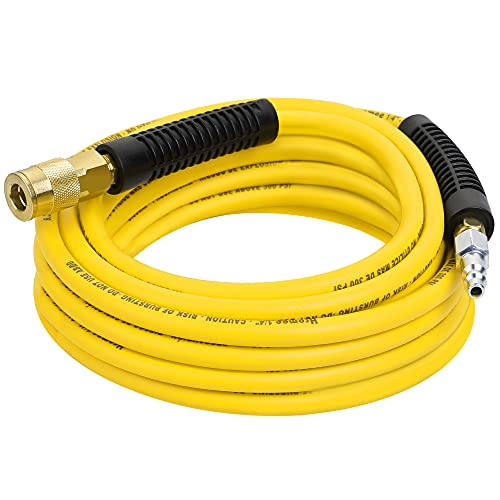
Hromee 1/4-Inch x 25-Foot Hybrid Air Compressor
The Hromee 1/4-Inch x 25-Foot Hybrid Air Compressor Hose provides a flexible, lightweight pneumatic connection with a 300 PSI working pressure, bend restrictors, and pre-attached industrial fittings. Rated for -40°F to 150°F, it is well-suited for trim carpenters, home mechanics, and DIYers seeking kink-resistant hose handling.
Pros
- Pliable hybrid polymer stays flexible in cold weather down to -40°F without severe memory coils
- Comes ready to use out of the box with pre-connected brass coupler and industrial steel plug
- Integrated bend restrictors minimize strain and kink points near the MNPT fittings
- Lightweight two-pound design makes overhead nailing and portable trim work easy on user arms
Cons
- The 25-foot length provides limited reach across larger garages or multi-room jobsite setups without an extension
- A 1/4-inch inner diameter creates higher airflow restriction than 3/8-inch hoses when supplying high-CFM continuous tools
- Bright yellow exterior easily shows garage grime, motor oil, and jobsite dirt over time
YOTOO Hybrid Lead-in Air Hose
Built from a durable rubber and PVC blend, this lead-in air hose connects compressors or reels directly to your air tools without requiring extra hardware. Pre-installed industrial fittings and built-in bend restrictors deliver reliable airflow and kink resistance for workshop tasks.
Pros
- Pre-assembled with industrial quick-connect fittings
- Dual bend restrictors extend hose longevity
- Abrasion-resistant hybrid material withstands heavy use
- High 300 PSI working pressure rating
Cons
- Limited reach designed only for lead-in connections
- Hybrid material can feel stiffer than pure rubber
Hromee 3/8-In x 6-Ft Hybrid Lead-In Air Hose
Built to bridge compressors and hose reels, this hybrid whip hose absorbs tool vibration and minimizes user fatigue. Its lightweight rubber-PVC construction and pre-attached brass coupler make it a dependable connection for garage setups.
Pros
- Stays flexible in extreme temperatures down to -40°F
- Pre-attached brass quick coupler saves setup time
- Built-in bend restrictors reduce kinking at connection points
- Lightweight hybrid build prevents user fatigue
Cons
- Short six-foot length limits use strictly to connector applications
- Steel plug is more prone to rust than full brass fittings
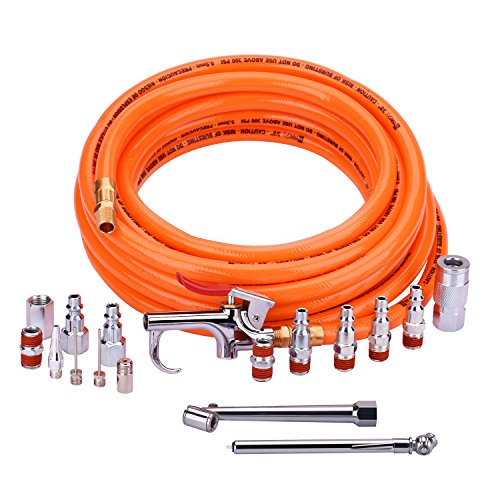
WYNNsky 3/8-Inch x 25ft PVC Air Hose Kit
Equipped with a lightweight PVC hose and a 17-piece accessory bundle, this package delivers the essential fittings needed for home workshop DIY projects. Solid brass connections ensure dependable seals, supported by a 300 PSI maximum working pressure.
Pros
- Solid brass fittings resist corrosion and seal reliably
- Complete accessory set provides essential starter fittings
- Lightweight hose design allows easy transport and handling
- Handles up to 300 PSI maximum working pressure
Cons
- 25-foot length provides limited reach across larger workshops
- PVC construction is typically less flexible than rubber hoses
FYCQER 25-Foot Coiled Air Hose (1/4 Inch)
Built from flexible polyurethane, this self-storing coiled hose extends your reach up to 25 feet without tangling. Its 300 PSI rating and pre-sealed brass fittings make it a dependable pick for light garage work and tire inflation.
Pros
- Pre-sealed brass fittings ensure secure, leak-resistant connections
- Compact coil profile snaps back quickly for easy storage
- Rated up to 300 PSI for high-pressure tools
- Wide operating temperature range prevents cold-weather kinking
Cons
- Coil tension may pull back when stretched near 25 feet
- 1/4-inch inner diameter limits high-CFM air tools
- 25-foot length may feel short for larger workshop layouts
Sizing Your Air Compressor Hose for Reliable Pneumatic Performance
Air compressor hoses are designated primarily by their inside diameter, which dictates how many cubic feet of compressed air can travel through the conduit each minute without generating excessive friction. A common misconception among tool operators is assuming that high tank pressure guarantees high air delivery at the tool trigger. In reality, dynamic friction along the interior walls of a narrow hose causes immediate pressure drops whenever a tool demands a burst of air. Selecting the correct hose size ensures that the regulated pressure configured at the compressor tank actually reaches the tool inlet under active working conditions.
Every pneumatic tool requires a specific volume of compressed air delivered at a stable operating pressure to function properly. When you pair an aggressive air tool with an undersized hose, the tool starves for air volume even while the compressor tank gauge shows full pressure. Understanding the physical relationship between inner hose diameter, total line length, and pneumatic consumption will keep your workshop running smoothly. Taking the time to evaluate your specific tool lineup prevents frustrating stall-outs and protects your equipment from unnecessary mechanical strain over years of frequent use.
Inside Diameter Explained: Choosing Between 1/4-Inch and 3/8-Inch Lines
Inside diameter represents the interior cross-sectional width through which compressed air travels. Manufacturers produce lines in several standard dimensions, but the two most prevalent choices for consumer garages and jobsite contractors are 1/4-inch and 3/8-inch lines. A 1/4-inch inner diameter hose provides a compact interior passage that naturally limits total airflow volume to roughly 15 to 20 CFM under standard operating pressures. Models like the Hromee Air Compressor Hose 1/4 Inch x 25 Feet demonstrate how lightweight and flexible a quarter-inch line feels during routine household repairs and trim carpentry.
While a 1/4-inch hose handles low-volume tools easily, it quickly creates a restrictive bottleneck when attached to demanding shop equipment. The narrow interior passage forces compressed air to accelerate to higher velocities, creating turbulent friction that strips away working pressure before the air reaches your tool. Because of this restriction, quarter-inch lines are best reserved for light-duty brad nailers, narrow-crown staplers, air blowguns, and vehicle tire inflation chucks. Using a 1/4-inch line on higher-demand air equipment forces the tool to run below its rated power capacity.
A 3/8-inch inner diameter hose expands the interior surface area dramatically, allowing more than double the air volume to pass through at equivalent velocity. This expanded bore reduces internal wall friction and enables portable or stationary air compressors to supply high-draw tools without immediate pressure collapse. Options such as the WYNNsky 3/8″ X 25ft PVC Air Compressor Hose Kit provide the broader airway required for heavy garage duty. For automotive impact wrenches, pneumatic ratchets, and continuous finish sanders, a 3/8-inch hose serves as the dependable standard across most workshops.
The Influence of Hose Length on Dynamic Pressure Drop
Total hose length acts as a compounding variable alongside inner diameter because air friction accumulates across every linear foot of conduit. Dynamic pressure drop refers to the immediate loss of working PSI that occurs the moment compressed air starts moving through an active line. If your regulator reads 90 PSI at rest, pulling the trigger on a continuous air tool might cause operating pressure at the tool to plunge down to 70 PSI or lower. This continuous loss occurs because rushing air molecules drag against the rubber or polymer walls along the entire length of the hose.
A standard 25-foot hose introduces minimal friction loss, making it the ideal working distance for single-bay garages and dedicated assembly workbenches. At 25 feet, tools receive immediate pressure response, and the hose remains simple to coil and store away when tasks wrap up. Stepping up to a 50-foot hose doubles internal surface resistance, requiring a slight upward pressure adjustment at the compressor regulator to compensate for line drag. Once a line extends to 100 feet, pressure drop becomes severe enough that an undersized 1/4-inch hose will struggle to cycle even moderate framing nailers reliably.
To avoid massive line drop across expansive job sites, smart operators upgrade their main run to a larger inner diameter rather than using narrow hoses. Running a 3/8-inch hose for a 50-foot or 100-foot run keeps air velocity manageable and minimizes turbulence compared to an extended quarter-inch line. If you are configuring a larger shop system or considering a two-stage compressor guide for commercial applications, keeping delivery lines adequately sized is critical for maximizing high tank storage pressure. Keeping your primary hoses as short as practical while maintaining adequate inner diameter remains the best way to prevent dynamic pressure starvation.
Short Lead-in Whip Hoses and Vibration Isolation
Short lead-in whip hoses serve a specialized purpose in workshop pneumatic systems by bridging the gap between rigid components and flexible working lines. Dedicated lead-in hoses, such as the YOTOO Hybrid Lead-in Air Hose 3/8-Inch by 3-Feet, measure only a few feet in length to connect an air compressor outlet directly to an overhead hose reel. Because these hoses are remarkably short, their dynamic friction drop is essentially negligible even under high airflow demand. They isolate compressor pump vibration from the mounting bracket of your hose reel, preventing stress fractures on rigid pipe threads.
Similarly, the Hromee Hybrid Lead-in Air Hose 3/8 Inch x 6FT provides enough reach to position a compressor away from moisture traps or filtration manifolds. Whip lines also function effectively when attached directly to high-vibration pneumatic tools like heavy-duty air hammers and impact wrenches. When a heavy tool vibrates violently during operation, attaching a quick coupler directly to the tool housing can cause rapid mechanical fatigue and annoying air leaks. Installing a short flexible whip hose between the tool and your main airline absorbs those destructive shock loads and saves your brass couplers from premature failure.
Matching Hose Dimensions to Continuous and Intermittent Air Tools
Pneumatic tools fall into two distinct air consumption categories: intermittent tools and continuous-draw tools. Intermittent tools consume air in brief, isolated pulses, allowing the compressor tank and hose volume to recover pressure between actuations. Examples of intermittent tools include brad nailers, finish nailers, staple guns, and tire inflation chucks. These tools typically draw less than 1 to 2 CFM and operate smoothly on lightweight 1/4-inch hoses without suffering noticeable pressure starvation or performance delays.
Continuous-draw tools, on the other hand, pull high volumes of compressed air non-stop for seconds or minutes at a time. Rotary die grinders, random orbital sanders, high-torque impact wrenches, and HVLP paint spray guns represent classic continuous tools. A typical 1/2-inch pneumatic impact wrench can consume between 4 and 6 CFM at 90 PSI during heavy lug removal, while an orbital sander easily demands 8 to 12 CFM. Running these demanding tools through a 1/4-inch line causes immediate pressure collapse, causing the tool to lose torque and RPM regardless of compressor motor size.
To prevent continuous tools from stalling, pairing them with a 3/8-inch inner diameter hose is mandatory for acceptable workshop performance. The larger air volume stored inside the 3/8-inch hose acts as an extended buffer reservoir right next to the tool inlet. In addition, keeping your line free of liquid moisture is essential for maintaining unrestricted air delivery. Regularly draining compressor tank moisture through a reliable drain valve prevents water accumulation from restricting airflow through your delivery lines. Clean, dry air travelling through an adequately sized hose guarantees that your pneumatic tools receive the exact volume and pressure they need to perform.
Hose Materials: Hybrid Polymers, Polyurethane, and PVC
The construction material of your air compressor hose dictates its daily usability, cold-weather flexibility, total carry weight, and lifespan. Traditional rubber hoses have long been favored for commercial shops due to their exceptional durability, heat resistance, and complete lack of coil memory. However, solid rubber hoses are notoriously heavy and tend to scuff painted baseboards or automobile clear coats during indoor use. In recent years, modern synthetic materials have emerged that offer distinct performance advantages for residential garages and mobile contractor trailers.
Hybrid polymer air hoses blend high-grade rubber with durable PVC compounds to deliver the benefits of both materials without their historical weaknesses. Products like the Goodyear 6′ x 3/8″ Hybrid Air Hoses feature a low-friction polymer outer jacket that resists oil, grease, and shop solvents while remaining flexible down to sub-zero temperatures. Hybrid hoses do not develop stiff coil memory, meaning they unroll flat on the ground without curling into frustrating loops. This lay-flat property prevents trip hazards across busy shop floors and makes coiling the hose at the end of a shift effortless.
Standard PVC hoses, such as the line included in the WYNNsky accessory kit, provide an exceptionally lightweight and economical option for light hobbyist use. PVC resists abrasion remarkably well and glides smoothly across concrete floors without leaving marks or catching on machinery corners. The primary trade-off with standard PVC is temperature sensitivity, as the material stiffens considerably when ambient temperatures drop below 50 degrees Fahrenheit. For heated indoor garages, PVC delivers great utility, while unheated job sites benefit more from cold-weather hybrid polymers.
Coiled polyurethane hoses offer a distinct design focused entirely on compact storage and rapid benchtop cleanup. The FYCQER Air Hose 1/4 NPT x 25 Feet uses strong recoil memory to snap back into a tight spiral immediately after use, keeping the hose elevated off dirty workshop floors. Polyurethane combines extreme lightweight characteristics with outstanding cold-weather flexibility from minus 40 to 150 degrees Fahrenheit. While coiled hoses can exert a slight pulling tension on your wrist when stretched to their maximum reach, they excel at electronics cleaning, tire inflation, and benchtop assembly stations.
Fittings, Coupler Restrictions, and Safety Working Pressure
Even if you select the ideal hose inner diameter, your pneumatic system can still suffer from flow restriction if your fittings are undersized. Most portable air compressor hoses come equipped with standard 1/4-inch NPT threaded brass male fittings on both ends. It is common to see a 3/8-inch inner diameter hose terminated with 1/4-inch NPT fittings because 1/4-inch connections match the standard couplers found on most consumer air tools. Sticking with solid brass end fittings and pre-applied thread sealant ensures tight connections that resist corrosion and minimize annoying leaks.
Heavy-duty bend restrictors installed at both ends of an air hose protect the connection point where the flexible hose meets the rigid brass crimp. Without molded bend restrictors, repeated flexing and tool movement cause the hose wall to kink and fatigue right at the fitting barb. Kinking restricts airflow instantly and eventually leads to outer jacket cracking or dangerous hose blowouts under high working pressures. Choosing hoses equipped with reinforced strain-relief collars extends hose longevity and ensures uninterrupted airflow throughout demanding automotive or framing projects.
Safety is paramount when working with pressurized air, and quality hoses feature explicit pressure ratings stamped directly along their outer jacket. A dependable pneumatic line should provide a standard working pressure rating of at least 300 PSI, which easily accommodates the 125 to 175 PSI maximum output of consumer air compressors. For example, the Goodyear, Hromee, YOTOO, and WYNNsky hoses all feature a 300 PSI working limit with burst ratings ranging from 900 to 1,200 PSI. This generous safety margin ensures that transient pressure spikes will not compromise hose integrity during heavy operation.
Matching your air compressor hose size to your tool workload ultimately comes down to balancing mobility against airflow demand. For finish nailers, staple guns, and driveway tire inflation, a 25-foot hose with a 1/4-inch inner diameter offers maximum flexibility and effortless storage. When you power automotive impact wrenches, rotary sanders, or extended 50-foot runs, stepping up to a 3/8-inch inner diameter hose prevents dynamic pressure drop and delivers consistent air volume. By selecting the proper diameter and material for your specific applications, you ensure that every pneumatic tool in your workshop operates at its full potential.
About the author
Tom Scalisi brings more than two decades of experience in construction, building maintenance, contracting, and hands-on tool use. His practical understanding of power tools, automotive work, repairs, and jobsite equipment helps readers evaluate compressors based on real workloads rather than specifications alone.