
Are Portable Tire Inflators Good: Practical Guide for 2026
Wondering are portable tire inflators good? Explore real-world inflation performance, duty cycles, and roadside reliability for November 2026.
 By Bob Beacham
Updated October 8, 2026


A sudden drop in ambient temperature often triggers the dreaded dashboard tire pressure monitoring light on a chilly morning commute. Stepping out into the cold to find a low tire usually leaves drivers debating whether to hunt down a working gas station air pump or keep a compact compressor in the trunk. Many motorists find themselves asking whether are portable tire inflators good enough to replace commercial service station equipment for regular tire maintenance. Modern automotive tire care equipment has evolved significantly from the noisy, vibrating novelties of past decades. Today, compact digital pumps engineered by brands such as AstroAI, CARSUN, CRAFTSMAN, and DEWALT deliver reliable airflow and automated shut-off features in packages small enough to fit inside a glove box or spare tire well.
Evaluating these compact tools requires understanding their practical strengths alongside their mechanical boundaries. While high-volume shop compressors remain necessary for industrial tasks, quality portable tire inflators excel at routine pressure top-offs, seasonal cold tire adjustments, and emergency roadside stabilization. Drivers investing in a reliable emergency kit frequently explore options highlighted in our guide to portable tire inflators to balance inflation speed against battery portability. Having a dependable pump tucked under a passenger seat prevents unnecessary rim damage, saves fuel economy lost to under-inflation, and eliminates the frustration of out-of-order coin-operated air pumps.
| Award | Product | ACR Score About ACR ScoreThe ACR Score is our own rating from 0 to 10, based on performance, design and build, ease of use, and value. It reflects independent research and is never influenced by manufacturers, retailers, or affiliate commissions. Learn more › | |
|---|---|---|---|
| Best Overall |
CRAFTSMAN 12V Portable Tire Inflator with
|
9.2/10 | Buy |
| Best Premium |
 DEWALT Cordless Tire Inflator Portable Air |
9.1/10 | Buy |
| Best Budget |
 AstroAI L7S 150 PSI Cordless Tire Inflator |
8.9/10 | Buy |
 Ipflin 160 PSI Portable Tire Inflator and Air |
8.9/10 | Buy | |
 QYQBOON Portable Tire Inflator 150 PSI Cordless |
8.8/10 | Buy | |
| Best Value |
 OlarHike Portable Tire Inflator Air Compressor |
8.8/10 | Buy |
 AstroAI Cordless Tire Inflator 160 PSI |
8.8/10 | Buy | |
 CARSUN 12V DC Portable Tire Inflator |
8.6/10 | Buy | |
 AstroAI 12V DC Portable Air Compressor Tire |
8.4/10 | Buy | |
 AstroAI AIRUN H 12V DC Portable Air Compressor |
8.4/10 | Buy |
CRAFTSMAN 12V Portable Tire Inflator with
The CRAFTSMAN 12V Portable Tire Inflator is an ultra-compact 1.9-pound roadside unit delivering up to 150 PSI with digital auto shut-off and built-in cord storage. Powered via a standard 12V car accessory plug, it offers fast tire top-offs and dependable emergency inflation without crowding trunk space.
Pros
- Weighs only 1.9 pounds for effortless glove box, under-seat, or trunk storage during road trips
- Digital auto shut-off prevents accidental over-inflation without requiring constant manual gauge monitoring
- Bright three-mode LED light provides critical illumination during nighttime roadside emergencies
- Comes fully equipped with multi-valve adapters, a replacement fuse, and a tailored carry pouch
Cons
- Requires a 12V DC vehicle accessory socket and does not include a 120V AC household outlet adapter
- Compact tankless pump is built strictly for tire inflation and cannot drive pneumatic nailers or air tools
- The 2.17-foot air hose length means the compressor must sit on the ground adjacent to the wheel valve stem
DEWALT Cordless Tire Inflator Portable Air
This compact DEWALT portable tire inflator delivers up to 150 PSI with smart auto shut-off, powered by an internal rechargeable battery or an included 10-foot 12V car plug. It provides an efficient, pocket-sized solution for vehicle owners, cyclists, and DIYers wanting rapid roadside top-offs without hauling a bulky tank compressor.
Pros
- True cordless freedom with an internal rechargeable battery plus a 10-foot 12V DC vehicle plug backup
- Accurate digital pressure gauge with 5 smart presets and automatic shut-off to eliminate overinflation
- Ultra-compact handheld design weighing just 0.63 kg for easy storage in glove boxes or saddlebags
- Integrated LED work light and emergency USB power bank functionality for travel safety
- Generous accessory bundle backed by a 3-year limited warranty
Cons
- Engineered exclusively for high-pressure inflation rather than operating pneumatic air tools or nailers
- Does not include a 120V AC residential wall outlet power adapter
- Compact tankless pump requires periodic cooling breaks during heavy multi-tire inflation runs
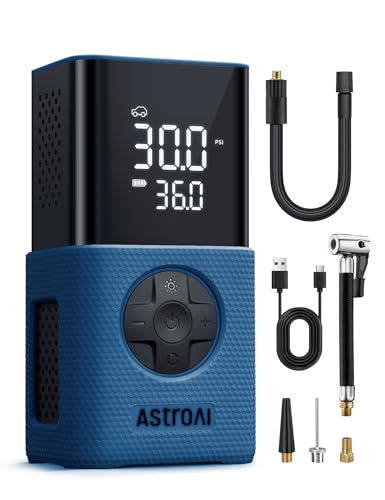
AstroAI L7S 150 PSI Cordless Tire Inflator
Weighing barely a pound, the AstroAI L7S delivers portable inflation up to 150 PSI alongside a shock-absorbing silicone sleeve and power bank utility. Five smart presets and automatic shut-off make it a practical roadside companion for passenger cars, bicycles, and sports gear.
Pros
- Pocketable design weighing just 1.01 pounds
- Protective silicone sleeve dampens vibration and drops
- Hands-free operation with automatic shut-off
- Built-in power bank charges mobile devices
- Clear digital display with five smart presets
Cons
- Incompatible with heavy-duty truck and RV tires
- Not suitable for off-road vehicle tires or trailers
Ipflin 160 PSI Portable Tire Inflator and Air
The Ipflin portable air compressor provides up to 160 PSI and 30 L/min airflow with a built-in 9600mAh battery and 12V DC vehicle backup. It is an ideal emergency inflator for motorists, garage DIYers, and cyclists who need quick tire pressure adjustments without hauling a heavy air tank.
Pros
- True dual-power flexibility allows cordless battery operation or direct 12V DC automotive corded power during roadside emergencies
- High 160 PSI maximum pressure rating handles high-pressure bike tires, trailer tires, and passenger vehicle inflation
- Automatic shutoff system prevents over-inflation by stopping airflow as soon as the preset pressure target is reached
- Built-in 9600mAh battery eliminates the need for separate external power tool batteries or standalone chargers
Cons
- High-pressure tire inflator design is strictly intended for inflation and cannot operate pneumatic tools like brad nailers or air ratchets
- Cordless lithium-ion battery requires periodic top-off charging during storage to maintain emergency readiness
- Continuous inflation runtime is capped at 30 minutes before requiring a short cool-down period
QYQBOON Portable Tire Inflator 150 PSI Cordless
The QYQBOON portable cordless tire inflator provides up to 150 PSI and a listed 35 L/min airflow with dual internal battery and 12V DC car cord power options. It is a compact, dependable roadside solution for drivers, cyclists, and DIYers seeking quick tire top-offs with automatic pressure shutoff.
Pros
- Dual-power design works via cordless battery or standard 12V DC vehicle plug so you are never stranded without power
- Automatic shutoff system reliably stops inflation at your chosen target pressure
- Extremely compact 1-pound footprint fits easily in a glove compartment, door pocket, or tool bag
- Integrated LED work light and USB power bank add valuable roadside emergency functionality
Cons
- Tankless mini pump design cannot operate workshop air tools or pneumatic finish nailers
- The 35 L/min airflow rate is intended for passenger tires and top-offs rather than rapid inflation of large commercial truck tires
- Does not include a 120V AC household wall adapter for running directly from standard residential wall outlets
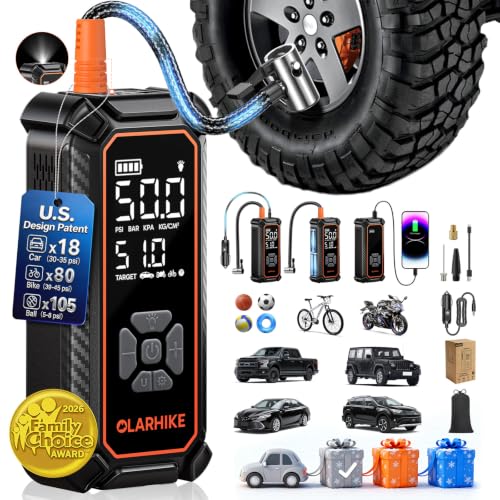
OlarHike Portable Tire Inflator Air Compressor
The OlarHike Portable Tire Inflator combines dual-power versatility via a 12V DC vehicle plug or built-in rechargeable battery with an automatic shut-off digital display. It provides dependable roadside tire top-offs and inflation for passenger cars, crossovers, motorcycles, and bicycles.
Pros
- Dual-power design allows cordless field operation or continuous power through any standard vehicle 12V DC port
- Automatic shut-off technology stops the motor precisely at preset pressure to prevent over-inflation
- Integrated 6000mAh battery reserve doubles as an emergency phone charger and includes an LED work light
- Pocket-sized footprint weighs well under two pounds for convenient transport in center consoles or backpacks
Cons
- Maximum vehicle pressure rating of 51 PSI is not suitable for heavy-duty commercial trucks, RVs, or high-pressure trailer tires
- Compact tankless inflator mechanism cannot power workshop pneumatic tools such as nail guns or air ratchets
- Recharging requires a standard 5V 2A or 5V 3A adapter and is not compatible with high-wattage fast chargers
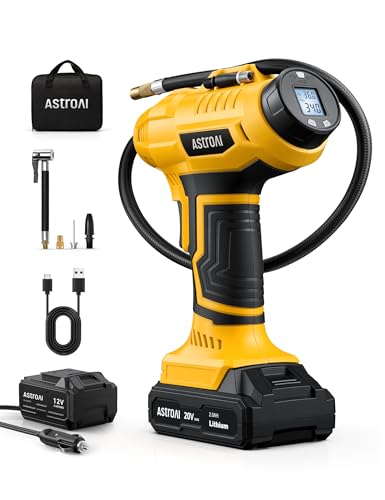
AstroAI Cordless Tire Inflator 160 PSI
The AstroAI Cordless Tire Inflator is a compact 160 PSI handheld air compressor featuring dual power via a 20V rechargeable battery and a 12V DC car adapter. Delivering digital auto shut-off and up to 20 minutes of continuous runtime, it is an ideal emergency tool for garage mechanics, commuters, and road-trippers.
Pros
- Dual-power versatility allows cordless battery operation at home or 12V DC vehicle plug-in on the road
- Reaches up to 160 PSI with automatic shut-off to prevent accidental tire over-pressurization
- Compact 2.54-pound footprint provides effortless trunk or glove-box storage for emergency readiness
- Backlit digital LCD screen provides clear readouts in PSI, BAR, and KPA units
- Integrated front LED light illuminates tire valve stems during dark roadside emergencies
Cons
- Includes a USB-C charging cable but requires an external USB power block to recharge the battery
- Designed specifically for tire and sports inflation rather than driving pneumatic workshop air tools
- Continuous runtime is limited to 20 minutes before requiring a cool-down pause
CARSUN 12V DC Portable Tire Inflator
The CARSUN 12V DC portable tire inflator delivers a listed 35 L/min airflow with automatic digital shut-off up to 150 PSI. It is an ideal, budget-friendly roadside emergency pump for passenger car owners, cyclists, and weekend campers.
Pros
- Automatic shut-off prevents accidental tire over-inflation by cutting power at the preset target pressure
- Lightweight 1.9-pound frame and compact dimensions fit neatly into vehicle trunks or roadside emergency kits
- Capable 35 L/min air volume airs up standard passenger tires quickly during routine seasonal pressure top-offs
- Bright integrated LED lighting assists with safe valve connection along dark roadways and unlit driveways
- Four included adapter nozzles expand utility across bicycles, sporting balls, and recreational air mattresses
Cons
- Powered exclusively via 12V DC vehicle sockets and does not include a 120V AC household electrical plug
- Manufacturer explicitly notes the unit is not suitable for heavy commercial trucks or large motor lorries
- Tankless high-pressure inflator design is not engineered to operate pneumatic workshop air tools
AstroAI 12V DC Portable Air Compressor Tire
The AstroAI 12V DC Portable Tire Inflator delivers a listed 25 L/min flow rate for fast roadside top-offs, featuring an auto-shutoff digital gauge and an 11.1-foot total reach. Powered strictly via 12V automotive sockets, it offers dependable emergency inflation for drivers, garage hobbyists, and compact vehicle owners.
Pros
- Quick roadside top-offs with manufacturer-rated 25 L/min pump speed
- Accurate digital display with auto-stop prevents over-pressurizing tires
- Long 11.1-foot combined cord and hose reaches all four vehicle tires
- Compact, sub-1.5-pound chassis with built-in cord and nozzle storage
- Integrated LED work light for roadside emergencies at night
Cons
- Restricted to 12V DC automotive sockets only with no direct 120V AC household plug included
- Requires a cool-down pause after 15 minutes of continuous run time
- Tankless design cannot operate pneumatic nailers, air ratchets, or automotive shop air tools
AstroAI AIRUN H 12V DC Portable Air Compressor
The AstroAI AIRUN H is a compact 12V DC tire inflator delivering up to 35 L/min airflow with automatic shut-off and digital pressure presets. It is an ideal portable emergency compressor for drivers, commuters, and garage hobbyists seeking fast tire top-offs.
Pros
- Automatic shut-off stops pumping reliably once target PSI is reached
- High-airflow 120W motor provides rapid top-offs for daily driver tires
- Long 9.84-foot power cord reaches all passenger vehicle wheels with ease
- Bright built-in LED flashlight and backlit display assist during night repairs
- Lightweight 2.2-pound form factor stores neatly in glove boxes and trunks
Cons
- Requires a 12V DC vehicle outlet and does not include a 120V AC household plug
- Mandates a 10-minute cool-down interval after 15 minutes of continuous operation
- Not intended for high-volume inflatables like large pool floats or air mattresses
Evaluating Portable Tire Inflator Capabilities, Limits, and Real-World Value
Directly answering the central question reveals that modern portable tire inflators are genuinely capable tools for everyday tire care, provided users respect their mechanical limits. These compact machines cannot match the cubic-feet-per-minute output of stationary shop compressors, but they easily handle the daily pressure maintenance tasks passenger vehicles demand. Knowing how these devices operate, what components govern their reliability, and where their physical boundaries lie allows motorists to make informed decisions for both driveway maintenance and emergency travel.
Mechanical Design and Reciprocating Piston Compression
Portable air compressors rely on miniature direct-drive or gear-driven reciprocating pistons to generate air pressure. A small electric motor spins an eccentric counterbalance shaft, driving a piston sealed with heat-resistant synthetic rings inside a compact cylinder sleeve. Unlike massive shop compressors that store pressurized air inside a large receiver tank, portable inflators operate on a direct, positive-displacement flow cycle. Ambient air enters through external intake vents, gets compressed immediately in the cylinder head, and travels directly through the high-pressure hose into the tire valve stem.
Because portable units lack a storage reservoir, the electric motor must overcome existing backpressure inside the tire with every stroke. When an inflator attaches to a tire already resting at thirty pounds per square inch, the miniature piston works against that baseline resistance upon startup. Higher-grade designs incorporate cast metal cylinders, powder metallurgy gears, and aluminum heat sinks to dissipate the friction generated by this continuous compression. Understanding this direct compression cycle explains why these machines warm up quickly and why airflow slows down slightly as tire pressure climbs.
Inflation Speed and Air Delivery Across Varied Tire Volumes
Airflow delivery rates measured in liters per minute dictate how quickly a portable pump can add pressure to a specific tire carcass. For a typical compact passenger car tire, such as a 195/65R15, raising the pressure by five or six pounds per square inch involves moving a relatively modest volume of air. Listed specifications across popular consumer units show that topping off standard commuter tires usually takes between forty seconds and two minutes under normal conditions. This brisk pace makes routine monthly pressure checks fast and painless during morning driveway maintenance.
The time commitment expands considerably when servicing larger crossover tires, light truck tires, or full-size SUV setups like 235/65R17 dimensions. A larger tire carcass requires a much greater mass of air molecules to achieve the exact same pressure increase. Raising an SUV tire by five pounds per square inch can require two to three minutes of continuous running, while bringing a completely flat truck tire up to operating spec takes longer. Drivers dealing with larger vehicles must recognize that small portable pumps are engineered for steady pacing rather than high-speed tire shop fills.
Evaluating Power Sources: 12V DC Vehicle Cords Versus Cordless Batteries
Choosing between a 12V DC auxiliary plug and an internal rechargeable lithium-ion battery comes down to operational readiness and user convenience. A 12V corded inflator draws steady electrical power directly from the vehicle charging system, ensuring it never runs out of battery during an unexpected roadside emergency on an isolated highway. The primary consideration involves physical cord reach, as a standard ten-foot power cord combined with a two-foot air hose must reach all four wheels without straining the connections. For motorists assembling a dependable emergency kit, pairing a 12V corded unit with a complete tire inflator kit provides maximum peace of mind.
Cordless battery-powered inflators eliminate the hassle of untangling long power cords and routing them through vehicle doors. These units utilize internal rechargeable lithium cells or modular tool batteries to offer total freedom of movement around any vehicle, trailer, or bicycle. However, lithium cells slowly lose charge over months of trunk storage and can suffer reduced discharge efficiency in sub-freezing weather. Multi-power inflators that offer both an internal rechargeable battery and a backup 12V car adapter bridge this gap, providing handheld ease without sacrificing emergency failsafes.
Duty Cycle Constraints and Managing Operational Heat
Duty cycle refers to the amount of continuous operating time a compressor can sustain before requiring a mandatory rest period to cool down. In compact portable inflators, typical duty cycles range from ten to fifteen minutes of continuous pumping, followed by an equal or longer cool-down interval. The miniature piston compresses air rapidly inside a tight chamber, creating intense thermal energy that radiates through the cylinder head, housing, and brass hose fittings. If a motorist attempts to inflate four completely flat truck tires consecutively without pauses, internal temperatures can degrade piston seals and trip thermal safety switches.
Built-in thermal protection mechanisms serve as crucial safety buffers in modern designs, automatically cutting electrical power if internal temperatures reach hazardous thresholds. Drivers can protect their equipment by planning inflation routines around short rest periods between wheels. Allowing a pump to rest for a couple of minutes between tires prevents thermal saturation in the motor windings. Motorists should also take care when handling the threaded chuck at the end of the air hose, as metal fittings become hot after several minutes of continuous pumping.
Digital Pressure Gauges, Accuracy Margins, and Auto Shut-Off
Older portable pumps relied on analog mechanical dial gauges with Bourdon tubes that frequently drifted out of calibration or were difficult to read in dim light. Modern portable compressors incorporate solid-state digital pressure transducers paired with backlit LCD screens. These digital sensors sample line pressure continuously, converting pneumatic resistance into clear numeric readouts in common measurement units. High-grade consumer units generally exhibit accuracy tolerances within one pound per square inch of calibrated shop gauges when reading static tire pressure.
Auto shut-off technology represents one of the most useful advancements in consumer tire care equipment. The user presets the desired target pressure indicated on the vehicle door jamb placard, starts the pump, and lets the internal microprocessor manage the fill. The sensor monitors the climb in pressure and automatically cuts power to the motor once the target is reached, preventing accidental over-inflation. When evaluating reputable brands like AstroAI, exploring dedicated analyses of compact digital tire inflators highlights how reliable digital sensors simplify roadside tasks.
Vehicle Electrical Draw, Inrush Current, and Fuse Protection
Most vehicle auxiliary power outlets are protected by a ten-amp or fifteen-amp fuse located inside the cabin fuse panel. Electric compressor motors demand a significant surge of current, known as inrush current, during the split second they begin spinning. If a pump is connected to a tire valve stem before the motor starts, the piston must fight against thirty pounds of static backpressure immediately. This starting resistance can cause the electric motor to draw an electrical spike that instantly blows the vehicle accessory fuse.
Preventing electrical issues involves following a simple operating sequence and maintaining correct system voltage. Motorists should always start the vehicle engine before powering a 12V DC inflator, which stabilizes system voltage at roughly fourteen volts and prevents vehicle battery drain. Additionally, turning on the inflator motor for a fraction of a second before securing the air chuck onto the valve stem allows the motor to overcome inertia without backpressure resistance. Replacing blown fuses requires using the exact amperage specified by the car manufacturer, as installing a higher-rated fuse risks damaging vehicle wiring.
Valve Chuck Mechanisms: Screw-On Brass vs Quick-Release Levers
The physical connection between the inflator hose and the tire valve stem plays a major role in overall usability. Threaded brass screw-on chucks provide a secure, airtight seal that cannot accidentally pop off under high operating pressures. The trade-off comes when unscrewing the fitting from the valve stem, as lingering over the threads can allow one or two pounds of compressed air to escape before the valve core fully seals. Experienced drivers learn to twist the collar quickly or slightly over-inflate by half a pound to compensate for the release.
Quick-release thumb-lock chucks offer an alternative design that clamps over the valve stem threads with an ergonomic cam lever. Clamping and releasing occurs in a fraction of a second, which virtually eliminates air loss during detachment. However, thumb-lock chucks contain small internal rubber gaskets that can wear down or misalign if pressed onto the valve stem at an angle. Inspecting these rubber seals periodically ensures that the quick-connect mechanism seats square and does not leak air while the compressor runs.
Environmental Resilience and Trunk Storage Across Changing Seasons
A portable inflator spends the vast majority of its life sitting inside a vehicle trunk, glove compartment, or under-seat storage bin. Vehicle interiors experience brutal temperature swings, dipping well below freezing during winter nights and soaring past one hundred and thirty degrees in direct summer sun. Traditional 12V corded compressors handle these thermal swings easily because they contain no delicate battery chemistries. The heavy-duty wiring, metal cylinder components, and composite housings are engineered to withstand prolonged temperature extremes without material breakdown.
Cordless lithium-ion units demand a bit more storage discipline to maintain reliable emergency readiness. Sub-freezing cold slows chemical reactions inside lithium cells, causing temporary voltage drops and reduced runtime when attempting to inflate tires in deep winter. Extreme summer heat accelerates internal cell degradation, shortening the overall lifespan of the rechargeable battery. Storing battery-powered inflators in a conditioned passenger compartment or establishing a quarterly charging schedule ensures the unit retains adequate reserve capacity when roadside trouble strikes.
Operational Mistakes That Reduce Compressor Lifespan
Premature failure in portable inflators rarely stems from factory defects; it usually results from preventable operational habits. The most common error involves ignoring the duty cycle and running a compact pump continuously until it overheats. When the direct-drive cylinder head becomes excessively hot, internal lubricating grease breaks down and synthetic piston seals begin to deform. Once the piston ring loses its tight seal against the cylinder wall, the compressor loses the ability to generate sufficient pressure and will run continuously without filling the tire.
Another frequent mistake is setting tire pressure immediately after driving highway miles on warm tires. Friction and road contact heat up the air inside a tire, naturally elevating the internal pressure by three to five pounds above cold resting levels. Inflating or deflating a warm tire leads to inaccurate baseline pressure once the vehicle cools down. Drivers should always adjust inflation pressures in the morning or after the car has been parked in the shade for at least three hours, using the vehicle placard values.
Defining Practical Boundaries: Portable Pumps Versus Heavy Shop Air
Portable compressors are specifically engineered for pressure maintenance, topping off slow leaks, and emergency reinflation. They deliver relatively high pressure, often rated up to one hundred and fifty pounds per square inch, but with a modest volume of airflow. This high-pressure, low-volume dynamic is ideal for bicycle tires, sports balls, motorcycle tires, and passenger automotive tires. The pump effortlessly pushes air through narrow valve stems against moderate backpressure to restore optimal vehicle handling and fuel efficiency.
However, compact portable inflators cannot perform heavy mechanical shop tasks that demand massive instantaneous air volume. Seating a new tire bead onto a wheel rim requires a sudden, massive surge of high-volume airflow that only a stationary compressor with a multi-gallon receiver tank can deliver. Similarly, portable units cannot power pneumatic air tools, impact wrenches, or paint spray guns. Recognizing this distinction keeps expectations realistic and prevents drivers from placing unreasonable mechanical demands on a compact emergency tool.
Selecting the Right Portable Model for Specific Driving Needs
Selecting a dependable portable tire inflator requires matching the pump specifications to your specific vehicle profile and storage preferences. Daily commuters driving sedans and compact crossovers benefit greatly from slim, handheld units featuring bright digital displays and automatic shut-off. These lightweight tools store neatly in door pockets and deliver fast top-offs without taking up valuable cargo space. Ensuring the included power cord and hose span the distance from your interior 12V port to the furthest rear tire avoids frustrating reach limitations.
Owners of larger SUVs, light trucks, or travel trailers should prioritize inflators with higher airflow rates and robust metal cylinder construction. Models featuring dual power capability, combining internal rechargeable batteries with a 12V vehicle cord, offer an outstanding balance of mobility and emergency backup. Investing in a unit equipped with an integrated multi-mode LED work light also makes nighttime roadside emergencies significantly safer. When treated within their operational boundaries, portable tire inflators represent one of the most practical, cost-effective investments any motorist can carry.
About the author
Bob Beacham is an experienced tools and workshop writer with deep knowledge of power equipment, mechanical systems, and practical DIY applications. His coverage of air compressors, welding equipment, saws, and workshop tools helps translate technical specifications into useful guidance for homeowners and serious DIYers.