
What Is a Tire Inflator Kit: Practical Guide for 2026
Learn what is a tire inflator kit, how emergency sealant and portable compressors operate, and essential features for October 2026.
 By Kenny Koehler
Updated October 8, 2026
By Kenny Koehler
Updated October 8, 2026

Morning dashboard TPMS warnings frequently activate during sudden seasonal cold snaps when ambient temperatures drop, leaving tires underinflated before a daily highway commute. Maintaining proper cold inflation pressure prevents accelerated shoulder tread wear, protects vehicle fuel efficiency, and reduces catastrophic blowout risks at highway speeds. Many drivers assembling vehicle emergency gear find themselves asking what is a tire inflator kit and how these organized systems differ from standard shop compressors. Whether addressing slow rim bead leaks or managing minor tread punctures far from roadside assistance, carrying dedicated tire inflation equipment provides reliable pressure recovery without relying on broken gas station air pumps.
A modern inflation kit bundles a motorized air compressor with vital pneumatic fittings, high-pressure air hoses, and specialized emergency accessories. Exploring a practical vehicle tire inflator kit guide reveals how contemporary automakers frequently supply compact electric pumps in place of bulky spare tires. These systems often incorporate digital auto-shutoff sensors, integrated work lights, and chemical sealants engineered to stabilize damaged tires quickly. Drivers can consult a digital tire inflator operation guide to see how real-time pressure transducers and preset targets prevent dangerous tire over-inflation during stressful roadside stops.
| Award | Product | ACR Score About ACR ScoreThe ACR Score is our own rating from 0 to 10, based on performance, design and build, ease of use, and value. It reflects independent research and is never influenced by manufacturers, retailers, or affiliate commissions. Learn more › | |
|---|---|---|---|
| Best Overall |
Slime 40088 Portable 12V Tire Inflator
|
9.1/10 | Buy |
| Best Value |
 Slime 50107 Smart Spair Emergency Flat Tire Repair
|
9.1/10 | Buy |
 Craftsman 150 PSI Cordless Tire Inflator
|
8.9/10 | Buy | |
 OlarHike Portable Tire Inflator Air Compressor
|
8.8/10 | Buy | |
| Best Budget |
 FYPower 10-Piece Air Compressor Accessory Kit
|
8.3/10 | Buy |
 Hausse Heavy Duty Air Compressor Accessory Kit
|
8.3/10 | Buy | |
| Best Premium |
 Airmoto 120 PSI Portable Tire Inflator
|
8.3/10 | Buy |
 OlarHike 12000mAh Cordless Tire Inflator
|
8.3/10 | Buy | |
 Spurtar 10-120 PSI Tire Inflator Gauge
|
8.0/10 | Buy | |
 AstroAI L7 Cordless Tire Inflator Portable Air
|
8.0/10 | Buy |
Slime 40088 Portable 12V Tire Inflator
The Slime 40088 is a compact 12V portable tire inflator featuring Inflate Right automatic shut-off, an easy-to-read digital 99 PSI display, and emergency tubeless tire repair tools. It provides garage DIYers, commuters, and mobile equipment owners with a dependable roadside and driveway tire maintenance solution.
Pros
- Automatic shut-off helps prevent accidental tire over-pressurization during inflation cycles
- Clear digital pressure gauge reads up to 99 PSI for straightforward pressure setting
- Built-in LED work light enhances visibility around valve stems in dark roadside conditions
- Compact footprint makes it easy to store in a vehicle trunk, utility box, or garage shelf
- Includes heavy-duty emergency plug tools and tire repair strings for tubeless punctures
Cons
- Operates on 12V vehicle power, requiring a vehicle accessory socket rather than a standard 120V garage wall outlet
- Listed 6-minute inflation time is intended for routine passenger tire top-offs rather than high-volume continuous shop air
- Emergency tire repair plugs are suitable only for temporary punctures to reach a dedicated service facility
Slime 50107 Smart Spair Emergency Flat Tire Repair
The Slime 50107 Smart Spair combines a compact tire inflator pump with 16 ounces of TPMS-safe sealant to get passenger vehicles rolling again in about 15 minutes. It offers an accessible, jack-free roadside recovery solution for daily commuters and road trippers facing unexpected tread punctures.
Pros
- Combines an air pump and puncture sealant into one self-contained roadside emergency kit
- Repairs standard highway punctures up to 1/4 inch without removing the wheel or lifting the car
- TPMS-safe and non-corrosive chemical composition keeps tire sensors and aluminum rims protected
- Zipped storage case keeps all components neatly organized in a small, trunk-friendly profile
- Includes inflatable adapter nozzles for sports balls and light recreation items
Cons
- Sealant formula is strictly temporary and must be professionally inspected within 3 days or 100 miles
- Compact inflator is tailored for passenger cars and is not built for high-volume off-road or truck tires
- Cannot repair structural tire damage, sidewall punctures, or severe blowouts
Craftsman 150 PSI Cordless Tire Inflator
Built for roadside emergencies and quick top-ups, this compact 1.28-pound Craftsman inflator combines a 6000mAh rechargeable battery with a 12V DC car adapter. Its real-time digital gauge and automatic shut-off make tire maintenance straightforward for daily commuters and road trippers.
Pros
- Operates cordlessly or via 12V car socket
- Automatic shut-off prevents accidental over-inflation
- Clear digital display shows live pressure readings
- Doubles as an emergency light and power bank
- Lightweight and easy to store in vehicles
Cons
- USB output port is limited to 5V/1A
- Battery runtime is tailored primarily for tire top-ups
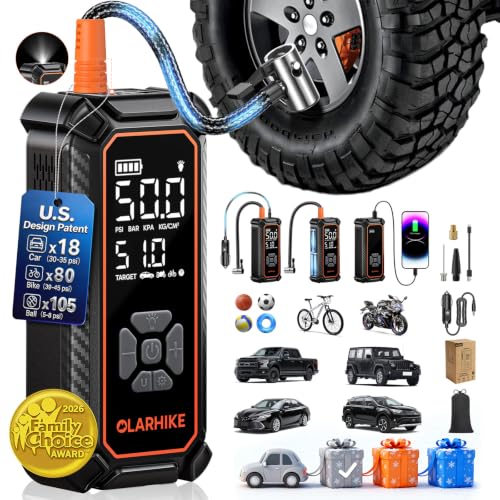
OlarHike Portable Tire Inflator Air Compressor
The OlarHike Portable Tire Inflator combines dual-power versatility via a 12V DC vehicle plug or built-in rechargeable battery with an automatic shut-off digital display. It provides dependable roadside tire top-offs and inflation for passenger cars, crossovers, motorcycles, and bicycles.
Pros
- Dual-power design allows cordless field operation or continuous power through any standard vehicle 12V DC port
- Automatic shut-off technology stops the motor precisely at preset pressure to prevent over-inflation
- Integrated 6000mAh battery reserve doubles as an emergency phone charger and includes an LED work light
- Pocket-sized footprint weighs well under two pounds for convenient transport in center consoles or backpacks
Cons
- Maximum vehicle pressure rating of 51 PSI is not suitable for heavy-duty commercial trucks, RVs, or high-pressure trailer tires
- Compact tankless inflator mechanism cannot power workshop pneumatic tools such as nail guns or air ratchets
- Recharging requires a standard 5V 2A or 5V 3A adapter and is not compatible with high-wattage fast chargers
FYPower 10-Piece Air Compressor Accessory Kit
Equipped with a 100 PSI tire inflator and heavy-duty blow gun, this brass and steel accessory kit covers routine tire maintenance and workshop cleanup. It suits DIYers and garage mechanics looking for reliable, corrosion-resistant air compressor attachments without unnecessary bulk.
Pros
- Corrosion-resistant brass and stainless steel construction
- Includes both tire inflator gauge and utility blow gun
- Versatile nozzle attachments for clearing debris and inflating
- Compatible with cars, SUVs, motorcycles, and bicycles
Cons
- 100 PSI gauge limit excludes high-pressure commercial tires
- Kit does not include an air hose
Hausse Heavy Duty Air Compressor Accessory Kit
This Hausse compressed air accessory kit pairs a 0-200 PSI digital tire inflator gauge with a durable metal blow gun and versatile 1/4-inch NPT fittings. It is a practical, value-focused setup for garage DIYers and homeowners handling tire maintenance, inflation tasks, and workshop dusting.
Pros
- Digital gauge displays pressure even when unhooked from the compressor for rapid walk-around tire checks
- Built-in pressure vent valve bleeds off excess tire pressure without needing to remove the air chuck
- Includes thread seal tape and AAA batteries to eliminate extra hardware trips during initial assembly
- Sturdy metal construction on both the primary inflator body and the utility air blow gun
Cons
- Does not include pre-installed quick-disconnect couplers (such as Industrial Type M), requiring users to supply their preferred plugs
- Blow gun features a standard nozzle configuration without stated OSHA safety pressure-relief venting
- Manufacturer specifications do not state a certified gauge calibration accuracy rating (such as ASME Grade B)
Airmoto 120 PSI Portable Tire Inflator
Weighing just 1.2 pounds, this compact cordless compressor delivers up to 120 PSI with automatic shutoff for routine top-offs on cars, bikes, and sports gear. Its pocket-sized form factor stores neatly in a glove box, serving as a convenient roadside backup.
Pros
- Extremely compact and lightweight design
- Auto shut-off prevents accidental over-inflation
- Clear digital LCD display with real-time pressure reading
- Integrated LED light aids night roadside repairs
- Internal hose storage keeps accessories organized
Cons
- Not suitable for heavy-load tires or large inflatables
- Cold temperatures and large tires drain battery quickly
- Requires frequent recharging before heavy usage
OlarHike 12000mAh Cordless Tire Inflator
The OlarHike Heavy Duty Tire Inflator is a compact 3.2-pound mobile air compressor featuring a twin-cylinder motor, integrated 12,000mAh battery, and 12V DC vehicle adapter. It provides rapid roadside inflation with auto-shutoff convenience, making it a dependable emergency tool for drivers, mechanics, and off-roaders.
Pros
- Twin-cylinder pump configuration delivers faster inflation times than typical single-piston mini inflators
- True dual-power flexibility prevents downtime by running via battery or vehicle 12V DC outlet
- Compact, lightweight 3.2-pound body offers exceptional portability without eating up cargo space
- 45W USB-C Power Delivery port provides practical utility beyond tire maintenance
- Auto-stop feature eliminates pressure guessing and prevents dangerous over-inflation
Cons
- Tankless mobile design is strictly intended for inflation and cannot operate continuous-draw pneumatic air tools
- Extended continuous runtime on large truck or RV tires will cause heat buildup that requires brief cool-down intervals
- Does not include a standard 120V AC household wall plug for direct residential outlet use
Spurtar 10-120 PSI Tire Inflator Gauge
Equipped with an extended dual-head chuck and chrome-plated iron stem, this bayonet-style inflator gauge handles pressures up to 120 PSI. It provides a durable, all-in-one inflation and pressure-checking solution for standard passenger vehicles and dual-wheel trucks.
Pros
- Reaches difficult inner valves on dually tires easily
- Durable chrome-plated steel stem resists wear
- Comes with extra valve cores and repair tools
- Calibrated to 2 percent accuracy standards
Cons
- Two-pound scale increments limit fine-tuning precision
- 120 PSI maximum range excludes higher-pressure commercial tires
- Requires connection to a separate air compressor
AstroAI L7 Cordless Tire Inflator Portable Air
The AstroAI L7 is a lightweight, handheld cordless air compressor delivering up to 150 PSI with an integrated 4000mAh rechargeable battery and precise auto-shutoff. It provides dependable, pocket-sized inflation performance for motorists, cyclists, and DIYers needing quick roadside tire top-offs.
Pros
- Weighs only 0.96 pounds for effortless storage in vehicle consoles, toolbags, or cycling packs
- High-speed digital sensor samples tire pressure at 200 times per second to prevent over-inflation
- Internal 4000mAh battery provides cordless freedom without tangling 12V cigarette lighter cords
- Versatile secondary utility as an emergency LED flashlight and portable USB power bank
Cons
- Not intended for heavy-duty truck tires or commercial tires larger than 25 inches in diameter
- Duty cycle requires allowing the unit to cool for 10 minutes after 15 minutes of continuous run time
- Tankless micro-compressor design cannot power workshop pneumatic air tools
Core Anatomy, Configurations, and Capabilities of a Tire Inflator Kit
A tire inflator kit is a self-contained collection of pneumatic components, connection hardware, and safety accessories structured to deliver regulated pressurized air directly into vehicle tires. Unlike bare workshop compressors that require separate hoses and couplers, a dedicated kit packages all required connection interfaces into a mobile format. Drivers utilize these assemblies for scheduled monthly tire maintenance, seasonal temperature adjustments, and unexpected roadside emergencies. Understanding the structural differences among available kit configurations ensures vehicle owners select equipment capable of handling specific vehicle tire volumes and pressure requirements.
The Fundamental Mechanical and Electrical Components
The operational core of any portable tire inflator kit is a compact reciprocating piston compressor powered by an electric motor. Inside the pump casing, a high-torque DC motor turns an eccentric crankshaft that drives a small piston within a finned cylinder head. Intake air enters through filtered ambient vents and compresses against a reed valve before exiting into the high-pressure discharge line. Direct-drive configurations eliminate complex gearboxes, providing dependable air volume while dissipating operational heat across aluminum cooling fins.
Connection hardware forms the pneumatic link between the compressor discharge port and the tire valve stem. Quality kits provide braided rubber or heat-resistant thermoplastic air hoses terminated with threaded brass Schrader fittings or quick-release thumb-lock chucks. Threaded brass connectors ensure a positive mechanical seal capable of withstanding pressures exceeding 100 PSI without slipping off the stem threads. Conversely, lever-activated quick-connect chucks speed up roadside attachment, allowing operators to clamp directly onto the valve with minimal air bleed during detachment.
Pressure monitoring systems provide the necessary data to prevent dangerous under-inflation or sidewall over-pressurization. Modern inflators incorporate digital pressure transducers that sample air line pressure hundreds of times each second, displaying real-time values on backlit LCD screens. These digital displays allow operators to toggle between multiple measurement units, including PSI, BAR, kPa, and kilograms per square centimeter. Analog kits rely on Bourdon tube dial gauges, offering mechanical reliability without requiring battery power for the display circuitry.
Auxiliary nozzle adapters expand the functional utility of the inflation kit across diverse household and recreational equipment. Standard accessory packs include tapered plastic nozzles for low-pressure inflatables, needle adapters for sports balls, and brass Presta adapters for high-pressure bicycle tires. Premium kits also integrate dedicated storage slots or zippered carry bags to keep these tiny adapters organized during trunk transit. Having the correct valve adapter readily accessible prevents valve core damage and eliminates air leakage during inflation cycles.
Distinguishing Standalone Inflators from Emergency Repair Kits
Consumer tire inflation kits generally divide into standalone air compressors and comprehensive emergency puncture repair systems. Standalone inflators focus entirely on air delivery, packing high-capacity motors, digital pressure management, and multi-power cords for routine pressure adjustments. These units excel at seasonal top-offs, bicycle servicing, and garage maintenance where mechanical tire damage is absent. Drivers who already own separate tire plug tools often prefer standalone inflators for their compact size and straightforward operation.
Emergency repair kits combine a 12V air compressor with chemical tire sealant or physical rope plug insertion tools. Systems like the Slime Smart Spair supply liquid sealant formulated to coat the inner tread face and seal punctures up to one-quarter inch. Operators inject the sealant directly through the valve stem before running the compressor to distribute the compound and restore driving pressure. This temporary roadside fix requires no wheel removal or scissor jack deployment, allowing motorists to vacate dangerous highway shoulders within fifteen minutes.
Chemical tire sealants carry strict operational boundaries that every driver must respect to avoid tire carcass damage. Sealant formulas designed for passenger vehicles serve solely as temporary measures, requiring professional inspection within three days or one hundred miles of driving. Furthermore, modern water-based sealants feature non-toxic and non-corrosive chemical properties engineered to protect internal Tire Pressure Monitoring System sensors from chemical corrosion. Drivers operating tubeless off-road vehicles or lawn equipment often rely on heavy-duty rubber string plug kits, utilizing ergonomic T-handle reamers to mechanically seal tread breaches without liquid formulas.
Pneumatic Workshop Tool Kits Versus 12V Portable Inflators
A distinct category of tire inflator kit caters specifically to home garages equipped with stationary pneumatic air compressors. Kits like the Hausse and FYPower assemblies contain heavy-duty tire inflator guns, blow guns, and quick-connect brass couplers rather than standalone motorized pumps. These tools feature standard one-quarter inch NPT industrial fittings that plug directly into air lines driven by high-capacity compressor tanks. They deliver immense airflow volumes, raising tire pressure in seconds rather than the several minutes required by compact 12V motors.
Workshop inflator handles integrate cast-metal pistol triggers that offer both inflation and controlled air deflation through built-in vent valves. A mechanical bayonet gauge or digital pressure module mounted directly above the handle displays line pressure while the operator depresses the trigger. Reviewing the procedures for connecting an inflator to a compressor clarifies how proper thread sealant tape and quick-release couplers prevent air leaks across pneumatic garage systems. Built-in pressure relief valves allow mechanics to dump excess air instantly if they accidentally overshoot placard specifications.
While workshop kits deliver unbeatable speed and durability, their reliance on external air tanks eliminates roadside mobility. Motorists cannot use pneumatic shop accessories during highway breakdowns unless they carry a charged portable air tank in their cargo area. Portable 12V DC and battery-operated pumps sacrifice massive airflow volume in exchange for self-contained, go-anywhere functionality. Consequently, serious automotive enthusiasts frequently maintain a pneumatic accessory kit for the garage and a compact electric inflator kit in the vehicle trunk.
Power Architecture: 12V DC Plugs, Lithium Batteries, and Dual Power
Power delivery determines where, when, and how long a portable tire inflator can operate before requiring replenishment. Traditional 12V DC portable compressors plug directly into the vehicle cigarette lighter or auxiliary power socket via long power cords. These units draw continuous electrical current from the vehicle electrical system, eliminating concerns about dead internal batteries during freezing winters. However, operators must keep the vehicle engine idling during inflation to prevent starter battery depletion and maintain stable 13.8V alternator output.
Rechargeable lithium-ion inflators provide complete cordless freedom, allowing drivers to inflate tires without routing ten-foot cables through car doors. Units equipped with internal battery packs, such as 4000mAh to 6000mAh cells found in CRAFTSMAN and AstroAI designs, top off multiple passenger car tires on a single charge. Exploring modern cordless tire inflator options highlights how USB-C charging inputs and integrated mobile power bank ports add valuable emergency utility during travel. Despite their convenience, cordless units require disciplined recharging routines to ensure they retain sufficient charge when unexpected emergencies strike.
Dual-power hybrid inflators combine internal rechargeable batteries with a backup 12V DC vehicle adapter cable to deliver uninterrupted reliability. Systems like the OlarHike dual-power compressors run wirelessly for rapid pre-trip adjustments, yet instantly switch to corded auxiliary power if the battery level drops. This dual-source architecture eliminates range anxiety when addressing multiple low tires on larger SUVs or light pickups. The 12V cord serves as a permanent failsafe, guaranteeing inflation capability even after months of vehicle storage.
Duty Cycle Limitations, Airflow Ratings, and Thermal Saturation
Compressor duty cycle represents the ratio of continuous operating time to required resting time, expressed in minutes or percentages. Most compact 12V and cordless tire inflators carry a continuous operating rating between ten and fifteen minutes before requiring ten minutes of cooling. The physical process of compressing ambient air generates substantial thermal energy inside the piston chamber and cylinder sleeve. Ignoring these cooling intervals causes thermal saturation, degrading Teflon piston ring seals and triggering internal thermal overload switches.
Airflow throughput directly dictates how rapidly an inflator kit restores pressure across different tire volume classes. Manufacturer benchmarks show that compact pumps can raise a standard 195/65R15 passenger car tire by five PSI in roughly forty-five to fifty-five seconds. However, inflating a large 235/65R17 SUV tire across the same pressure delta demands over two minutes of continuous pumping. Attempting to fill high-volume light truck tires from zero PSI requires multiple duty cycles to avoid motor burnout, making high-torque twin-cylinder models preferable for heavy vehicles.
Thermal overload protection circuits act as vital safety barriers, cutting motor power automatically when internal temperatures exceed safe thresholds. When thermal protection trips, operators must allow the aluminum housing and cylinder head to dissipate heat before restarting the pump. Attempting to bypass thermal pauses or forcing immediate restarts risks melting internal brush assemblies and blowing the 12V auxiliary plug fuse. Allowing adequate cool-down pauses preserves motor winding insulation and maintains consistent compression performance across the lifespan of the tool.
Digital Gauge Precision, Auto-Shutoff Logic, and Pressure Verification
Digital pressure sensors have transformed portable tire inflation by replacing ambiguous analog needles with exact numeric targets. Modern microprocessors sample pressure data up to two hundred times per second, dynamically filtering out the hydraulic pulsation waves generated by the reciprocating piston. This high sampling rate ensures that the pressure reading on the display reflects true tire internal pressure rather than artificial backpressure spikes. Accurate digital monitoring eliminates guess work and helps drivers maintain balanced tire pressures across all four wheel positions.
Automatic shut-off functionality allows operators to preset target pressure values before starting the compressor motor. Once the digital sensor detects that the preset threshold has been reached, the controller cuts power to the motor instantly to prevent over-inflation. This hands-free feature protects tire sidewalls from structural stress and allows the user to monitor surroundings rather than hovering over the valve stem. Operators must always base preset targets on the vehicle door-jamb placard cold inflation specification rather than the maximum pressure stamped on the tire sidewall.
Static resting pressure verification represents the critical final step in every tire inflation procedure. While active, air flowing through the flexible rubber hose creates line friction that can slightly skew active digital gauge readouts. Once the compressor motor stops, internal hose pressure stabilizes, revealing the genuine static pressure contained inside the tire chamber. Operators should observe the resting digital readout or cross-check the valve with an independent calibrated tire gauge to confirm perfect placard compliance before replacing the valve stem cap.
Operational Safety, Fuse Protection, and Trunk Storage Habits
Operating a 12V portable inflator requires strict adherence to automotive electrical safety practices. Vehicle auxiliary 12V sockets typically utilize ten-ampere or fifteen-ampere fuses that can blow if a compressor draws excessive inrush current upon startup. To prevent blown vehicle fuses, operators should connect the 12V plug securely into the socket and start the compressor motor before latching the air chuck onto the tire valve. This technique allows the electric motor to gain rotational momentum before confronting thirty or forty pounds of standing tire backpressure.
Roadside emergencies introduce severe personal safety hazards that demand proper positioning and equipment deployment. Drivers forced to service a flat tire along highway shoulders must steer well clear of active traffic lanes, engage hazard flashers, and set the parking brake. Many modern inflator kits feature built-in multi-mode LED work lights, offering steady floodlights, emergency strobe modes, and red SOS flashing beacons. These illumination tools provide essential visibility on dark roads, warning oncoming motorists while allowing the driver to inspect tread damage safely.
Environmental conditions inside vehicle cabins and trunks exert strong effects on tire inflator reliability over time. Lithium-ion battery packs suffer accelerated self-discharge in freezing winter temperatures and risk thermal degradation when stored in sun-baked trunks exceeding one hundred degrees Fahrenheit. Storing cordless inflators inside insulated glove compartments or bringing them indoors for seasonal top-off charges preserves battery chemistry and ensures instant readiness. For extreme climates, dedicated 12V corded units or dual-power inflators stored alongside heavy-duty tire plug strings offer unmatched long-term resilience.
A complete tire inflator kit bridges the gap between everyday automotive maintenance and critical roadside survival. Investing in a quality setup tailored to vehicle tire dimensions eliminates dependence on unpredictable service station air hoses while safeguarding tire longevity. By understanding component capabilities, adhering strictly to cold placard pressure ratings, and observing compressor duty cycles, drivers ensure reliable tire performance on every journey.
About the author
Kenny Koehler is a power-tool specialist with more than a decade of hands-on evaluation experience and a science-based approach to product testing. His expertise in repeatable testing, tool performance, impact wrenches, and professional equipment brings a practical, data-focused perspective to compressor and pneumatic-tool comparisons.