
Which Air Compressor Do I Need: Practical Sizing and Selection Guide for 2026
Determine which air compressor do i need for pneumatic tools, workshop tasks, and tire inflation with this guide updated for October 2026.
 By Bob Beacham
Updated October 8, 2026
By Bob Beacham
Updated October 8, 2026

Air tools that suddenly lose torque or stall during a project usually point to a severe mismatch between tool consumption and compressor delivery. Deciding which air compressor do i need starts with understanding how volume and pressure interact under sustained load. A compact pancake compressor easily drives an intermittent finish nailer, but running continuous rotary sanders or automotive paint sprayers requires substantially higher volume. Clarifying your primary pneumatic tools and working environment prevents frustrating pressure drops and frequent motor cycling.
Electrical circuit limits and workshop noise tolerances also dictate the ideal setup. Powerful motors can draw high startup amps that trip standard household breakers, while loud pump assemblies quickly overwhelm an enclosed basement or residential garage. Low-RPM oil-free dual-piston designs now deliver quiet operation at manageable electrical draws, making them practical for indoor woodshops and home garages. Evaluating tank capacity, delivered airflow at 90 PSI, and duty cycle limits ensures you select a dependable machine tailored to your actual workload.
| Award | Product | ACR Score About ACR ScoreThe ACR Score is our own rating from 0 to 10, based on performance, design and build, ease of use, and value. It reflects independent research and is never influenced by manufacturers, retailers, or affiliate commissions. Learn more › | |
|---|---|---|---|
| Best Overall |
California Air Tools 2010A 1.0 HP Ultra Quiet
|
9.1/10 | Buy |
| Best Value |
 GX PUMP PCP Air Compressor CS1-I with Built-in
|
9.1/10 | Buy |
| Best Premium |
 California Air Tools CAT-4610S Ultra Quiet
|
9.1/10 | Buy |
| Best Budget |
 MZB 13.2 Gallon Ultra Quiet Air Compressor 115PSI
|
8.8/10 | Buy |
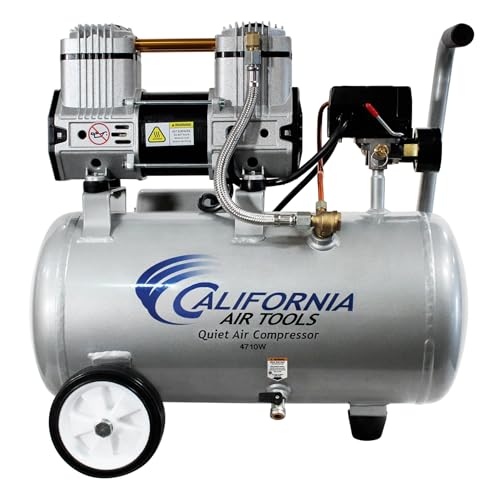 California Air Tools CAT-4710W 1.0 HP Quiet
|
8.3/10 | Buy | |
 BUNKER INDUST 12V Air Compressor
|
8.0/10 | Buy | |
 California Air Tools 20020 2.0 HP Ultra Quiet
|
7.8/10 | Buy |
Matching Air Compressor Capabilities to Your Real-World Needs
Selecting the right air compressor depends on the specific tools you operate, your workspace limits, and the volume of air needed to sustain your workflow. Compressors do not produce infinite airflow on demand; they generate pressurized air and store it inside a tank reserve. Balancing air delivery, tank capacity, circuit limits, and pump design allows you to match equipment precisely to your tasks. A methodical look at pneumatic systems removes guesswork before you invest in workshop equipment.
Air Volume and Pressure: CFM at 90 PSI Versus Maximum PSI
Pneumatic tools rely on pressure, measured in pounds per square inch (PSI), and air delivery volume, measured in cubic feet per minute (CFM). While maximum PSI ratings are prominent on marketing labels, air volume delivery at specific working pressures is the true indicator of tool performance. Most pneumatic equipment operates between 70 and 90 PSI, which is why compressors are evaluated by their delivered CFM at 90 PSI. A compressor with 120 or 150 PSI maximum pressure can still stall tools if its pump delivers insufficient volume under active load.
Different pneumatic tools impose vastly different demands on a compressor pump. Fastening tools like brad nailers and finish staplers operate intermittently by consuming a brief burst of air per shot. Because these intermittent tools typically require between 0.5 and 2.5 CFM at 90 PSI, compact compressors run them without noticeable pressure drops. Continuous air tools like orbital sanders, die grinders, and paint sprayers consume large, uninterrupted air streams. Attempting to power a continuous tool rated at 6 to 10 CFM with an entry-level pump quickly exhausts the tank and stalls the tool.
Calculating required airflow starts with identifying your most demanding air tool. Take the tool manufacturer CFM rating and multiply it by a safety margin of 1.25 to 1.5. This buffer prevents the pump from running continuously at maximum capacity, reducing thermal stress and wear. If you plan to operate multiple tools simultaneously, combine their individual air requirements to establish your baseline volume requirement.
Tank Capacity and Air Storage: Buffer Volume Versus Pump Recovery
Air storage tanks serve as pressurized reservoirs that provide a buffer between tools and the compressor pump. When a tool demands more air volume than the pump produces in real time, the tank bridges the deficit until the pressure switch triggers the motor. Compact vessels, such as 2-gallon or 4.6-gallon tanks found on portable units like the California Air Tools 2010A and CAT-4610S, excel at trim work and tire maintenance. These smaller tanks maintain a portable footprint, though their limited air buffer means the pump cycles frequently during extended use.
Larger storage reservoirs become necessary when operating continuous tools or high-torque pneumatic equipment. Compressors equipped with 13.2-gallon or 20-gallon tanks, such as the MZB 13.2 Gallon Ultra Quiet or the California Air Tools 20020, offer substantially greater air storage reserves. A larger air buffer allows tools like automotive impact wrenches and spray guns to complete tasks without rapid line pressure drops. While a large vessel cannot compensate indefinitely for an undersized pump, it provides the recovery margin needed to prevent constant motor cycling.
Tank cycle dynamics include initial fill time and cut-in recovery speed. The cut-in threshold marks the lower pressure level where the switch activates the pump, while the cut-out threshold shuts the motor down once full tank pressure is restored. Units with rapid recovery times, such as dual-piston designs that regain operating pressure in under 15 to 20 seconds, keep operators working smoothly. Evaluating both tank capacity and pump recovery speed ensures the compressor maintains regulated line pressure throughout your workday.
Pump Architecture: Dual-Piston Oil-Free Motors Versus Splash Lubrication
The mechanical design of the compressor pump directly influences long-term durability, maintenance, and sound levels. Traditional jobsite compressors often feature single-cylinder oil-lubricated pumps or high-speed oil-free universal motors that spin at over 3,000 RPM. These older designs generate substantial friction, noticeable vibration, and harsh high-frequency noise. In contrast, modern prosumer compressors utilize dual-piston oil-free systems powered by low-RPM induction motors. These dual-piston assemblies operate at approximately 1,680 RPM, distributing mechanical load across two opposing cylinders to minimize wear and operating heat.
Oil-free dual-piston pumps offer practical advantages for home workshops, finish carpentry, and paint applications. Because the pump uses self-lubricating Teflon or PTFE cylinder sleeves, it requires zero oil checks and will not discharge oil mist into your air hose. This clean air delivery protects sensitive wood finishes, spray projects, and pneumatic tool seals from hydrocarbon contamination. In addition, oil-free designs start reliably in cold temperatures without the sluggish resistance caused by thickened motor oil.
Duty cycle ratings represent another critical distinction between pump designs. Duty cycle indicates the percentage of time a compressor can actively compress air within a ten-minute window without overheating, with standard ratings ranging from 50 to 70 percent. While dual-piston oil-free pumps are engineered for thousands of operating hours under intermittent workloads, they still require adequate cooling intervals between compression cycles. Splash-lubricated cast-iron pumps remain common in heavy industrial environments where continuous duty cycles are mandatory, but modern low-RPM oil-free systems satisfy most garage requirements.
Operational Noise Management: Decibel Ratings in Enclosed Workspaces
Excessive operating noise remains a frequent complaint among air compressor owners working in residential settings. Traditional direct-drive portable compressors typically produce noise levels between 80 and 90 decibels (dBA), which rivals the roar of a gas lawnmower. In an enclosed garage, basement workshop, or customer living area, that intense sound creates immediate communication barriers and ear fatigue. The logarithmic nature of the decibel scale means that an increase of 10 dBA represents a perceived doubling of loudness, making sound ratings a paramount consideration for indoor use.
Ultra-quiet air compressors engineered around low-RPM motors have transformed indoor pneumatic power options. Units such as the California Air Tools 2010A and CAT-4610S operate at a quiet 60 dBA, while larger models like the MZB 13.2 Gallon and California Air Tools 20020 operate around 70 dBA. At 60 dBA, the sound output is comparable to a normal conversation, allowing you to operate tools without disturbing family members or neighbors. Even at 70 to 75 dBA, these machines operate noticeably quieter than conventional contractor units, eliminating the harsh screech associated with high-speed universal motors.
Selecting an ultra-quiet model eliminates the need to isolate the compressor in an exterior shed or construct cumbersome acoustic sound baffles. Operating the machine directly adjacent to your workbench simplifies pressure adjustments and allows for short hose runs, which reduces pressure drops along the line. For woodworkers, finish carpenters, and automotive hobbyists working in residential zones, low decibel ratings provide a dramatically more comfortable working environment.
Electrical Compatibility: Motor Horsepower, Amperage Draw, and Circuit Limits
Matching compressor electrical requirements to your workshop wiring is essential for preventing nuisance breaker trips. Electric air compressors draw a surge of startup inrush current when the motor first spins up against internal cylinder head pressure. If that inrush current exceeds the rating of the branch circuit, the breaker trips immediately. Standard residential circuits supply 120 volts on either 15-amp or 20-amp breakers, often shared with lighting or other workshop appliances. Carefully examining motor running amperage ratings helps ensure trouble-free starts every time the pressure switch calls for air.
Low-amp draw motors offer significant installation flexibility across standard household outlets. Models like the California Air Tools CAT-4710W draw only 7.5 amps, while the CAT-4610S draws 8.5 amps, making them well-suited for standard 15-amp household circuits or portable generators. Larger 2.0 HP compressors, such as the California Air Tools 20020, require approximately 14 amps of running current. A 14-amp motor demands a dedicated 15-amp or preferably 20-amp circuit to accommodate startup current spikes without interrupting other electrical devices in your garage.
Extension cords represent a common source of electrical failure when powering heavy pneumatic equipment. Using an undersized 16-gauge or 14-gauge extension cord causes severe voltage drop, which starves the electric motor of power, overheats the windings, and trips thermal overload protection switches. To avoid motor damage, manufacturers strongly recommend plugging the compressor directly into a grounded wall receptacle. If you require extended reach across a garage or jobsite, run a longer 50-foot or 100-foot air hose rather than extending your electrical power cord.
Specialized Pneumatic Systems: High-Pressure Air and 12V Mobile Inflation
Standard workshop compressors operating up to 125 or 150 PSI cannot satisfy every high-pressure or mobile pneumatic requirement. Enthusiasts operating pre-charged pneumatic (PCP) air rifles, paintball markers, or small air tanks require extreme pressure levels up to 4,500 PSI (300 bar). Standard shop compressors are mechanically incapable of generating such intense pressures. Dedicated high-pressure compressors, such as the GX PUMP CS1-I, feature multi-stage compression systems, integrated cooling fans, auto-shutoff sensors, and built-in power transformers that operate on 12V vehicle batteries or standard wall outlets.
Mobile automotive and off-road applications demand a different specialized approach focused on high volume and direct current portability. Heavy-duty 12-volt air pumps, such as the BUNKER INDUST 12V dual-cylinder compressor, deliver massive airflow rates up to 12.36 CFM specifically tailored for rapid tire inflation. These compact inflators connect directly to vehicle batteries via high-current Anderson-style plugs, allowing drivers to air down for rough terrain and quickly reinflate large 4WD tires on the trail. Their digital LCD control panels and automatic shutoff features provide precise pressure management without requiring a bulky storage tank.
Understanding these specialized equipment categories prevents costly purchasing mistakes. Attempting to use a standard shop compressor to fill a 4,500 PSI PCP air rifle cylinder is physically impossible and hazardous. Similarly, relying on a bulky workshop compressor for roadside trail maintenance is impractical compared to a dedicated 12V direct-drive inflator. Clarifying whether your task demands standard regulated shop air, extreme high-pressure charging, or mobile off-road tire inflation immediately narrows your equipment focus.
Portability, Form Factor, and Moisture Drainage Maintenance
Portability requirements vary drastically between stationary garage setups and mobile jobsite applications. Hand-carry units like the California Air Tools 2010A weigh approximately 35 pounds and feature compact aluminum or steel frames that fit easily into a vehicle trunk. Mid-sized units equipped with rugged wheels and pull handles, such as the CAT-4710W at 35 pounds or the MZB 13.2-gallon model, roll smoothly across rough shop floors and outdoor terrain. Large 20-gallon stationary units weigh over 110 pounds, sacrificing vehicle portability in exchange for stationary air storage capacity and high continuous delivery.
Air tank maintenance is another critical operational factor that directly impacts equipment longevity and safety. As ambient air is compressed, atmospheric moisture condenses and pools at the bottom of the steel or aluminum storage vessel. If left undrained, this accumulated water causes internal tank corrosion, reduces usable storage volume, and travels downstream into delicate air tools. Regular maintenance requires opening the drain valve at the base of the tank at the conclusion of every working session to purge accumulated moisture under low residual pressure.
Drain valve design significantly affects how easily you can maintain your storage vessel. Many traditional compressors incorporate recessed, threaded needle petcocks that prove stiff to turn and prone to seizing over time. Modern compressors increasingly utilize quarter-turn brass ball valves that allow quick, hassle-free purging with a simple flick of the lever. Keeping the tank clean and dry preserves tank wall integrity and guarantees clean, moisture-free airflow for sensitive pneumatic tools.
Step-by-Step Selection: How to Determine Your Ideal Setup
Determining your ideal compressor setup involves a structured four-step assessment of your planned projects. First, audit your pneumatic tools and identify the single highest CFM requirement at 90 PSI. If your primary tasks involve brad nailing, finish carpentry, or tire maintenance, a compact 1.0 HP compressor delivering 2.2 CFM provides ample volume. If your plans include automotive impact wrenches, rotary sanders, or small paint sprayers, prioritize units delivering 5.0 CFM or higher paired with a 13-gallon to 20-gallon tank reservoir.
Second, evaluate your workspace acoustics and electrical infrastructure. If you work in an attached garage, basement, or shared apartment space, selecting an ultra-quiet pump operating between 60 and 70 dBA protects hearing and prevents disturbances. Verify your electrical circuit capacity, choosing a low-draw 7.5-amp to 8.5-amp motor for shared 15-amp household outlets, or reserving a dedicated circuit for larger 2.0 HP machines. Third, consider your transport frequency, deciding whether a lightweight hand-carry tank or a wheeled vertical unit best supports your workflow.
Finally, always confirm safety features, including ASME pressure relief valves, thermal overload resets, and easily accessible regulator controls. Aligning your pneumatic tool demands with confirmed CFM output, appropriate tank buffers, manageable electrical requirements, and comfortable noise thresholds ensures dependable performance across all your workshop projects.
About the author
Bob Beacham is an experienced tools and workshop writer with deep knowledge of power equipment, mechanical systems, and practical DIY applications. His coverage of air compressors, welding equipment, saws, and workshop tools helps translate technical specifications into useful guidance for homeowners and serious DIYers.