
What Size Air Compressor to Run Air Tools: Practical Guide for 2026
Learn what size air compressor to run air tools with our CFM and tank capacity guide for October 2026, matching pressure to your workshop tools.
 By Tom Scalisi
Updated October 8, 2026
By Tom Scalisi
Updated October 8, 2026
Pneumatic equipment requires a dependable source of pressurized air, but pairing an ambitious tool with an undersized power unit inevitably leads to stalled motors, sputtering finishes, and frustrating workflow delays. Determining what size air compressor to run air tools requires looking beyond basic tank capacity and focusing on continuous volume delivery. When an air tool consumes more volume than the pump mechanism generates, line pressure collapses rapidly and forces you to pause mid-task while the pump struggles to catch up. Planning your equipment setup around sustained airflow rather than peak marketing numbers prevents workflow bottlenecks and protects delicate pneumatic motor components from premature wear.
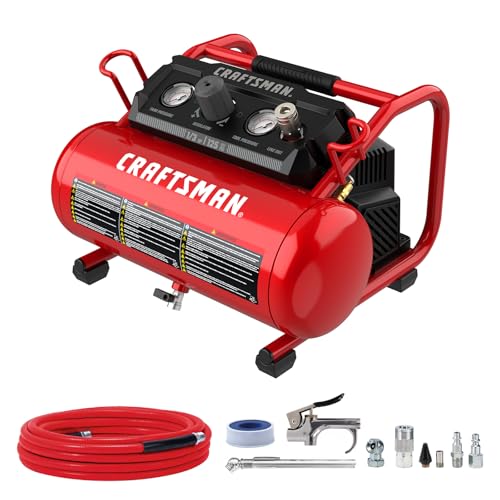
Every pneumatic device operates within specific pressure thresholds and air consumption rates, ranging from light-duty blow guns and brad nailers to air-hungry orbital sanders and impact wrenches. Small portable units, such as a compact oil-free CRAFTSMAN Air Compressor with a two-gallon tank, excel at intermittent tasks like tire inflation, dust removal, and finish fastening. However, heavier workshop jobs require significantly larger air reserves and higher continuous displacement to maintain consistent operating pressure. If you are setting up a dedicated workspace, reviewing home garage air compressor sizing principles helps balance electrical circuit limitations with your anticipated pneumatic workload. Understanding how delivery volume, maximum working pressure, and storage capacity interact ensures your workshop equipment runs smoothly without tripping household electrical breakers.
| Award | Product | ACR Score About ACR ScoreThe ACR Score is our own rating from 0 to 10, based on performance, design and build, ease of use, and value. It reflects independent research and is never influenced by manufacturers, retailers, or affiliate commissions. Learn more › | |
|---|---|---|---|
| Best Overall |
CRAFTSMAN Air Compressor
|
9.1/10 | Buy |
| Best Premium |
 160 PSI Tire Inflator Portable Air Compressor
|
8.9/10 | Buy |
 CRAFTSMAN Tire Inflator Portable Air Compressor
|
8.9/10 | Buy | |
| Best Budget |
 13 Pcs 2-Way Connection Air Nozzle Blow Gun Set
|
8.8/10 | Buy |
 4PCS Air Nozzle Blow Gun Kit for Compressor
|
8.6/10 | Buy | |
| Best Value |
 FYPower 18 Pieces Air Compressor Accessories Kit
|
8.6/10 | Buy |
 WYNNsky Air Compressor Kit
|
8.3/10 | Buy | |
 LUMITECO 2-Pack Ball Foot Air Chuck Set
|
8.1/10 | Buy | |
 SARDVISA 20 Pcs Air Compressor Tool Kit
|
8.1/10 | Buy | |
 WYNNsky Air blow Gun Kit
|
8.0/10 | Buy |
How to Determine the Right Air Compressor Size for Pneumatic Tools
Selecting the correct compressor size requires evaluating the specific pneumatic tools you plan to operate, rather than guessing based on tank gallon capacity alone. Air tools rely on a combination of air delivery volume, measured in cubic feet per minute, and operating pressure, measured in pounds per square inch. When you mismatch the compressor pump to the pneumatic demand, the tool starves for air, loses torque or speed, and forces the motor into continuous cycling. By analyzing how volume consumption, pressure drops, storage reserves, and duty cycles interact, you can configure an air delivery system that reliably supports your workshop or jobsite workflow.
Understanding CFM Delivery Versus Tank Volume
Many buyers assume that a larger air tank automatically guarantees more power for air tools, but tank capacity represents only stored air volume rather than active production. True air delivery is determined by the compressor pump output, specifically rated as standard cubic feet per minute at ninety pounds per square inch. This rating describes the volume of compressed air the pump can continuously deliver to your air lines under working load. If your pneumatic tool demands more volume than the pump produces, you will quickly drain the storage tank regardless of its overall physical size.
The storage tank serves as an essential buffer that absorbs temporary demand spikes and allows the motor to rest between compression cycles. A two-gallon portable tank, like that on the CRAFTSMAN Air Compressor, provides sufficient buffer volume for brief bursts of air, but the pump displacement dictates how quickly the tank recovers. When running continuous pneumatic equipment, the pump must replace air as quickly as the tool consumes it to avoid severe pressure drops. Therefore, matching tool consumption to delivered volume at your target working pressure remains the single most critical sizing calculation.
Intermittent Fasteners Versus Continuous Air Consumption Tools
Pneumatic tools fall into two distinct operational categories: intermittent-demand tools and continuous-demand tools. Intermittent tools include brad nailers, finish nailers, framing guns, and staplers, which consume compressed air in short, isolated bursts with each actuation. A standard finish nailer typically requires less than one cubic foot per minute at ninety pounds per square inch because the tool rests between consecutive fasteners. Because of this low average consumption, even small portable compressors with two to six gallons of storage can support finish carpentry and light construction without stalling.
Continuous-demand tools, on the other hand, draw a steady stream of compressed air for extended periods during operation. Equipment such as dual-action orbital sanders, die grinders, needle scalers, and paint spray guns require continuous airflow between four and fifteen cubic feet per minute. When you attempt to run a rotary sander on a compact two-gallon compressor, the tool exhausts the stored air reserve within seconds, causing motor stall and erratic speed. For automotive technicians matching equipment to heavy torque requirements, detailed guidance on air compressor sizing for impact tools highlights how burst torque applications differ significantly from sustained grinding or surface preparation.
Operating Pressure Thresholds and Dynamic Line Pressure Drops
Every pneumatic tool is designed to operate within a specific working pressure range, most commonly between seventy and one hundred pounds per square inch. While portable compressors frequently boast maximum tank pressures between one hundred twenty-five and one hundred sixty pounds per square inch, tool performance depends strictly on regulated output pressure. The internal regulator steps down the higher tank storage pressure to deliver a stable, uniform airflow to your pneumatic whip line. If the regulated pressure falls below the tool operating threshold, mechanical efficiency collapses and fastener driving depth becomes erratic.
Dynamic line pressure drop occurs whenever compressed air travels through restrictive fittings, narrow hoses, and dirty manifold couplers. As air rushes through a coiled twenty-five-foot nylon hose or a standard quick-connect coupler, friction against the internal tubing walls reduces the effective pressure reaching the tool inlet. A gauge reading ninety pounds per square inch at the compressor manifold might drop to seventy pounds per square inch at the tool during active trigger depression. Maintaining a healthy pressure differential between the tank cut-in switch and your regulated tool pressure helps buffer against these sudden dynamic losses.
The Rule of One Point Two Five for Air Volume Calculations
A dependable industry guideline for sizing an air compressor is the rule of one point two five, which adds a safety margin to calculated tool demand. To apply this formula, identify the highest volume requirement among the air tools you plan to operate simultaneously, then multiply that rating by one point two five. For example, if a medium-duty pneumatic impact wrench consumes four cubic feet per minute at ninety pounds per square inch, your compressor should deliver at least five cubic feet per minute at that pressure. This twenty-five percent safety margin accounts for pump wear over time, minor fitting leaks, and elevated ambient temperatures.
Sizing a compressor without this overhead margin forces the mechanical pump to operate at its absolute limit, increasing internal heat and accelerating component wear. When pump output exactly equals tool consumption, the compressor runs without stopping to meet baseline demand, leaving zero margin for error. Adding a safety buffer also provides flexibility for operating multiple smaller accessories, such as a SARDVISA air blow gun kit or tire chuck, without interrupting other pneumatic tasks. Selecting an air delivery rate that comfortably exceeds your peak tool consumption ensures predictable performance across diverse workshop applications.
Evaluating Air Tank Capacity and Recovery Cycle Times
Tank capacity, measured in gallons, dictates how much pressurized air reserve sits immediately available before the compressor motor must activate. Small tanks ranging from one to three gallons, common among compact units like the CRAFTSMAN 2 Gallon model, prioritize lightweight mobility and swift initial pressurization. These compact reservoirs work exceptionally well for inflating vehicle tires, clearing dust with blow gun nozzles, and driving occasional brad nails. However, because small tanks store limited physical volume, running continuous tools causes rapid pressure drops that trigger frequent motor restarts.
Larger storage tanks ranging from twenty to sixty gallons act as substantial energy accumulators for demanding commercial and garage environments. A thirty-gallon vertical tank stores ample compressed air to smooth out intermittent heavy draws, allowing tools to maintain peak torque even if the pump takes time to cycle on. Furthermore, greater tank volume extends recovery cycle intervals, which protects electric motors from the mechanical and electrical strain of rapid on-off cycling. When balancing space constraints and tool demands, reviewing detailed resources on selecting the right air compressor clarifies when large stationary tanks justify their larger workshop footprint.
Single-Stage Versus Two-Stage Compression Mechanics
Compressor pump architecture directly influences maximum storage pressure, airflow efficiency, and thermal management during extended operation. Single-stage compressors draw atmospheric air into one or more cylinders and compress it directly into the storage tank in a single stroke. These systems typically generate maximum operating pressures between one hundred twenty and one hundred fifty pounds per square inch, which satisfies most residential and light-duty contractor needs. Because single-stage pumps generate significant heat at higher compression ratios, their continuous volume delivery tends to taper off above ninety pounds per square inch.
Two-stage air compressors utilize a specialized two-cylinder setup where air is compressed in a large low-pressure cylinder before passing through an intercooler to a smaller high-pressure cylinder. This stepped compression method allows two-stage units to achieve working pressures of one hundred seventy-five pounds per square inch or higher with superior thermodynamic efficiency. Storing air at higher pressure effectively doubles the usable air volume stored within an identical tank size compared to a lower-pressure single-stage system. Commercial workshops operating multiple heavy tools simultaneously rely heavily on two-stage pumps to maintain adequate volume reserves throughout full working shifts.
Motor Horsepower Ratings and Electrical Circuit Limitations
Understanding motor horsepower ratings helps buyers distinguish realistic mechanical capability from exaggerated marketing figures. Advertised peak horsepower often reflects theoretical surge power that the motor draws for a fraction of a second during locked-rotor startup, rather than continuous running power. True continuous running horsepower directly limits how much air volume a pump can compress without overloading the electrical supply. A realistic one-horsepower continuous electric motor on a standard one hundred twenty-volt line produces approximately three to four cubic feet per minute at ninety pounds per square inch.
Electrical circuit limitations establish a hard physical boundary for portable workshop air compressors connected to standard household outlets. A typical fifteen-amp residential branch circuit can safely support electric motors drawing up to twelve continuous running amps without tripping breakers. Compressors requiring more than two running horsepower typically necessitate a dedicated twenty-amp one hundred twenty-volt circuit or a two hundred forty-volt workshop connection. Operating a powerful compressor on an undersized circuit or through a light-gauge extension cord causes severe voltage drops, motor hum, and frequent breaker trips.
Hose Diameter, Manifold Couplers, and Airflow Restrictions
Even an appropriately sized compressor cannot deliver adequate airflow to pneumatic tools if the distribution lines introduce severe physical restrictions. Standard accessory kits, including the FYPower 18 Pieces Air Compressor Accessories Kit and WYNNsky kits, rely on standard one-quarter-inch NPT couplers and quarter-inch recoil hoses. While quarter-inch hoses work seamlessly for tire inflation gauges, air blow guns, and light finish nailers, they restrict flow rates on high-demand pneumatic tools. For tools consuming more than five cubic feet per minute, transitioning to a three-eighths-inch inner diameter hose reduces line friction dramatically.
Quick-connect fittings and ball foot tire chucks also represent points of significant restriction when air passes through tiny internal orifices. Closed-flow chucks, like the LUMITECO 2-Pack Ball Foot Air Chuck Set, incorporate built-in shut-off valves that seal air until engaged with a valve stem, holding pressures up to three hundred pounds per square inch safely. Installing high-flow industrial couplers across your air manifold and tool inlets allows your compressor to deliver its rated volume without artificial throttling. Sealing all threaded NPT pipe connections with PTFE thread tape ensures zero air leaks, preserving valuable compressor pressure and motor runtime.
Pump Lubrication Design, Duty Cycles, and Moisture Management
Choosing between oil-free and oil-lubricated compressor pumps impacts maintenance schedules, noise characteristics, and pump longevity. Oil-free pumps feature Teflon-coated piston rings and sealed bearings, eliminating the need for oil changes and preventing oil vapor contamination in air lines. These low-maintenance pumps excel in portable applications and cold-weather environments where thick crankcase oil might cause hard starting. However, oil-free designs typically feature lower continuous duty cycle ratings, often around fifty percent, requiring equal run and rest intervals to dissipate heat.
Oil-lubricated cast-iron pumps provide superior heat dissipation and longer operational lifespans under rigorous high-duty-cycle workloads. Splash lubrication protects internal cylinders and wrist pins during continuous runs, making oil-lubricated pumps standard for automotive paint bays and mechanical garages. Regardless of pump design, compressing atmospheric air causes moisture condensation to accumulate rapidly at the bottom of the steel storage tank. Purging accumulated water daily through the tank drain valve prevents internal tank corrosion, extends cylinder life, and keeps rust particles from damaging sensitive pneumatic tool seals.
Matching Specific Air Tools to Recommended Compressor Sizes
To establish the right compressor size for your projects, compare the specific pneumatic tools in your collection against practical volume and tank guidelines. Light-duty applications such as tire chucks, sports ball inflation needles, and dust blow guns require minimal volume, operating reliably on two- to six-gallon compressors producing under two cubic feet per minute. Fastening tools like brad nailers, finish nailers, and framing guns perform smoothly on three- to six-gallon portable units delivering two to three cubic feet per minute. These portable setups offer outstanding mobility while keeping up with the rapid pace of framing and finish carpentry.
Demanding automotive equipment and surface preparation tools require a substantially larger equipment investment to ensure uninterrupted operation. Half-inch pneumatic impact wrenches, air ratchets, and reciprocating air saws generally require four to six cubic feet per minute at ninety pounds per square inch, paired with at least a twenty-gallon tank. Continuous-demand equipment, including dual-action sanders and HVLP sprayers, demands seven to twelve cubic feet per minute, requiring a sixty-gallon stationary compressor or two-stage pump. Matching your planned pneumatic workload against these volume categories ensures your air compressor delivers dependable performance across every project.
Key Takeaways for Selecting the Ideal Compressor Size
Selecting the ideal compressor size ultimately centers on identifying your highest continuous volume consumer and matching delivered airflow at working pressure. Always check the cubic feet per minute rating at ninety pounds per square inch on the tool manufacturer label before evaluating tank gallon capacity. Adding a twenty-five percent safety margin provides essential protection against line pressure drops and ensures your electric motor is not overworked. When you balance electrical circuit capacities with tool air demands and appropriate hose diameters, your pneumatic equipment operates at peak efficiency for years to come.
About the author
Tom Scalisi brings more than two decades of experience in construction, building maintenance, contracting, and hands-on tool use. His practical understanding of power tools, automotive work, repairs, and jobsite equipment helps readers evaluate compressors based on real workloads rather than specifications alone.