
What Size Air Compressor for Home Garage: Practical Workshop Guide for 2026
Learn what size air compressor for home garage tasks you need in November 2026, matching tank volume and CFM delivery to your pneumatic tools.
 By Tom Scalisi
Updated October 8, 2026


Air tools stalling midway through a project or line pressure plummeting during routine tire inflation often signals an underlying mismatch between workshop air demand and pump capacity. Selecting the right setup requires looking far beyond basic tank dimensions to evaluate delivered airflow, storage capacity, and electrical circuit thresholds. Deciding what size air compressor for home garage setups requires balancing intermittent tasks like tire maintenance against continuous pneumatic workflows. Careful sizing prevents frequent motor cycling, reduces heat buildup, and keeps your garage tools operating at peak performance without frustrating delays.
A compact handheld inflator easily handles automotive tires or sporting goods, but running impact wrenches, nailers, or paint sprayers demands significantly more airflow and rapid recovery. Understanding air compressor CFM delivery and circuit amperage ensures your compressor functions smoothly on a standard household outlet without tripping electrical breakers. If you want to evaluate tool air consumption before buying, reviewing our air compressor sizing for pneumatic tools helps establish realistic baseline requirements. Matching your workshop tank volume and pump horsepower to your specific pneumatic applications guarantees reliable operation and extends overall machine durability.
| Award | Product | ACR Score About ACR ScoreThe ACR Score is our own rating from 0 to 10, based on performance, design and build, ease of use, and value. It reflects independent research and is never influenced by manufacturers, retailers, or affiliate commissions. Learn more › | |
|---|---|---|---|
| Best Overall |
CRAFTSMAN 12V Portable Tire Inflator with
|
9.2/10 | Buy |
| Best Value |
 Slime 40045 120V Garage Tire Inflator |
9.2/10 | Buy |
 Baococo 4-Gallon 0.5 HP Air Compressor |
9.2/10 | Buy | |
| Best Premium |
 VEVOR 13-Gallon 2HP Quiet Air Compressor |
9.2/10 | Buy |
 CRAFTSMAN 2-Gallon Portable Air Compressor |
9.1/10 | Buy | |
 ECOMAX 6-Gallon 150 PSI Portable Pancake Air |
8.8/10 | Buy | |
 Klutch 20-Gallon Portable Air Compressor |
8.4/10 | Buy | |
| Best Budget |
 CARSUN Dual Power AC/DC Portable Tire Inflator |
8.3/10 | Buy |
 AstroAI Portable Tire Inflator Air Compressor |
8.1/10 | Buy | |
 CRAFTSMAN Dual Power Tire Inflator |
8.1/10 | Buy |
CRAFTSMAN 12V Portable Tire Inflator with
The CRAFTSMAN 12V Portable Tire Inflator is an ultra-compact 1.9-pound roadside unit delivering up to 150 PSI with digital auto shut-off and built-in cord storage. Powered via a standard 12V car accessory plug, it offers fast tire top-offs and dependable emergency inflation without crowding trunk space.
Pros
- Weighs only 1.9 pounds for effortless glove box, under-seat, or trunk storage during road trips
- Digital auto shut-off prevents accidental over-inflation without requiring constant manual gauge monitoring
- Bright three-mode LED light provides critical illumination during nighttime roadside emergencies
- Comes fully equipped with multi-valve adapters, a replacement fuse, and a tailored carry pouch
Cons
- Requires a 12V DC vehicle accessory socket and does not include a 120V AC household outlet adapter
- Compact tankless pump is built strictly for tire inflation and cannot drive pneumatic nailers or air tools
- The 2.17-foot air hose length means the compressor must sit on the ground adjacent to the wheel valve stem
Slime 40045 120V Garage Tire Inflator
Designed for home garages, the Slime 40045 mounts to the wall and plugs into standard 120V outlets to air up a typical tire in four minutes. It provides a dependable setup for inflating car tires, sports balls, and rafts without taking up floor space.
Pros
- Convenient wall-mounted design saves garage floor space
- Reliable direct drive motor with thermal overload protection
- Includes extra-long hose and reach for garage use
- Safe for tires equipped with tire pressure monitoring sensors
- Generous accessory bundle includes adapters and manual gauges
Cons
- Requires 120V AC power, unusable on roadside 12V outlets
- Analog gauge lacks exact digital decimal readouts
- Maximum pressure output capped at 100 psi
Baococo 4-Gallon 0.5 HP Air Compressor
Built for light household maintenance and quick inflation tasks, this compact 4-gallon unit pairs a quiet 0.5 HP motor with an automatic overpressure safety shut-off. Its modest air delivery handles small nailers and tire filling without creating excessive workshop noise.
Pros
- Quiet operation suitable for residential spaces
- Automatic overpressure shut-off enhances operational safety
- Compact footprint stores easily in tight spaces
- Stable base minimizes movement during use
Cons
- Low airflow output limits heavy pneumatic tool use
- Maximum pressure capped at 110 PSI
- Modest 0.5 HP motor lacks heavy-duty capability
VEVOR 13-Gallon 2HP Quiet Air Compressor
Delivering 4.6 SCFM at 90 PSI with a quiet 66-decibel sound profile, this 13-gallon compressor suits home garages and workshops needing steady air supply without disruptive motor noise. Its oil-free 2HP motor fills the tank in under three minutes, while large rubber wheels help maneuver its substantial 71-pound frame.
Pros
- Quiet 66-decibel noise level during operation
- Oil-free motor design eliminates routine maintenance
- Fast air buildup in under three minutes
- Sturdy 7-inch rubber wheels assist transport
Cons
- Heavy 71-pound weight makes vehicle loading difficult
- Maximum 125 PSI ceiling limits high-pressure tools
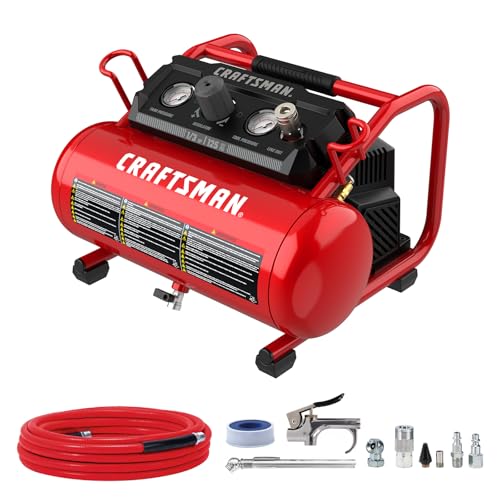
CRAFTSMAN 2-Gallon Portable Air Compressor
This CRAFTSMAN 2-gallon portable compressor package pairs a max 125 PSI oil-free pump with a versatile 10-piece pneumatic accessory kit using standard 1/4-inch NPT fittings. It is a practical, lightweight solution for DIYers and homeowners tackling tire inflation, air dusting, and light fastening.
Pros
- Complete out-of-the-box pneumatic package with air hose, blow gun, tire chuck, and 1/4-inch NPT quick-connect hardware
- Lightweight 19-pound carry weight makes moving between the garage, driveway, and workbench effortless
- Oil-free pump eliminates crankcase oil checks and prevents oil aerosol contamination in downstream air lines
- Dual quick couplings allow quick hookups without needing additional brass splitters
Cons
- Small 2-gallon receiver tank and 1/3 HP motor are limited to light-duty pneumatic tasks rather than continuous air-hungry tools
- The included starter air hose and accessories are entry-level components that high-volume shops may eventually want to upgrade
- Fittings utilize standard 1/4-inch auto profile plugs which require matching couplers if your shop uses alternate pneumatic profiles
ECOMAX 6-Gallon 150 PSI Portable Pancake Air
The ECOMAX 6-Gallon 150 PSI Pancake Air Compressor delivers portable, low-maintenance pneumatic power with its 1.5 HP oil-free pump, dual quick-connect couplers, and bundled 10-piece accessory kit. Featuring cold-weather starting support and a flip-up handle, it is an accessible choice for DIYers, trim carpenters, and garage tire maintenance.
Pros
- Comes with a 10-piece accessory kit including an air hose, tire chuck, and blow gun ready out of the box
- Dual quick-connect couplers enable two operators to run pneumatic lines simultaneously
- Oil-free pump design requires zero motor oil maintenance and prevents oil discharge into air lines
- Low-voltage and cold-weather startup capability helps ensure reliable motor turnover in chilly garages
- Flip-up carrying handle and built-in cord bracket simplify transport and tidy storage
Cons
- PVC air hose included in the kit can become stiff and difficult to manage in freezing temperatures
- Not intended for continuous high-demand air tools such as rotary sanders or automotive paint sprayers
- Standard universal motor noise level makes hearing protection advisable during indoor use
Klutch 20-Gallon Portable Air Compressor
Featuring a 2.0 HP 120V motor and a 20-gallon tank, the Klutch portable air compressor delivers a rated 4.2 SCFM at 90 PSI for versatile workshop air. Its oil-free pump and wheeled design make it a dependable choice for garage mechanics, woodworkers, and serious DIYers needing steady air storage.
Pros
- Generous 20-gallon air storage capacity provides a substantial buffer for intermittent shop tools
- Delivers a listed 4.2 SCFM at 90 PSI, outperforming smaller pancake compressors for workshop chores
- Oil-free pump design eliminates messy oil changes and allows clean, upright transport
- Rugged rubber wheels and built-in ergonomic handle make moving the 90-pound frame manageable
- Integrated thermal overload protection helps prevent motor burnout during demanding cycles
Cons
- Substantial 90-pound weight makes lifting into truck beds or carrying up stairs difficult without assistance
- Oil-free motor configurations generally produce noticeable operating noise compared to low-RPM lubricated units
- At 4.2 SCFM at 90 PSI, high-draw continuous air tools like sanders or grinders will require recovery pauses
CARSUN Dual Power AC/DC Portable Tire Inflator
The CARSUN Dual Power Tire Inflator delivers up to 150 PSI of high-pressure air running from either a 110V household outlet or a 12V vehicle socket. With digital pressure presets, automatic shutoff, and a lightweight 2.1-pound frame, it is an ideal maintenance pump for passenger vehicles, bicycles, and household inflatables.
Pros
- Versatile dual-voltage operation works seamlessly in the home garage or on the road without requiring an external converter
- Accurate auto-shutoff mechanism protects tires from accidental over-pressurization during routine top-offs
- Compact 2.1-pound build packs away easily in car trunks, under vehicle seats, or on garage shelving
- Clear digital display allows fast switching across four standard pressure measurement units
Cons
- Requires a mandatory 10-minute cooldown period after every 15 minutes of continuous operation
- Manufacturer explicitly states it does not support heavy truck tires, tractor tires, or stand-up paddleboards (SUP)
- Tankless inflator design cannot run standard workshop pneumatic air tools like brad nailers or paint sprayers
AstroAI Portable Tire Inflator Air Compressor
The AstroAI Dual Power Tire Inflator combines a 12V DC vehicle plug and 120V AC household cord, delivering up to 150 PSI for car tires and a 350 L/min high-volume mode for rafts and mattresses. It is a dependable, compact choice for garage mechanics, road-trippers, and homeowners wanting versatile inflation without needing a bulky air tank.
Pros
- Dual 12V DC and 120V AC power cords offer genuine versatility for garage benches, driveways, and roadside emergencies
- Two dedicated inflation modes handle high-pressure tires up to 150 PSI as well as high-volume camping gear at 350 L/min
- Digital auto-shutoff stops pumping once target pressure is reached, preventing accidental over-inflation
- Integrated cord and air hose storage compartments maintain a clean, compact footprint in vehicle trunks
- Dual metal motor build provides reliable output with up to 15 minutes of continuous run time per cycle
Cons
- Not designed to support heavy-duty commercial truck tires or high-volume commercial vehicle applications
- Requires a mandatory 10-minute cooling rest after 15 minutes of continuous high-pressure pumping
- Tankless electric inflator design cannot drive pneumatic air tools such as brad nailers or impact wrenches
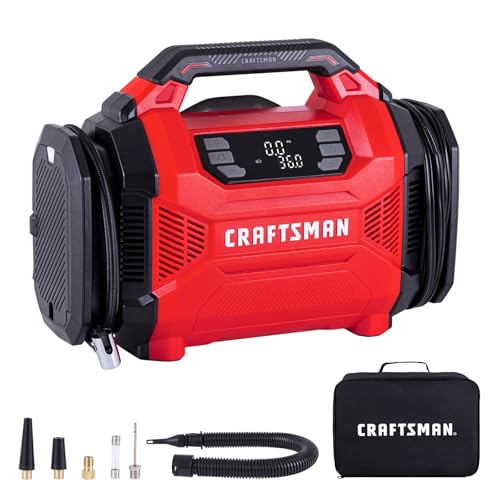
CRAFTSMAN Dual Power Tire Inflator
The CRAFTSMAN Dual Power Tire Inflator delivers versatile high-pressure air delivery up to 150 PSI using either a 120V AC home outlet or a 12V DC vehicle plug. Featuring digital auto shut-off presets and an integrated LED work light, it is an essential portable air solution for DIYers, garage mechanics, and road commuters.
Pros
- Dual 120V AC and 12V DC power inputs offer exceptional flexibility for both driveway maintenance and unexpected roadside flats
- Accurate digital pressure gauge with automatic shut-off prevents over-pressurizing vehicle and bicycle tires
- Capable of reaching 150 PSI, making it suitable for high-pressure road bike tires as well as passenger car tires
- Built-in LED work light enhances nighttime safety and visibility when working alongside highway traffic
- Complete package includes dedicated air hose, multiple nozzle adapters, spare fuse, and a zippered storage bag
Cons
- Tankless direct-drive mechanism is engineered for tire inflation and cannot power pneumatic air tools such as nailers or impact wrenches
- Takes longer to fill large volume leisure items like oversized air mattresses or rafts compared to dedicated high-volume blowers
- Lacks an onboard cordless tool battery dock, requiring access to an active 120V wall outlet or 12V vehicle socket
Sizing an Air Compressor for Your Home Garage: The Complete Guide
Determining what size air compressor for home garage spaces requires looking closely at how air tools consume compressed air and how mechanical pumps replenish pressure reserves. Many garage owners mistakenly evaluate an air compressor strictly by the physical volume of its steel receiver tank. While tank size provides a temporary cushion of stored compressed air, the continuous delivery rate of the pump determines whether your tools can run without interruption. Understanding how storage volume interacts with air delivery ensures you select a machine that meets your workshop needs without consuming unnecessary floor space or overloading circuits.
Understanding Airflow: Why CFM at 90 PSI Matters More Than Tank Gallons
Pneumatic power is primarily governed by airflow volume, which is measured in cubic feet per minute (CFM) at a specified operating pressure. Most garage air tools operate around 90 pounds per square inch (PSI), making standard CFM at 90 PSI the most critical specification on any manufacturer data plate. If an air tool consumes four CFM at 90 PSI but the compressor pump only generates two CFM, the tool will quickly deplete the stored air buffer. Once the tank pressure drops below the tool operating threshold, the tool will stall while waiting for the pump to recover.
Air volume at 40 PSI is also commonly listed by manufacturers, representing low-pressure tasks such as inflating bicycle tires, operating small touch-up sprayers, or blowing dust. A pump delivering ample CFM at 40 PSI may struggle considerably when forced to compress air against 90 PSI of backpressure. Evaluating both pressure metrics helps you understand the pump displacement curve under real working resistance. Always cross-reference the continuous air demand of your heaviest pneumatic tool against the rated CFM output of the compressor at 90 PSI before making a purchase.
Matching Garage Tasks to Air Consumption Profiles
Pneumatic tools fall into two distinct operational categories: intermittent-demand tools and continuous-demand tools. Intermittent tools include pneumatic brad nailers, finish staplers, and standard tire chucks that consume brief pulses of pressurized air. Because these tools allow the compressor motor to rest between individual cycles, they can operate effectively on smaller tanks with modest CFM outputs. A compact tank holds plenty of air to drive several fasteners in sequence before the pressure switch triggers a brief motor recovery cycle.
Continuous-demand tools create an entirely different mechanical challenge inside a home garage. Equipment such as dual-action orbital sanders, die grinders, cut-off wheels, and paint spray guns pull a continuous stream of pressurized air through the delivery hose. Running an orbital sander requiring six to eight CFM on a compact compressor will exhaust the tank reserve in mere seconds. Once the reserve drops, line pressure collapses and the pump will run continuously, causing thermal stress on the motor and stalling your workflow.
Compact Inflators and Small Tanks for Basic Garage Maintenance (1 to 4 Gallons)
Homeowners whose garage activities focus on tire maintenance, bicycle care, and seasonal inflatables rarely need large floor-standing compressor tanks. A dedicated wall-mounted unit like the Slime 40045 Home Tire Inflator, Wall Mounted 120V operates from a standard 120V outlet to inflate passenger car and SUV tires up to 100 PSI without cluttering workspace floor area. Similarly, portable 12V DC and dual-power 120V AC inflators such as the CARSUN AC/DC Tire Inflator Portable Air, CRAFTSMAN Dual Power Tire Inflator with, and AstroAI Tire Inflator Portable Air Compressor offer versatile high-pressure inflation up to 150 PSI with automatic shut-off functionality. These compact systems eliminate the footprint of a traditional receiver tank while delivering dependable pressure for vehicle tires.
When light pneumatic fastening or dust cleaning enters the equation, small tank units between two and four gallons offer an ideal entry point. The CRAFTSMAN Air Compressor provides a compact two-gallon tank paired with a 1/3 HP motor delivering up to 125 PSI, weighing only 19 pounds for effortless shelf storage. Stepping up slightly, the 4 Gallon Portable Air compressor features a 0.5 HP motor generating 0.6 SCFM at 90 PSI and 1.0 SCFM at 40 PSI with a 110 PSI maximum pressure. These compact tanks provide an immediate burst of air for brad nailers, tire chucks, and blow guns without demanding dedicated floor space.
Mid-Size Compressors for Fasteners and Light Pneumatics (6 Gallons)
The six-gallon pancake tank represents the most popular general-purpose configuration for residential garages and mobile DIY projects. The ECOMAX Air Compressor 6 Gallon 150 PSI Pancake illustrates why this form factor thrives, pairing a 1.5 HP motor with a 150 PSI tank to deliver three cubic inches of air at 90 PSI. That extra pressure capacity allows the compressor to store a denser volume of air within a relatively small steel vessel. As a result, home woodworkers and DIYers can fire framing nailers, install trim, and inflate truck tires without waiting for constant pump cycling.
Portability remains a primary benefit of the six-gallon pancake design, which typically weighs around 34 pounds and features a stable, low center of gravity. You can easily lift the unit into a truck bed or move it across the driveway to service trailer tires. While a six-gallon tank offers plenty of air buffer for intermittent nailing and tire filling, it still lacks the sustained CFM output required for heavy sanders or automotive impact wrenches. Recognizing this boundary ensures you do not overheat a pancake pump by asking it to perform sustained production tasks.
Large Workshop Compressors for Automotive and Continuous Air Tools (10 to 20 Gallons)
When automotive repair, suspension work, and surface preparation become regular garage activities, compressor capacity must expand significantly. The VEVOR 13-Gallon Air Compressor, 2HP provides an outstanding balance for active garages by pairing a two-horsepower motor with a 13-gallon tank that builds air in under three minutes. Delivering 4.6 SCFM at 90 PSI with a 125 PSI ceiling, this unit generates enough continuous air to operate ratchet wrenches, finish sprayers, and medium-demand air tools comfortably. Its rubber wheels and vertical tank design also keep floor obstruction minimal while maintaining roll-around mobility across concrete slabs.
For serious hobbyists tackling frequent impact wrench work, tire changes, and light sandblasting, a 20-gallon semi-portable unit provides essential air reserves. The Klutch 20-Gallon Air Compressor, 2 HP, 120V features a robust 2.0 HP motor that outputs 4.2 SCFM at 90 PSI to handle demanding mechanical cycles. That substantial 20-gallon air reserve acts as a deep storage battery, absorbing sudden high-draw bursts from 1/2-inch pneumatic impact guns without immediate line pressure drops. This extended reserve buffer allows pneumatic tools to deliver full rated torque, preventing the frustrating stalls common on undersized units.
Evaluating Motor Horsepower and Standard Household Electrical Demands
Motor horsepower directly dictates how rapidly an air compressor pump can replenish the receiver tank during heavy usage. If you are comparing electric motor capabilities, exploring an in-depth air compressor horsepower guide will clarify the difference between true continuous running horsepower and exaggerated peak ratings. In a residential garage, electrical circuit compatibility is just as vital as mechanical pump capacity. Most home garages operate on standard 120-volt branch circuits protected by 15-amp or 20-amp circuit breakers.
Compressor electric motors draw an initial surge of current, known as inrush amperage, when starting against backpressure in the pump head. A true two-horsepower motor running on 120 volts pushes the upper threshold of a 15-amp breaker, especially during cold weather when mechanical lubricants stiffen. Running a heavy compressor on a long, thin extension cord causes significant voltage drops that can overheat the motor windings or trip the circuit breaker repeatedly. Planners should plug their workshop compressor directly into a dedicated 20-amp garage wall outlet and use a longer air hose rather than an electrical extension cord.
Operating Noise Levels and Enclosed Garage Acoustics
Garages with concrete floors and drywall walls act as echo chambers that dramatically amplify operational noise. Traditional oil-free pancake compressors often operate between 78 and 85 decibels, creating an ear-splitting racket that quickly causes hearing fatigue and disturbs household members. Fortunately, modern quiet pump technology has transformed residential air compressors by utilizing dual-piston low-RPM pump architectures. Units like the VEVOR 13-gallon compressor operate at an impressively quiet 66 decibels, allowing normal conversation without protective earmuffs during pump cycles.
Selecting a quiet machine makes home workshop sessions far more enjoyable and neighbor-friendly, especially during late-night or weekend repairs. If low operational noise is a major priority for your space, consulting our quiet workshop air compressor guide offers helpful context on sound dampening pump designs. Dual-opposed piston pumps distribute the compression workload across two cylinders, reducing mechanical vibration and operating temperature. Lower operating RPM also places less mechanical stress on internal seals, contributing to a longer service life under typical DIY workloads.
Oil-Free Pumps Versus Oil-Lubricated Durability
Pump lubrication design represents another important consideration when deciding on compressor size and maintenance commitment. Oil-free pumps utilize Teflon-coated piston rings and permanently sealed bearings to eliminate oil maintenance entirely. These systems can operate on uneven garage floors or be transported in vehicle trunks without risking messy crankcase oil spills. Furthermore, oil-free designs guarantee that discharge air remains free of oil aerosols, which is essential when spray painting or applying wood finishes.
Traditional oil-lubricated cast-iron pumps, while requiring regular oil level checks and scheduled fluid changes, offer superior thermal dissipation and prolonged operational longevity. They excel in high-duty-cycle workshop environments where the compressor pump must run frequently throughout the day. However, modern oil-free pumps have advanced significantly, delivering reliable multi-year performance for typical homeowner and hobbyist applications. Assessing how many hours per month you plan to operate your equipment will guide whether zero-maintenance oil-free convenience or cast-iron durability best matches your garage.
Tank Condensation Purging and Air Delivery Reliability
Compressing atmospheric air naturally draws ambient moisture into the compressor pump, where compression heat turns it into water vapor. As compressed air cools inside the steel receiver tank, water condenses and collects at the lowest point of the tank shell. Allowing moisture to pool inside an air tank accelerates internal rust, decreases usable storage volume, and can damage connected pneumatic tools. Regular purging through the bottom drain valve is essential to preserve the structural integrity of your pressure vessel.
Different air compressors feature distinct drain valve designs that impact regular maintenance convenience. Many compact pancake units utilize small, threaded thumb petcocks that can stiffen over time, making routine draining awkward and difficult. Larger workshop models often incorporate accessible quarter-turn brass ball valves that simplify purging moisture after each work session. Always remember to depressurize your tank and wear appropriate eye protection when opening the drain valve, following all manufacturer safety guidelines to maintain a safe working environment.
Practical Sizing Framework for Your Garage Workshop
Choosing the perfect air compressor size ultimately comes down to an honest assessment of your pneumatic tool ambitions. If your requirements are confined to seasonal tire pressure checks, bicycle tires, and emergency inflation, a compact 12V or 120V inflator provides maximum space savings and convenience. Homeowners doing occasional finish carpentry, trim installation, or general garage cleanup will find a two-to-six-gallon portable compressor strikes an ideal balance between mobility and storage. These portable options deliver adequate air buffer while tucking neatly under a workbench between tasks.
If your garage doubles as an automotive repair bay where impact wrenches, air ratchets, or paint guns are standard tools, invest in a 10-to-20-gallon compressor delivering at least four CFM at 90 PSI. That extra tank reserve and continuous airflow output prevents mechanical stalling, protects motor longevity, and keeps your projects moving forward smoothly. By matching tool air consumption, electrical circuit safety, and workspace noise tolerance, you can confidently select an air compressor that powers your garage projects reliably for years to come.
About the author
Tom Scalisi brings more than two decades of experience in construction, building maintenance, contracting, and hands-on tool use. His practical understanding of power tools, automotive work, repairs, and jobsite equipment helps readers evaluate compressors based on real workloads rather than specifications alone.