
What Size Air Compressor for Finish Nailer: Sizing Guide for 2026
Learn what size air compressor for finish nailer setups you need in October 2026, covering CFM, tank gallons, PSI, and operating noise.
 By Bob Beacham
Updated October 8, 2026
By Bob Beacham
Updated October 8, 2026

Pneumatic finish nailers rely on sudden, short bursts of compressed air rather than continuous airflow. Because each fastener cycle only consumes a fraction of a cubic foot of air, selecting what size air compressor for finish nailer projects does not demand a massive workshop tank. Many carpenters and DIY woodworkers discover that compact 1-gallon to 6-gallon portable units provide more than enough reserve for trim, baseboards, and cabinetry. Understanding the exact relationship between operating pressure, delivered airflow, and tank recovery speed helps you avoid hauling unnecessary weight to your jobsite.
Evaluating air requirements involves looking at both pressure ratings and pump cycle frequency. When exploring air compressor nail gun requirements, you quickly find that an 18-gauge brad nailer or a 15-gauge angled finish nailer needs between 70 and 120 PSI to drive pins flush into dense hardwoods. A small oil-free compressor with reliable pressure regulation keeps each fastener seated cleanly without overloading your electrical circuits. Balancing tank capacity against maneuverability ensures that your finish carpentry runs smoothly from room to room.
| Award | Product | ACR Score About ACR ScoreThe ACR Score is our own rating from 0 to 10, based on performance, design and build, ease of use, and value. It reflects independent research and is never influenced by manufacturers, retailers, or affiliate commissions. Learn more › | |
|---|---|---|---|
| Best Overall |
Metabo HPT Quiet Air Compressor
|
9.1/10 | Buy |
| Best Budget |
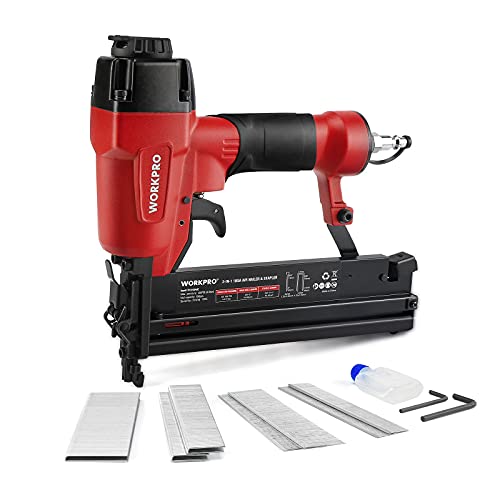 WORKPRO 2-in-1 Pneumatic Brad Nailer/Staple Gun
|
8.9/10 | Buy |
 Metabo HPT Brad Nailer, Pneumatic 18 Gauge
|
8.9/10 | Buy | |
 Metabo HPT 15 Gauge Angled Finish Nailer
|
8.8/10 | Buy | |
| Best Value |
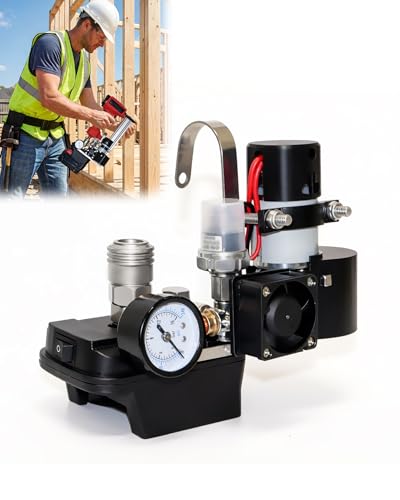 Cordless Portable Air Compressor Pump for 1/4"
|
8.8/10 | Buy |
 Valu-Air T64C 16 Gauge 7/8-Inch to 2-1/2-Inch
|
8.6/10 | Buy | |
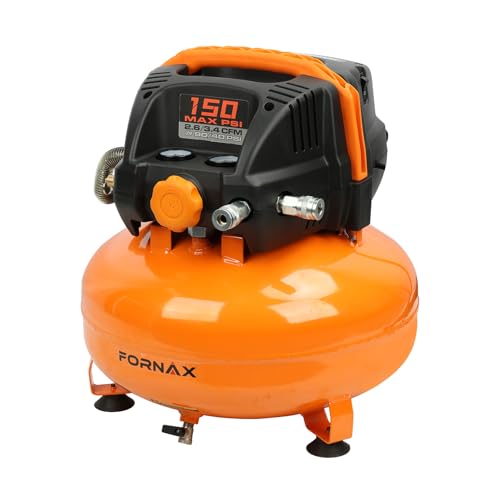 FORNAX Pancake Air Compressor with two couplers
|
8.4/10 | Buy | |
 DEWALT Brad Nailer Kit, 18GA, 5/8-Inch to 2-Inch
|
8.3/10 | Buy | |
| Best Premium |
 Metabo HPT Portable Pancake Air Compressor
|
8.3/10 | Buy |
 SENCO Pneumatic Brad Nailer 18 Gauge
|
8.1/10 | Buy |
Matching Air Compressor Specifications to Finish Nailing
Selecting the appropriate compressor size for pneumatic finish carpentry comes down to understanding intermittent air consumption versus continuous tool demand. Finish nailers, including 18-gauge brad nailers, 16-gauge straight finish nailers, and 15-gauge angled nailers, consume compressed air in momentary pulses rather than a sustained flow. A single fastener typically requires between 0.02 and 0.05 cubic feet of air per shot, translating to an average draw well below 1.0 CFM during normal working tempos. Because the tool does not drain the air reserve continuously, tank storage capacity primarily determines how frequently the pump motor must cycle on and off.
Air Volume and Pressure Requirements for Finish Fasteners
Every pneumatic finish nailer operates within a specified pressure window, typically ranging between 70 and 120 PSI depending on fastener gauge and wood density. Fastening soft pine molding often requires only 75 to 85 PSI, whereas driving a 2-1/2-inch 15-gauge nail into solid oak casings demands closer to 100 to 110 PSI. The compressor must be capable of delivering this working pressure consistently through its output regulator without substantial lag. As long as the compressor delivers at least 90 PSI of regulated pressure, even a small pump will seat fasteners flush beneath the wood surface.
Airflow volume, measured in cubic feet per minute (CFM), represents the actual output capacity of the pump. Most finish nailers require between 0.3 and 0.8 CFM at 90 PSI when fired at moderate speeds. High-demand tools like paint sprayers or dual-action sanders require continuous volumes exceeding 8 to 12 CFM, but finish nailers place almost negligible continuous demand on a compressor. Consequently, a portable compressor rated to deliver between 0.7 and 2.0 CFM at 90 PSI provides more than enough airflow for any standard finish carpentry task.
Tank Volume Differences: 1-Gallon Versus 6-Gallon Capacities
Air tank capacity dictates the volume of stored air available before the pressure switch triggers the motor to refill the vessel. A 1-gallon air compressor holds a compact air reserve that suits individual trim carpenters installing shoe molding, window casings, or crown trim. Because the storage volume is modest, the motor will cycle on after every ten to twenty rapid nail strikes. For precision woodworking where each piece is measured, cut, and carefully placed, this frequent cycling goes largely unnoticed.
A 6-gallon pancake compressor provides a considerably larger air reserve that buffers multiple rapid nail drives without immediately triggering the motor. Units like the 6-gallon models from Metabo HPT or FORNAX can easily support rapid sequential nailing without dropping below the tool operating threshold. Furthermore, higher-capacity pancake tanks allow multiple workers to run independent nailers from dual quick-connect couplers. If two carpenters are installing baseboards simultaneously, a 6-gallon tank prevents pressure dips that could leave fasteners standing proud.
Weight and jobsite portability represent the primary tradeoff between these two popular tank categories. A 1-gallon compressor typically weighs between 20 and 26 pounds, allowing an installer to carry the unit effortlessly up stairs or into tight residential closets. In contrast, 6-gallon pancake compressors generally weigh between 28 and 42 pounds, making them sturdier but bulkier to load into vehicles. When deciding on capacity, evaluate whether you value lightweight room-to-room mobility or the extended firing buffer of a larger tank.
Gauge Sizing: Matching 15, 16, and 18-Gauge Nailers to Compressors
Fastener gauge directly influences how much air volume and driving force a pneumatic cylinder requires for each stroke. An 18-gauge brad nailer uses slender wire nails designed for delicate trim, picture frames, and thin paneling. Because the driving piston is relatively small, brad nailers use minimal air per cycle and operate seamlessly on ultra-compact 1-gallon pumps. Tools such as the Metabo HPT NT50AE2 or DEWALT DWFP12231 fire easily even on lower-output portable units.
Stepping up to a 16-gauge straight finish nailer or a heavy-duty 15-gauge angled finish nailer increases the internal cylinder displacement. The Metabo HPT NT65MA4 angled nailer, for example, fires fasteners up to 2-1/2 inches in length to secure door jambs and heavy stair components. Driving these thicker fasteners into framing studs demands higher burst pressure, usually around 90 to 110 PSI. While a 1-gallon tank can still operate a 15-gauge nailer, the compressor will cycle much more frequently to recover its pressure switch cut-out threshold.
Combination tools, such as the WORKPRO 2-in-1 nailer and staple gun, also fit comfortably within standard finish compressor output limits. Operating between 60 and 100 PSI with a standard 1/4-inch NPT inlet, multi-purpose guns do not strain portable air pumps. Matching your nailer gauge to your expected daily production rate helps determine whether a 1-gallon trim unit or a 6-gallon pancake tank provides the ideal workflow balance.
Acoustic Output and Decibel Considerations for Indoor Woodworking
Operational noise is often the most critical consideration for carpenters working inside occupied homes or enclosed workshops. Standard universal motor pancake compressors can reach noise levels between 80 and 95 decibels, creating a harsh racket in reflective rooms. A sudden 95 dB blast from an open-frame compressor can startle occupants and cause significant operator fatigue over an eight-hour shift. If you are comparing equipment sound performance, reviewing our compressor noise comparison guide highlights how lower motor decibels transform enclosed workspaces.
Modern quiet-series compressors utilize low-RPM induction motors that dramatically reduce operational sound levels. Units like the Metabo HPT EC28M operate at approximately 59 decibels, while the Senco PC1010 runs around 68 decibels. At 59 decibels, the compressor generates less sound than a standard spoken conversation, allowing finish carpenters to work comfortably in finished homes without ear protection. For custom cabinet installations or residential trim upgrades, choosing an ultra-quiet compressor prevents customer complaints and ear strain.
Decibel ratings are measured on a logarithmic scale, meaning that a 10 dB increase represents a perceived doubling of loudness. An 80 dB compressor sounds twice as loud as a 70 dB model, while a 90 dB unit sounds four times as loud. High-speed universal motors turn at roughly 3,400 RPM to compress air quickly, generating substantial mechanical vibration and high-frequency whine. Dual-piston quiet compressors spin at roughly 1,750 RPM, distributing the mechanical workload across two cylinders to dampen sound while maintaining adequate CFM delivery.
Pump Mechanism: Oil-Free Convenience Versus Oil-Lubricated Longevity
Nearly all portable finish carpentry air compressors utilize oil-free pump designs equipped with self-lubricating Teflon or PTFE piston rings. Oil-free mechanisms offer major practical advantages for indoor trim work, beginning with zero risk of oil mist discharging through the air hose. If compressor oil discharges onto bare wood moldings or unpainted cabinetry, it can cause severe staining and ruin stain or paint adhesion. Furthermore, oil-free pumps require zero oil changes, eliminating the need to monitor sight glasses or transport messy lubricants.
Oil-free pumps also start much more reliably in cold weather compared to splash-lubricated cast-iron pumps. When temperatures drop near freezing on unheated jobsites, compressor oil thickens and creates high mechanical drag against the crankshaft. This drag frequently causes the electric motor to pull excessive startup inrush current, tripping standard 15-amp household circuit breakers. Oil-free pumps eliminate cold-oil resistance, allowing the motor to spin up quickly even in sub-freezing morning temperatures.
The primary operational limitation of oil-free pumps is their lower duty cycle tolerance compared to commercial cast-iron units. Most oil-free trim compressors carry a 50 percent duty cycle rating, meaning the pump should rest as long as it runs to dissipate frictional heat. Because finish nailers consume air intermittently, exceeding the duty cycle during standard trim work is rare. However, attempting to run high-draw air tools like die grinders or spray guns on a small oil-free compressor will overheat the cylinder sleeve and lead to premature ring wear.
Maximum Pressure and Cut-In Versus Cut-Out Thresholds
Understanding the relationship between cut-in pressure and cut-out pressure explains why tank storage volume functions the way it does. The cut-out pressure is the maximum pressure at which the pressure switch turns off the motor, commonly between 125 and 150 PSI on standard models. Higher-end units, such as the Metabo HPT EC914S pancake compressor, operate up to 200 PSI, packing significantly more air mass into the same 6-gallon vessel. A higher maximum PSI rating creates a deeper reserve buffer before line pressure drops to the tool operating limit.
The cut-in pressure is the lower threshold at which the pressure switch turns the motor back on to replenish the tank, typically set between 90 and 105 PSI. If your finish nailer requires 100 PSI to sink 15-gauge nails into hardwood, a compressor with a cut-in threshold of 90 PSI could cause occasional shallow nail drives right before the pump kicks on. To prevent this, setting the regulator to exactly what the tool needs while using a compressor with a high cut-in threshold guarantees continuous flush drives. Having a wide differential between maximum storage pressure and regulated tool pressure ensures consistent performance.
Accurate manifold pressure gauges allow you to monitor both storage pressure and regulated output pressure independently. The tank gauge displays the raw energy stored inside the steel vessel, showing the rise from zero to cut-off. The regulated line gauge reflects the working pressure delivered through the quick-connect coupler to your air hose. Investing in a compressor with a smooth, locking regulator knob prevents vibration from accidentally altering your firing depth while you work.
Electrical Demands and Household Circuit Compatibility
Portable finish compressors are designed to operate on standard 120-volt residential circuits without specialized electrical wiring. Most 1-gallon to 6-gallon models draw between 2 and 12 running amps, making them compatible with common 15-amp household branch circuits. However, electric motors experience a brief surge of inrush current during the first second of startup that can peak near the circuit breaker limit. If other high-draw appliances or shop vacuums share the same electrical branch, starting the compressor may trip the breaker.
Extension cord selection plays a vital role in preventing motor stalling and breaker trips on residential jobsites. Running a lightweight, undersized 16-gauge extension cord causes substantial voltage drop over distance, starving the compressor motor of necessary electrical power. This voltage drop causes the motor to hum, overheat, and trip its internal thermal overload protector. Instead of using a long electrical extension cord, experienced carpenters connect the compressor directly to a wall receptacle and use a longer 50-foot or 100-foot air hose to reach distant work areas.
When analyzing equipment budgets, exploring typical air compressor costs helps frame the balance between initial purchase expense and long-term electrical reliability. Low-power, ultra-quiet models often feature low-amp draw induction motors that pull only 2 to 4 amps under full compression load. This exceptionally low current draw allows you to run the compressor safely on shared circuits without fear of nuisance interruptions while installing trim.
Air Hoses, Regulators, and Pneumatic System Delivery
The connection between your compressor and your finish nailer relies on an air hose and quick-connect fittings that must preserve steady line pressure. Standard 1/4-inch inner diameter (ID) air hoses are the industry norm for finish carpentry because they are lightweight, flexible, and easy to drag across hardwood floors without causing scuffs. Polyurethane hoses offer superior flexibility and cold-weather pliability compared to heavy rubber or stiff PVC alternatives. A lightweight hose reduces wrist fatigue when maneuvering a 2.2-pound brad nailer around ceiling crowns or intricate moldings.
Dynamic pressure drop occurs when air rushes through a narrow hose, resulting in slightly lower pressure at the tool end during firing. For short finish nailing bursts through a 25-foot to 50-foot 1/4-inch hose, pressure drop is minimal and rarely impacts nail setting depth. If you must run a 100-foot air line, increasing the hose diameter to 3/8-inch ID minimizes friction losses and maintains full regulated pressure at the nailer inlet. Standard industrial quick-connect couplers ensure rapid tool swaps between brad nailers, finish nailers, and blow guns.
Integrated air dusters, found on premium nailers like the Metabo HPT NT65MA4, utilize stored air to clear wood shavings and drywall dust from workpieces before fastening. Using an air duster draws slightly more continuous airflow than single nail shots, momentarily dipping line pressure if used excessively. A compressor with rapid recovery speed and stable regulator control restores full operating pressure within seconds after dusting away debris.
Cordless Jobsite Pumps and Battery Ecosystem Integration
Battery-powered cordless air compressor pumps represent an evolving alternative for mobile trim carpenters seeking ultimate freedom from wall outlets. Compact units designed for pneumatic nail guns attach directly to power tool battery platforms, such as 18-volt systems, to pressurize a tiny internal buffer. These micro-compressor pumps eliminate traditional air tanks and bulky cords entirely, making them exceptional for quick repair work, punch-list fixes, and remote jobsites.
While cordless compressor pumps deliver true mobile convenience, they have strict performance boundaries compared to traditional electric compressors. These battery pumps are engineered specifically for low-volume pneumatic nailers and cannot support continuous air-demand tools like sprayers or inflators. Furthermore, battery runtime limits the total number of fasteners you can drive before swapping power packs. For whole-house baseboard installation or production trim carpentry, a corded 1-gallon or 6-gallon electric compressor remains the more practical and cost-effective workhorse.
Moisture Management and Tank Maintenance Routines
Atmospheric air contains ambient humidity that condenses into liquid water inside the steel storage tank as pressurized air cools down. This accumulated water pools at the lowest point of the tank vessel, creating a risk of internal rust and valve corrosion if neglected. Furthermore, excess tank moisture can travel through the air line and wash away factory lubricants inside your finish nailer, causing sticky valves or premature seal failure.
Draining the compressor tank at the conclusion of every working day is the most effective way to protect your investment. Most modern pancake and portable compressors feature an underside drain valve, either an accessible quarter-turn brass ball valve or a threaded thumb petcock. To drain the unit safely, reduce tank pressure below 30 PSI, position a shop rag beneath the valve, and slowly open the mechanism to blow out accumulated moisture. Always remember to depressurize the tank completely and wear protective eyewear during regular maintenance cycles.
Summary of Sizing Recommendations for Finish Carpentry
Matching the right compressor size to your finish carpentry projects requires balancing firing cadence, mobility, and workspace acoustic limits. If your work primarily involves custom furniture, cabinet assembly, or delicate trim inside finished homes, an ultra-quiet 1-gallon oil-free compressor delivering around 0.8 CFM at 90 PSI provides an optimal blend of low noise and easy carry weight. For production carpenters installing extensive baseboards, running multiple nailers simultaneously, or driving heavy 15-gauge casing nails all day, a 6-gallon pancake compressor operating up to 150 or 200 PSI delivers the necessary air reserve to keep your entire crew working without interruption.
About the author
Bob Beacham is an experienced tools and workshop writer with deep knowledge of power equipment, mechanical systems, and practical DIY applications. His coverage of air compressors, welding equipment, saws, and workshop tools helps translate technical specifications into useful guidance for homeowners and serious DIYers.