
Can a Tire Inflator Be Used as an Air Compressor: Practical Guide for 2026
Can a tire inflator be used as an air compressor for garage tools? Learn key differences in CFM, pressure limits, and duty cycles for October 2026.
 By Tony Carrick
Updated October 8, 2026
By Tony Carrick
Updated October 8, 2026

Air tool operators frequently face situations where hauling a heavy workshop tank feels inconvenient for quick pneumatic tasks. Reaching for a portable roadside tire pump seems like an easy shortcut when a tire is low or a small tire bead needs air. However, understanding whether can a tire inflator be used as an air compressor requires looking at continuous air volume rather than just peak pressure ratings. While tire inflators can reach impressive pressure levels up to 150 or 160 PSI, their internal pump design is engineered specifically for enclosed pressure vessels rather than continuous flow demands.
Pneumatic equipment like impact wrenches, paint sprayers, and rotary die grinders relies on continuous cubic feet per minute rather than static pressure. Checking a pneumatic tool air consumption guide reveals that most air tools require several cubic feet of air delivered continuously at 90 PSI to function without stalling. Standard automotive inflators lack the receiver tanks and high-displacement pistons necessary to sustain that kind of airflow. Exploring the mechanical realities behind both machines helps clarify what tasks an inflator can handle safely and where a dedicated workshop air compressor remains essential.
| Award | Product | ACR Score About ACR ScoreThe ACR Score is our own rating from 0 to 10, based on performance, design and build, ease of use, and value. It reflects independent research and is never influenced by manufacturers, retailers, or affiliate commissions. Learn more › | |
|---|---|---|---|
| Best Overall |
CRAFTSMAN 12V Portable Tire Inflator with
|
9.2/10 | Buy |
| Best Value |
 AstroAI H2 Pro Cordless Tire Inflator 150 PSI
|
9.2/10 | Buy |
 AstroAI Dual Power 110V/12V Tire Inflator
|
8.9/10 | Buy | |
| Best Premium |
 Ipflin 160 PSI Portable Tire Inflator and Air
|
8.9/10 | Buy |
| Best Budget |
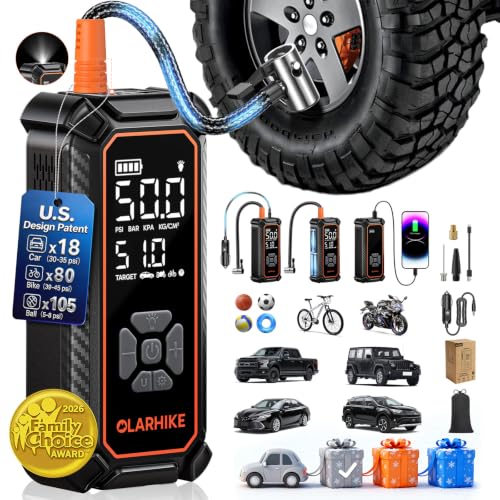 OlarHike Portable Tire Inflator Air Compressor
|
8.8/10 | Buy |
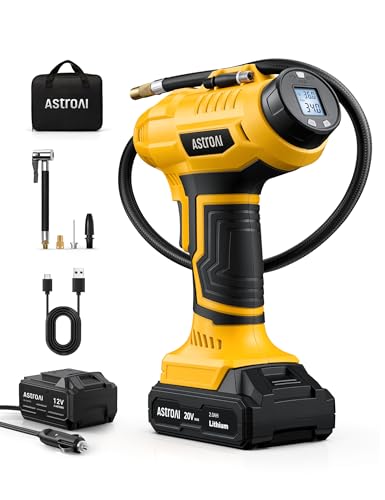 AstroAI Cordless Tire Inflator 160 PSI
|
8.8/10 | Buy | |
 CARSUN 12V DC Portable Tire Inflator
|
8.6/10 | Buy | |
 AstroAI AIRUN H 12V DC Portable Air Compressor
|
8.4/10 | Buy | |
 OlarHike Portable Tire Inflator Air Compressor
|
8.3/10 | Buy | |
 OlarHike 12000mAh Cordless Tire Inflator
|
8.3/10 | Buy |
CRAFTSMAN 12V Portable Tire Inflator with
The CRAFTSMAN 12V Portable Tire Inflator is an ultra-compact 1.9-pound roadside unit delivering up to 150 PSI with digital auto shut-off and built-in cord storage. Powered via a standard 12V car accessory plug, it offers fast tire top-offs and dependable emergency inflation without crowding trunk space.
Pros
- Weighs only 1.9 pounds for effortless glove box, under-seat, or trunk storage during road trips
- Digital auto shut-off prevents accidental over-inflation without requiring constant manual gauge monitoring
- Bright three-mode LED light provides critical illumination during nighttime roadside emergencies
- Comes fully equipped with multi-valve adapters, a replacement fuse, and a tailored carry pouch
Cons
- Requires a 12V DC vehicle accessory socket and does not include a 120V AC household outlet adapter
- Compact tankless pump is built strictly for tire inflation and cannot drive pneumatic nailers or air tools
- The 2.17-foot air hose length means the compressor must sit on the ground adjacent to the wheel valve stem
AstroAI H2 Pro Cordless Tire Inflator 150 PSI
The AstroAI H2 Pro is a versatile dual-power portable tire inflator delivering up to 150 PSI via an internal rechargeable lithium battery or 12V DC vehicle plug. Featuring digital auto shut-off, accurate dual pressure displays, and onboard accessory storage, it is an ideal roadside emergency and garage solution for vehicle owners and cyclists.
Pros
- Dual power supply provides cordless convenience with a 12V DC vehicle fallback for roadside emergencies.
- Automatic shut-off and dual digital display prevent overinflation and eliminate manual pressure monitoring.
- ToughUltra internal components improve mechanical durability compared to standard plastic gear assemblies.
- Integrated nozzle storage compartment keeps bicycle adapters and ball needles organized inside the unit.
Cons
- Tankless high-pressure inflator design is not compatible with pneumatic workshop air tools like nailers or impact wrenches.
- Cordless runtime is limited to approximately 18 minutes before requiring a recharge or switching to the 12V DC vehicle cord.
- Direct-drive high-pressure pump requires cool-down pauses during continuous multi-tire inflation tasks.
AstroAI Dual Power 110V/12V Tire Inflator
Versatile dual-power support lets this lightweight inflator run from either a garage wall outlet or a vehicle cigarette lighter. An automatic shutoff and onboard cord storage make routine tire top-offs straightforward for any driver.
Pros
- Flexible dual AC and DC power options
- Automatic shutoff prevents over-inflation
- Compact and lightweight at 2.2 pounds
- Integrated cord and nozzle storage
Cons
- Requires a 10-minute cooldown after 15 minutes of runtime
- Must be plugged into a power source to operate
Ipflin 160 PSI Portable Tire Inflator and Air
The Ipflin portable air compressor provides up to 160 PSI and 30 L/min airflow with a built-in 9600mAh battery and 12V DC vehicle backup. It is an ideal emergency inflator for motorists, garage DIYers, and cyclists who need quick tire pressure adjustments without hauling a heavy air tank.
Pros
- True dual-power flexibility allows cordless battery operation or direct 12V DC automotive corded power during roadside emergencies
- High 160 PSI maximum pressure rating handles high-pressure bike tires, trailer tires, and passenger vehicle inflation
- Automatic shutoff system prevents over-inflation by stopping airflow as soon as the preset pressure target is reached
- Built-in 9600mAh battery eliminates the need for separate external power tool batteries or standalone chargers
Cons
- High-pressure tire inflator design is strictly intended for inflation and cannot operate pneumatic tools like brad nailers or air ratchets
- Cordless lithium-ion battery requires periodic top-off charging during storage to maintain emergency readiness
- Continuous inflation runtime is capped at 30 minutes before requiring a short cool-down period
OlarHike Portable Tire Inflator Air Compressor
The OlarHike Portable Tire Inflator combines dual-power versatility via a 12V DC vehicle plug or built-in rechargeable battery with an automatic shut-off digital display. It provides dependable roadside tire top-offs and inflation for passenger cars, crossovers, motorcycles, and bicycles.
Pros
- Dual-power design allows cordless field operation or continuous power through any standard vehicle 12V DC port
- Automatic shut-off technology stops the motor precisely at preset pressure to prevent over-inflation
- Integrated 6000mAh battery reserve doubles as an emergency phone charger and includes an LED work light
- Pocket-sized footprint weighs well under two pounds for convenient transport in center consoles or backpacks
Cons
- Maximum vehicle pressure rating of 51 PSI is not suitable for heavy-duty commercial trucks, RVs, or high-pressure trailer tires
- Compact tankless inflator mechanism cannot power workshop pneumatic tools such as nail guns or air ratchets
- Recharging requires a standard 5V 2A or 5V 3A adapter and is not compatible with high-wattage fast chargers
AstroAI Cordless Tire Inflator 160 PSI
The AstroAI Cordless Tire Inflator is a compact 160 PSI handheld air compressor featuring dual power via a 20V rechargeable battery and a 12V DC car adapter. Delivering digital auto shut-off and up to 20 minutes of continuous runtime, it is an ideal emergency tool for garage mechanics, commuters, and road-trippers.
Pros
- Dual-power versatility allows cordless battery operation at home or 12V DC vehicle plug-in on the road
- Reaches up to 160 PSI with automatic shut-off to prevent accidental tire over-pressurization
- Compact 2.54-pound footprint provides effortless trunk or glove-box storage for emergency readiness
- Backlit digital LCD screen provides clear readouts in PSI, BAR, and KPA units
- Integrated front LED light illuminates tire valve stems during dark roadside emergencies
Cons
- Includes a USB-C charging cable but requires an external USB power block to recharge the battery
- Designed specifically for tire and sports inflation rather than driving pneumatic workshop air tools
- Continuous runtime is limited to 20 minutes before requiring a cool-down pause
CARSUN 12V DC Portable Tire Inflator
The CARSUN 12V DC portable tire inflator delivers a listed 35 L/min airflow with automatic digital shut-off up to 150 PSI. It is an ideal, budget-friendly roadside emergency pump for passenger car owners, cyclists, and weekend campers.
Pros
- Automatic shut-off prevents accidental tire over-inflation by cutting power at the preset target pressure
- Lightweight 1.9-pound frame and compact dimensions fit neatly into vehicle trunks or roadside emergency kits
- Capable 35 L/min air volume airs up standard passenger tires quickly during routine seasonal pressure top-offs
- Bright integrated LED lighting assists with safe valve connection along dark roadways and unlit driveways
- Four included adapter nozzles expand utility across bicycles, sporting balls, and recreational air mattresses
Cons
- Powered exclusively via 12V DC vehicle sockets and does not include a 120V AC household electrical plug
- Manufacturer explicitly notes the unit is not suitable for heavy commercial trucks or large motor lorries
- Tankless high-pressure inflator design is not engineered to operate pneumatic workshop air tools
AstroAI AIRUN H 12V DC Portable Air Compressor
The AstroAI AIRUN H is a compact 12V DC tire inflator delivering up to 35 L/min airflow with automatic shut-off and digital pressure presets. It is an ideal portable emergency compressor for drivers, commuters, and garage hobbyists seeking fast tire top-offs.
Pros
- Automatic shut-off stops pumping reliably once target PSI is reached
- High-airflow 120W motor provides rapid top-offs for daily driver tires
- Long 9.84-foot power cord reaches all passenger vehicle wheels with ease
- Bright built-in LED flashlight and backlit display assist during night repairs
- Lightweight 2.2-pound form factor stores neatly in glove boxes and trunks
Cons
- Requires a 12V DC vehicle outlet and does not include a 120V AC household plug
- Mandates a 10-minute cool-down interval after 15 minutes of continuous operation
- Not intended for high-volume inflatables like large pool floats or air mattresses
OlarHike Portable Tire Inflator Air Compressor
The OlarHike Portable Tire Inflator delivers dependable dual-power flexibility using three internal 2000mAh batteries or an included 12V DC vehicle adapter, topping off standard car tires in under a minute with digital auto shut-off precision. It is an ideal glovebox or trunk companion for drivers, cyclists, and DIY garage owners needing quick tire maintenance without hauling heavy shop tanks.
Pros
- Dual power versatility provides cordless portability alongside standard 12V vehicle cord backup
- Digital display with target pressure auto-shutoff helps avoid guesswork and over-pressurization
- Compact 1.2-pound handheld design stows effortlessly in door pockets, glove boxes, or backpacks
- Built-in LED work light and power bank USB output offer practical utility during nighttime roadside stops
Cons
- Operating threshold tops out at 51 PSI for automotive tires, making it unsuitable for commercial trucks, heavy-duty pickups, or RVs
- Compact piston displacement is designed for tire top-offs rather than driving pneumatic shop tools or framing nailers
- Requires a dedicated 5V 2A or 3A charging adapter (not included) to properly recharge the internal lithium cells
OlarHike 12000mAh Cordless Tire Inflator
The OlarHike Heavy Duty Tire Inflator is a compact 3.2-pound mobile air compressor featuring a twin-cylinder motor, integrated 12,000mAh battery, and 12V DC vehicle adapter. It provides rapid roadside inflation with auto-shutoff convenience, making it a dependable emergency tool for drivers, mechanics, and off-roaders.
Pros
- Twin-cylinder pump configuration delivers faster inflation times than typical single-piston mini inflators
- True dual-power flexibility prevents downtime by running via battery or vehicle 12V DC outlet
- Compact, lightweight 3.2-pound body offers exceptional portability without eating up cargo space
- 45W USB-C Power Delivery port provides practical utility beyond tire maintenance
- Auto-stop feature eliminates pressure guessing and prevents dangerous over-inflation
Cons
- Tankless mobile design is strictly intended for inflation and cannot operate continuous-draw pneumatic air tools
- Extended continuous runtime on large truck or RV tires will cause heat buildup that requires brief cool-down intervals
- Does not include a standard 120V AC household wall plug for direct residential outlet use
The Mechanical and Operational Realities of Using a Tire Inflator as an Air Compressor
A portable tire inflator is technically a miniature air compressor, but mechanical differences dictate radically different working capabilities. Asking whether can a tire inflator be used as an air compressor usually means wondering if that compact emergency tool can power workshop equipment or blow away garage debris. In simple terms, a tire inflator can compress air up to high pressures, but it cannot function like a general-purpose workshop compressor for pneumatic tools. Understanding the physical engineering behind air displacement, motor cooling, and pressure storage explains why these two devices cannot simply replace one another.
Pressure Ratings Versus Airflow Delivery: Why PSI Misleads Buyers
High maximum pressure ratings often mislead garage owners into believing a tire inflator can handle heavy workshop duties. Many portable 12-volt inflators, including models from AstroAI and Ipflin, boast maximum ratings of 150 to 160 PSI. Those numbers match or exceed the maximum tank pressure found on standard consumer pancake compressors. However, pressure represents only the potential force exerted by compressed air, not the volume moving through the hose.
Air tools require cubic feet per minute, commonly measured as CFM, rather than static pressure alone. A compact tire inflator produces an airflow rate around 30 to 35 liters per minute, which converts to approximately 1 to 1.2 CFM at zero resistance. Under a working load of 90 PSI, that volume drops to a tiny fraction of a single CFM. In contrast, standard pneumatic tools require anywhere from 2 to 15 CFM at 90 PSI to turn motors or strike fasteners. The tiny piston in an inflator simply cannot displace enough ambient air to meet that demand.
The Critical Role of Compressed Air Storage Tanks
Receiver tanks serve as energy storage batteries for pneumatic power systems. Dedicated workshop compressors use tanks ranging from 1 to 60 gallons to store compressed air under high pressure. When you trigger an air tool, the tool draws air directly from this pressurized reservoir, allowing high volume delivery without depending solely on immediate pump displacement. Once tank pressure falls to a preset cut-in threshold, the electric motor restarts to replenish the buffer.
Tire inflators operate as tankless, direct-displacement devices that feed air directly from the pump cylinder into the tire valve. Without a storage tank, the tool at the other end of the line receives only what the tiny piston compresses on each individual stroke. Some hobbyists consider connecting a compressor to an external air tank to build an artificial buffer for an inflator. While theoretically possible, an inflator pumping only 30 liters per minute would take dozens of minutes of continuous running just to fill a small five-gallon auxiliary tank, pushing the miniature pump past its mechanical heat threshold.
Operating Demands of Continuous Air Tools Versus Intermittent Fasteners
Continuous air tools demand vast volumes of air that quickly exhaust small pumping systems. Equipment such as dual-action sanders, rotary die grinders, and HVLP paint spray guns consume steady streams of air at high velocity. If you connect an orbital sander requiring 6 CFM at 90 PSI to a tire inflator, the tool will instantly stop turning after exhausting the small amount of air inside the hose. The inflator motor simply cannot replenish that volume in real time.
Intermittent tools like nailers present a different mechanical challenge that still defeats portable inflators. A finish nailer or brad nailer consumes air in quick bursts rather than a continuous stream. Reviewing compressor sizing for pneumatic framing nail guns demonstrates that driving heavy fasteners requires immediate delivery of pressurized air at 90 to 120 PSI to actuate the internal driver piston. A tankless tire inflator cannot supply that sudden surge of volume because it lacks an instantaneous pressurized reservoir. Even if adapted to fit, the inflator would struggle to cycle the firing valve properly.
Duty Cycle Limitations and Thermal Heat Dissipation
Small direct-current motors generate significant heat when forcing air into restricted spaces. Standard tire inflators are engineered with strict duty cycle ratings designed around the time required to top off four automotive tires. Manufacturer documentation for models like the AstroAI AIRUN H specifies that the pump should run for no more than 15 minutes before requiring a 10-minute cooling period. Exceeding these thermal thresholds causes internal piston seals to soften and fail.
Dedicated workshop compressors handle heat much better because they feature larger displacement cylinders, aluminum heat-sink fins, and integrated cooling fans. Many heavy-duty compressors run at continuous 50-percent to 100-percent duty cycles without risking thermal meltdown. Tire inflators pack compact 120-watt motors and miniature planetary gears into tightly sealed plastic housings. Running an inflator continuously to simulate a workshop compressor will rapidly overheat the internal motor windings and degrade the Teflon piston cup.
Dust Blowguns and Workshop Surface Cleaning
Cleaning sawdust and metal shavings from workbenches is one of the most common tasks garage owners hope to accomplish with compressed air. A standard blowgun nozzle requires sustained air velocity to lift debris from cracks and machinery tables. Connecting a blowgun to a tire inflator produces a feeble hiss rather than an energetic blast of air. Without a pressurized tank to release a rapid gust, the air stream lacks the velocity needed for effective dusting.
High-volume inflatables present a similar airflow problem despite requiring very little pressure. Inflatable rafts, air mattresses, and pool toys require large volumes of low-pressure air rather than small amounts of high-pressure air. Portable tire inflators pump slowly through narrow 1/4-inch hoses and restrictive valve attachments, taking an excessively long time to fill a mattress. Specialized high-volume blowers or shop vacuums configured in reverse move far more air volume for large inflatable items.
Power Supply Constraints: 12-Volt DC Versus Workshop AC Circuits
Electrical power input directly dictates mechanical compression capacity. Most tire inflators operate on 12-volt direct current drawn from a vehicle cigarette lighter socket or an internal rechargeable lithium battery pack. A typical vehicle accessory circuit is protected by a 15-amp fuse, restricting total power draw to roughly 180 watts. That electrical limitation translates to approximately 0.24 horsepower, which severely caps the physical work the motor can perform.
Stationary and portable garage compressors draw power from dedicated 120-volt 15-amp or 20-amp household alternating current circuits. These workshop units utilize induction or heavy-duty universal motors producing anywhere from 1.0 to 3.0 true running horsepower. That tenfold increase in available wattage allows garage compressors to turn larger cast-iron or dual-piston pump assemblies quickly. An inflator powered by a 9600mAh battery pack or vehicle socket simply cannot generate the mechanical force required to match a mains-powered compressor.
Coupler Fittings, Air Hoses, and Pressure Regulation
Connecting pneumatic accessories to a tire inflator presents significant mechanical compatibility hurdles. Workshop air compressors feature standardized 1/4-inch or 3/8-inch NPT quick-connect couplers that allow instant connection of rubber air lines and tools. Tire inflators arrive equipped with small-diameter rubber hoses ending in threaded Schrader valve chucks or quick-clamp lever fittings. Adapting a Schrader valve stem to accept a standard industrial quick-connect fitting introduces severe airflow restriction.
Pressure control also functions completely differently across the two equipment categories. A workshop compressor incorporates an adjustable mechanical pressure regulator with analog line gauges, letting the operator dial in precise working pressures like 70 PSI for light nailers or 90 PSI for impact wrenches. Portable tire inflators utilize digital target-pressure auto-shutoff sensors designed to shut the motor off when a car tire reaches a set pressure. They lack regulated downstream manifolds to supply continuous, throttled working pressure during operation.
Legitimate Shared Tasks Where an Inflator Excels
While an inflator cannot power workshop pneumatic tools, it serves its intended purpose far better than a heavy stationary compressor. Topping off automobile tires, light pickup tires, bicycle tires, and motorcycle tubes is exceptionally convenient with a compact unit. Products like the CRAFTSMAN portable 12-volt inflator weigh under two pounds and store easily in a glove compartment or trunk corner. Lugging a 30-pound pancake compressor and a 50-foot hose across a driveway simply to add three pounds of pressure to a tire is inefficient.
Modern inflators also provide precise digital auto-shutoff capabilities that eliminate manual pressure checking. You can preset your target pressure on an illuminated digital screen, press start, and let the unit stop automatically when complete. Cordless models with built-in battery packs, such as the OlarHike multi-battery units, allow roadside top-offs without unwinding long power cords. For routine vehicle tire pressure maintenance, sports balls, and roadside emergencies, a tire inflator is the superior, purpose-built choice.
Making the Right Equipment Choice for Your Workshop Needs
Choosing between these two tools comes down to matching equipment design to your real-world tasks. If your primary goal is checking tire pressure before a road trip, managing motorcycle tires, or keeping an emergency pump in your vehicle, a portable tire inflator is an essential investment. Its compact dimensions, automated digital shut-off, and low power requirements make vehicle maintenance simple and accessible.
If your goals include driving fasteners, running impact wrenches, spraying finishes, or cleaning machinery with high-velocity air, a dedicated air compressor with a storage tank is mandatory. Attempting to force a 12-volt inflator to handle workshop air tool duties results in stalled tools, excessive wait times, and overheated motors. Keeping a dedicated tank compressor in the garage for pneumatic projects and stowing a compact tire inflator in your vehicle gives you the proper tool for every pressure requirement.
About the author
Tony Carrick is an experienced product researcher and writer specializing in tools, home improvement, automotive maintenance, and consumer equipment. With extensive experience reviewing tools and tackling hands-on renovation projects, he brings a buyer-focused perspective to compressor performance, usability, and overall value.