
How to Remove Moisture From Air Compressor Tank: Practical Guide for 2026
Learn how to remove moisture from air compressor tank systems using manual valves, auto drains, and inline dryers in this October 2026 guide.
 By Tony Carrick
Updated October 8, 2026
By Tony Carrick
Updated October 8, 2026
Ambient atmospheric air carries relative humidity that condenses rapidly into liquid water as an air compressor pump squeezes air into a storage vessel. Over repeated compression cycles, pooling condensate creates internal corrosion hazards, degrades pneumatic nailers, and causes finish defects during spray painting. Understanding how to remove moisture from air compressor tank reservoirs is essential for preserving tank structural integrity and maintaining dependable downstream pressure. Without routine purging, collected water displaces valuable storage volume, leading to rapid pump cycling and premature mechanical wear.
Managing tank condensate involves both daily manual purging routines and strategic inline filtration accessories to keep delivery lines dry. Simple upgrades like electronic timed solenoid valves, point-of-use particulate traps, and inline desiccant dryers help safeguard air tools from water contamination. Balancing proper tank drainage with stage-appropriate air filtration ensures your air tools receive clean, dry air without unexpected line pressure drop. Taking control of moisture buildup extends compressor service life while protecting sensitive pneumatic equipment across demanding workshop and garage tasks.
| Award | Product | ACR Score About ACR ScoreThe ACR Score is our own rating from 0 to 10, based on performance, design and build, ease of use, and value. It reflects independent research and is never influenced by manufacturers, retailers, or affiliate commissions. Learn more › | |
|---|---|---|---|
| Best Overall |
Air Dryer & Water Oil Separator for Compressor
|
9.1/10 | Buy |
| Best Value |
 1/2" Particulate filter water trap seperator
|
9.1/10 | Buy |
| Best Premium |
 UNOX Electronic Drain Valve for Air Compressor
|
8.9/10 | Buy |
 LE LEMATEC Inline Air Compressor Water Separator
|
8.3/10 | Buy | |
 DEWALT Inline Dessicant Dryer with Viewing Window
|
8.1/10 | Buy | |
| Best Budget |
 1/4" Compressor Air Filter Air Pressure Regulator
|
7.8/10 | Buy |
A Practical Engineering Guide to Tank Moisture Removal and Air Line Drying
Compressed air systems naturally generate liquid water through standard operation, creating ongoing maintenance challenges for workshop operators and tradespeople. As atmospheric air is compressed into a rigid receiver, thermal energy concentrates before the air cools against the steel tank walls, causing water vapor to condense into liquid. Managing this accumulation requires clear procedural draining habits alongside appropriate inline moisture separation equipment. Establishing a dependable moisture removal routine safeguards air equipment, prevents tank rust-through, and stabilizes downstream airflow.
Why Moisture Forms Inside Compressor Tanks
Atmospheric air contains invisible water vapor measured as relative humidity. When an air compressor pump draws ambient air through its intake filter, it compresses that volume into a fraction of its original space. Compressing air raises its temperature significantly, which temporarily increases the air’s capacity to hold moisture. Once this hot, dense air enters the receiver tank, it cools against the internal metal walls, dropping below the dew point and condensing into liquid water.
Air receiver tanks act as primary heat exchangers in compressed air systems. Because liquid water is much denser than compressed air, gravity pulls the condensed moisture down to the lowest part of the tank. A compressor operating in a humid garage can generate several ounces of liquid water in just a few hours of intermittent duty. If this liquid remains unaddressed, it creates a persistent pool that reduces effective tank volume and promotes aggressive internal rust.
Operational Risks of Condensed Moisture
Liquid water pooling at the base of an air compressor tank poses serious structural and mechanical threats. Internal rust gradually thins the steel tank walls from the inside out, weakening the pressure vessel over years of cyclic expansion. Because internal corrosion remains hidden until a structural leak occurs, moisture accumulation directly compromises tank safety. Draining moisture regularly is the primary defense against internal scale buildup and structural tank deterioration.
Downstream pneumatic tools suffer severe damage when excess tank moisture travels into delivery hoses. Water washes away factory lubricants inside pneumatic impact wrenches, nailers, and ratchet motors, leading to cylinder scoring and premature seal failure. In surface finishing applications, water droplets cause fish-eye blemishes, blistering, and adhesion failures in spray paint coats. Plasma cutting torches and sandblasters also experience electrode degradation and media clumping whenever wet air escapes the receiver tank.
Step-by-Step Manual Tank Purging Procedure
Manual drainage remains the foundational method for purging water from portable and stationary air compressor tanks. Every standard compressor vessel features a drain valve located at the lowest point of the tank, commonly configured as a petcock valve or a brass ball valve. Before draining, users should disconnect the compressor from its electrical power supply to prevent unintended pump cycling. Reducing tank pressure to a moderate level between 10 PSI and 20 PSI ensures sufficient force to eject heavy sludge without violent discharge.
Positioning a shallow catch pan beneath the tank prevents rusty condensate from staining concrete workshop floors. Slowly rotating the drain valve allows pressurized air to force liquid water, oil vapor, and rust scale through the drain port. Keep the valve open until the air discharge turns into a dry mist, indicating that liquid reserves are fully cleared. Once the tank empties, close the valve securely by hand to preserve an airtight seal for the next pressurization cycle.
Automating Drainage with Timed Electronic Solenoid Valves
Upgrading to an automated electronic drain valve removes the risk of human forgetfulness in busy shop environments. Electronic units like the UNOX Electronic Drain Valve for Air Compressor provide reliable, scheduled purging directly from the bottom drain port. This brass solenoid assembly features dual analog timer knobs that govern opening duration and cycle frequency. Operators can adjust the drain opening time from 0.5 to 10 seconds while setting the cycle interval between 0.5 and 45 minutes.
Operating on standard 110V to 120V household current, this electronic valve includes an integrated strainer to trap rust debris before it clogs the internal solenoid orifice. Its IP65 dust and water resistance rating allows reliable operation in harsh garage and industrial settings. With pressure handling rated up to 235 PSI and an included 1/2-inch to 1/4-inch NPT adapter fitting, it adapts to stationary receiver tanks and refrigerated dryers. Automating the purge cycle ensures that condensate never sits in the vessel long enough to initiate destructive corrosion.
Semi-Automatic Drains for Air Line Water Traps
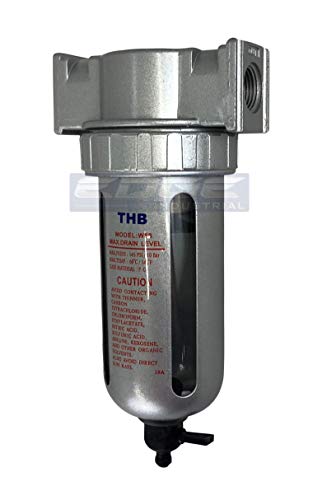
Semi-automatic drain valves provide another low-maintenance approach for air filtration bowls and line drip legs. Units like the 1/2″ Particulate filter water trap seperator from THB utilize a pressure-responsive semi-automatic drain mechanism. When the compressed air system is pressurized, the internal drain mechanism seals tightly to retain trapped moisture inside the 5-ounce polycarbonate bowl. Once the shop air system depressurizes at the end of the workday, the internal spring mechanism opens automatically to evacuate collected water.
This style of drain works exceptionally well for main distribution lines that experience regular daily shutdowns. The THB unit handles input pressures up to 175 PSI and maintains an airflow capacity of 106 CFM, making it suitable for stationary workshop plumbing. Its 5-micron filter element captures up to 95 percent of moisture droplets and particulate debris before air moves downstream. Operators can also manually discharge accumulated moisture during pressurized operation by bumping the bottom valve pin.
Early-Stage Particulate and Water Separation
While draining the receiver tank removes bulk standing water, compressed air leaving the tank remains saturated with aerosolized moisture. Installing a dedicated particulate filter and water separator directly at the tank discharge port captures water droplets before they enter distribution piping. As compressed air enters the filter housing, internal directional vanes spin the incoming air rapidly. Centrifugal force throws heavy water droplets and oil mist outward against the bowl walls, where they trickle down into a quiet zone.
The protective metal bowl guard on industrial separators shields polycarbonate bowls from shop impacts and flying debris. Filter elements rated at 5 microns stop rust scale, pipe debris, and liquid droplets from traveling further into the pneumatic network. Replacing these internal elements periodically ensures unimpeded airflow and prevents sudden line pressure drops during high-demand tool operation. Combining a clean tank drain with early-stage particulate filtration provides dual-layer moisture protection for workshop piping.
Point-of-Use Inline Filters for Air Tools
Pneumatic hand tools benefit greatly from compact moisture traps attached directly to the tool inlet. The LE LEMATEC Inline Air Compressor Water Separator mounts right before spray guns, blowers, or impact wrenches to catch residual line condensation. Weighing just 4.2 ounces with a compact 2.94-inch body, this filter minimizes wrist fatigue during extended automotive painting or sanding sessions. Its sintered bronze element separates fine water droplets, oil particles, and airborne dust without choking airflow.
Rated for operating pressures up to 200 PSI, this aluminum alloy unit provides heavy-duty defense against sudden pressure surges. A clear polycarbonate inspection bowl allows operators to visually monitor liquid collection throughout the workday. When moisture accumulates, a spring-loaded push-button valve at the base ejects liquid instantly without depressurizing the main air hose. Adding point-of-use filtration safeguards sensitive equipment against condensation that forms inside long distribution hoses downstream of the main compressor tank.
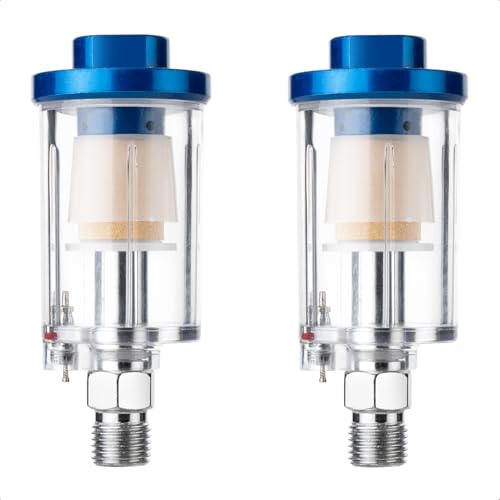
Another practical lightweight solution for everyday tool maintenance is the Air Dryer & Water Oil Separator for Compressor from Loyzen. Configured with standard 1/4-inch NPT threaded fittings, this inline moisture filter operates up to 90 PSI to provide clean air for light pneumatic nailers and hobby paint guns. Built with rust-proof aluminum and brass fittings, the clear housing allows instant monitoring of debris and liquid accumulation. A simple push-button release valve clears trapped contaminants quickly, prolonging tool lifespan without complicated maintenance steps.
Desiccant Inline Dryers for Moisture-Sensitive Finishing
Certain compressed air tasks demand ultra-dry air that mechanical centrifugal filters cannot achieve alone. Automotive topcoats, clear coats, plasma cutting, and delicate sandblasting require air stripped of vaporous humidity. The DEWALT Inline Dessicant Dryer with Viewing Window addresses this need by passing compressed air through moisture-absorbing chemical beads. Rated for system pressures up to 175 PSI with 3/8-inch NPT female ports, this dryer drops the dew point of the air to prevent any liquid condensation at the spray nozzle.
Integrated viewing windows allow painters to monitor the chemical condition of the desiccant material without dismantling the housing. As the desiccant beads absorb humidity from the airflow, they change color to signal when replacement or reactivation is required. The unit operates safely in ambient temperatures up to 140 degrees Fahrenheit and comes supplied with two desiccant material bags. Placing a desiccant dryer as the final stage behind a mechanical water trap ensures pristine, defect-free finishes on high-end automotive bodywork.
Combining Pressure Regulation with Moisture Separation
Comprehensive air preparation stations frequently integrate filtration, pressure regulation, and lubrication into a single modular block. The 1/4″ Compressor Air Filter Air Pressure Regulator by ZHONG AN combines moisture trapping with an adjustable diaphragm regulator and an atomizing lubricator cup. The locking top knob pulls up smoothly, allowing users to rotate clockwise to increase line pressure or counterclockwise to reduce output. Maintaining stable regulated pressure reduces tool wear and eliminates air velocity fluctuations that worsen moisture carryover.
The lubricator cup atomizes pneumatic oil into a fine mist that travels directly into rotary motors, ratchets, and reciprocating air tools. However, operators must take care to segregate lubricated lines from painting and plasma cutting lines. Running oily, moist air through spray paint guns ruins surface finishes and contaminates desiccant media. Installing dedicated drops or quick-disconnect bypasses allows workshops to supply lubricated air to mechanical tools while keeping finishing lines clean and completely dry.
Workshop Air Distribution Piping and Drip Legs
Proper garage air piping layout plays a vital mechanical role in moisture control. Air distribution pipes should always slope slightly back toward the compressor or toward dedicated drain legs, typically at an angle of one inch per ten feet of run. This gentle pitch allows condensed water inside the pipe to flow by gravity toward drain points rather than pooling near tool outlets. Smooth-walled piping materials like aluminum, copper, or black iron minimize flow friction and promote predictable condensate drainage.
Tool drop lines should always branch off the top of the main horizontal distribution header using an inverted tee or gooseneck bend. Taking air from the top of the pipe prevents gravity-bound water rolling along the bottom of the main line from entering tool hoses. Each vertical drop should extend six to twelve inches below the tool take-off fitting to create a dedicated drip leg. Capping these bottom drip legs with ball valves or automatic drains provides accessible collection points where trapped water can be purged without interrupting ongoing tool work.
Routine Purging Schedules and Preventive Habits
Establishing a disciplined compressor maintenance schedule is the single most effective way to eliminate tank water buildup. Portable pancake, hot dog, and twin-stack compressors should be drained manually at the conclusion of every working day. Opening the drain valve overnight prevents standing water from sitting against bottom weld seams during temperature drops. For stationary shop compressors running continuous industrial shifts, installing automated electronic drain valves eliminates reliance on manual routines.
In addition to daily draining, inspect mechanical filter bowls weekly for particulate scale and clear sediment accumulation. Replace 5-micron filter elements and desiccant media according to workload intensity or whenever visible discoloration occurs in sight glasses. Always check that safety relief valves snap open and close freely, confirming that overpressure protection remains intact. Combining consistent tank drainage with multi-stage inline filtration ensures your pneumatic power system delivers dry, reliable performance for years to come.
Removing moisture from an air compressor tank requires a comprehensive strategy that combines daily purging with appropriate inline separation accessories. By pairing accessible bottom drain valves with automated solenoids, mechanical water separators, and point-of-use desiccant dryers, workshop owners can completely eliminate water contamination. Keeping receiver tanks dry protects structural steel integrity, extends pneumatic tool longevity, and guarantees flawless painting and finishing results. Consistent maintenance habits transform compressed air from a wet, abrasive liability into a dependable, dry power source.
About the author
Tony Carrick is an experienced product researcher and writer specializing in tools, home improvement, automotive maintenance, and consumer equipment. With extensive experience reviewing tools and tackling hands-on renovation projects, he brings a buyer-focused perspective to compressor performance, usability, and overall value.