
Is a 3 Gallon Air Compressor Good: Practical Guide and Limits for 2026
Explore whether is a 3 gallon air compressor good for finish nailing, DIY repairs, and tire inflation, plus key CFM limits for October 2026.
 By Bob Beacham
Updated October 8, 2026
By Bob Beacham
Updated October 8, 2026

Matching workshop projects to the right pneumatic power supply often comes down to balancing tank reserve volume against physical portability. Many DIY homeowners and hobbyists wonder, is a 3 gallon air compressor good for routine household chores, finish carpentry, and garage tire inflation? A three-gallon capacity tank serves as an approachable middle ground between tiny tire inflators and cumbersome workshop tanks. These compact power units deliver sufficient air volume for low-consumption tools while remaining light enough to carry up ladders or store on utility shelves.
Understanding pump capabilities and air delivery volume is essential before hooking up air tools to a small reservoir. Most units in this size class feature oil-free pumps that produce modest air delivery rates between 0.6 and 2.2 CFM at 90 PSI. That output easily fires brad nailers, inflates vehicle tires, and clears dust around workbenches without tripping standard fifteen-amp household circuit breakers. However, continuous air-demand equipment like rotary sanders and paint sprayers will quickly overwhelm a small tank, making it crucial to evaluate your specific tool requirements.
| Award | Product | ACR Score About ACR ScoreThe ACR Score is our own rating from 0 to 10, based on performance, design and build, ease of use, and value. It reflects independent research and is never influenced by manufacturers, retailers, or affiliate commissions. Learn more › | |
|---|---|---|---|
| Best Overall |
STEALTH Air Compressor 3 Gallon
|
9.1/10 | Buy |
| Best Value |
 Portable Air Compressor with 3 Gallon Steel Tank
|
8.9/10 | Buy |
| Best Premium |
 ECOMAX Air Compressor 3 Gallon 110 PSI Pancake
|
8.8/10 | Buy |
| Best Budget |
 Ironton Oil-Free Pancake Air Compressor, 0.3 HP
|
8.6/10 | Buy |
 STEALTH Air Compressor 3 Gallon
|
8.1/10 | Buy | |
 FORNAX 3 Gallon Portable Air Compressor with Kits
|
8.0/10 | Buy | |
 FORNAX Pancake Air Compressor, 3 Gallon
|
7.8/10 | Buy | |
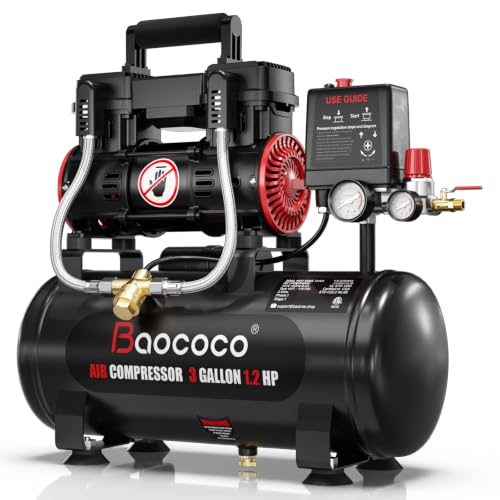 3Gallon Ultra Quiet Air Compressor with Two Quick
|
7.8/10 | Buy |
Evaluating the Capabilities and Limits of a 3 Gallon Air Compressor
Determining whether a three-gallon compressor suits your workshop begins with understanding its mechanical scale and practical output. A 3 gallon air compressor provides an efficient, portable solution for light pneumatic chores, but its value depends entirely on matching the air storage volume to the specific pneumatic tools you plan to operate. Homeowners tackling tire maintenance, craft projects, and trim installation often find this compact size ideal for their immediate needs. It bridges the gap between handheld cordless inflators and heavy stationary workshop units, offering a dedicated pressure vessel in a frame that is easy to transport.
Air equipment in this category focuses on convenience and mobility rather than raw, continuous air production. The compact tank acts as an air storage buffer that temporarily holds compressed volume generated by an electric motor and pump. When paired with tools that fire in quick bursts or require modest pressure, a small compressor operates reliably without taking up excess floor space. Examining the underlying engineering helps clarify where these machines succeed, how they behave under daily workloads, and where larger shop equipment becomes necessary.
How Air Storage Capacity and Usable Buffer Affect Pneumatic Tools
The three-gallon volume represents the total internal capacity of the pressure vessel, but usable air reserve depends on the operating pressure differential. In practice, the usable air reserve is dictated by the difference between the pump cut-out pressure and the lower cut-in threshold. Many compact models feature an auto cut-out threshold around 110 PSI to 115 PSI, while higher-pressure designs reach up to 150 PSI. When the tank drops to approximately 85 PSI during tool discharge, the pressure switch engages to restart the motor and rebuild the reserve.
Because three gallons is a relatively small storage reservoir, high-draw air tools will deplete the stored air in a matter of seconds. Once that pressurized reserve is exhausted, the connected pneumatic tool must rely solely on whatever volume the pump can generate in real time. For intermittent fasteners, the air buffer recovers during the brief pauses between shots, often refilling the tank in twenty to thirty seconds. For tools that run non-stop, an undersized buffer results in rapid pressure loss, tool stalling, and frustrating operational interruptions.
Realistic Air Delivery: Understanding CFM Ratings at 90 PSI
Air delivery volume, measured in cubic feet per minute at 90 PSI, serves as the most critical performance metric for any pneumatic setup. Manufacturer specifications for three-gallon units indicate air delivery rates that generally range between 0.6 SCFM and 2.2 CFM at standard operating pressures. Lower-powered motors delivering 0.6 to 0.8 CFM at 90 PSI provide adequate air for light nailing and inflation, but they offer little extra headroom for demanding tasks. Understanding this flow rating prevents buyers from expecting industrial air production from a compact, lightweight machine.
Models engineered with larger displacement pumps can deliver up to 2.2 CFM at 90 PSI or 116 PSI, expanding the practical range of home tasks they can support. This higher output allows the compressor to recover its pressure reserve much faster between cycles, keeping pace with faster nailing speeds. Even with improved pump displacement, buyers must recognize that small pumps cannot support tools requiring four or five CFM. Checking the CFM rating on your air tools before connecting them prevents premature motor wear and disappointing performance.
Motor Horsepower and Electrical Compatibility on Standard Circuits
Electric motors on three-gallon portable compressors typically feature continuous ratings ranging from 0.3 HP up to 1.2 HP. These motors are engineered to operate on standard 110V or 120V household branch circuits, making them exceptionally convenient for residential garages and home basements. Because these machines run on common fifteen-amp circuits, users can plug them in near workbenches without installing dedicated commercial electrical lines. This plug-and-play convenience makes them accessible for hobbyists who do not possess dedicated high-amperage workshop wiring.
Startup inrush current can occasionally create challenges on crowded residential circuits, particularly during colder winter months when pump components stiffen. Quality small compressors incorporate no-load cold-start valves and integrated thermal protection switches to prevent tripped circuit breakers. Units that feature low-amp startup mechanisms draw power smoothly, allowing the motor to reach full operational speed before the pump works against high internal tank head pressure. If extended reach is needed across a workspace, using a longer air hose rather than an electrical cord preserves voltage and prevents motor damage.
Operational Noise Levels: Quiet Technology Versus High-RPM Pumps
Operational sound output is one of the most noticeable distinctions across different compact air compressors. Traditional high-speed universal motors can spin at up to 4,950 RPM, generating noise levels around 89 decibels. In an enclosed garage, basement, or living space, an 89-decibel machine can create significant acoustic fatigue and make regular conversation difficult during extended compression cycles. The high pitch of these rapid motors can quickly become intrusive during home renovation projects.
Modern quiet air compressors address this issue by utilizing low-speed dual-piston configurations and thickened intake mufflers. These specialized sound insulation systems lower operational noise output to roughly 65 to 70 decibels, which sounds similar to normal household dialogue. Woodworkers and finish carpenters working inside occupied homes often prefer these low-noise units because they allow for productive indoor trim work without disturbing residents. Reinforced rubber isolator feet also reduce vibration transfer, keeping the chassis stable on concrete garage floors.
Form Factor Dynamics: Pancake Versus Hot Dog Configurations
Tank architecture plays a significant role in jobsite stability, storage footprint, and daily handling. Pancake compressors feature a flat, circular tank profile with a wide footprint that keeps the center of gravity low to the floor. This design minimizes the risk of accidental tipping when pulling on an air hose across an uneven jobsite or workshop floor. Models with low-profile pancake bases also incorporate molded cord wraps and fold-down carrying handles for straightforward storage on garage shelves.
Hot dog compressors utilize a cylindrical horizontal tank that aligns the motor and air vessel in a compact, linear arrangement. These units fit easily between narrow framing studs and take up minimal floor space in crowded utility closets or vehicle trunks. Both pancake and hot dog units weigh between 16 and 19 pounds, making them light enough for easy one-handed carrying. Some horizontal designs also include built-in wheels and extended pull handles, which simplify transport across driveways or active construction sites.
Manifold Configuration, Pressure Regulators, and Dual Coupler Usability
A well-designed air manifold transforms a basic pressure tank into a versatile pneumatic workstation. Compact compressors typically feature dual analog gauges that display tank pressure alongside regulated working line pressure. The tank gauge informs the operator of stored reserve volume, while the regulator knob allows precise calibration of airflow exiting through the discharge port. Proper regulator adjustment ensures that connected tools receive the exact operating pressure recommended by their manufacturers.
Dual quick-connect couplers on select three-gallon models significantly increase jobsite convenience. Having two separate output ports enables an operator to leave a tire inflator and a nail gun connected simultaneously, eliminating the need to swap fittings constantly. Dual couplers also allow two finish carpenters to run light pin nailers at the same time, provided combined air demand remains within the pump recovery threshold. High-flow brass or steel fittings minimize dynamic pressure drop across the manifold during rapid tool firing.
Pneumatic Tool Compatibility: What Runs Well and What Stalls
A three-gallon air compressor excels when powering intermittent pneumatic fasteners that require short bursts of air. Brad nailers, eighteen-gauge pin nailers, and crown staplers consume only a fraction of a cubic foot of air per actuation. Because the tool fires intermittently, the compressor tank easily maintains proper line pressure without continuous cycling. Hobbyists assembling furniture, building picture frames, or installing baseboards will find this tank size perfectly suited for their fastening tasks, allowing clean and consistent nail drive depth.
Vehicle maintenance chores also align well with the capabilities of a compact compressor. Inflating passenger car tires, motorcycle tires, sports balls, and bicycle tubes requires minimal air volume, making a small tank an excellent emergency inflation station. Using a blow gun for short dusting bursts across engine bays, lawnmower decks, or workshop machinery works reliably as well, provided the user allows short pauses for the pump to recover. These light maintenance chores match the intended duty cycle of portable oil-free pumps.
Conversely, continuous air-demand tools will quickly stall when connected to a small three-gallon compressor. Dual-action orbital sanders, pneumatic die grinders, cutoff wheels, and HVLP spray guns demand constant airflow exceeding six to twelve CFM. A small three-gallon reservoir will drain within a few seconds of continuous trigger pull, causing operating pressure to collapse and forcing the tool to stop. Attempting to run high-consumption equipment on a compact unit also overheats the pump, trips thermal overloads, and shortens motor life.
Essential Maintenance and Moisture Management for Steel Tanks
Maintaining an oil-free three-gallon compressor requires relatively little effort, but moisture management remains mandatory. When air is compressed, atmospheric moisture condenses inside the steel tank vessel due to changes in temperature and pressure. If water is allowed to accumulate over weeks or months, it accelerates internal tank rust and can travel downstream into connected air tools. Moisture entering pneumatic nailers washes away factory lubricants and causes internal O-rings to degrade prematurely.
Operators should drain accumulated moisture from the tank at the end of each working day. Most compact units feature a drain valve located on the bottom of the tank, which purges condensation when opened under low residual pressure. Depressurizing the tank fully before storage protects the integrity of the pressure vessel and ensures that air delivered to your pneumatic tools remains dry and clean. Checking the safety relief valve periodically by pulling the release ring confirms that mechanical overpressure protection remains functional.
Practical Buying Takeaway: When a 3 Gallon Compressor Makes Sense
Investing in a 3 gallon air compressor makes complete sense for homeowners, hobbyists, and mobile trim carpenters whose primary tasks involve tire inflation, light cleaning, and intermittent nail gun operation. The combination of modest weight, low storage footprint, and standard electrical compatibility provides outstanding utility for everyday maintenance and small renovation projects. Selecting a model with a low-decibel rating further improves comfort when working in shared residential spaces, basements, and apartment workshops.
If your planned projects include continuous air tool usage, such as auto body sanding, abrasive blasting, or automotive spray painting, a larger air compressor with a twenty-gallon or sixty-gallon tank is required. However, for users who need a nimble, portable machine ready for fast setup and zero pump oil maintenance, a quality three-gallon compressor delivers the exact balance of performance and practicality needed for everyday DIY work. Matching your tool consumption to the realistic output of the machine guarantees years of reliable, trouble-free operation.
About the author
Bob Beacham is an experienced tools and workshop writer with deep knowledge of power equipment, mechanical systems, and practical DIY applications. His coverage of air compressors, welding equipment, saws, and workshop tools helps translate technical specifications into useful guidance for homeowners and serious DIYers.