
How to Work an Air Compressor: Step-by-Step Guide for 2026
Master how to work an air compressor in October 2026 with pre-start checks, regulator setup, tool connections, and daily tank draining routines.
 By Clint DeBoer
Updated October 8, 2026
By Clint DeBoer
Updated October 8, 2026

Pneumatic power transforms routine garage chores and intensive jobsite tasks by converting electrical energy or direct current into stored mechanical pressure. Learning how to work an air compressor correctly prevents common mechanical frustrations such as motor stalling, continuous unloader hissing, and sudden line pressure drops during critical fastening or inflation work. Whether you are running a high-pressure electric pancake tank or a compact twelve-volt portable tire inflator, following a disciplined startup sequence and understanding regulated output pressure guarantees consistent airflow without overloading your workshop circuits.
Every pneumatic system operates around a delicate balance between total tank air volume, pump recovery speeds, and delivered air volume measured in cubic feet per minute. Overlooking fundamental operational procedures often leads to blown household fuses, moisture contamination inside pneumatic tools, or severe pump overheating on high duty cycles. Mastering your machine’s pressure gauges, quick-connect couplers, and bottom drain valves allows you to run pneumatic nailers, paint sprayers, and tire chucks with complete confidence and safety.
| Award | Product | ACR Score About ACR ScoreThe ACR Score is our own rating from 0 to 10, based on performance, design and build, ease of use, and value. It reflects independent research and is never influenced by manufacturers, retailers, or affiliate commissions. Learn more › | |
|---|---|---|---|
| Best Overall |
DEWALT Tire Inflator, Portable Air Compressor
|
9.1/10 | Buy |
| Best Budget |
 GSPSCN Digital Tire Inflator 12V Heavy Duty Metal
|
8.8/10 | Buy |
 4PCS Air Nozzle Blow Gun Kit for Compressor
|
8.6/10 | Buy | |
| Best Value |
 Ironton 3-Gallon Oil-Free Pancake Air Compressor
|
8.6/10 | Buy |
| Best Premium |
 Metabo HPT 6-Gallon Pancake Air Compressor Review
|
8.6/10 | Buy |
 Hromee 20-Piece Brass Air Hose Fittings Kit
|
8.4/10 | Buy | |
 VIAIR 88P 00088 12V Portable Air Compressor Kit
|
8.4/10 | Buy | |
 DEWALT DWFP55130 2.5-Gallon 200 PSI Quiet Trim Air
|
8.4/10 | Buy | |
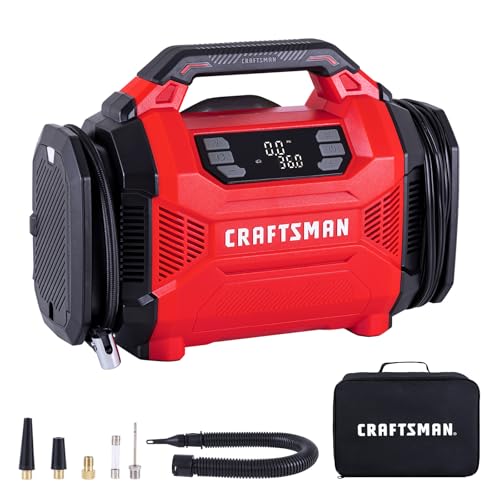 CRAFTSMAN Dual Power Tire Inflator with
|
8.1/10 | Buy |
Ironton 3-Gallon Oil-Free Pancake Air Compressor
The Ironton 3-Gallon Oil-Free Pancake Air Compressor combines a 0.3 HP motor and 110 PSI max pressure with an ultra-portable 20.6-pound frame and fold-down handle. It is a practical, low-maintenance option for DIY homeowners and hobbyists handling light brad nailing, stapling, and tire inflation.
Pros
- Lightweight 20.6-pound build with a fold-down carry handle makes one-handed portability nearly effortless
- Wide pancake base delivers outstanding stability with a low center of gravity to prevent tipping
- Zero-maintenance oil-free pump means clean discharge air and no messy oil changes
- Protective shroud includes convenient molded wraps for both the power cord and air hose
- Large regulator knob and quick-connect coupler allow fast, intuitive line adjustments
Cons
- Modest 0.3 HP motor and 110 PSI ceiling cannot support continuous high-CFM air tools like sanders or sprayers
- 3-gallon capacity requires occasional recovery pauses during rapid fastener firing
- Bare-tool setup does not include an air hose, tire chuck, or pneumatic nailer out of the box
Metabo HPT 6-Gallon Pancake Air Compressor Review
The Metabo HPT EC711S is a portable 6-gallon pancake air compressor delivering 2.8 CFM at 90 PSI with a 165 PSI tank ceiling and an operating sound level of 73 dB. With its quick 46-second recovery cycle and dual quick couplers, it is an excellent choice for finish carpenters, punch-list contractors, and DIYers running pneumatic nailers.
Pros
- 73 dB operational sound rating is substantially quieter than standard job-site pancake units
- 165 PSI maximum pressure provides ample air storage with a swift 46-second recovery cycle
- Two 1/4-inch universal quick couplers support multi-tool setups right out of the box
- Sturdy steel roll cage protects gauges and the manifold assembly against knocks and drops
- Oil-free 1.0 HP motor ensures low maintenance and reliable cold-weather motor startup
Cons
- At 38.5 lbs, it is slightly heavier than ultra-compact 1-to-3-gallon trim compressors
- Airflow of 2.8 CFM at 90 PSI is designed for intermittent fastening, not continuous rotary tools or paint sprayers
- Bare-tool configuration means air hoses and pneumatic fastening tools must be purchased separately
Hromee 20-Piece Brass Air Hose Fittings Kit
This 20-piece pneumatic accessory kit provides solid brass 1/4-inch NPT industrial couplers and plugs alongside clean-up, inflation, and hose repair tools. It serves as an accessible starter setup for garage DIYers and homeowners looking to equip a utility air compressor.
Pros
- Solid brass couplers and plugs deliver dependable rust resistance compared to bare steel and greater wear tolerance than aluminum
- Broad selection of utility attachments covers dusting, tire inflation, tool swapping, and unexpected hose punctures in one package
- Includes dedicated brass splicing barbs and stainless steel hose clamps for quick emergency repairs on 1/4-inch to 5/8-inch air hoses
- Compact clear storage box keeps small fittings organized and prevents lost adapters in busy garage environments
Cons
- Included pencil tire gauge only measures between 10 and 50 PSI, excluding high-pressure truck or trailer tires
- Standard 1/4-inch Industrial fitting profile may restrict airflow volume on high-CFM pneumatic tools like 1/2-inch impact wrenches
- Thread sealant or PTFE tape is not included and must be sourced separately to ensure airtight NPT connections
DEWALT DWFP55130 2.5-Gallon 200 PSI Quiet Trim Air
The DEWALT DWFP55130 delivers a capable 3.0 SCFM at 90 PSI with a 200 max PSI 2.5-gallon tank, running at a quiet 71.5 dBA on an efficient 12-amp motor. It is an ideal pneumatic power source for trim carpenters, punch-list contractors, and DIYers working on residential circuits.
Pros
- Delivers 3.0 SCFM at 90 PSI with a high 200 max PSI ceiling for rapid pressure recovery during sequential fastening
- Quiet 71.5 dBA sound output makes indoor trim carpentry and remodeling far less disruptive to homeowners
- Low 12-amp draw reduces breaker trips when running on shared 15-amp household circuits
- Integrated roll cage and console protect critical components while supporting horizontal or vertical operation
- Dual quick couplers allow two trim carpenters to connect and work off a single compressor
Cons
- Bare-tool configuration means you must supply your own air hoses, couplers, and pneumatic nail guns
- At 36 pounds, it is heavier to haul up flights of stairs than ultra-compact 1-gallon finish compressors
- Air output of 3.0 SCFM is built for intermittent finish fastening and will not support continuous tools like rotary sanders or sprayers
Operating an Air Compressor: Setup, Safety, and System Controls
Operating a pneumatic power system safely requires understanding how mechanical compression creates stored pneumatic energy. Every compressor draws ambient air through an intake filter, compresses it within a cylinder or chamber, and directs the pressurized air into a storage tank or straight into an application hose. Taking time to learn the controls, gauges, and safety mechanisms prevents equipment damage and protects against workplace accidents. This guide outlines the exact sequence for starting, regulating, using, and shutting down your air compressor.
Inspecting Mechanical Components and Pump Oil Before Starting
A thorough visual check before connecting power ensures your compressor runs without mechanical failure. If you are operating an oil-lubricated cast-iron pump, verify the pump oil level through the transparent sight glass or dipstick before flipping the power switch. Oil-free units, such as modern pancake compressors, eliminate this step because their pistons feature low-friction coated rings. Regardless of pump architecture, inspect the physical machine frame, ensuring rubber isolator feet remain intact to absorb motor vibrations during operation.
Inspecting the primary safety hardware takes only a few seconds but prevents hazardous pressure overloads. Locate the ASME safety relief valve on the manifold and briefly pull the brass ring to ensure the internal spring moves freely. If the ring feels stuck or corroded, replace the valve before pressurizing the vessel. Finally, check the condensation drain valve at the bottom of the air tank to verify it is fully closed before you introduce electrical power.
Managing Electrical Demands and Power Source Selection
Electric stationary and jobsite air compressors draw significant electrical current, especially during the initial startup cycle. Induction motors often pull a heavy startup inrush amperage that can easily trip a standard fifteen-amp household circuit breaker. To prevent breaker trips, connect your compressor directly to a dedicated twenty-amp outlet whenever possible. Never connect multiple heavy power tools to the same circuit while the compressor pump is running.
Using standard, lightweight extension cords is one of the most common mistakes operators make on jobsites. Long, thin cords create a severe voltage drop that starves the electric motor of power, causing it to overheat or stall under pressure. If you must work far from an electrical outlet, leave the compressor plugged into the wall and run a longer air hose to your workspace instead. Stored air moves through extra hose length with minimal pressure loss, whereas electric motors suffer immediate damage from low voltage.
Twelve-volt portable tire inflators require a completely different approach to electrical supply management. High-output metal compressors designed for off-road or truck tires draw too much current for standard vehicle accessory sockets and can blow internal car fuses. These heavy-duty inflators include heavy-gauge battery cables with alligator clamps that must attach directly to the vehicle battery terminals. Running the vehicle engine while operating a twelve-volt inflator keeps the electrical system voltage steady and prevents accidental battery drainage.
Initial Pressurization and Reading Pressure Gauges
Once plugged into an appropriate power source, turn the power switch to the on position to start the pressurization cycle. As the electric motor drives the pump pistons, ambient air is forced into the sealed steel tank. Most workshop compressors feature two distinct dials on the control manifold: the tank pressure gauge and the regulated line pressure gauge. The tank pressure gauge displays the actual volume of pressurized air stored inside the vessel.
The automatic pressure switch monitors internal tank pressure and governs the motor operation. When the storage tank reaches its factory cut-out threshold, typically between one hundred ten and one hundred sixty-five PSI, the pressure switch cuts electrical power to the motor. As the motor stops, you should hear a brief, sharp hiss of escaping air from the unloader valve. This quick venting depressurizes the pump head so the motor can start freely during the next cycle without fighting trapped head pressure.
Setting the Pressure Regulator for Pneumatic Air Tools
Delivering full tank pressure directly to pneumatic tools can rupture internal seals, ruin workpieces, and cause dangerous tool blowouts. The regulated line pressure gauge indicates the specific airflow pressure traveling through the discharge coupler to your air hose. To adjust working pressure, turn the oversized regulator knob clockwise to increase outlet PSI or counterclockwise to reduce output. Always refer to your pneumatic tool’s operating manual to confirm its recommended operating pressure range.
Pneumatic finish nailers typically require between seventy and ninety PSI, while air blow guns and tire chucks often operate at lower pressures. However, setting the regulator while the tool sits idle will cause dynamic pressure drop when you pull the tool trigger. To calibrate accurately, turn the regulator knob while briefly depressing the tool trigger or activating an air blow nozzle. Adjusting the dial while air flows compensates for friction loss inside the hose and ensures proper working pressure under load.
Understanding the distinction between air pressure and air delivery volume is essential when pairing tools to your compressor. Pressure, measured in PSI, represents the force delivered to the tool, while airflow volume, measured in cubic feet per minute, represents the continuous quantity of air supplied. Intermittent tools such as brad nailers consume minimal CFM and operate well on small pancake compressors. In contrast, continuous air tools like rotary sanders or paint sprayers consume high CFM volumes that can quickly outpace a compact pump, causing regulated pressure to plummet mid-job.
Connecting Hoses, Couplers, and Quick-Disconnect Fittings
Secure connections prevent line blowouts and stop wasteful air leaks that force the compressor to cycle continuously. Most consumer and professional compressors utilize standard one-quarter-inch NPT brass quick-connect couplers on the manifold. To connect an air hose, pull back the spring-loaded outer collar on the female coupler, firmly push the male plug into the sleeve, and release the collar until it snaps locked. Give the hose a gentle tug to verify that the locking balls have engaged the male fitting completely.
Threaded fittings between air hoses, manifolds, and tool inlets must be sealed against high-pressure leaks. Wrap two to three layers of Teflon thread tape clockwise around the male threads before threading components together. Threading without sealant allows microscopic gaps that continuously bleed tank pressure and waste electrical energy. If you hear a steady hissing sound at any connection point, depressurize the system and reseal the threaded joint before resuming work.
Running Jobsite Tanks Versus Compact Twelve-Volt Tire Inflators
Standard jobsite compressors store air inside a pressurized tank to buffer intermittent bursts of high airflow, such as driving framing nails. Compact twelve-volt tire pumps operate as direct-drive machines without a storage tank, feeding compressed air continuously straight into the tire stem. Modern digital tire inflators feature preset modes for automobiles, bicycles, motorcycles, and sports balls. You simply select the target pressure on the digital screen, attach the brass chuck to the valve stem, and press start.
Digital inflators simplify roadside operation by using integrated sensors that trigger an automatic shut-off once target pressure is met. Unlike large workshop compressors equipped with continuous-duty motors, compact portable inflators have strict duty cycle ratings. A direct-drive pump rated for twenty-five minutes of continuous operation must rest to cool down before inflating another set of heavy tires. Ignoring duty cycle limits can overheat the small piston assembly and cause premature motor failure.
Safe Disconnection and Complete System Depressurization
Shutting down an air compressor correctly is just as critical as the initial startup procedure. Always turn the master power switch to the off position before pulling the electrical cord from the wall outlet. Turning off the switch allows the unloader valve to release head pressure cleanly, preparing the machine for its next start. Disconnecting power while the motor runs can pit electrical contacts and leave trapped pressure against the pump piston.
Never disconnect an air hose or pneumatic tool while the discharge line remains under high pressure. Trapped air can turn the hose end into an uncontrollable whip that damages equipment or causes physical injury. To depressurize safely, squeeze the tool trigger or activate an air blow gun until all residual line pressure drops to zero. Once both the line gauge and tool indicate zero pressure, slide back the coupler sleeve to release the hose safely.
Purging Internal Moisture Condensation from Storage Tanks
Ambient air contains natural humidity that condenses into liquid water inside the steel tank during compression. Warm, compressed air cools against the steel tank walls, causing water droplets to collect at the lowest point of the cylinder. Leaving condensation inside the tank causes severe internal corrosion that weakens the steel walls over time. In addition to damaging the tank, moisture travels down the air line, contaminating paint finishes and washing away internal lubricants from air tools.
Draining moisture at the end of every operating session is the single most important maintenance step for tank longevity. With the compressor turned off and line pressure reduced below thirty PSI, locate the drain valve at the very bottom of the tank. Slowly open the quarter-turn brass ball valve or twist the thumb petcock counterclockwise, allowing rusty water and pressurized air to vent into a catch basin. Keep the valve open until only dry air escapes, then close it securely to prepare the machine for future use.
For applications requiring exceptionally dry air, such as spray finishing or plasma cutting, relying solely on tank draining is insufficient. Operators working in humid climates should install an in-line moisture separator or desiccant filter between the tank discharge port and the air hose. These filter bowls trap suspended vapor droplets before they enter the tool mechanism. Inspect the filter bowl regularly during extended work sessions and press the bottom release pin to purge collected water before it overflows into your air line.
Diagnosing Common Operational Faults and Cycling Failures
When an air compressor fails to operate normally, observing the symptoms narrows down the mechanical or electrical cause quickly. If the electric motor hums loudly upon startup and trips the circuit breaker, trapped air pressure is likely holding the piston in place. This problem usually stems from a faulty one-way tank check valve that leaks tank pressure backward into the pump head. Replacing the brass check valve allows the unloader mechanism to dump head pressure properly and lets the motor spin freely.
Another common operational issue is continuous air hissing from the unloader valve port long after the motor has shut off. Operators often assume the unloader valve itself is broken, but the true culprit is almost always the in-tank check valve failing to seat closed. If the compressor runs continuously without reaching its cut-out pressure, check for dirty intake air filters, loose fittings, or worn reed valves inside the pump head. Keeping intake filters clean and replacing worn seals maintains rapid recovery times and prevents thermal overload shutdowns.
Operating an air compressor successfully comes down to establishing consistent habits across every phase of use. Taking time for pre-start inspections, matching regulator pressure to tool ratings, managing electrical circuit loads, and purging condensation daily keeps your equipment running smoothly for years. Whether you are inflating tires on the trail or driving nails in the shop, disciplined operation ensures reliable pneumatic performance and safe working conditions every time you power on the pump.
About the author
Clint DeBoer is an experienced tool-industry specialist with decades of involvement in technical media, hands-on product evaluation, and testing methodology. His focus on performance, practical usability, and data-driven comparisons makes his expertise highly relevant to professional air compressors, pneumatic tools, and workshop equipment.