
How Does a Two Stage Air Compressor Work: Practical Workshop Guide for 2026
Learn how does a two stage air compressor work to boost pneumatic tool power and workshop efficiency in this October 2026 practical guide.
 By Clint DeBoer
Updated October 8, 2026
By Clint DeBoer
Updated October 8, 2026

Operating pneumatic tools like dual-action sanders, paint sprayers, or heavy impact wrenches in an active shop demands consistent airflow without severe pressure drop. When standard single-stage compressors struggle to maintain sustained pressure or run excessively hot under continuous demand, understanding how does a two stage air compressor work becomes essential for workshop productivity. Rather than compressing ambient air in a single stroke, these heavy-duty machines divide the mechanical workload between two distinct compression steps separated by an intercooler. Exploring single and twin cylinder compressor designs helps clarify why having multiple pistons does not automatically mean a compressor operates in two stages.
This stepped mechanical process allows two-stage pumps to generate significantly higher storage pressures, often reaching 175 PSI compared to the typical 135 to 150 PSI limit of single-stage units. The higher storage pressure creates a denser air reserve inside an ASME-certified vertical storage tank, giving your air tools a broader operating buffer before the motor must cycle back on. In this practical guide, we examine the mechanical cycle, the critical role of intermediate cooling, and the workshop benefits that make two-stage compression effective for demanding pneumatic applications.
| Award | Product | ACR Score About ACR ScoreThe ACR Score is our own rating from 0 to 10, based on performance, design and build, ease of use, and value. It reflects independent research and is never influenced by manufacturers, retailers, or affiliate commissions. Learn more › | |
|---|---|---|---|
| Best Overall |
DEWALT 60-Gallon Vertical Electric Stationary Air
|
9.2/10 | Buy |
| Best Premium |
 HPDMC 13HP Gas Air Compressor 24CFM 180PSI
|
9.1/10 | Buy |
| Best Value |
 Campbell Hausfeld 60-Gallon Air Compressor
|
8.9/10 | Buy |
| Best Budget |
 GSPSCN Digital Tire Inflator 12V Heavy Duty Metal
|
8.8/10 | Buy |
 Campbell Hausfeld 80-Gallon Air Compressor, 5 HP
|
8.8/10 | Buy | |
 Metabo HPT 6-Gallon Pancake Air Compressor Review
|
8.6/10 | Buy | |
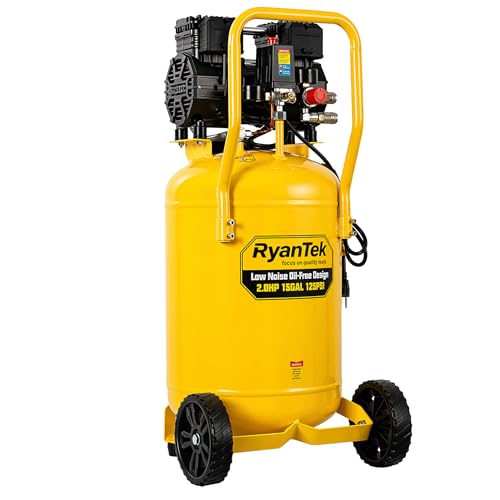 RyanTek 15-Gallon Air Compressor, 2HP, Quiet 66dB
|
8.6/10 | Buy | |
 NorthStar Air Compressor Pump, 175 Max. PSI
|
8.6/10 | Buy | |
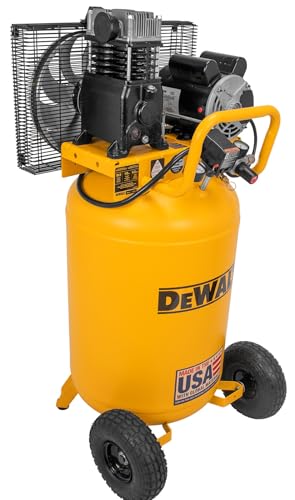 DEWALT 30-Gallon Vertical Portable Electric Air
|
8.3/10 | Buy | |
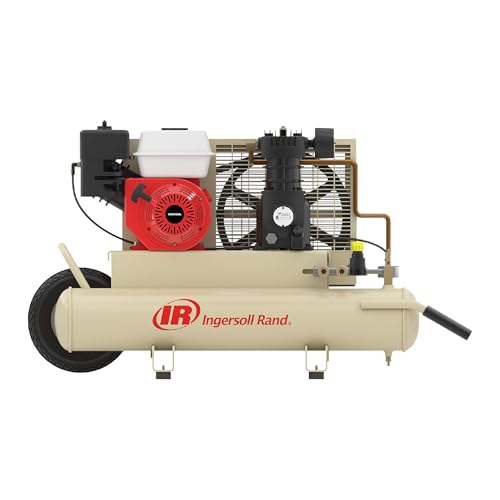 Ingersoll Rand SS3J5.5GH-WB 5.5 HP Gas Air
|
8.3/10 | Buy |
Campbell Hausfeld 60-Gallon Air Compressor
Built for demanding garage and workshop tasks, this stationary compressor combines a 3.7 HP motor with a two-stage cast-iron pump reaching 175 PSI. It provides steady airflow to support high-demand air tools like sprayers, grinders, and sanders.
Pros
- High 175 PSI maximum output pressure
- Durable cast-iron pump rated for longevity
- Large 60-gallon capacity supports sustained pneumatic tool use
- Vertical tank design saves workshop floor space
Cons
- Requires a dedicated 230V to 240V electrical connection
- Heavy 255-pound stationary build is difficult to move
Metabo HPT 6-Gallon Pancake Air Compressor Review
The Metabo HPT EC711S is a portable 6-gallon pancake air compressor delivering 2.8 CFM at 90 PSI with a 165 PSI tank ceiling and an operating sound level of 73 dB. With its quick 46-second recovery cycle and dual quick couplers, it is an excellent choice for finish carpenters, punch-list contractors, and DIYers running pneumatic nailers.
Pros
- 73 dB operational sound rating is substantially quieter than standard job-site pancake units
- 165 PSI maximum pressure provides ample air storage with a swift 46-second recovery cycle
- Two 1/4-inch universal quick couplers support multi-tool setups right out of the box
- Sturdy steel roll cage protects gauges and the manifold assembly against knocks and drops
- Oil-free 1.0 HP motor ensures low maintenance and reliable cold-weather motor startup
Cons
- At 38.5 lbs, it is slightly heavier than ultra-compact 1-to-3-gallon trim compressors
- Airflow of 2.8 CFM at 90 PSI is designed for intermittent fastening, not continuous rotary tools or paint sprayers
- Bare-tool configuration means air hoses and pneumatic fastening tools must be purchased separately
The Mechanical Principles and Workshop Advantages of Two-Stage Compression
A two-stage air compressor functions by compressing air in two sequential steps rather than forcing atmospheric air straight into the tank in a single stroke. This staged mechanical workflow utilizes two distinct cylinders of differing bore diameters connected by a finned intercooler tube. Dividing the mechanical workload enables the pump head to produce significantly higher pressures while operating at cooler temperatures than standard single-stage designs. Understanding this internal operation helps shop owners configure reliable pneumatic air systems that easily handle heavy continuous workloads.
The Fundamental Mechanical Cycle of Staged Air Compression
The compression process begins when atmospheric air enters the pump head through an external intake filter. During the downward stroke of the first piston, an intake reed valve opens to draw atmospheric air into a large-diameter low-pressure cylinder. As the piston ascends, it compresses the captured air to an intermediate pressure range between 40 and 90 PSI. Once this intermediate pressure is reached, the primary exhaust valve opens, pushing the warm, pressurized air out of the cylinder bore.
Instead of heading directly into the storage receiver, this partially compressed air travels through a finned copper or aluminum intercooler tube toward the second cylinder. The second piston, which operates inside a noticeably smaller bore diameter, draws this pre-compressed air in during its intake cycle. As this high-pressure cylinder piston rises, it completes the second compression phase, multiplying the air pressure up to a maximum threshold of 175 or 180 PSI. Finally, the pressurized charge pushes through a heavy-duty discharge valve and a one-way tank check valve into the steel storage tank.
The Thermodynamic Purpose of Intercooling Between Stages
Compressing any gas naturally generates intense heat as air molecules are rapidly forced into a smaller volume. In a single-stage system, trying to reach extreme pressures in a single stroke creates excessive pump head temperatures that can rapidly degrade lubricating oil and cause reed valves to warp. Two-stage engineering resolves this thermal dilemma by integrating a finned intercooler between the low-pressure and high-pressure cylinders. Air passing through this external finned tube sheds substantial thermal energy into the surrounding shop atmosphere before entering the second stage.
Cooling the air between cycles provides a tremendous thermodynamic benefit rooted in basic physical gas laws. Cooler air is significantly denser than hot air, which means the smaller second-stage cylinder can pack more air mass into each high-pressure stroke. Lower operating temperatures also prevent internal oil carbonization and reduce the thermal stress placed on critical internal pump components. Advanced replacement pumps like the NorthStar two-stage pump highlight this cooling efficiency by utilizing V-style cylinder orientations and floating-type Swedish steel valves to maximize passive heat transfer.
Differentiating Two-Stage Systems from Dual-Cylinder Single-Stage Pumps
A widespread misunderstanding among air compressor buyers is assuming that any pump with two cylinders operates as a two-stage machine. In reality, many dual-cylinder units operate as single-stage compressors where both pistons work in parallel rather than in series. In a dual-cylinder single-stage setup, both pistons are typically identical in diameter, and each cylinder pulls atmospheric air directly from the intake filter to discharge simultaneously into the tank manifold. Machines like the Campbell Hausfeld 80-gallon 5 HP compressor utilize two parallel cylinders to deliver massive volume at 140 PSI without staging the compression.
A true two-stage pump is visually distinguished by unequal cylinder sizes and the presence of a connecting intercooler tube. The first-stage cylinder must have a substantially larger diameter because it draws in low-density ambient air, whereas the second cylinder is smaller to compress dense, pre-pressurized air. If you observe two identical cylinders feeding straight into a common exhaust header, the unit is operating as a parallel single-stage machine regardless of cylinder count. When evaluating workshop equipment, checking workshop air compressor sizing will clarify whether your shop requires higher working pressure or simply high volume delivery.
Why 175 PSI Maximum Pressure Delivers a Greater Usable Air Buffer
Single-stage compressors typically cut out between 125 and 150 PSI, whereas two-stage industrial compressors routinely reach 175 to 180 PSI. This extra 25 to 50 PSI difference might seem minor on a specification sheet, but it represents a dramatic increase in stored pneumatic energy. Because air is compressible, storing air at 175 PSI maximum pressure packs roughly one-third more air mass into the exact same tank volume compared to a 135 PSI cutoff. Stationary units such as the Campbell Hausfeld 60-gallon two-stage compressor leverage this 175 PSI capacity to deliver 7.6 SCFM at 90 PSI and 6.9 SCFM at 175 PSI.
This heightened storage pressure creates a wider usable buffer between the compressor cut-out pressure and cut-in threshold. Most workshop pneumatic tools require a stable line pressure of 90 PSI to maintain full operating torque and speed. When your tank pressure switch is calibrated with a 175 PSI cut-out and a 140 PSI cut-in, the tank pressure never dips close to the 90 PSI tool regulator setting during heavy tool cycling. This extended buffer prevents pressure drops and tool starvation while allowing the motor to rest longer between pump recovery cycles.
Heavy Cast-Iron Pump Construction and Low-RPM Operating Life
Two-stage compressor pumps are predominantly built with solid cast-iron crankcases, cylinders, and heads to withstand the mechanical forces of high-pressure compression. Premium designs often incorporate dense FC35 grade cast iron and replaceable cylinder sleeves that resist continuous thermal and mechanical friction. Unlike small consumer-grade oil-free compressors that spin at 3,400 RPM and generate loud high-pitch noise, stationary two-stage cast-iron pumps are engineered to run at significantly slower rotational speeds. Slower pump speeds between 800 and 1,000 RPM produce far less operating vibration, lower internal friction, and deeper, more tolerable exhaust notes.
The gas-powered HPDMC 13HP compressor illustrates this engineering approach by pairing a heavy three-cylinder cast-iron pump with a slow 880 RPM operational speed to produce 24 CFM at 180 PSI. Slower rotating speeds dramatically extend the service life of internal crank bearings, wrist pins, and compression rings. Splash lubrication systems continuously coat internal contact points with oil, preventing premature metal-on-metal wear during long production shifts. As a result, industrial cast-iron two-stage pumps are routinely rated for thousands of operating hours before requiring valve overhauls or cylinder rebuilds.
Understanding Valve Design and Volumetric Efficiency in Two-Stage Pumps
The internal valving inside a two-stage pump head plays a decisive role in maintaining high volumetric efficiency under extreme pressure. In standard pumps, high compression ratios place immense mechanical stress on thin reed valves, leading to flutter, fatigue, and eventual pressure blow-by. Two-stage engineering divides the overall compression ratio between the two cylinders, allowing each set of valves to operate under much milder pressure differentials. High-grade Swedish steel floating valves and precision-ground valve plates open and seal cleanly with every stroke, preventing compressed air from leaking back into the intake stream.
Lower valve stress directly translates into higher volumetric efficiency, meaning a larger percentage of the cylinder volume is successfully discharged on each cycle. Because the high-pressure cylinder receives air that is already compressed and cooled, the pump displaces air far more effectively than a single-stage pump attempting to force air against high tank pressure. This mechanical efficiency prevents the dramatic drop in CFM output that single-stage units experience as the receiver tank approaches its maximum cutoff pressure. Maintaining consistent airflow right up to full shutoff pressure allows two-stage compressors to cycle off faster and recover tank pressure with remarkable speed.
Sizing Air Delivery for Continuous Versus Intermittent Air Tools
Matching your compressor capacity to your actual tool consumption profile is vital when setting up a functional pneumatic workspace. Intermittent air tools such as framing nailers, brad nailers, and ratchet wrenches consume short bursts of air followed by natural pauses. These intermittent tasks place minimal continuous demand on a pump, allowing smaller portable single-stage compressors to keep up easily. Continuous pneumatic tools like random orbital sanders, high-volume low-pressure spray guns, and abrasive blast cabinets demand massive continuous CFM demand without interruption.
Running a continuous orbital sander that requires 10 to 12 CFM at 90 PSI will rapidly drain a standard single-stage receiver and force an undersized motor to run continuously. A heavy-duty stationary setup like the DEWALT 60-gallon vertical compressor delivers 11.5 CFM at 90 PSI with a 175 max PSI tank, providing the continuous throughput required to keep continuous finishing tools from bogging down. If multiple technicians operate air tools simultaneously on a shared piping loop, plumbing stationary workshop compressors into a unified manifold can double system air reserves while balancing pump runtimes.
Electrical Demands and Dedicated Power Requirements for Workshop Installations
Stationary two-stage air compressors rely on powerful electric motors, typically ranging from 3.7 to 5 running horsepower or higher. Powering motors of this size requires dedicated 208-volt, 230-volt, or 240-volt single-phase electrical lines capable of handling substantial continuous amperage draw. Many commercial-grade units feature spread-volt electric induction motors designed to adapt seamlessly across 208V and 230V service panels commonly found in residential garages and commercial shops. Attempting to run large stationary equipment on shared or undersized branch circuits will inevitably cause nuisance breaker tripping and potential motor winding damage.
Electric induction motors demand an initial burst of inrush current during startup that can be two to three times higher than their steady running amperage. Installing an unloader valve on the compressor manifold is critical because it bleeds trapped head pressure from the discharge tube when the pressure switch cuts out. Relieving this trapped pressure ensures the heavy two-stage pump starts completely unloaded during its next cycle, minimizing startup strain on the motor capacitors and branch breakers. In remote service trucks or field jobsites without high-voltage grid power, gas-powered engines with electric start provide an effective alternative for running heavy two-stage pumps.
Essential Maintenance Procedures to Protect Two-Stage Pump Internals
Protecting your investment in a two-stage air compressor requires consistent attention to basic mechanical maintenance and moisture purging routines. Because these pumps generate substantial compression heat and moisture drop, daily moisture draining of the steel ASME receiver tank is essential. As compressed air cools inside the tank, atmospheric humidity condenses into liquid water at the bottom of the vessel. Neglecting daily draining leads to accelerated internal tank rust and sends unwanted moisture through your air lines, ruining fine spray paint finishes and corroding internal pneumatic tool motors.
Monitoring and changing the pump crankcase oil is equally critical for preserving two-stage longevity. Manufacturers recommend high-grade non-detergent air compressor oil or specialized synthetic blends that do not foam under rapid piston agitation. Checking the oil level through the crankcase sight glass before every major work session ensures the connecting rods and wrist pins stay properly lubricated. In addition, keeping the intake filter clean and periodically blowing dust off the exterior intercooler fins guarantees optimal cooling airflow across the cylinder heads during extended operations.
Practical Guidance for Selecting the Right Workshop Compression System
Deciding whether to invest in a two-stage compressor ultimately depends on your pneumatic tool lineup, operating duty cycle, and storage space. If your daily tasks center on tire inflation, light nailing, and occasional impact wrench use, a standard single-stage compressor provides ample volume without requiring dedicated 230V electrical wiring. When your work shifts to continuous sanding, vehicle restoration, abrasive blasting, or multi-operator production, the 175 PSI storage buffer and cool-running durability of a two-stage cast-iron pump become indispensable. Matching the mechanical strengths of two-stage compression to your shop demands ensures consistent pneumatic performance, minimal downtime, and decades of reliable service.
About the author
Clint DeBoer is an experienced tool-industry specialist with decades of involvement in technical media, hands-on product evaluation, and testing methodology. His focus on performance, practical usability, and data-driven comparisons makes his expertise highly relevant to professional air compressors, pneumatic tools, and workshop equipment.