
How Much Air Compressor for Impact Wrench: Sizing Guide for 2026
Understand how much air compressor for impact wrench demands you need in October 2026, covering CFM ratings, tank sizes, and operating pressures.
 By Clint DeBoer
Updated October 8, 2026
By Clint DeBoer
Updated October 8, 2026
Operating a pneumatic impact wrench without sufficient air supply leads to immediate frustration when stubborn suspension bolts or lug nuts refuse to budge. Many mechanics initially assume that maximum pressure is the primary factor, yet air volume delivery dictates whether an impact gun maintains full rotational torque during heavy use. Determining how much air compressor for impact wrench setups require involves matching tool consumption ratings against pump production while establishing a sufficient tank buffer. If you are uncertain about tool consumption ratings, reviewing our guide on calculating air compressor CFM helps prevent common mismatch mistakes.
A standard pneumatic wrench demands substantial bursts of air to drive its internal hammer mechanism at maximum speed. While an undersized portable compressor might break a single loose fastener free, sustained tasks like rotating vehicle tires rapidly deplete smaller air reserves and stall productivity. Investing in the correct pump volume, tank reserve, and delivery plumbing ensures consistent power across every automotive or fabrication project.
| Award | Product | ACR Score About ACR ScoreThe ACR Score is our own rating from 0 to 10, based on performance, design and build, ease of use, and value. It reflects independent research and is never influenced by manufacturers, retailers, or affiliate commissions. Learn more › | |
|---|---|---|---|
| Best Overall |
Ingersoll Rand Edge Series 2317G 1/2-Inch Air
|
9.1/10 | Buy |
| Best Premium |
 Ingersoll Rand 231C 1/2-Inch Air Impact Wrench
|
8.9/10 | Buy |
| Best Value |
 Dynamic Power 50-Piece Pneumatic Air Tool Kit
|
8.8/10 | Buy |
| Best Budget |
 AEROPRO 1/2-Inch Air Impact Wrench
|
8.6/10 | Buy |
 AEROPRO 1/2-Inch Air Impact Wrench Set
|
8.6/10 | Buy | |
 AEROPRO 3/8-Inch 50 Ft-Lb Air Ratchet Wrench
|
8.3/10 | Buy | |
 BESWELL BW-112BN 1/2-Inch Air Impact Wrench
|
8.3/10 | Buy | |
 AEROPRO A398 1/2-Inch Air Impact Wrench
|
8.3/10 | Buy | |
 Trivd Frol 1/2-Inch Air Impact Wrench
|
8.3/10 | Buy | |
 Ingersoll Rand 231HA-2 1/2-Inch Drive Air Impact
|
8.3/10 | Buy |
Ingersoll Rand Edge Series 2317G 1/2-Inch Air
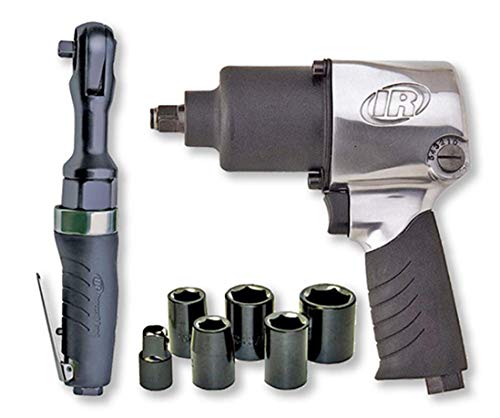
The Ingersoll Rand Edge Series 2317G combo kit pairs a 500 ft-lb 1/2-inch impact wrench and a 2.6-pound air ratchet for dependable vehicle maintenance. It is a practical, durable pneumatic package for garage hobbyists and DIY mechanics with a capable air supply.
Pros
- Delivers up to 500 ft-lbs of maximum torque to break loose stubborn vehicle lug nuts and suspension bolts
- Lightweight 2.6-pound air ratchet maneuvers easily inside cramped engine bays and beneath dashboards
- Twin hammer mechanism provides smooth, balanced impact force with reduced internal vibration
- Complete kit includes five utility sockets and a durable blow-molded carrying case
Cons
- High rotary airflow demand exceeds the continuous capacity of compact 1-gallon to 6-gallon pancake air compressors
- Does not include quick-connect air fittings, whip hoses, or thread sealant out of the box
- Air ratchet top speed of 170 RPM requires manual initial breakaway for extremely over-torqued fasteners
Ingersoll Rand 231C 1/2-Inch Air Impact Wrench
The Ingersoll Rand 231C is a classic 1/2-inch pneumatic impact wrench delivering up to 600 foot-pounds of reverse torque with a durable twin-hammer mechanism. Requiring a minimum 90 PSI air supply and a 3/8-inch hose, it is an ideal choice for DIY mechanics and garage workshops tackling tire rotations and bolt extraction.
Pros
- Up to 600 foot-pounds of reverse breakaway torque easily removes stubborn vehicle lug nuts and seized bolts
- Durable twin-hammer mechanism delivers smooth, reliable impacts with reduced tool vibration
- Adjustable power regulator offers precise forward power selection to prevent over-tightening
- Manageable 5.8-pound weight and 7.3-inch length allow convenient access in tight automotive spaces
- Pressure-fed lubrication system promotes long-term mechanical reliability in busy garage settings
Cons
- Requires an air compressor capable of maintaining at least 90 PSI and a 3/8-inch air hose (sold separately)
- Small portable or pancake air compressors will quickly deplete their air reserve during extended burst cycles
- Front exhaust port can blow loose dust and debris forward toward the work surface if positioned close to dirty components
Dynamic Power 50-Piece Pneumatic Air Tool Kit
The Dynamic Power D-W3-50K 50-piece pneumatic air tool kit bundles an impact wrench, ratchet wrench, air hammer with chisels, and a blow gun into a portable 17-pound organized case. It is a practical starter set for DIY garage owners and home mechanics who need versatile air tools for fastening, cutting, and workshop cleanup.
Pros
- Comprehensive 50-piece pneumatic tool and accessory selection for diverse garage and DIY jobs
- Includes core air tools: an impact wrench, ratchet wrench, air hammer with 5 chisels, and a blow gun
- Sturdy organized blow-molded carrying case ensures quick access and secure vehicle transport
- Practical all-in-one value for home mechanics setting up their first pneumatic workshop collection
Cons
- Requires pairing with an adequately sized workshop air compressor to sustain continuous tool operation
- Compact pancake air compressors may struggle to supply sufficient continuous CFM for the impact wrench and air hammer
- Does not include an air hose inside the carrying case
AEROPRO 1/2-Inch Air Impact Wrench
The AEROPRO 1/2-inch air impact wrench delivers up to 1,200 ft-lbs of loosening torque with a lightweight 4.64-pound housing and twin hammer mechanism operating at 90 PSI. It is an ideal addition for garage workshop owners and DIY mechanics who already maintain a reliable pneumatic air supply and need serious breakaway force for vehicle maintenance.
Pros
- High 1,200 ft-lbs loosening torque breaks free stubborn vehicle lug nuts and rusted suspension bolts
- Lightweight 4.64-pound body substantially reduces arm fatigue compared to traditional all-metal impact wrenches
- Three-speed forward dial provides regulated speed control to prevent over-torquing during initial fastener seating
- Rear exhaust port keeps air blast and debris directed away from the technician
Cons
- Requires an external air compressor with sufficient air volume delivery that is not included with the bare tool
- Not practical for small 1-to-6 gallon pancake compressors due to the high intermittent CFM demand of 1/2-inch rotary air tools
- Bare-tool configuration requires users to supply their own 1/4-inch quick-connect fitting, 3/8-inch air hose, and impact sockets
AEROPRO 1/2-Inch Air Impact Wrench Set
Delivering up to 1380 ft-lbs of loosening torque with a twin hammer mechanism, this pneumatic wrench provides heavy-duty power for automotive and suspension jobs. The set comes equipped with five standard metric sockets and a rear exhaust design to keep workspaces clean.
Pros
- High 1380 ft-lbs loosening torque capacity
- Includes five practical metric impact sockets
- Rear exhaust keeps debris off work surfaces
- Three forward speed settings provide torque control
Cons
- Requires a compatible external air compressor
- Weighs 5.25 pounds before attaching sockets
AEROPRO 3/8-Inch 50 Ft-Lb Air Ratchet Wrench
Delivering 50 ft-lbs of torque at 160 rpm, this compact 2.6-pound pneumatic ratchet is built to tackle automotive maintenance in cramped engine bays. Its 360-degree directional exhaust and included 1/2-inch adapter make it a practical pneumatic addition for home mechanics.
Pros
- Lightweight 2.6-pound design fits into cramped spaces
- 360-degree rotating exhaust keeps airflow away from user
- Includes a 1/2-inch adapter for broader socket compatibility
- Solid 50 ft-lbs torque output for automotive maintenance
Cons
- Requires at least a 1HP air compressor to operate
- 160 rpm speed is modest for pneumatic ratchets
- 12.23-inch tool length may restrict clearance in tight spots
BESWELL BW-112BN 1/2-Inch Air Impact Wrench
Built for heavy-duty automotive and industrial jobs, this pneumatic wrench delivers 1,180 ft-lbs of nut-busting torque in a manageable 4.62-pound composite frame. Its twin-hammer mechanism and three-speed forward regulator give mechanics balanced power and vibration control for all-day use.
Pros
- High breakaway torque quickly frees seized fasteners
- Lightweight composite frame reduces arm fatigue
- Smooth twin-hammer design dampens operating vibration
- Internal cooling system supports prolonged heavy use
Cons
- Requires a compatible high-pressure shop air compressor
- Full-size housing can be cumbersome in tight clearances
AEROPRO A398 1/2-Inch Air Impact Wrench
The AEROPRO A398 is a 1/2-inch pneumatic impact wrench delivering up to 1380 ft-lbs of loosening torque and 810 ft-lbs of working torque at 90 PSI via a twin-hammer mechanism. Weighing 5.28 pounds with an aluminum body, it suits DIY mechanics and garage hobbyists who have an air compressor capable of supplying steady 90 PSI pneumatic line pressure.
Pros
- High breakaway power with up to 1380 ft-lbs of loosening torque at 90 PSI
- Twin-hammer design delivers balanced, smooth impact strikes on heavy fasteners
- Manageable 5.28-pound aluminum body reduces fatigue during vehicle maintenance
- Rear exhaust directs exhaust air and debris away from the immediate work area
- Includes a 1/4-inch NPT air fitting, spanner, and oil bottle out of the box
Cons
- Requires a dedicated air compressor with sufficient CFM reserves, as small pancake units can only manage very short bursts
- Pneumatic tool oil is not pre-installed, requiring routine manual oiling before each use
- High torque output demands caution on smaller automotive fasteners to avoid stripped threads
Trivd Frol 1/2-Inch Air Impact Wrench
The Trivd Frol 1/2-inch air impact wrench combines a twin-hammer mechanism with a lightweight 4.73-pound composite body, delivering up to 1500 ft-lbs of advertised torque at 90 PSI. It is a practical, budget-conscious choice for garage hobbyists and DIY auto mechanics tackling lug nuts and suspension hardware with a capable pneumatic air setup.
Pros
- High advertised torque output of up to 1500 ft-lbs for breaking loose seized vehicle fasteners and stubborn lug nuts
- Lightweight 4.73-pound composite housing reduces user arm and wrist strain compared to heavier all-metal impact guns
- Twin-hammer impact mechanism and 45mm cylinder provide balanced, smooth blows during heavy fastener work
- Multi-speed adjustment knob offers three forward speeds and full reverse power for precise fastening control
Cons
- Requires a substantial air supply at 90 PSI; compact pancake compressors will struggle to sustain air volume during continuous impact use
- Manufacturer indicates reaching maximum torque requires higher airflow and pressure than standard 90 PSI regulation
- Bare-tool package requires users to provide their own air hose, quick-connect fittings, and pneumatic tool oil
Ingersoll Rand 231HA-2 1/2-Inch Drive Air Impact
The Ingersoll Rand 231HA-2 is a heavy-duty 1/2-inch pneumatic impact wrench delivering up to 600 ft-lbs of reverse torque with an extended 2-inch anvil and twin-hammer mechanism. Designed for automotive garages and workshop tire service, it requires an air compressor supplying at least 90 PSI through a 3/8-inch air hose.
Pros
- Delivers up to 600 ft-lbs of reverse torque for breaking loose stubborn lug nuts and heavy chassis hardware.
- Twin-hammer mechanism and pressure-fed lubrication provide reliable durability and smooth power delivery.
- The 2-inch extended anvil offers practical clearance when servicing deep wheel wells and automotive rims without extra adapters.
- Adjustable power regulator gives operators straightforward forward torque management.
Cons
- Requires a minimum of 90 PSI and a 3/8-inch air hose, demanding more continuous air volume than standard compact pancake compressors can typically sustain.
- Sold as a bare tool without pneumatic couplers, air hose, or air compressor included.
- At 6.1 pounds, extended one-handed overhead use under a vehicle lift may contribute to arm fatigue.
Essential Air Compressor Sizing Factors for Impact Wrenches
Pneumatic impact wrenches rely on sustained volumetric air movement rather than static storage pressure alone. Volumetric delivery is quantified as cubic feet per minute (CFM), typically specified at 90 pounds per square inch (PSI) across standard automotive tools. A large storage tank without an adequately sized pump provides only temporary reserve before air pressure plummets below functional thresholds. The pump mechanism must deliver continuous CFM to replace air as rapidly as the tool exhausts it during heavy mechanical tasks.
Decoupling CFM Delivery from Storage Tank Volume
Fastener removal requires distinct bursts of energy, but multiple fasteners in quick succession behave essentially like a continuous air demand. When removing lug nuts across four wheels, an undersized pump falls behind immediately after the first wheel. The line pressure then drops from the standard operating level down to 60 PSI or lower, cutting breaking torque significantly. Matching continuous CFM output to your tool consumption prevents having to pause between fasteners while waiting for pressure recovery.
Most manufacturer specification sheets rate impact wrenches by their average air consumption rather than continuous wide-open trigger usage. Average air consumption assumes a duty cycle of roughly 25 percent, representing intermittent bursts of five to ten seconds. Continuous usage requires multiplying that average CFM rating by a factor of three or four to establish true pump delivery needs. Sizing the compressor for continuous tool demand guarantees that the impact gun will consistently generate its rated breakaway torque.
Evaluating your specific workflow helps dictate whether average CFM or continuous CFM ratings should govern your compressor purchase. A hobbyist changing one tire seasonally can manage with a smaller pump paired with a modest reserve tank. Conversely, automotive fabricators and suspension technicians demand continuous volumetric airflow to prevent tool stalling on seized hardware. Accurately anticipating your cycle frequency ensures you invest in an air compressor capable of sustaining your workload.
Air Consumption Requirements Across Common Drive Sizes
Pneumatic tools feature differing air appetites depending directly on the internal anvil mass and motor cylinder displacement. Compact 3/8-inch drive impact wrenches and air ratchets generally consume between 2.5 and 4.5 CFM at 90 PSI under typical operating conditions. These smaller units operate efficiently on modest shop compressors, making them well-suited for light engine bay assembly or interior vehicle maintenance. Their smaller displacement cylinders place manageable loads on consumer-grade air pumps during typical shop routines.
The ubiquitous 1/2-inch drive air impact wrench represents the standard tool for automotive tire shops and general home garages. Popular heavy-duty models like the Ingersoll Rand 231 series or high-torque twin hammer designs from AEROPRO generally require between 4 and 6 CFM at 90 PSI under average duty cycles. Continuous operation on stubborn suspension components or rusted truck hardware can easily push dynamic demand beyond 8 to 10 CFM. Selecting an air compressor capable of delivering at least 5 to 6 CFM at 90 PSI provides a reliable baseline for 1/2-inch tools.
Heavy-duty 3/4-inch and 1-inch industrial impact wrenches require massive air volume to actuate their oversized hammer assemblies. These industrial tools routinely consume 8 to 15 CFM at 90 PSI, demanding dedicated commercial air supply systems. Operating tools of this scale on smaller home garage compressors results in immediate motor stalling and severely reduced output. Fleet maintenance facilities and agricultural workshops require large two-stage stationary compressors to handle these higher volumetric demands effectively.
Storage Tank Gallon Capacity and Pressure Recovery Cycles
Air storage tank capacity acts as a crucial energy buffer that absorbs sudden bursts of heavy pneumatic consumption. Small pancake and hot dog compressors featuring tanks between 2 and 6 gallons store insufficient total air mass for high-torque impact tools. While a 6-gallon tank pressurized to 150 PSI can break two or three lug nuts loose, the pressure quickly falls to the pump cut-in point. At that stage, the user must stop working and wait for the small displacement pump to recharge the tank.
A 20-gallon to 30-gallon air tank offers an optimal balance for residential workshops and active DIY mechanics. This reserve volume allows the operator to remove all four vehicle wheels without encountering severe pressure drops or premature tool starvation. The larger physical vessel provides adequate buffer time, enabling the motor and pump assembly to cycle on and off according to normal duty cycles. Preventing continuous motor running protects internal pump components from extreme thermal accumulation and valve wear.
Commercial automotive repair bays typically utilize 60-gallon or 80-gallon stationary vertical tanks to maintain constant line stability. Larger storage vessels ensure that multiple mechanics can operate impact wrenches, ratchets, and air blow guns simultaneously without system degradation. The extensive air volume acts as a dampener against localized pressure fluctuations across the workshop delivery piping. For high-volume automotive tire service, larger tank capacity directly translates to uninterrupted workflow and improved productivity.
Dynamic Pressure Drop and Air Delivery Plumbing
Pneumatic impact wrenches are rated to produce maximum torque at 90 PSI of dynamic pressure measured directly at the tool inlet. Static pressure displayed on the compressor manifold gauge before the trigger is pulled does not represent operating pressure. Once air flows through regulators, fittings, and extended hose lines, friction causes a noticeable drop in line pressure. If dynamic pressure drops below 90 PSI during trigger pull, the wrench loses a substantial percentage of its loosening capability.
The internal diameter of your air delivery hose plays a massive role in maintaining dynamic flow to the tool motor. Standard 1/4-inch inside diameter (ID) hoses severely restrict volumetric airflow, particularly when run across lengths of 25 to 50 feet. Upgrading to a 3/8-inch ID or 1/2-inch ID air hose substantially minimizes internal friction and delivers unrestricted volume to the tool. Professional garage setups routinely pair 3/8-inch lines with high-flow quick-connect couplers to preserve full breakaway torque.
Standard industrial automotive couplers often act as severe flow bottlenecks that restrict high-draw pneumatic tools. Traditional 1/4-inch NPT couplers feature restricted internal orifices that choke volumetric flow even when paired with large air hoses. High-flow V-style couplers feature larger internal passages that permit twice the air volume of standard fittings at equivalent operating pressures. Installing high-flow fittings across your compressor manifold, hose ends, and impact wrench inlets ensures maximum power transfer.
Single-Stage versus Two-Stage Compression Mechanics
Compressor pump design heavily influences maximum tank pressure and overall air storage efficiency. Single-stage compressors draw atmospheric air directly into the cylinder and compress it in a single stroke before discharging it into the storage tank. These units typically cap maximum working pressures between 125 and 150 PSI, which is adequate for moderate pneumatic tasks. Single-stage pumps represent the majority of portable and semi-portable garage compressors on the market today.
Two-stage air compressors utilize a dual-cylinder configuration where air is compressed in an initial low-pressure cylinder before passing through an intercooler. The second high-pressure cylinder compresses the air further, delivering storage pressures up to 175 PSI. Comparing single-stage and two-stage compressor configurations reveals significant performance advantages for continuous pneumatic wrench operation. Storing air at 175 PSI packs substantially more air volume into the same physical tank capacity compared to single-stage units.
The higher operating pressure of a two-stage system creates a significantly wider buffer before reaching the cut-in pressure threshold. Regulating down from 175 PSI tank pressure to 90 PSI tool working pressure ensures rock-solid consistency throughout extended wrenching jobs. Two-stage pumps also operate at lower internal cylinder temperatures due to the intercooling phase between compression steps. For serious automotive restoration work and commercial fleet repair, two-stage systems provide superior air delivery and continuous reliability.
Pump Mechanisms and Operational Duty Cycle Limits
Evaluating the internal pump construction helps determine how long a compressor can run safely without overheating. Exploring oil-free versus oil-lubricated compressors clarifies the tradeoffs between maintenance convenience and industrial durability. Oil-free dual-piston units feature Teflon-coated piston rings and sealed bearings, eliminating the need for regular crankcase lubricant checks. While convenient for clean transport, oil-free pumps generally feature shorter operational lifespans and lower duty cycle ratings.
Oil-lubricated cast-iron pumps remain the standard choice for rigorous workshop environments and continuous tool demands. Splash-lubricated crankshafts and oil-bathed cylinders dissipate thermal energy effectively, permitting extended duty cycles up to 70 or 100 percent. Maintaining appropriate ISO 68 or ISO 100 non-detergent compressor oil levels protects internal valves and cylinder walls from friction wear. For users regularly driving high-torque 1/2-inch impact wrenches, cast-iron oil-lubricated pumps deliver superior endurance and cooler operating temperatures.
Duty cycle ratings define the percentage of time an air compressor can run within a given ten-minute operating window. A compressor rated for a 50 percent duty cycle should only operate for five minutes out of every ten to prevent thermal shutdown. Pushing an undersized compressor past its rated duty cycle to keep up with an impact wrench causes reed valve fatigue and premature pump failure. Selecting a pump with adequate volumetric output ensures it cycles off comfortably between tasks, preserving its mechanical integrity.
Electrical Circuit Requirements and Garage Wiring Considerations
Air compressor electric motors draw significant amperage, particularly during startup under loaded head pressure. Standard residential garage circuits are commonly wired for 120 volts on 15-amp branch breakers shared with overhead lighting or workbench tools. Running a portable air compressor drawing 13 to 15 running amps on a shared 15-amp circuit frequently causes nuisance breaker trips. Motor inrush current during the first second of startup can briefly surge to three times the continuous running amperage.
Dedicated 20-amp 120-volt circuits provide the electrical headroom necessary for reliable cold-weather compressor starts and consistent performance. Operating compressors on long, undersized electrical extension cords creates severe voltage drop that can damage electric motor windings. Voltage drop starves the motor of necessary electrical energy, leading to sluggish rotation, excessive heat accumulation, and tripped thermal overload switches. If additional reach is necessary, users should always extend the air hose length rather than the electrical power cord.
Stationary workshop compressors generating 3 continuous running horsepower or higher generally require dedicated 240-volt electrical service. A 240-volt supply draws roughly half the amperage of an equivalent 120-volt motor, promoting cooler electrical operation and improved motor efficiency. Dedicated 240-volt circuits eliminate startup voltage dips and provide stable power for high-output single-stage or two-stage pumps. Homeowners planning serious automotive shop setups should evaluate their garage breaker panel capacity before purchasing larger stationary units.
Impact Wrench Motor Mechanics and Air Efficiency
The internal mechanical design of an impact wrench determines both its striking energy and volumetric air consumption efficiency. Modern high-performance tools utilize twin-hammer strike mechanisms that deliver balanced blows to the anvil with minimal rotational vibration. Twin-hammer assemblies require smooth, rapid cylinder filling to accelerate the internal rotor to free speeds reaching 7,500 to 8,000 RPM. When air volume drops, rotor acceleration slows immediately, resulting in sluggish hammer engagement and weak breakaway force.
Many pneumatic impact wrenches incorporate multi-position power regulators that allow users to modulate forward torque output. Dialing back regulator settings on lighter fasteners reduces overall air consumption and prevents over-torquing delicate threaded bolts. Reversing functions typically bypass internal regulator restrictions to deliver full pneumatic volume and maximum torque for fastener removal. Sensitive feathering triggers also provide fine speed control, allowing users to align sockets precisely before unleashing full hammer blows.
Ergonomic composite housings and lightweight motor components have reduced tool weight while maintaining substantial breakaway power. However, high-torque composite tools still require the exact same volumetric air supply as traditional all-metal service wrenches. Even lightweight tools equipped with advanced anti-aging valves require consistent 90 PSI line delivery to actuate internal vanes properly. Pairing an efficient twin-hammer tool with an appropriately matched compressor ensures optimal torque transfer across demanding tasks.
Moisture Management and In-Line Filtration Setup
Compressing atmospheric air naturally concentrates ambient humidity, resulting in substantial liquid water condensation inside the steel storage tank. If this accumulated moisture is not managed properly, water travels down air lines directly into the pneumatic tool motor. Water washes away internal lubricants, corrodes cylinder vanes, and causes premature wear across delicate rotor bearings and hammer cages. Daily tank drainage through underside drain valves is essential for preserving tank integrity and tool performance.
Installing a dedicated in-line water separator and particulate filter near the air delivery manifold traps moisture before it enters whip lines. In-line coalescing filters capture microscopic water droplets and rust scale that could otherwise foul impact wrench control valves. Maintaining clean, dry airflow protects internal seals and ensures smooth trigger actuation during heavy shop use. For workshops located in humid climates, installing dedicated copper or aluminum hard piping helps cool compressed air and drop out moisture.
Pneumatic impact wrenches require regular lubrication to protect motor vanes and rotating hammer components from metal-on-metal friction. Adding a few drops of pneumatic tool oil into the air inlet before each work session maintains proper cylinder lubrication. Alternatively, installing an automatic in-line lubricator provides continuous micro-misting during high-volume automotive production. Proper lubrication combined with dry air delivery maximizes mechanical efficiency and ensures that your impact wrench delivers its full rated torque.
Diagnosing Low Torque and Rapid Air Starvation
When an air impact wrench fails to loosen a stubborn fastener, identifying the root cause prevents unnecessary equipment replacement. The primary diagnostic step involves observing the compressor tank gauge and regulator gauge while holding the tool trigger wide open. If regulated line pressure drops drastically from 90 PSI down to 50 PSI during operation, a severe flow restriction exists. This pressure drop points toward undersized hoses, restrictive quick-connect fittings, or a clogged compressor regulator port.
If line pressure remains rock-solid at 90 PSI but the tool still lacks breaking force, the issue likely resides within the tool itself. Internal mechanical friction caused by dry hammer mechanisms or gummed-up rotor vanes severely restricts rotational velocity. Flushing the air inlet with pneumatic oil or specialized air tool cleaner often dissolves old lubricant deposits and restores full hammer power. Ensuring that the compressor check valve and unloader valve are sealing cleanly also guarantees maximum system efficiency.
Regularly testing system connections using soapy water identifies subtle air leaks that compromise overall workshop performance. Leaking quick-connect couplers, damaged hose crimps, or unsealed thread fittings force the air compressor to cycle unnecessarily and waste stored energy. Resolving small pneumatic leaks across your garage air delivery system maintains consistent pressure reserves for high-draw impact operations. Taking a systematic approach to maintenance ensures dependable pneumatic power whenever demanding automotive projects arise.
Selecting the appropriate air compressor for your pneumatic impact wrench ultimately depends on balancing volumetric CFM output, tank buffer size, and delivery plumbing. For occasional garage maintenance, a compressor delivering 4 to 5 CFM at 90 PSI with a 20-gallon tank provides adequate power for standard automotive fasteners. Professional shops and heavy restoration projects benefit substantially from stationary units providing 10 CFM or more paired with large storage reserves. Prioritizing volumetric flow and unrestricted air lines ensures that your pneumatic tools consistently generate maximum breakaway torque without frustrating downtime.
About the author
Clint DeBoer is an experienced tool-industry specialist with decades of involvement in technical media, hands-on product evaluation, and testing methodology. His focus on performance, practical usability, and data-driven comparisons makes his expertise highly relevant to professional air compressors, pneumatic tools, and workshop equipment.