
How to Connect Two Air Compressor Tanks: Practical Setup Guide for 2026
Learn how to connect two air compressor tanks safely with this complete workshop guide for October 2026. Explore auxiliary tanks, manifolds, safety valves, and drain plumbing.
 By Clint DeBoer
Updated October 8, 2026
By Clint DeBoer
Updated October 8, 2026

Pneumatic tools such as rotary sanders, paint guns, and high-torque impact wrenches frequently demand more sustained air volume than a single small compressor tank can comfortably supply. When a compact pump runs out of pressurized air buffer mid-job, line pressure drops rapidly and forces operators to pause while the motor struggles through extended recovery cycles. Learning how to connect two air compressor tanks offers a cost-effective method to expand air storage capacity without forcing the purchase of an expensive commercial stationary unit. Linking an auxiliary receiver vessel or a second portable compressor creates a larger pressurized reservoir that stabilizes delivery pressure during demanding garage or workshop projects.
Achieving a dependable multi-tank configuration requires a firm grasp of pneumatic plumbing, safety relief limits, and condensation maintenance across both pressure vessels. Plumbers and workshop operators must distinguish between daisy-chaining an unpowered auxiliary storage tank to boost air reserves and plumbing two active motorized compressors in parallel to double delivered airflow. Using robust fittings such as heavy-duty brass manifolds, flexible connecting hoses, and dedicated moisture drains ensures that your extended pneumatic circuit remains leak-free and safe under continuous operating pressure.
| Award | Product | ACR Score About ACR ScoreThe ACR Score is our own rating from 0 to 10, based on performance, design and build, ease of use, and value. It reflects independent research and is never influenced by manufacturers, retailers, or affiliate commissions. Learn more › | |
|---|---|---|---|
| Best Overall |
JOROY 10-Inch Extended Air Compressor Tank Drain
|
9.2/10 | Buy |
| Best Budget |
 LUMITECO 11-Inch Swivel Tire Inflator Hose
|
9.1/10 | Buy |
 Hromee 5-Piece 1/4-Inch Drain Valve Kit
|
8.9/10 | Buy | |
| Best Premium |
 Hromee Automatic Air Compressor Tank Drain Valve
|
8.6/10 | Buy |
 Hromee Air Tank Manifold Tool with Fill Port
|
8.4/10 | Buy | |
 SUNROAD 10-Inch Compressor Tank Drain Kit
|
8.3/10 | Buy | |
| Best Value |
 BokWin Air Hose Replacement Kit
|
8.3/10 | Buy |
 2-Way Air Hose Splitter, 1/4" NPT Air Compressor
|
7.8/10 | Buy | |
 QWORK 10-Inch Tank Drain Valve Kit
|
7.8/10 | Buy | |
 New Air Compressor Tank Manifold w/Built in Ball
|
7.8/10 | Buy |
LUMITECO 11-Inch Swivel Tire Inflator Hose
This braided extension hose upgrades portable inflators with a 360-degree swivel lock-on chuck and a protective heat sleeve. It provides a secure, leak-free connection for bicycles, cars, and motorcycles with awkward valve angles.
Pros
- Swivel chuck rotates 360 degrees for awkward valve angles
- Rubber sleeve protects hands from hot compressor fittings
- Converts twist-on connections into quick thumb-press lock-on chucks
- Comes with Presta adapter and extra conversion nuts
Cons
- Short 11-inch length provides limited extra reach
- Open-flow chuck requires active pump connection to prevent deflation
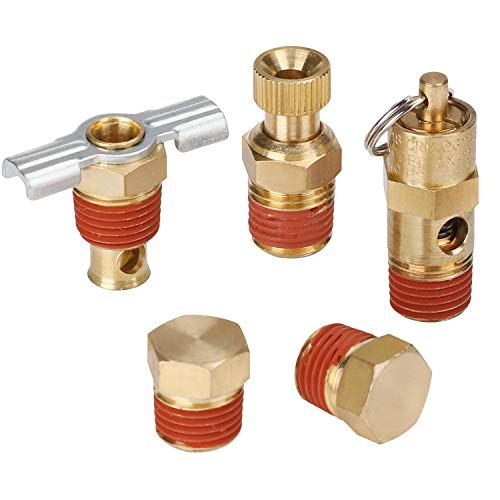
Hromee 5-Piece 1/4-Inch Drain Valve Kit
This brass fitting assortment provides essential replacement valves and plugs for routine compressor tank maintenance. It pairs winged and knurled drain petcocks with a 140 PSI safety relief valve for dependable pneumatic management.
Pros
- Solid brass body provides corrosion and heat resistance
- Two petcock styles offer flexible moisture draining options
- Integrated safety valve handles up to 55 SCFM flow
- Stainless steel relief components resist rust over time
Cons
- Requires separate thread sealant for proper sealing
- Safety valve maximum pressure is capped at 140 PSI
- Winged drain handle has a 12-pound torque limit
Hromee Automatic Air Compressor Tank Drain Valve
The Hromee Automatic Air Compressor Tank Drain Valve Kit automates moisture removal from pneumatic receiver tanks and filters using an adjustable electronic timer and durable braided steel hose. It is an ideal preventative upgrade for garage hobbyists, woodworkers, and shop owners looking to protect their air equipment from internal rust without manual draining.
Pros
- Fully adjustable cycle and duration timers match purge frequency to workshop humidity levels
- Extensive adapter collection fits common 1/4-inch, 3/8-inch, and 1/2-inch NPT tank drain ports
- Braided steel lead hose provides generous clearance to route moisture away from hard-to-reach petcocks
- Pre-wired 6-foot grounded 110V-120V plug eliminates the need for electrical hardwiring
- IP65 enclosure provides dependable protection against dust and workshop moisture
Cons
- Requires an accessible 110V-120V electrical outlet positioned near the compressor location
- Minimum operating ambient temperature of 32°F makes it unsuitable for unheated sub-freezing shops
- Audible pressurized purge bursts may startle users inside small, quiet residential garages
SUNROAD 10-Inch Compressor Tank Drain Kit
Draining moisture prevents compressor tank rust, and this SUNROAD kit simplifies routine maintenance with a flexible braided steel line and an accessible quarter-turn shutoff. It provides a practical upgrade for standard 1/4-inch and 3/8-inch drain ports operating under 175 PSI.
Pros
- Durable braided steel hose prevents kinks
- Corrosion-resistant chrome-plated brass valve
- Complete installation kit with clamps and tape
- Rubber-coated handle allows easy quarter-turn operation
Cons
- 10-inch hose may be short for large tanks
- Working pressure is limited to 175 PSI
- Requires manual operation after every compressor use
QWORK 10-Inch Tank Drain Valve Kit
This braided steel extension kit simplifies tank draining by relocating hard-to-reach compressor valves. Rated up to 175 PSI and packaged with an adapter, it offers a reliable setup for standard workshop compressors.
Pros
- Corrosion-resistant braided steel construction
- Pre-applied sealant speeds up installation
- Includes adapter for 3/8-inch ports
- Handles up to 175 PSI reliably
Cons
- Fixed 10-inch length restricts mounting flexibility
- Not rated for high-pressure industrial systems
Engineering Principles and Practical Methods for Connecting Air Compressor Tanks
Connecting two pneumatic vessels requires balancing physical air volume, compressor pump capacity, and mechanical safety limits. While expanding overall tank volume provides a larger pressurized reserve for heavy air tools, improper plumbing can cause motor strain, dangerous pressure imbalances, or severe moisture accumulation. Understanding how compressed air behaves across connected vessels allows operators to design an efficient multi-tank setup that delivers consistent line pressure while protecting equipment from premature failure.
Storage Capacity vs. Airflow Delivery: Why Connecting Tanks Changes Buffer, Not CFM
Pneumatic power depends on two distinct performance metrics: volume stored inside the pressure vessel and continuous airflow produced by the pump. Adding a second air tank increases total gallon capacity, which acts as an expanded energy accumulator for intermittent high-volume air demands. An impact wrench or framing nailer draws brief, intense bursts of air that deplete small single tanks rapidly. A larger combined tank volume prevents the sudden pressure drops that typically stall tools during intermittent operations.
Pneumatic pumps deliver a fixed volume of air measured in cubic feet per minute at specific pressures, such as 90 PSI. Connecting an unpowered auxiliary tank does not increase the pump’s CFM rating or accelerate continuous air delivery. A small compressor producing two CFM will still generate only two CFM, regardless of whether it feeds a six-gallon tank or a thirty-gallon reservoir. Continuous tools like rotary sanders and paint sprayers will still outpace the pump once the expanded storage reserve is exhausted.
Recovery times and motor duty cycles change dramatically when tank volume expands without an increase in pump capacity. The electric motor must run significantly longer during each cycle to pressurize the doubled volume from cut-in to cut-out pressure. Standard consumer compressors frequently feature intermittent duty cycles, requiring cool-down periods between compression cycles to avoid motor overheating. Running an undersized pump continuously to fill multiple large tanks risks triggering internal thermal overload switches or causing premature valve plate fatigue.
Auxiliary Receiver Tank Setup: Linking a Powered Compressor to an Unpowered Vessel
Plumbing an unpowered auxiliary air receiver represents the simplest method for expanding total workshop air storage. This configuration uses a primary motorized air compressor connected directly to a secondary carry tank or stationary vessel via heavy-duty pneumatic lines. The secondary vessel acts as a passive expansion chamber, absorbing pressure pulses and storing additional air volume without drawing extra electrical power. Operators frequently position the auxiliary tank closer to the work area to minimize dynamic pressure drops across long hose runs.
Connection points between the primary compressor and the auxiliary vessel dictate how efficiently the system operates. Connecting from the primary unit’s unregulated tank port directly into the auxiliary tank manifold preserves full storage pressure across both vessels. Utilizing dedicated brass manifolds, such as the Hromee Air Tank Manifold Tool with Fill Port or the Ei New Air Compressor Tank Manifold w/Built in Ball Valve and 130 PSI Safety Valve, provides standard 1/2-inch male NPT tank inlets and 1/4-inch female NPT outlet ports. These manifold assemblies allow direct installation onto standard portable carry tanks while retaining independent port connections for pressure gauges and safety valves.
Flow restriction between the two tanks must remain minimal to ensure rapid pressure equalization. Linking the tanks using 3/8-inch inner diameter air hoses rather than narrow 1/4-inch lines reduces friction losses during high-velocity air transfers. The BokWin Air Hose Replacement Kit provides an example of a dedicated connection assembly featuring four-foot air line routing paired with a 200 PSI pressure gauge and brass manifold hardware. High-flow quick-connect couplers on the link line allow operators to detach the secondary tank quickly for portable use around the garage or jobsite.
Dual Powered Compressor Plumbing: Combining Two Active Units in Parallel
Combining two active, motorized compressors in a parallel circuit doubles both stored air capacity and continuous CFM delivery. This advanced setup allows two modest portable compressors to supply high-demand pneumatic tools that normally require an expensive industrial stationary unit. Both compressor discharge lines connect into a centralized manifold or heavy-duty tee fitting before routing air toward the primary regulator and delivery hose. The parallel arrangement divides the mechanical workload between two separate pumps, reducing thermal strain on individual motors.
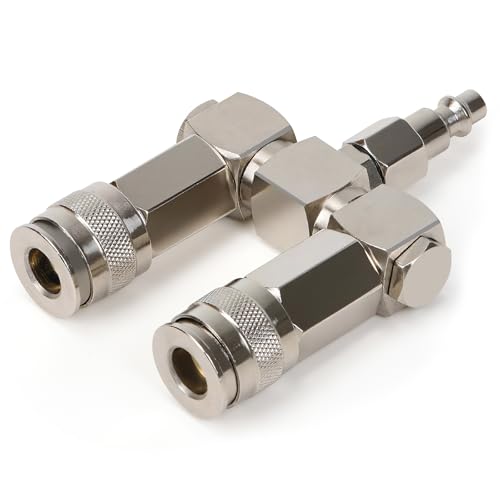
Tandem configurations require durable distribution fittings capable of handling high pneumatic throughput. The 2-Way Air Hose Splitter, 1/4″ NPT Air Compressor Connector demonstrates how dual-line manifolds utilize nickel-plated steel bodies and 360-degree swivel designs to prevent hose tangling while managing working pressures up to 300 PSI. Operators connect the discharge lines from both compressors into the dual inlets of the splitter or parallel tee fitting. Machined universal couplers ensure leak-free engagement while maintaining unobstructed airflow toward the workshop distribution line.
Electrical distribution represents the most critical constraint when running two powered compressors simultaneously. Standard residential workshops typically feature 15-amp or 20-amp branch circuits that cannot support the startup inrush current of two electric compressor motors at once. Plugging both units into the same branch circuit will reliably trip the circuit breaker as both motors attempt to start simultaneously under load. Each compressor must plug into a separate, dedicated electrical circuit to handle running amperage and high initial inductive surges safely.
Pressure switch calibration determines whether both compressors share the workload equally or stage their cycling sequentially. If both mechanical pressure switches share identical cut-in and cut-out thresholds, minor mechanical variations will still cause one compressor to trigger slightly ahead of the other. Setting one compressor to cut in at 90 PSI and the second at 80 PSI creates a staggered system where the primary unit handles light duty, and the secondary unit engages only during severe pressure drawdowns. This staged approach reduces electrical strain while maintaining adequate air reserves for demanding pneumatic tools.
Selecting Connection Hardware: Hoses, Manifolds, and Pressure Ratings
Pneumatic fittings, hoses, and manifolds must match or exceed the maximum operating pressure of the highest-rated compressor in the system. High-pressure air lines between tanks experience continuous pressure cycles and vibrational stress during operation. Brass fittings offer superior corrosion resistance and ductility at high operating temperatures, making them the preferred material for rigid tank connections. Components like hex head plugs and petcocks from the Hromee 5 Piece 1/4 Inch Compressor Air Tank Port Fittings Drain Valve Kit demonstrate the utility of solid brass construction in maintaining air-tight seals across critical port openings.
Thread sealing demands meticulous preparation to prevent microscopic air leaks that bleed tank pressure overnight. National Pipe Taper (NPT) threads rely on mechanical interference between mating tapered threads to generate a tight seal. Applying quality PTFE thread seal tape or liquid anaerobic thread sealant lubricates the threads during assembly and fills micro-voids between metal surfaces. Pre-applied thread sealant on fittings simplifies installation while reducing the risk of excess tape fragments shearing off and clogging downstream regulator orifices or pneumatic tool valves.
Flexible connecting lines between stationary and portable tanks should incorporate braided reinforcement to withstand pressure pulses. Stainless steel braided hoses or heavy-duty rubber lines prevent catastrophic ruptures caused by pump vibrations transmitted through rigid pipe connections. When connecting specialized pneumatic gear or inflating auxiliary vessels, multi-purpose adapters such as the LUMITECO Tire Inflator Hose Adapter illustrate how 360-degree rotating swivels and secure lock-on chuck connections maintain airtight integrity under pressure. Secure hose routing clamps should support connecting lines to minimize mechanical stress on threaded tank bung fittings.
Overpressure Safety Protocols and Relief Valve Calibration
Pressure vessels represent substantial stored energy hazards that require multiple layers of mechanical overpressure protection. Every individual tank connected to a compressed air system must possess its own dedicated, certified safety relief valve. Connecting two tanks together creates a shared pressure envelope, but isolating one tank behind a closed ball valve could leave that vessel completely unprotected if the primary pressure switch fails. A secondary tank lacking an active pop-off valve risks severe structural rupture if overpressurized beyond its yield strength.
Safety valves utilize spring-loaded poppets designed to vent excessive air volume automatically when internal tank pressure exceeds a predetermined limit. The brass safety valves included in manifold assemblies, such as the 140 PSI safety valve in Hromee kits or the 130 PSI valve on the Ei manifold, provide essential fail-safe operation. Operators must ensure that the relief valve pressure rating matches or remains slightly below the maximum working pressure stamped on the tank data plate. Installing a 200 PSI safety valve on an auxiliary carry tank rated for only 125 PSI creates an extreme failure risk.
Routine inspection of safety devices prevents catastrophic mechanical failure during unattended compressor cycling. Operators should manually test safety relief valves periodically by gently pulling the external metal ring while the tank holds moderate pressure. A healthy relief valve should release a brisk burst of air and reseat immediately without leaking when released. If a valve sticks, fails to vent, or bleeds air continuously below its rated setpoint, the compressor must be shut down and depressurized immediately until a replacement brass valve is installed.
Condensation Control and Moisture Drainage in Dual-Tank Systems
Compressing atmospheric air naturally precipitates substantial amounts of moisture as water vapor condenses against the cool internal steel walls of storage tanks. When two tanks are linked, air expansion and temperature drops between the primary compressor and secondary vessel cause increased moisture dropout. The auxiliary tank effectively functions as a massive water trap, accumulating condensation that will rapidly rust internal steel walls if not drained regularly. Moisture accumulation also displaces usable air volume, reducing the effective gallon capacity of the storage system over time.
Factory drain petcocks on compressor tanks often feature recessed, stiff thumb-twist designs that discourage daily maintenance. Upgrading to an extended quarter-turn ball valve assembly transforms moisture draining into a fast, effortless procedure. Assemblies such as the JOROY 10-Inch Extended Air Compressor Tank Drain, the SUNROAD Extended Tank Drain Valve Assembly Kit, and the QWORK Extended Tank Drain Valve Assembly Kit utilize flexible braided steel hoses rated up to 175 PSI working pressure. These kits relocate the drain port away from the cramped tank underside, allowing operators to purge water cleanly using an ergonomic quarter-turn lever handle.
Automated moisture purging systems offer complete protection for stationary workshops where manual draining might be overlooked. The Hromee Automatic Air Compressor Tank Drain Valve Kit provides an electronic timed solenoid valve with adjustable interval timers ranging from 0.5 to 45 minutes and discharge durations up to 10 seconds. Integrating an automated timed purge valve at the lowest point of the secondary receiver tank guarantees that accumulated condensate is evacuated systematically without requiring manual intervention. Consistent condensation removal protects expensive air tools from internal corrosion and ensures dry, clean air delivery for spray painting and plasma cutting applications.
System Verification, Leak Diagnostics, and Airflow Tuning
Assembling a dual-tank network concludes with systematic pressure testing and leak verification before subjecting the equipment to workshop tasks. After threading all fittings with proper sealant and tightening connections securely, operators should allow thread sealants adequate curing time. The primary compressor should then be energized, allowing both vessels to pressurize gradually up to full cut-out pressure. Operators must observe pressure gauges carefully throughout initial pressurization to confirm that both vessels equalize smoothly and that safety cut-off switches disengage the pump at the correct pressure.
Subtle air leaks across threaded joints and quick-connect couplers can severely compromise multi-tank efficiency and cause compressors to cycle unnecessarily. Applying a solution of soapy water or commercial leak-detection fluid across all threaded connections, manifold bungs, and drain valves quickly reveals hidden leaks through active bubble formation. Any joint exhibiting bubbles should be marked, depressurized completely, disassembled, and resealed before placing the system into regular service. Verifying airtight integrity ensures that the expanded air reserve remains stored indefinitely without leaking down between workshop sessions.
Regulator tuning and delivery hose management complete the pneumatic configuration for maximum tool performance. Dual-tank systems provide stable reserve volume, but restrictive regulators or narrow whip hoses can still cause dynamic pressure drops at the tool inlet. Setting the working regulator on the secondary tank outlet ensures that pneumatic tools receive precisely calibrated pressure regardless of fluctuations inside the main storage vessels. Combining properly sized storage vessels, unobstructed link lines, and reliable moisture drainage provides an efficient workshop air supply that powers demanding pneumatic equipment smoothly.
About the author
Clint DeBoer is an experienced tool-industry specialist with decades of involvement in technical media, hands-on product evaluation, and testing methodology. His focus on performance, practical usability, and data-driven comparisons makes his expertise highly relevant to professional air compressors, pneumatic tools, and workshop equipment.