
How to Clean Compressor Air Filter: Practical Guide for 2026
Learn how to clean compressor air filter media properly to preserve airflow and protect pump components during October 2026.
 By Bob Beacham
Updated October 8, 2026
By Bob Beacham
Updated October 8, 2026

Atmospheric dust, sawdust, and airborne debris constantly challenge workshop and jobsite compressors by gathering on external intake housings. When an intake element becomes clogged, the pump must work harder against suction vacuum, which drives up head temperatures and slows tank recovery cycles. Learning how to clean compressor air filter assemblies correctly ensures that your pump receives sufficient airflow while keeping abrasive particles out of the compression cylinder. Consistent maintenance also protects reed valves from carbonizing and prevents premature wear across piston rings and cylinder walls.
Many operators attempt to clear clogged cartridges by aggressively banging them against workbenches or blasting them with unregulated line pressure. Those harsh habits frequently rupture delicate paper pleats and create pinholes that allow gritty dust to bypass filtration entirely. Whether your compressor uses a compact threaded intake silencer, a washable foam pre-filter, or a heavy cylindrical cartridge, understanding proper cleaning steps protects your machine. Regular intake care keeps your pneumatic setup running quietly, reliably, and with steady CFM delivery across demanding projects.
| Award | Product | ACR Score About ACR ScoreThe ACR Score is our own rating from 0 to 10, based on performance, design and build, ease of use, and value. It reflects independent research and is never influenced by manufacturers, retailers, or affiliate commissions. Learn more › | |
|---|---|---|---|
| Best Overall |
Moisture Boss Air Compressor Intake Filter
|
8.9/10 | Buy |
| Best Premium |
 Pete Industries Junior Air Filter Cleaner Kit
|
8.9/10 | Buy |
| Best Budget |
 Darlingao 6-Pack Intake Filter Elements
|
8.8/10 | Buy |
 Zizlurnar 1/2" NPT Metal Air Compressor Intake
|
8.1/10 | Buy | |
 Darlingao 1/2-Inch Male Thread Air Compressor
|
8.0/10 | Buy | |
| Best Value |
 AIRZOE 1/4-Inch NPT Air Compressor Filter
|
8.0/10 | Buy |
 Clean Resources IDC-350 Separator 15-125 HP
|
8.0/10 | Buy | |
 Pete Industries Original Air Filter Cleaner
|
7.8/10 | Buy |
Moisture Boss Air Compressor Intake Filter
This Moisture Boss intake filter cartridge provides 5-micron particulate filtration and a 35 CFM rating to protect compressor pump cylinders from abrasive shop dust. It serves as an exact aftermarket replacement for Solberg 15 style housings on Campbell Hausfeld, Ingersoll Rand, Quincy, and Grainger units.
Pros
- Direct drop-in replacement for widely used Solberg 15 canisters across dozens of major compressor brands
- Effective 5-micron filtration traps fine debris before it causes piston ring scoring or reed valve fouling
- Rigid metallic inner core prevents pleated media from imploding during heavy compressor pumping cycles
- Pliable plastisol end caps compress neatly into canister bases for an airtight edge seal
- Generous 1.12 square foot media surface area allows steady 35 CFM intake flow
Cons
- Filter cartridge only; does not include the metal canister housing, silencing tube, or mounting stud
- Rated for 35 CFM, meaning larger multi-stage industrial pumps may require larger elements or multi-canister setups
- Height specification shows minor variation between 2.31 and 2.5 inches, requiring canister clearance verification
Pete Industries Junior Air Filter Cleaner Kit
Built for agricultural and construction maintenance, this compact rig clears dust from cylindrical filters measuring 3.5 to 7.5 inches inside diameter. An 18-inch shaft and interchangeable tubing arms deliver rotational airflow to extend the lifespan of small engine filters.
Pros
- Cleans 3.5 to 7.5-inch inner diameter filters
- Lifetime warranty on the rotating nozzle assembly
- Includes three interchangeable pre-cut tubing sets
- Durable poly nylon tubing with quick-connect fittings
Cons
- Limited to filters under 7.5 inches inside diameter
- Requires manual tubing changes for different sizes
- 18-inch shaft cannot reach extra-deep industrial canisters
Darlingao 6-Pack Intake Filter Elements
Designed for routine workshop maintenance, these Darlingao replacement paper elements help trap airborne debris while dampening intake noise on compatible compressors and blowers. The multi-pack format supports straightforward, tool-free swaps for machinery accepting 2.32 by 1.97-inch filters.
Pros
- Reinforced paper media with sturdy metal shell
- Dampens operating noise and intake vibration
- Simple tool-free installation onto intake ports
- Convenient multi-pack bundle for ongoing maintenance
Cons
- Requires frequent monthly replacements for peak efficiency
- Requires manual sizing checks before purchase
Zizlurnar 1/2" NPT Metal Air Compressor Intake
This 1/2-inch NPT intake silencer set by Zizlurnar features a coated metal housing designed to reduce pump induction noise while filtering ambient dust from intake air. It is a durable, cost-effective replacement for garage DIYers, woodworkers, and mechanics seeking quieter compressor cycles and reliable pump protection.
Pros
- Sturdy coated metal casing resists heat, vibration, and accidental impacts far better than brittle OEM plastic filters
- Standard 1/2-inch NPT threading threads directly onto common compressor intake ports without specialized adapters
- Comes with two spare filter media inserts to extend service intervals before needing new replacement parts
- Quick spin-on installation immediately addresses harsh pump intake noise in enclosed workshop spaces
Cons
- Does not state a specific micron filtration rating, serving primarily as a general particulate screen and sound baffle
- Thread sizing combines 1/2-inch NPT and 20mm callouts, requiring careful pitch verification on imported or metric cylinder heads
- Filter elements require frequent inspection and replacement in high-dust woodworking or metal grinding environments to prevent intake restriction
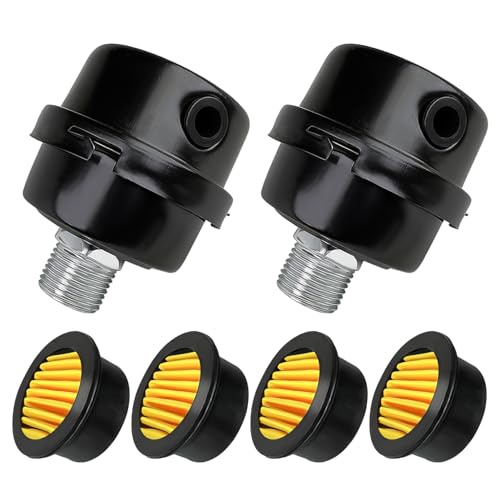
Darlingao 1/2-Inch Male Thread Air Compressor
This two-pack of Darlingao intake silencer filters features a sturdy coated metal shell, 1/2-inch (20mm) male threads, and replaceable sound-absorbing elements to help dampen pump intake suction roar while keeping ambient dust out. It is a practical replacement for garage DIYers, woodworkers, and maintenance technicians seeking durable metal intake protection.
Pros
- Coated metal housing provides far better impact and heat durability than fragile plastic intake caps
- Includes additional replacement filter media to simplify periodic intake maintenance
- Helps dampen rhythmic intake suction noise across small compressors and shop blowers
- Twin-pack configuration offers great utility for twin-cylinder pumps or keeping a spare on hand
Cons
- Thread specification is listed as 1/2-inch / 20mm, requiring users to verify their pump intake port pitch and threading before purchasing
- Only dampens air intake suction sound and will not reduce mechanical motor hum or reciprocating pump clatter
- Requires regular inspection and element replacement in high-dust woodworking or sanding environments
AIRZOE 1/4-Inch NPT Air Compressor Filter
The AIRZOE AF2000-02M is an in-line 1/4-inch NPT pneumatic moisture filter rated for up to 26.5 SCFM and 145 PSI working pressure. Equipped with a reusable 5-micron brass filter element and a manual push drain, it provides cost-effective particulate and water separation for home garages and small workshops.
Pros
- Reusable 5-micron brass element cleans easily and avoids recurring replacement cartridge costs
- Flow rating of 26.5 SCFM easily accommodates brad nailers, staple guns, and tire inflation tools
- Compact footprint and standard 1/4-inch NPT threads simplify installation on compact air setups
- Straightforward manual drain valve allows fast water discharge at the end of a project
Cons
- Manual drain requires regular visual inspection and manual release rather than draining automatically
- Flow capacity of 26.5 SCFM is not suited for continuous high-demand tools like sandblasters or dual-action sanders
- Does not replace a desiccant dryer for critical moisture-free tasks like professional automotive spray painting
Clean Resources IDC-350 Separator 15-125 HP
Built for compressed air setups from 15 to 125 HP, the Clean Resources IDC-350 separates lubricant via molecular sieve technology without requiring electricity. It operates on passive gravity flow with six inlets, making it a practical fit for multi-compressor industrial facilities.
Pros
- Zero electrical power required for operation
- Six inlets support multiple compressor lines
- Low carryover of 10 ppm or less
- No messy filter bag change-outs required
Cons
- Capacity capped at 125 HP systems
- Gravity flow requires downward sloped drain lines
Pete Industries Original Air Filter Cleaner
Designed for workshops and heavy machinery maintenance, this pneumatic tool cleans radial sealed filters from the inside out in under a minute. Its stepped lid self-centers across six diameters, while the regulated rotating nozzle protects delicate filter media from direct air pressure.
Pros
- Cleans thoroughly in under one minute
- Tiered lid fits six filter sizes
- Regulated airflow prevents filter media damage
- Durable stainless steel and Delrin build
- Lifetime warranty on rotating nozzle
Cons
- Requires an external air compressor to operate
- Only compatible with radial sealed filter designs
- Bulky 25-inch frame requires ample storage space
Maintaining Compressor Air Filters for Peak Airflow and Longevity
Air compressors pull substantial volumes of ambient air during every compression cycle, trapping airborne particulates directly against the intake filter media. Restricting this intake pathway forces the electric motor and pump to draw against heavy vacuum resistance, elevating cylinder temperatures and noticeably slowing down tank recovery times. Following verified maintenance protocols ensures that intake components shield internal pump mechanisms without choking pneumatic volume.
Identifying Your Filter Media and Housing Configuration
Air compressor systems utilize different filtration media depending on whether the element is installed at the pump intake port or downstream along the regulated airline. Suction intake filters typically mount inside plastic or metal silencer canisters and feature dry pleated cellulose paper, synthetic media, or washable foam sleeves. Downstream inline filters, such as moisture separators and particulate traps, often feature rigid sintered bronze or 5-micron brass elements housed within transparent or metal bowls. Understanding the exact construction of your element is critical because each material demands a specific maintenance procedure.
Paper elements with plastisol molded end caps and metal inner support cores require dry cleaning methods to prevent structural collapse. Applying liquid cleaners or harsh solvents to standard paper pleats dissolves the resin binders and ruins the filtration structure. Porous brass elements found in inline moisture traps tolerate mild degreasing washes, while polyurethane foam pre-filters require gentle soap and water baths. Matching your cleaning technique to the exact filter media prevents accidental damage and ensures consistent pump protection.
Safe Disassembly and Pre-Cleaning Inspection
Before touching any filtration assembly, turn off the compressor switch, disconnect the electrical cord or shut off the dedicated breaker, and drain all stored pressure from the receiver tank. Depressurizing the tank protects your hands and prevents accidental motor cycling while servicing intake components. Inspect the exterior silencer housing for impact cracks, loose threaded fittings, or metal corrosion around the intake port. Unthread the silencer canister or remove the retaining wing nut and cover carefully to access the internal element without forcing the components.
Remove the filter element and inspect the pleats under a bright workshop light for oil saturation, tears, or structural pinholes. Oily residue on an intake filter mounted to an oil-lubricated pump often signals excessive crankcase blow-by or an overfilled oil sump. Discard any paper cartridge that exhibits tears, crushed metal mesh, or hardened greasy sludge. Cleaning compromised media risks allowing abrasive particulate bypass straight into the compression cylinders, leading to rapid pump wear.
Cleaning Pleated Paper Intake Filter Elements
Dry pleated paper elements represent the most common intake filtration media for both portable jobsite compressors and stationary garage units. Start by tapping the rubber or plastisol end cap gently against a clean, flat surface to dislodge loose surface dust and sawdust from the external folds. Avoid striking the paper media directly against sharp edges or workbench corners, as mechanical impacts easily crush the pleats and rupture the paper fibers. Light tapping removes the bulk of loose debris without stressing the delicate internal substrate.
After tapping out loose debris, connect a blow gun regulated to a maximum pressure of 30 PSI to blow compressed air through the element from the inside out. Directing airflow from the clean interior core toward the dirty exterior surface lifts lodged particles out of the paper without embedding them deeper. Keep the blow gun nozzle at least one to two inches away from the paper surface to avoid puncturing the delicate substrate with localized high-velocity air jets. Work the nozzle slowly along each pleat channel until visible dust clouds stop emerging from the exterior face.
Never apply water, parts washer solvent, or petroleum-based degreasers to paper intake filters. Liquid binders quickly soften the paper fibers and cause the microscopic pores to swell shut permanently. Once the cartridge has been blown out, verify that the inner metallic support core remains intact and free of loose particulate. Set the cleaned element aside on a clean rag while preparing the housing for reassembly.
Servicing Foam and Sponge Pre-Filters
Many jobsite compressors and metal silencer canisters feature a washable polyurethane foam sleeve that wraps around the paper element or sits alone inside the intake port. This foam pre-filter captures coarse jobsite debris, airborne sawdust, and hair before those particles can reach the finer secondary paper folds. Servicing foam sleeves requires a gentle wet-cleaning process using warm water and a mild dishwashing detergent to dissolve surface grime. Gentle handling keeps the cellular structure of the sponge material flexible and intact over repeated wash cycles.
Submerge the foam sleeve in soapy water and gently squeeze the material repeatedly to flush out accumulated contaminants without stretching or twisting the foam. Rinse the element thoroughly under clean running water until all soap residue vanishes completely, ensuring no detergent remains to attract fresh dust. Squeeze out excess moisture inside a dry lint-free shop towel rather than wringing the sleeve, which could tear the porous cellular matrix. Rinsing out all soap residue keeps the foam porous and prevents chemical residues from drying inside the material.
Allow the foam pre-filter to air-dry completely in a well-ventilated area before attempting to reinstall it over the paper cartridge. Installing a damp foam sleeve on an air compressor draws moisture directly into the dry paper media, promoting mildew growth and rapid clogging. If the equipment manufacturer specifies light oiling for the foam element, apply only a few drops of non-detergent oil and knead it evenly through the material. Always leave dry foam un-oiled if it fits directly over a primary paper intake cartridge.
Cleaning Sintered Brass and Downstream Line Elements
Downstream airline filters, such as inline point-of-use particulate traps and water separators, employ rigid 5-micron sintered brass or bronze elements rather than paper media. These porous metallic elements trap rust flakes, pipe scale, and condensed liquid droplets before pressurized air enters pneumatic tools or paint sprayers. Because these elements consist of solid porous metal, they tolerate chemical cleaning procedures that would destroy intake paper cartridges. Regular maintenance of these downstream elements ensures optimal moisture separation and prevents pressure drops across your air lines.
To service a sintered brass element, isolate the air line, depressurize the filter bowl completely using the manual drain, and unscrew the protective bowl assembly. Unthread the internal baffle and retaining nut to free the brass element from the filter body. Soak the element in a mild solvent bath or warm ultrasonic cleaning solution to dissolve trapped oil mists, varnish, and sticky residues accumulated from compressor pump oil carryover. Agitating the brass element gently in the cleaning bath loosens deeply set varnish from the microscopic pores.
After soaking, blow clean shop air through the interior cavity of the brass element toward the outer surface at moderate pressure to clear dislodged solids. Allow the metal element to dry completely before reassembling the unit with fresh rubber O-rings lubricated with a light coat of silicone grease. Inspect the manual drain valve on the bottom of the bowl to ensure smooth operation when purging liquid condensate during daily compressor operation. Proper reassembly of the bowl housing prevents air leaks and maintains stable downstream pressure.
Using Inside-Out Rotary Cleaning Tools for Cylindrical Filters
Operators running high-demand pneumatic setups or larger cylindrical filters often rely on specialized inside-out rotary air filter cleaning tools to restore intake elements quickly. Tools such as those manufactured by Pete Industries utilize precision-machined rotating nozzles with interchangeable arms to distribute pressurized air across the entire internal circumference of a radial cartridge. This mechanical rotation eliminates the uneven pressure patterns and human error associated with waving a handheld blow gun across delicate pleats. The automated rotating motion sweeps air through every fold with consistent speed and angle.
The tool features a tiered lid that seals against the open end of cylindrical filters spanning multiple inner diameters, centering the rotating shaft inside the housing. When compressed air is connected, multi-port arms spin inside the cartridge to direct uniform streams of pressurized air outward through the filter media. Because the nozzle design regulates air velocity and prevents direct, concentrated blasting against any single pleat, it cleans the filter from the inside out in less than a minute without damaging the internal structure. This controlled airflow safely lifts fine dust and debris away from the pleats without tearing delicate filter fibers.
This approach proves especially beneficial for agriculture, construction, and busy workshop environments where filters accumulate dense coatings of fine soil, grain dust, or concrete powder. Utilizing an engineered cleaning tool extends the working life of heavy-duty replacement cartridges by thoroughly purging embedded particulate that standard hand tapping cannot loosen. Ensuring a uniform clean across all pleats preserves steady CFM airflow and minimizes suction restriction on large single-stage and two-stage compressor pumps. Consistent airflow protection helps stationary workshop units run cooler and last longer through intense production schedules.
Critical Mistakes That Ruin Filter Media and Damage Pumps
One of the most widespread maintenance errors is using excessive blast pressure from an unregulated blow gun directly against the outer surface of a paper filter. Blasting air from the outside inward drives sharp dirt particles deeper into the porous paper fibers, wedging contaminants into the media and creating microscopic ruptures. Once paper fibers separate, unfiltered jobsite dust passes freely into the intake valves, leading to abrasive wear on cast-iron cylinders, piston rings, and valve reeds. Maintaining regulated pressure and spraying strictly from the inside out prevents this structural damage.
Another severe mistake involves washing dry paper cartridges with water, gasoline, brake cleaner, or parts-washing solvents in an attempt to remove oil stains. Solvents break down the specialized bonding adhesives holding the pleated media to the molded end caps and dissolve the resin binders that maintain paper rigidity. The saturated paper then collapses under the intake vacuum created during pump suction strokes, completely blocking airflow or getting drawn directly into the pump manifold. Oily paper cartridges must always be discarded and replaced rather than subjected to chemical washes.
Striking the filter violently against concrete floors or metal equipment frames to dislodge dirt is equally destructive. Impact shock cracks brittle plastic end caps, bends metallic center cores, and separates the glued pleat seams. Neglecting to clean the interior of the silencer housing before reinstalling the filter leaves loose dirt waiting to be sucked directly into the refreshed element the moment the motor switches on. Wiping down the housing with a clean, lint-free cloth ensures a clean environment for the reinstalled filter.
Verification, Reassembly, and Post-Cleaning Performance Checks
After cleaning, hold the element up to a bright inspection lamp to examine the pleats thoroughly from both the inside and outside. Look for light beams shining through pinpoint punctures, separated seams along the end caps, or crushed pleat groupings that could restrict free air passage. If the cartridge passes visual inspection, wipe down the interior walls of the silencer housing using a clean, damp shop cloth to remove lingering loose dirt. Taking time to inspect the element under good lighting prevents accidental installation of torn or defective media.
Reinstall the element carefully over the center locating flange and ensure that the sealing gaskets or plastisol end caps seat flush against the housing surfaces. Tighten the retaining wing nut or thread the silencer canister into the pump cylinder head by hand to prevent cross-threading delicate aluminum intake threads. An improper seal around the housing perimeter allows ambient dust to bypass the filter entirely, defeating the entire purpose of the maintenance routine. Ensuring a snug, aligned fit guarantees that every cubic foot of incoming air passes through the protective media.
Restore electrical power to the compressor, close the tank drain valve, and start the motor to monitor pump fill performance. Pay attention to intake sound and pump recovery time, checking whether the compressor reaches cut-out pressure within its normal operating window without labored motor humming. A properly cleaned filter restores unrestricted airflow, helping the pump run at lower cylinder head temperatures and maintaining steady CFM delivery to your air tools. Confirming smooth pressurization gives you confidence that the intake assembly is functioning properly.
Knowing When to Clean Versus When to Replace
While routine cleaning helps extend the usable lifespan of intake elements, paper filter media cannot be cleaned indefinitely. Over time, microscopic particulate becomes permanently embedded in the cellulose substrate, steadily reducing intake CFM even if the exterior pleats appear relatively clean. Many manufacturers recommend replacing standard paper intake elements periodically during heavy daily use, or immediately if the media exhibits oil contamination or physical deformation. Recognizing the limits of filter cleaning prevents prolonged pump starvation and excessive operating heat.
Multi-pack replacement elements designed for standard 1/2-inch, 3/8-inch, or 1/4-inch intake silencer canisters make routine replacement practical and cost-effective. Keeping spare intake cartridges and replacement silencer mufflers in your workshop inventory prevents costly equipment downtime when a filter becomes too clogged or damaged to clean. Balancing regular gentle cleanings with timely element replacements guarantees that your air compressor operates reliably, quietly, and with maximum pneumatic efficiency. Fresh replacement filters restore original factory airflow rates and offer peace of mind during demanding pneumatic tasks.
Regularly checking the intake filter should form an integral part of your overall pneumatic maintenance routine alongside daily tank condensation draining and line pressure checks. Clean intake air directly protects cylinder walls, reduces piston friction, and keeps reed valves seating cleanly without carbon buildup. Investing a few minutes to inspect and clean or replace filter elements ensures dependable air tool operation and protects your investment across years of workshop projects. Clean filtration keeps your compressor running at full efficiency, ready to handle framing nailers, spray equipment, or automotive impact tools whenever duty calls.
About the author
Bob Beacham is an experienced tools and workshop writer with deep knowledge of power equipment, mechanical systems, and practical DIY applications. His coverage of air compressors, welding equipment, saws, and workshop tools helps translate technical specifications into useful guidance for homeowners and serious DIYers.