
Can You Paint With a 20 Gallon Air Compressor: Practical Guide for 2026
Determining whether can you paint with a 20 gallon air compressor works requires matching CFM, spray guns, and moisture filters for October 2026.
 By Tom Scalisi
Updated October 8, 2026
By Tom Scalisi
Updated October 8, 2026

Pneumatic spray finishing places severe demands on shop air systems, often pulling steady airflow that outpaces small portable pumps. Woodworkers and automotive hobbyists frequently ask whether a medium-sized workshop tank provides enough stamina for automotive panels, furniture, or primers. The short answer is yes, but your success depends entirely on spray gun air consumption, operating pressure, and the delivered volume of the pump. Understanding whether can you paint with a 20 gallon air compressor requires looking closely at continuous CFM ratings rather than tank size alone.
A twenty-gallon tank functions primarily as a storage buffer that absorbs brief surges in air usage while the pump works to restore pressure. When paired with high-efficiency spray guns like low-volume, low-pressure (LVLP) units or modest detail sprayers, a 20-gallon setup delivers dependable, steady performance. However, attempting to spray full automotive clear coats with a power-hungry high-volume, low-pressure (HVLP) gun will quickly drain the air reservoir and cause noticeable pressure drops. Matching your spray equipment to your compressor’s delivery rate helps prevent orange peel, dry spray, and motor overheating during long finishing sessions.
| Award | Product | ACR Score About ACR ScoreThe ACR Score is our own rating from 0 to 10, based on performance, design and build, ease of use, and value. It reflects independent research and is never influenced by manufacturers, retailers, or affiliate commissions. Learn more › | |
|---|---|---|---|
| Best Overall |
Craftsman 20-Gallon Oil-Free Air Compressor
|
8.4/10 | Buy |
| Best Budget |
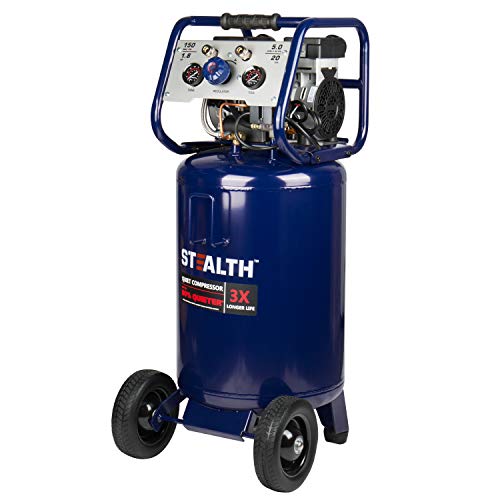 Stealth 20-Gallon 1.8 HP Air Compressor
|
7.8/10 | Buy |
 Ingersoll Rand P1.5IU-A9 2 HP Air Compressor
|
7.8/10 | Buy |
Craftsman 20-Gallon Oil-Free Air Compressor
The Craftsman CMXECXA0232043 pairs a large 20-gallon tank with a 1.8 HP oil-free pump to deliver 4 SCFM at 90 PSI and up to 175 PSI of maximum storage pressure. It offers dependable air reserves and dual quick couplers for home garage mechanics, woodworkers, and DIYers tackling intermittent pneumatic tasks.
Pros
- Generous 20-gallon air storage capacity paired with an elevated 175 PSI maximum shutoff pressure
- Solid 4 SCFM output at 90 PSI handles intermittent automotive fastening and rapid framing nailer cycling
- Convenient maintenance-free oil-free pump eliminates crankcase oil changes and cold-weather oil thickening
- Outfitted with dual quick couplers and an easily operated quarter-turn ball drain valve at the tank base
- Sturdy upright wheeled frame saves garage floor space while remaining easy to tilt and roll
Cons
- Continuous high-demand tools such as rotary sanders or production paint sprayers will exceed the 4 SCFM continuous threshold
- Oil-free direct-drive pump assemblies typically generate higher operating noise levels than low-RPM induction models
- Vertical footprint standing over 41 inches high requires dedicated clearance in compact utility spaces or vehicles
Stealth 20-Gallon 1.8 HP Air Compressor
Delivering 5 CFM at 90 PSI at an ultra-quiet 68 decibels, this oil-free machine is tailored for home garages and noise-sensitive workshops. Its generous 20-gallon tank supports high-demand pneumatic tools, though the 121-pound build limits effortless transport.
Pros
- Quiet 68-decibel sound output protects hearing
- Reliable 5 CFM delivery at 90 PSI
- Maintenance-free oil-free pump design
- Dual couplers streamline multi-tool setups
- Substantial 20-gallon tank capacity
Cons
- Hefty 121-pound weight hampers vehicle loading
- Tall 42-inch frame demands dedicated storage space
Ingersoll Rand P1.5IU-A9 2 HP Air Compressor
Built for demanding DIY and shop applications, this 20-gallon unit pairs a cast-iron build with a 100% continuous duty rating. Semi-pneumatic tires and an ergonomic handle provide practical workshop mobility despite its heavy-duty construction.
Pros
- Continuous duty cycle supports demanding workloads
- Durable cast iron pump and frame
- Long 2,000-hour service intervals between oil changes
- Built-in wheels and handle aid positioning
Cons
- Heavy build at nearly 200 pounds
- Audible operating noise level of 80 dBA
A Practical Analysis of Painting with a 20-Gallon Air Compressor
Painting successfully with a 20-gallon air compressor is entirely feasible when your project scope and equipment align with the mechanical output of the machine. The air tank acts as a temporary reservoir, storing pressurized volume so your spray gun operates with a stable, steady pattern. However, the pump ultimately dictates how long that pressure remains consistent before the motor must engage to replenish the vessel. Achieving professional, defect-free finishes on furniture, automotive parts, or cabinetry requires balancing the air consumption of your spray gun against the continuous delivery capacity of the compressor pump.
Air Consumption: Understanding CFM Demands Across Spray Gun Types
Pneumatic spray guns require continuous airflow, which fundamentally differs from the intermittent bursts needed by framing or finish nailers. Traditional high-volume, low-pressure (HVLP) spray guns are notorious for heavy air consumption, frequently demanding between 8 and 14 cubic feet per minute (CFM) at 30 to 40 PSI. In contrast, low-volume, low-pressure (LVLP) spray guns operate efficiently on significantly lower air volumes, typically consuming between 3.5 and 6 CFM at working pressures around 25 to 30 PSI. Detail guns and small touch-up sprayers operate on even smaller volumes, often requiring only 2 to 4 CFM to atomize thin finishes smoothly.
Understanding the distinction between volume at low pressure and delivery at high pressure is essential when evaluating air tools. Compressor specifications typically highlight air delivery measured at 90 PSI, while paint sprayers operate at regulated pressures between 20 and 45 PSI at the gun inlet. Because air compressors produce higher effective CFM at lower operating pressures, a pump rated at 4 CFM at 90 PSI might deliver roughly 5 to 5.5 CFM at 40 PSI. You must verify that your chosen spray gun requires less air volume than the pump can continuously produce at spraying pressure, or the tank will gradually bleed off its stored reserve.
Tank Buffer Versus Continuous Output: The 20-Gallon Capacity Reality
A 20-gallon tank holds a respectable volume of compressed air, but air volume alone does not determine how long you can trigger a paint gun without stopping. When you pressurize a tank to 150 or 175 PSI, that stored air provides an initial buffer that cushions the demand of the spray gun. If your paint gun consumes 10 CFM while your compressor pump only produces 4.5 CFM, the system operates at a net deficit of 5.5 CFM during every second of continuous triggering. That deficit draws directly from the 20-gallon storage reserve, causing overall tank pressure to fall rapidly toward the cut-in threshold.
Once tank pressure drops below the working pressure dialed into your line regulator, the spray gun experiences an immediate drop in atomization energy. This pressure loss causes the spray fan to collapse, producing uneven fluid distribution, heavy paint droplets, and noticeable orange peel textures. An air compressor with a 20-gallon receiver can easily sustain a continuous spray pass for 45 to 90 seconds under a moderate deficit before line pressure drops. This brief window is plenty of time to paint an automotive fender, a bumper cover, or a cabinet door, but it makes coating a large vehicle roof or full trailer panel practically impossible without pausing.
Selecting Compatible Spray Guns for 20-Gallon Systems
Low-volume, low-pressure spray guns represent the optimal match for medium-capacity air compressors. These guns use specialized internal air passages and air caps designed to atomize automotive basecoats, single-stage enamels, and wood lacquers using minimal air volume. Because many quality LVLP guns demand only 4 to 5 CFM at roughly 28 PSI, they can run nearly continuously on a 20-gallon compressor without forcing the tank into severe pressure starvation. The reduced overspray common to LVLP designs also improves paint transfer efficiency, saving expensive material while keeping garage air cleaner.
Miniature touch-up guns with 0.8 mm to 1.0 mm fluid nozzles offer another practical solution for wood finishing, motorcycle parts, and spot repairs. These compact guns draw very low CFM, allowing a 20-gallon unit to easily keep up with continuous spraying while cycling on and off normally. Conventional high-pressure guns, while inexpensive and capable of fine atomization, generally require substantial pressure that rapidly drains small air reservoirs. Unless you are spraying very small items, full-sized production HVLP guns with 1.3 mm to 1.5 mm nozzles will severely strain a 20-gallon workshop compressor unless you adopt a disciplined, panel-by-panel workflow.
Comparing Oil-Free and Oil-Lubricated Compressor Pumps for Painting
Pump construction influences both air cleanliness and operational duty cycle during demanding spray sessions. Oil-free compressors, such as the Craftsman 20-gallon unit with 1.8 horsepower and 175 PSI maximum pressure, deliver 4 SCFM at 90 PSI without introducing oil vapor into the air stream. Oil-free dual-piston configurations, like the Stealth 20-gallon ultra-quiet model, generate 5.5 CFM at 40 PSI and 5 CFM at 90 PSI while running at a quiet 68 decibels. These oil-free pumps eliminate the risk of oil aerosols traveling down the air line, which is a major advantage for sensitive automotive clear coats that develop fisheyes when exposed to trace lubricants.
Oil-free pumps generate significant mechanical heat and generally feature intermittent duty cycle ratings, meaning they require rest intervals between heavy cycles to prevent thermal breakdown. In comparison, cast-iron oil-lubricated compressors provide exceptional thermal durability under sustained use. The Ingersoll Rand P1.5IU-A9 features a durable cast-iron cylinder, a 2 horsepower single-stage pump, and a 100 percent continuous duty rating designed for tough applications. While oil-lubricated cast-iron pumps handle non-stop running without thermal fatigue, they require strict air filtration downstream to capture trace oil mists before they reach the spray gun.
Moisture Management and Air Line Filtration Requirements
Compressed air becomes intensely hot as it is compressed inside the pump cylinder, holding high levels of suspended atmospheric moisture. As that hot air enters the 20-gallon steel receiver and begins to cool, moisture condenses rapidly into liquid water along the internal tank walls. If this condensation escapes down the air hose into your spray gun, it will cause blistering, clouding, and catastrophic adhesion failures in your fresh paint film. Spray painting requires dry, clean air, making proper moisture management just as critical as selecting the right compressor capacity.
Installing an effective filtration setup begins directly at the compressor discharge port. A quality particulate filter and water separator should be mounted at least 25 to 50 feet away from the compressor using copper or iron piping to give the air adequate time to cool and condense. For automotive and fine woodworking finishes, pairing a standard water trap with a disposable desiccant filter right at the gun inlet guarantees dry air delivery. Regular maintenance of the tank itself is equally essential, requiring you to open the lower drain valve after every session to purge accumulated water and protect the tank floor from corrosion.
Optimizing Air Hose Diameter and Pressure Regulation
Air delivery restrictions between the compressor manifold and the spray gun often cause unexpected pressure drops during painting. Many DIY users connect standard 1/4-inch inner diameter (ID) air hoses, which create severe friction and restrict the volume of air reaching the tool. Upgrading to a 3/8-inch ID air hose allows significantly higher air volume to reach your spray gun with minimal line friction over a typical 25-foot or 50-foot run. High-flow quick-connect couplers should also replace standard industrial fittings to maximize airflow through every connection point along the line.
Accurate pressure control requires monitoring both the compressor tank gauge and a dedicated mini-regulator mounted at the base of the paint gun. Setting your line regulator at the compressor to roughly 10 to 15 PSI above your target spraying pressure compensates for dynamic pressure drop across the hose. When you pull the trigger with air flowing freely, use the mini-regulator at the gun handle to set the exact operating pressure recommended by the paint manufacturer. This dual-gauge arrangement prevents pressure fluctuations at the nozzle, ensuring that your spray pattern remains uniform from start to finish.
Practical Spraying Techniques for 20-Gallon Setups
Adapting your spraying technique to the limits of a 20-gallon compressor prevents common finish defects caused by pressure drops. Instead of attempting to spray an entire car or a full suite of kitchen cabinets in one continuous pass, break the work down into individual panels. Coat one fender, door, or cabinet face thoroughly, then release the trigger and inspect your work while the compressor pump cycles back up to its cut-out pressure. This intermittent rhythm allows the motor to catch up, ensuring you begin each new panel with a full tank of pressurized air.
Adjusting your paint viscosity also eases the burden on your pneumatic equipment. Thinning your coatings according to the paint manufacturer’s technical data sheet allows the fluid to atomize cleanly at lower air pressures. Lower atomization pressures reduce the overall CFM demand on the compressor, extending the duration of your spray passes before the tank pressure dips. Maintaining a consistent six-to-eight-inch distance from the surface and a 50 percent overlap pattern yields flat, glossy coats without demanding excessive trigger time.
Electrical Supply and Workshop Duty Cycle Limitations
Most 20-gallon air compressors feature 1.8 to 2 horsepower electric motors designed to operate on standard 120-volt household alternating current. These electric motors draw significant amperage, especially during initial startup against high internal head pressure in the pump. Running a compressor on a shared 15-amp branch circuit can easily trip the circuit breaker if shop lights or ventilation fans share the same wiring. Connecting your compressor to a dedicated 20-amp circuit provides the electrical headroom needed for reliable motor starts and uninterrupted recovery cycles.
Using long, undersized extension cords is one of the most common mistakes made in home workshops. Light-gauge extension cords cause voltage drops that starve the electric motor of power, causing it to overheat and trip its internal thermal overload switch. If you need extra reach inside your workspace, always keep the compressor plugged directly into a wall outlet and extend your reach using longer 3/8-inch air hoses instead. Respecting the duty cycle of consumer-grade pumps by allowing adequate cool-down time preserves the cylinder seals and valve plates for years of reliable operation.
Clear Operational Boundaries: What a 20-Gallon Tank Cannot Do
While a 20-gallon air compressor handles small to medium painting tasks admirably, recognizing its practical limits prevents ruined finishes and damaged machinery. Attempting a complete automotive respray, where you must lay down basecoat and clear coat across an entire vehicle without stopping, will inevitably overwhelm the pump. The continuous air demand of full-vehicle spraying drains a 20-gallon tank in minutes, forcing the pump to run non-stop while line pressure drops below atomization thresholds. For full-vehicle automotive restoration or high-production commercial spraying, a stationary 60-gallon or 80-gallon two-stage compressor delivering 14 or more CFM is mandatory.
Similarly, running heavy pneumatic sanders for surface preparation immediately prior to painting will expose the volume limits of a 20-gallon reservoir. Dual-action orbital sanders consume continuous air volumes comparable to large HVLP guns, often drawing 8 to 12 CFM under continuous load. Attempting to featheredge body filler or sand large primer panels with an air sander will cause the compressor to run continuously and overheat quickly. Using electric orbital sanders for prep work preserves your compressed air supply strictly for the critical spraying and atomization stages where pneumatic equipment truly excels.
Summary Guidelines for Workshop Painting Success
Operating a 20-gallon compressor for painting projects delivers rewarding results when approached with realistic expectations and the right pneumatic setup. Pairing your machine with a quality low-volume, low-pressure spray gun keeps air consumption within the delivery limits of typical 1.8 to 2 horsepower pumps. Equipping your system with 3/8-inch hoses, effective water traps, and clean filtration ensures that every pass lays down flat, contamination-free coatings. By adopting a disciplined panel-by-panel painting rhythm, you can achieve professional-grade finishes on furniture, automotive parts, and home projects without investing in massive industrial equipment.
About the author
Tom Scalisi brings more than two decades of experience in construction, building maintenance, contracting, and hands-on tool use. His practical understanding of power tools, automotive work, repairs, and jobsite equipment helps readers evaluate compressors based on real workloads rather than specifications alone.