
How to Connect Extra Tank to Air Compressor: Practical Guide for 2026
Master how to connect extra tank to air compressor systems to expand usable air volume and prevent line pressure drops in October 2026.
 By Bob Beacham
Updated October 8, 2026
By Bob Beacham
Updated October 8, 2026

Continuous pneumatic tools like sanders and impact wrenches quickly drain small compressor tanks, causing rapid line pressure drops and forcing the motor to cycle repeatedly. Adding an auxiliary air reservoir expands your total storage volume so your setup can absorb heavy bursts without immediate pressure loss. Knowing how to connect extra tank to air compressor units gives you the extra capacity needed to stabilize line pressure during demanding shop tasks. When plumbing these auxiliary lines, connecting air compressor hoses properly with reliable fittings ensures that no air escapes between the storage vessels.
While adding an auxiliary tank does not increase the continuous CFM produced by the pump, it significantly broadens your usable air buffer between duty cycles. This buffer prevents pneumatic equipment from stalling mid-cut and reduces frequent motor restart cycles that heat up electric motors. Taking time to review understanding compressor CFM ratings helps clarify what an extra tank can and cannot do for your workshop workflow. Setting up the auxiliary vessel with safe bypass relief valves and solid brass couplers creates a dependable dual-tank system that handles demanding pneumatic jobs smoothly.
| Award | Product | ACR Score About ACR ScoreThe ACR Score is our own rating from 0 to 10, based on performance, design and build, ease of use, and value. It reflects independent research and is never influenced by manufacturers, retailers, or affiliate commissions. Learn more › | |
|---|---|---|---|
| Best Overall |
SUNROAD Air Tank Repair Kit with 4-Ft Hose
|
9.2/10 | Buy |
| Best Budget |
 AIJOJUMY 4-Piece Brass Air Tank Valve Kit
|
9.1/10 | Buy |
| Best Premium |
 SUNROAD 2-Pack Extended Air Compressor Tank Drain
|
9.1/10 | Buy |
 QWORK 2-Pack Air Compressor Extended Tank Drain
|
9.1/10 | Buy | |
| Best Value |
 Tondiamo 1/4 Inch NPT Brass Mini Ball Valve
|
8.6/10 | Buy |
 JIOTAR 740112 Air Compressor Hose Adapter
|
8.6/10 | Buy | |
 ZKZX 1/4" to 3/4" GHT Blowout Adapter 2-Pack
|
8.4/10 | Buy | |
 Hromee Air Tank Manifold Replacement with Fill
|
8.4/10 | Buy | |
 LUMITECO 20-Inch Tire Inflator Hose Adapter
|
8.3/10 | Buy | |
 SUNROAD 10-Inch Compressor Tank Drain Kit
|
8.3/10 | Buy |
SUNROAD Air Tank Repair Kit with 4-Ft Hose
Designed for refurbishing portable air tanks, this all-in-one assembly combines a solid brass manifold, an easy-to-read 200 PSI gauge, and a flexible four-foot hose. It offers a practical fix for garage mechanics and DIYers needing to replace leaky or worn tank components.
Pros
- Includes manifold, gauge, hose, and thread seal tape
- Easy-to-read 2-inch dual-unit dial gauge
- Corrosion-resistant solid brass connections ensure reliable sealing
- Flexible PVC hose rated up to 300 PSI
Cons
- Short four-foot hose restricts working radius
- Requires 1/2-inch MNPT port or additional adapters
AIJOJUMY 4-Piece Brass Air Tank Valve Kit
This four-piece brass valve set provides replacement 1/4-inch and 1/8-inch MNPT fittings for standard air compressor tanks. Featuring universal VG8 valve cores and protective dust caps, it offers a durable solution for tank maintenance.
Pros
- Solid brass build resists rust and seizing
- Includes two common tank port sizes
- Universal VG8 threads simplify valve core replacement
- Comes with protective dust caps
Cons
- Requires PTFE tape during installation to prevent seepage
- Only fits 1/8-inch and 1/4-inch ports
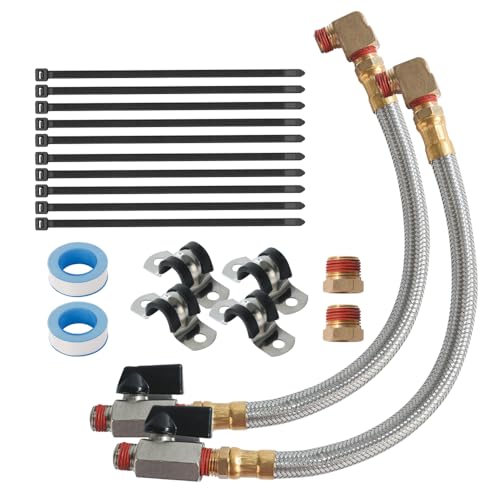
SUNROAD 2-Pack Extended Air Compressor Tank Drain
The SUNROAD 2-Pack Extended Tank Drain Valve Kit relocates awkward tank drain ports using a 10-inch braided steel hose rated to 175 PSI and a smooth quarter-turn brass ball valve rated to 300 PSI. It provides DIYers, garage mechanics, and woodworkers with a clean, ergonomic way to purge tank condensation and help protect air receiver vessels from internal rust.
Pros
- Eliminates having to reach or crawl beneath bulky air tanks to turn stiff factory drain screws
- Rugged 10-inch braided steel hose handles up to 175 PSI working pressure and 200 degrees Fahrenheit
- Smooth quarter-turn chrome-plated brass ball valve provides reliable shutoff without leaking air
- Supplied with 3/8-inch adapter bushings, thread seal tape, and vibration-damping mounting clamps
Cons
- Hose working pressure is capped at 175 PSI, making it unsuitable for high-pressure industrial systems operating above that threshold
- Initial installation into tight bottom bungs on low-clearance tanks may require tipping the compressor
- Thread connections require careful wrapping with the included Teflon tape to ensure an airtight seal
QWORK 2-Pack Air Compressor Extended Tank Drain
The QWORK 2-Pack Extended Tank Drain Valve Assembly Kit relocates hard-to-reach petcock drains using a 10-inch braided steel hose rated for 175 PSI working pressure. It provides DIYers, mechanics, and shop owners with a durable brass upgrade that simplifies regular moisture draining to prevent internal tank corrosion.
Pros
- Durable braided steel hose and brass construction resist workshop wear, rust, and corrosion
- 10-inch extended length eliminates crawling under tanks or scraping knuckles on low-clearance petcocks
- High working pressure rating of 175 PSI with a 475 PSI blasting threshold ensures safe pneumatic containment
- Complete two-pack kit includes 1/4-inch to 3/8-inch brass adapters and thread seal tape for quick installation
Cons
- Requires checking your specific compressor tank port size to verify 1/4-inch or 3/8-inch NPT compatibility
- Does not include an integrated shut-off ball valve, requiring you to attach an existing valve or fitting to the hose end
Tondiamo 1/4 Inch NPT Brass Mini Ball Valve
The Tondiamo 1/4-inch NPT Brass Mini Ball Valve 2-Pack provides a practical replacement for stubborn compressor petcocks, offering quick quarter-turn manual moisture drainage. Built with a solid brass body and full-port design, it is an ideal maintenance upgrade for garage DIYers and workshop mechanics looking to protect air tanks from internal corrosion.
Pros
- Smooth quarter-turn lever eliminates the knuckle-scraping hassle of factory screw-type drain cocks
- Corrosion-resistant brass construction handles rusty tank water and condensation runoff
- Standard 1/4-inch NPT male by female threading ensures easy adaptation to common compressor tanks
- Two-piece pack delivers great value for outfitting multiple shop compressors or maintaining a spare
Cons
- Manufacturer data does not state a verified maximum working PSI rating, requiring caution on high-pressure systems
- Compact lever handle may require extra clearance or a street elbow depending on tank baseplate clearance
- Does not include pre-applied thread sealant or PTFE tape, requiring manual sealing during installation
JIOTAR 740112 Air Compressor Hose Adapter
Designed as a direct replacement for ARB-style 740112 fittings, this aluminum alloy quick-connect coupling features standard 1/4-inch NPT threads and a protective rubber dust cap. It is an ideal pick for off-roaders, mobile technicians, and DIYers setting up leak-free on-board air systems for tire inflation and air tools.
Pros
- Integrated rubber dust cap protects internal seals from harsh outdoor and shop debris
- Standard 1/4-inch NPT threads integrate smoothly with common air tanks and manifolds
- Lightweight aluminum alloy body offers good corrosion resistance for vehicle mounting
- Affordable replacement alternative for ARB 740112 on-board air couplings
Cons
- Aluminum alloy threads require careful alignment to avoid cross-threading into harder brass or steel ports
- Does not include pre-applied thread sealant or PTFE tape in the package
- Intended specifically for ARB-style quick-connect profiles and may not mate with non-matching industrial plugs
ZKZX 1/4" to 3/4" GHT Blowout Adapter 2-Pack
Designed for winterizing outdoor plumbing, this brass fitting connects standard air compressors to garden hose lines to clear remaining water. It provides a straightforward solution for safeguarding RVs, camper water lines, and sprinkler systems against freezing temperatures.
Pros
- Solid brass build resists rust and corrosion
- Fits standard 1/4-inch compressor quick-connect couplers
- Threads directly into 3/4-inch female hose ports
- Includes two blowout adapters per pack
Cons
- Only fits female garden hose connections
- Requires a separate air compressor to operate
Hromee Air Tank Manifold Replacement with Fill
The Hromee Air Tank Manifold is a heavy-duty brass replacement assembly engineered to restore portable air carry tanks with a durable aluminum shut-off knob, Schrader fill valve, and 125-150 PSI safety bypass. It offers an easy, dependable rebuild solution for DIYers and mobile mechanics fixing leaking portable air bubbles.
Pros
- Durable solid brass body and stainless steel spring resist internal moisture corrosion
- Machined aluminum shut-off knob provides far greater longevity than fragile plastic turn valves
- Integrated 125-150 PSI safety relief valve includes a manual pull ring for pressure venting
- Standardized port threads allow straightforward installation of gauges, hoses, and quick-connect couplers
Cons
- Inlet thread is fixed at 1/2-inch MNPT, requiring step-down bushings for tanks with alternative port sizes
- Pop-off safety valve threshold of 125-150 PSI makes it unsuitable for high-pressure systems rated over 150 PSI
- Requires proper thread sealant or quality PTFE tape during installation to prevent hairline air leaks
LUMITECO 20-Inch Tire Inflator Hose Adapter
The LUMITECO 20-inch tire inflator hose adapter upgrades portable pumps and inflators with an extended nylon-wrapped rubber line, hands-free locking chuck, and integrated pressure release button. It is a practical upgrade for DIYers, motorists, and cyclists looking to service recessed valve stems without wrestling awkward twist-on fittings.
Pros
- 20-inch nylon-braided rubber extension provides significantly more maneuvering room around large wheel rims and tight spokes
- Built-in thumb-press air bleeder button makes dumping excess pressure fast and accurate without uncoupling the chuck
- 90-degree thumb-lock chuck creates an airtight seal that eliminates in-depth holding during tire filling
- Includes dedicated Presta valve adapter and converting nuts for broader vehicle and bicycle utility
Cons
- Open-flow chuck design will discharge air continuously if connected to an unvalved, live air line without an upstream trigger valve
- Features standard 0.305-inch x 32 TPI tire Schrader fine threads rather than standard workshop 1/4-inch NPT pipe threads
- Working pressure and burst pressure ratings are not explicitly stated in the manufacturer specifications
SUNROAD 10-Inch Compressor Tank Drain Kit
Draining moisture prevents compressor tank rust, and this SUNROAD kit simplifies routine maintenance with a flexible braided steel line and an accessible quarter-turn shutoff. It provides a practical upgrade for standard 1/4-inch and 3/8-inch drain ports operating under 175 PSI.
Pros
- Durable braided steel hose prevents kinks
- Corrosion-resistant chrome-plated brass valve
- Complete installation kit with clamps and tape
- Rubber-coated handle allows easy quarter-turn operation
Cons
- 10-inch hose may be short for large tanks
- Working pressure is limited to 175 PSI
- Requires manual operation after every compressor use
Complete Guide to Connecting an Auxiliary Air Tank
Connecting an auxiliary air storage tank is an effective way to stabilize line pressure and expand usable air volume in a workshop or jobsite environment. By linking a secondary reservoir to your existing setup, you provide your pneumatic tools with a larger pressurized buffer to draw from during demanding operating cycles. Understanding the proper mechanical plumbing and safety precautions ensures that your expanded pneumatic system runs reliably without damaging your compressor pump.
Mechanics of Auxiliary Air Storage: Volume vs. Flow
Expanding compressed air capacity by tying a secondary reservoir to a primary compressor changes how air volume behaves in your workshop. A standard portable unit often runs out of stored air after just a few seconds of continuous pneumatic tool use. Connecting an auxiliary tank increases the physical volume of compressed air stored at high pressure without modifying internal pump components. This larger air reserve absorbs sudden pressure drops that typically cause pneumatic equipment to lose torque or stall mid-cut.
Pneumatic systems operate on two distinct metrics: pressure measured in pounds per square inch and volume measured in cubic feet per minute. The primary compressor pump dictates the rate at which fresh air enters the system, while storage tanks determine how much pressurized air is immediately available. When you integrate a secondary vessel, you multiply the available storage volume without altering pump flow rates. This setup creates a dependable buffer that supports high-draw tools during brief operating cycles while delaying pressure switch cut-in activation.
Plumbing Configurations: Regulated Port vs. Direct Tank Manifold
Connecting an additional air vessel generally follows one of two common plumbing approaches depending on your equipment design. The simplest method feeds air from the primary compressor regulated discharge port directly into the auxiliary tank inlet through standard quick-connect couplers. This configuration limits the secondary tank pressure to whatever level you set on the primary regulator. While quick to install, it restricts the stored pressure in the extra tank and narrows your total energy reserve compared to a full-pressure tie-in.
The more efficient approach ties the secondary vessel directly into the unpressurized tank manifold before the primary regulator. Direct tank-to-tank plumbing allows the auxiliary reservoir to charge up to full cut-out pressure alongside the main tank. This method maximizes the total volume of air stored at maximum operating pressure, providing the greatest possible buffer for heavy pneumatic tools. It requires dedicated pipe fittings, sturdy brass tees, and appropriate shut-off valves to ensure safe and dependable isolation when needed.
Essential Safety Hardware and Pressure Relief Valves
Storing compressed air carries serious safety considerations that require proper pressure management hardware on every connected vessel. An auxiliary air tank must never rely solely on the primary compressor safety relief valve for overpressure protection. If a valve closes or an interconnecting line becomes pinched, an isolated vessel without its own relief valve can become dangerously over-pressurized. Every auxiliary tank must feature an ASME-certified safety pop-off valve set to discharge before reaching the tank maximum pressure rating.
Many portable carry tanks use replacement brass manifold tools that incorporate an integrated safety valve rated between 125 PSI and 150 PSI. These manifolds feature a built-in brass bypass with a manual ring pull, allowing you to vent excess pressure manually whenever necessary. The aluminum shut-off knob provides quick flow isolation so you can disconnect the tank without discharging its contents. Checking that the relief valve rating matches or falls below the secondary tank working limit is essential before introducing pressurized air.
Step-by-Step Connection Procedure Using Quick-Connect Couplers
Preparing your equipment requires complete depressurization before loosening any pneumatic fittings or attaching auxiliary lines. Turn off the primary compressor motor and disconnect the power cord from the electrical outlet to prevent unexpected cycling. Open the primary tank drain valve and pull the safety relief ring until the tank pressure gauge reads zero PSI. Follow the same depressurization procedure on the secondary tank to eliminate any residual stored pressure before handling connections.
Begin by installing a solid brass tee fitting at the primary air outlet or downstream from your main manifold. Apply PTFE thread sealant tape generously around all male NPT threads, wrapping in the direction of the thread spiral to prevent tape bunching. Thread a 1/4-inch industrial interchange quick-connect coupler into one branch of the tee for your primary work hose. Attach a heavy-duty ball valve and a matching male coupler plug to the second branch to serve as the auxiliary tank supply line.
Connect a high-pressure air hose between the primary compressor auxiliary port and the inlet port of your secondary tank. Using a 3/8-inch internal diameter hose rather than a narrow 1/4-inch hose minimizes flow restriction between the two vessels during rapid air transfers. Reconnect the compressor to electrical power and allow the pump to pressurize both tanks simultaneously while monitoring the pressure gauge. Listen carefully around every coupler, threaded joint, and valve stem for audible air leaks during the initial fill cycle.
Port Sizing, NPT Thread Standards, and Leak-Free Sealing
Plumbing an auxiliary tank through direct manifold ports requires careful attention to National Pipe Taper thread standards. Most portable carry tanks feature a standard 1/2-inch female NPT bung welded directly into the steel shell. Replacement brass manifold assemblies typically provide a matching 1/2-inch male NPT tank connection, an 1/8-inch female port for the pressure gauge, and a 1/4-inch female port for the discharge line. Matching these thread diameters correctly prevents cross-threading and catastrophic thread stripping under high pressure.
When assembling brass manifold components, inspect the tapered threads to ensure they are clean of old pipe sealant or debris. Brass is a relatively soft metal that creates a mechanical seal through thread wedging, which means overtightening can crack the casting. Thread the 1/2-inch manifold into the tank bung by hand until it seats snugly, then use an adjustable wrench to advance it another two to three turns. The pressure gauge dial should face outward so you can monitor internal PSI easily during operation.
Brass bushing adapters and elbow fittings allow you to route connecting hoses neatly along the floor or shop wall without sharp bends. Pre-applied thread sealant or fresh PTFE tape must cover every joint to ensure an airtight bond across temperature fluctuations. Inspecting these threaded connections after the first few full pressurization cycles confirms that vibration has not loosened the fittings.
Condensation Management and Dual-Tank Moisture Purging
Compressing ambient atmospheric air generates significant heat and concentrates ambient moisture inside storage vessels. As warm compressed air travels from the primary compressor into the cooler secondary tank, rapid thermal drop causes water vapor to condense aggressively. Consequently, the auxiliary reservoir often accumulates moisture at a faster rate than the primary tank. If left unmanaged, this accumulated water promotes internal rust, reduces usable storage volume, and carries liquid water into your pneumatic tools.
Factory thumb petcocks installed on the underside of air tanks are notoriously difficult to turn and often discourage regular draining. Upgrading both vessels with extended tank drain valve assemblies makes daily maintenance fast and effortless. These kits utilize a flexible braided steel hose that relocates a quarter-turn brass ball valve to an accessible position on the tank leg. The chrome-plated ball valve and rubber-wrapped lever handle allow you to purge water cleanly in seconds after every work session.
To drain the combined system safely, reduce tank pressure to around 20 to 30 PSI before opening the drain valves. Opening a drain valve under full 150 PSI pressure creates an aggressive blast that can aerosolize rusty water and damage flooring. Crack the quarter-turn valve slowly into a small catch container until all liquid discharges and only dry air escapes. Performing this purge routine on both vessels after every use protects the steel tank walls from corrosive pitting and prolongs equipment lifespan.
Pump Duty Cycles, Thermal Recovery, and Compressor Longevity
While adding an extra tank increases total stored air volume, it fundamentally changes how your compressor pump runs. The compressor motor and pump assembly must run for a significantly longer duration to fill the combined volume from zero to cut-out pressure. For example, doubling tank capacity from six gallons to twelve gallons will roughly double the initial fill time. When evaluating your equipment, matching compressors to high-demand air tools requires acknowledging the practical limitations of small electric pumps.
Most consumer and prosumer electric air compressors feature pumps with a 50% to 70% rated duty cycle. A 50% duty cycle rating means the pump should only run for ten minutes out of every twenty-minute window to allow adequate heat dissipation. Forcing an undersized pump to pressurize an oversized secondary reservoir can push the motor past its continuous thermal threshold. Overheating causes piston rings to degrade rapidly, breaks down lubricating oil, and can trigger the internal thermal overload reset switch.
Keep secondary tank volume proportionate to the displacement capacity of your compressor pump. Pairing a compact two-gallon trim compressor with a large twenty-gallon auxiliary tank will subject the pump to severe thermal strain. A good rule of thumb keeps auxiliary tank capacity roughly equal to or slightly larger than the primary compressor tank. This proportion yields meaningful air reserve gains without forcing the pump into dangerously extended recovery cycles that accelerate mechanical wear.
Pneumatic Tool Performance: Usable Reserve vs. Continuous CFM
Workshop owners often mistakenly believe that adding a secondary air tank increases the continuous operating power of their compressor. A storage vessel is strictly a battery for pressurized air; it stores energy but cannot generate new airflow. If a pneumatic tool consumes more CFM than the pump produces, the system will eventually deplete both tanks during sustained operation. Understanding this distinction is vital when sizing compressors for automotive air tools like rotary sanders and paint guns.
Intermittent pneumatic tools benefit immensely from an auxiliary air reservoir. Tools such as heavy impact wrenches, framing nailers, and ratchet wrenches demand high CFM in short bursts followed by rest intervals. The auxiliary tank provides the sudden volume needed to maintain full operating torque without immediate line pressure drop. During the rest period between fastener drives, the compressor pump has ample time to refill the expanded reservoir back to cut-out pressure without stalling the tool.
Conversely, continuous-demand tools like dual-action sanders, die grinders, and HVLP paint sprayers quickly exhaust auxiliary storage. Once the extra tank pressure drops to the tool operating threshold, performance depends entirely on pump displacement. When the pump cannot keep up with continuous tool consumption, pressure falls steadily regardless of tank size. An extra tank buys extra operating minutes before pressure falls, but it cannot replace a high-output pump for continuous industrial applications.
System Verification, Pressure Testing, and Safe Disconnection
Validating the integrity of your dual-tank setup requires thorough leak testing before putting the system into service. Mix a simple solution of liquid dish soap and water in a spray bottle or apply commercial leak-detection fluid. Pressurize both tanks to maximum operating pressure and coat every threaded joint, coupler fitting, valve stem, and hose crimp with the solution. Watch carefully for expanding soap bubbles, which indicate small air leaks that will bleed down stored pressure over time.
Pay close attention to the Schrader tire fill valve and safety relief valve on any carry tank manifold. Schrader valve cores can develop minor leaks if dirt enters the valve stem or if the internal rubber seal degrades. Installing a brass dust cap with an integrated rubber sealing gasket provides an extra barrier against slow leaks. If bubbles appear around the manifold threads, depressurize the system and reinstall the fitting with fresh PTFE thread seal tape.
Always grip hose ends firmly when disconnecting quick-connect couplers under system pressure. Pressurized air lines can whip violently if released carelessly, posing a risk of injury to eyes and hands. Wearing safety glasses and work gloves during all connection and disconnection procedures is standard workshop practice. Keeping both tanks properly drained, securely plumbed, and fitted with certified relief valves ensures dependable performance throughout every shop project.
About the author
Bob Beacham is an experienced tools and workshop writer with deep knowledge of power equipment, mechanical systems, and practical DIY applications. His coverage of air compressors, welding equipment, saws, and workshop tools helps translate technical specifications into useful guidance for homeowners and serious DIYers.