
How to Hook up Two Air Compressors Together: Dual Setup Guide for 2026
Learn how to hook up two air compressors together safely in October 2026 to double your CFM output without tripping garage breakers or risking tank damage.
 By Glenda Taylor
Updated October 8, 2026
By Glenda Taylor
Updated October 8, 2026

High-demand pneumatic tools like dual-action sanders, paint sprayers, and continuous die grinders frequently exhaust small garage air compressors, leaving DIYers and mechanics waiting for slow tanks to recover. Instead of replacing functional shop equipment with an expensive industrial stationary unit, learning how to hook up two air compressors together offers a practical way to multiply available airflow. Coupling two separate pumps creates a combined pneumatic system that boosts delivered CFM at 90 PSI while utilizing equipment already on hand.
Proper execution requires careful attention to pneumatic physics and electrical safety rather than simply splicing air hoses. Connecting air receivers in parallel combines total volume without exceeding individual pressure limits, but it demands proper brass check valves to prevent air from back-feeding through mechanical unloader ports. Split electrical wiring across separate branch circuits is equally critical because dual electric motors will immediately trip standard household breakers when cycling simultaneously. Understanding these core plumbing and electrical dynamics ensures your combined setup delivers steady, reliable air pressure across tough workshop tasks.
| Award | Product | ACR Score About ACR ScoreThe ACR Score is our own rating from 0 to 10, based on performance, design and build, ease of use, and value. It reflects independent research and is never influenced by manufacturers, retailers, or affiliate commissions. Learn more › | |
|---|---|---|---|
| Best Overall |
Stealth SAQ-1234 2-Gallon Air Compressor
|
9.2/10 | Buy |
| Best Value |
 Rolair FC2002 2 HP Twin Stack Compressor
|
9.2/10 | Buy |
| Best Premium |
 Vixen Air VXO4852DB 200 PSI 5-Gallon Air Kit
|
9.2/10 | Buy |
 VIAIR TLC BOOST XL 2-Gallon Air Compressor
|
9.1/10 | Buy | |
| Best Budget |
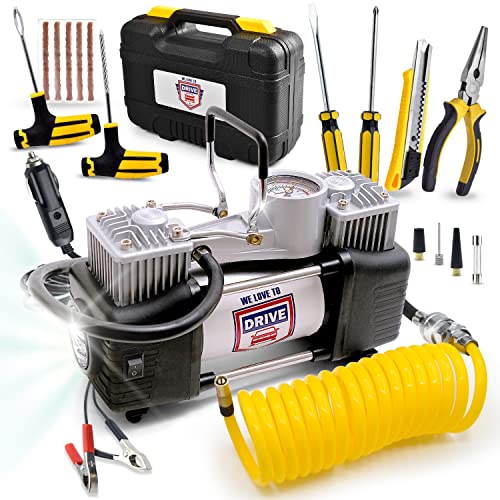 WE LOVE TO DRIVE Dual Cylinder Tire Inflator
|
8.6/10 | Buy |
 Air Lift 16060 12V Air Compressor
|
8.6/10 | Buy | |
 Air Lift 25592 Load Controller II Compressor
|
8.4/10 | Buy | |
 Air Lift 25980EZ WirelessONE Air Compressor
|
8.1/10 | Buy | |
 VEVOR 2 Gallon 1HP Air Compressor
|
7.8/10 | Buy | |
 EVIL ENERGY 2-Gallon 12V Air Compressor Kit
|
7.8/10 | Buy |
Stealth SAQ-1234 2-Gallon Air Compressor
Operating at under 60 decibels, this compact unit provides exceptionally quiet performance for garage DIY tasks, brad nailing, and tire inflation. Its oil-free motor reaches up to 125 PSI while keeping routine maintenance to a minimum.
Pros
- Quiet operation suitable for indoor workspaces
- Maintenance-free oil-free pump design
- Durable steel tank with rubber vibration dampening
- Reliable pressure recovery for intermittent nailing
Cons
- Relatively heavy to carry at nearly 42 pounds
- Small two-gallon tank limits continuous tool use
- Modest 1.8 CFM flow rate at 90 PSI
Rolair FC2002 2 HP Twin Stack Compressor
Engineered for workshop and job-site tasks, this Rolair twin-stack compressor provides 4.1 CFM at 90 psi via a 2 HP motor. Its cast-iron cylinder and splash-lubricated design offer dependable durability for pneumatic fastening and inflation duties.
Pros
- Solid 4.1 CFM output at 90 psi
- Durable cast-iron cylinder build
- Splash lubrication system extends pump life
- Built-in overload protection with manual reset
Cons
- Heavy 62-pound weight reduces portability
- Splash-lubricated pump requires regular oil maintenance
Vixen Air VXO4852DB 200 PSI 5-Gallon Air Kit
Engineered for heavy load leveling and onboard air systems, this setup pairs dual 200 PSI compressors with a 9-port, 5-gallon steel tank for rapid refill cycles. Its pre-lubricated, weather-resistant components make it a dependable choice for trucks, RVs, and auxiliary horn installations.
Pros
- Dual compressors provide rapid air recovery
- Nine tank ports offer versatile plumbing configurations
- Maintenance-free, pre-lubricated compressor design
- Thermal overload protection prevents motor burnouts
- Remote filter kit protects intake from dirt
Cons
- Large 32-inch footprint requires substantial mounting clearance
- Steel tank construction adds notable weight to the vehicle
- Extensive wiring and plumbing needed for dual-compressor setup
VIAIR TLC BOOST XL 2-Gallon Air Compressor
Built around a 2-gallon tank and a 150 PSI compressor, this kit provides ready air volume for seating tubeless bike tires, inflating vehicle tires, and running light air tools. Its complete accessory bundle and dual portable or vehicle-mount design make it a capable setup for roadside maintenance and cycling events.
Pros
- Integrated 2-gallon tank supplies immediate high-volume air
- Complete accessory bundle includes 30-foot coiled hose
- Automatic shut-off maintains working pressure automatically
- Supports both portable use and permanent vehicle mounting
Cons
- Weighs 22 pounds, making it heavy for continuous carrying
- Relies on direct battery or SAE connection without AC plug
WE LOVE TO DRIVE Dual Cylinder Tire Inflator
Combining a dual cylinder 12V compressor with a complete plug and patch kit, this roadside set delivers up to 150 PSI for car, truck, and recreation tires. It serves as a comprehensive trunk solution for drivers who want both rapid inflation and immediate flat repair tools on road trips.
Pros
- Dual cylinder mechanism delivers high-pressure 150 PSI output
- Bundles essential flat tire repair plugs and patch tools
- Integrated gauge enables straightforward pressure monitoring
- Versatile application for trucks, SUVs, and recreational gear
Cons
- Relatively hefty carry weight at over eight pounds
- Tethered to a 12V DC vehicle power source
Air Lift 16060 12V Air Compressor
Built for automotive air suspension setups, the Air Lift 16060 delivers onboard pneumatic support in a compact package weighing under two pounds. Its modest footprint makes it an easy fit for drivers seeking a dedicated 12V compressor that can mount into tight vehicle spaces.
Pros
- Lightweight construction under two pounds
- Compact size fits tight underbody spaces
- Standard 12-volt vehicle power compatibility
- Manufactured in the United States
Cons
- Restricted to 12V automotive power sources
- Requires separate air lines and fittings
Air Lift 25592 Load Controller II Compressor
Designed for light to medium-duty air spring setups, this universal on-board system lets drivers adjust pressure directly from the cab. An integrated low-pressure sensor automatically restores air loss to help maintain balanced ride support.
Pros
- Automatic compressor activation prevents under-inflation
- Convenient on-the-go pressure adjustments from the cab
- Balanced simultaneous inflation for both air springs
- Includes compressor, gauge, and wiring harness
- Universal fit for various light to medium-duty vehicles
Cons
- Single-path design cannot adjust springs independently
- Not intended for heavy-duty suspension demands
Air Lift 25980EZ WirelessONE Air Compressor
Designed for effortless vehicle leveling, the Air Lift 25980EZ combines a pre-assembled 12V compressor with wireless app and remote control. It is an ideal on-board inflation solution for drivers regularly towing or hauling heavy payloads.
Pros
- Pre-assembled bracket noticeably cuts down installation time
- Dual control options via wireless remote or mobile app
- Capable 120 PSI output handles demanding towing needs
- Three custom presets enable quick pressure adjustments
- Backed by a two-year manufacturer warranty
Cons
- Single-path system cannot level side-to-side loads independently
- Maximum pressure output capped at 120 PSI
- Requires adequate vehicle underbody mounting clearance
VEVOR 2 Gallon 1HP Air Compressor
Built for DIYers tackling tire inflation and light pneumatic work, this compact unit delivers 2.1 CFM at 90 PSI with a maintenance-free oil-free pump. Its sturdy steel tank and integrated safety shut-offs offer dependable performance for home garages.
Pros
- Maintenance-free oil-free pump design
- Durable rust-resistant three-layer steel tank
- Reliable automatic overheating and overpressure shut-off
- Adequate air delivery for light pneumatic tools
Cons
- Small two-gallon tank limits continuous high-demand tool use
- Produces 81 dB of operational noise
- Relatively heavy at 33 pounds for quick carrying
EVIL ENERGY 2-Gallon 12V Air Compressor Kit
Built for onboard air horns, suspension systems, and tire inflation, this compact 12V kit pairs a reinforced steel tank with a 150 PSI compressor. Its six connection ports offer solid versatility for custom vehicle air systems.
Pros
- Six ports allow versatile multi-accessory routing
- Compact footprint fits neatly in vehicle spaces
- Includes essential installation hardware and drain valve
- Reinforced steel construction resists structural wear
Cons
- Requires regular weekly tank draining
- Manufacturer recommends professional installation
- Intended solely for fixed vehicle installations
Dual Compressor System Architecture and Connection Strategies
Combining two pneumatic power sources creates a high-output air supply that can handle demanding workshop tools without stalling. The primary engineering goal when connecting two units is multiplying total volume delivery, measured in cubic feet per minute, while preserving the safe operational pressure limits of each tank. Linking machines together successfully requires understanding fluid dynamics, check valve mechanics, and electrical distribution. When done properly, the configuration provides steady air delivery that keeps pneumatic sanders, impact wrenches, and paint guns running smoothly.
Parallel Versus Series Plumbing: Why Flow Multiplies and Pressure Remains Constant
Pneumatic compressors must always be plumbed together in a parallel arrangement rather than a series layout. In a parallel configuration, the discharge outlets of both compressors feed into a single common distribution manifold or shared receiver tank. This connection method sums the air volume produced by each pump while keeping the overall system pressure capped at the cut-out threshold of the lowest-rated machine. For example, pairing a unit producing 4.1 CFM at 90 PSI, like a Rolair FC2002 cast-iron twin-stack, with a secondary unit producing 2.1 CFM at 90 PSI yields approximately 6.2 CFM of continuous airflow at that pressure level.
Attempting to plumb air compressors in series by feeding the pressurized discharge of the first machine directly into the air intake of the second machine causes catastrophic mechanical failure. Standard single-stage and two-stage compressor pumps rely on atmospheric air pressure at their intake ports to operate within design tolerances. Forcing pre-compressed air into an uncooled intake creates extreme cylinder heat, blows out head gaskets, shatters reed valves, and overloads the electric motor. Parallel coupling avoids these hazards by allowing each machine to draw clean ambient air through its own intake filter while discharging into a common header.
Check Valve Integration to Prevent Back-Feeding and Unloader Venting
Every dual compressor setup requires dedicated one-way brass check valves installed between each tank discharge port and the common manifold. These directional valves permit compressed air to flow outward into the shared air line while stopping backward pressure from entering the opposite tank. Without individual check valves, air will naturally migrate toward the compressor with lower internal pressure or leak through a resting machine’s mechanical components. That pressure imbalance creates unnecessary pump strain and prevents the system from maintaining uniform line pressure.
A major failure point in unprotected dual setups occurs at the pressure switch unloader valve. When an electric compressor reaches its cut-out pressure and shuts off, its unloader valve opens to release trapped head pressure between the pump cylinder and the tank check valve. If the second compressor remains running without an external check valve separating the lines, its tank pressure will bleed backward and escape continuously through the first unit’s open unloader port. Installing a heavy-duty brass check valve rated for the system’s maximum operating PSI on each machine’s outlet line completely eliminates this air leak.
Electrical Circuit Isolation and Managing Motor Inrush Amperage
Powering two electric air compressors from a single household branch circuit almost always causes the breaker to trip immediately. A typical 120-volt garage circuit is protected by a 15-amp or 20-amp breaker, which accommodates roughly 1,800 to 2,400 watts of continuous electrical load. A single portable unit equipped with a 1 HP or 2 HP motor draws between 10 and 15 running amps under full compression load. When two motors cycle under load at the same time, their combined running current exceeds branch circuit thresholds and generates excessive heat within wall wiring.
Motor startup inrush current presents an even greater electrical hazard than steady running amperage. Induction electric motors often pull three to five times their normal running amperage for several fractions of a second during initial startup to overcome trapped pump friction. If both compressors attempt to start simultaneously on the same electrical line, the combined inrush surge easily surpasses 35 to 50 amps. Each compressor must therefore be plugged into a separate, dedicated branch circuit supplied by its own breaker. Extension cords should be strictly avoided because wire resistance causes voltage drop, which slows motor startup and overheats motor windings.
Step-by-Step Manifold Plumbing and Fitting Assembly
Building a durable connecting manifold begins with sizing the fittings to prevent airflow bottlenecks. The plumbing assembly should consist of brass or schedule 40 steel tees, nipples, and couplers sized at 3/8-inch or 1/2-inch National Pipe Taper (NPT). Standard 1/4-inch fittings should generally be avoided at the central manifold because their narrow internal diameter creates friction and restricts high CFM throughput. As seen in multi-port tank setups like the Vixen Air 5-gallon steel reservoir or EVIL ENERGY six-port air tanks, having generous port sizes makes it easy to balance incoming flow lines and outgoing distribution whips.
To begin the assembly, completely depressurize both compressor tanks by opening their bottom drain valves and lifting the rings on the ASME safety relief valves. Thread a brass check valve directly into the regulated or unregulated outlet of each compressor tank, using liquid anaerobic thread sealant or several wraps of PTFE tape on all male threads. Connect high-pressure rubber or reinforced polyurethane jumper hoses from each check valve outlet into opposite sides of a brass tee fitting. The center branch of the tee then serves as the unified air supply, where you can mount a master regulator, moisture filter, and high-flow quick-connect coupler.
Pressure Switch Calibration: Synchronized Versus Staggered Staging
Controlling how the two compressors cycle depends on whether you set their cut-in and cut-out pressures in a synchronized or staggered configuration. In a synchronized setup, both pressure switches are calibrated to start and stop at identical pressure thresholds, such as starting at 90 PSI and cutting off at 120 PSI. This approach forces both pumps to start together whenever tank pressure drops, which works well for continuous high-demand tasks like media blasting or spray painting. However, synchronized cycling increases peak electrical strain and wear on both machines during lighter workshop tasks.
A staggered lead-lag configuration is usually the superior strategy for general garage and workshop utility. In this setup, Compressor A is designated as the primary lead unit with a cut-in pressure of 100 PSI and a cut-out pressure of 125 PSI. Compressor B acts as the secondary lag unit, adjusted to cut in at 85 PSI and cut out at 115 PSI. During light-duty jobs like tire inflation or brad nailing, only the primary compressor cycles, saving energy and reducing noise. Pairing an ultra-quiet oil-free model like the Stealth SAQ-1234, which operates at less than 60 decibels, as your primary lead unit keeps everyday workshop noise minimal. When a high-draw tool drags system pressure below 85 PSI, the secondary unit kicks in automatically to double total CFM delivery until the lines recover.
Air Distribution Sizing and Preventing Downstream Flow Bottlenecks
Doubling pump volume delivery provides little benefit if downstream delivery hoses choke the airflow before it reaches your pneumatic tools. A single 1/4-inch inner diameter (ID) air hose creates substantial dynamic friction loss over distances longer than twenty-five feet, especially when flow rates exceed 6 CFM. This friction causes noticeable dynamic pressure drop at the tool trigger, meaning a gauge at the tank might show 90 PSI while the tool experiences only 70 PSI during heavy operation. Such restrictions starve high-draw pneumatic motors and defeat the purpose of twinning two air compressors together.
Upgrading to a 3/8-inch or 1/2-inch ID air hose ensures that the combined volume from both pumps moves freely to the tool without severe restriction. Industrial high-flow pneumatic couplers and plugs should replace restrictive automotive-style couplers at the manifold outlet. These high-flow fittings feature larger internal bores that can increase usable flow volume by up to thirty percent compared to standard connectors. Larger diameter lines also minimize rapid cycling by providing extra volumetric storage between the manifold and tool intake. Investing in generous hose diameters protects the continuous torque and rotational speed of demanding tools like pneumatic impact wrenches and rotary sanders.
Condensation Management and Tank Drain Maintenance Across Two Receivers
Operating two compressors simultaneously produces double the thermal energy and moisture condensation in your pneumatic lines. As hot air leaves the compressor pump cylinders, it cools rapidly inside the steel storage tanks, causing atmospheric humidity to condense into liquid water. If this water is allowed to accumulate, it reduces available air storage capacity, accelerates internal tank corrosion, and travels downstream into paint guns and air tool motor bearings. Dual tanks act as two separate collection points, meaning moisture must be addressed at both locations systematically.
Routine moisture maintenance requires purging both storage tanks at the end of every operating session. Opening bottom tank drain valves while residual pressure remains inside expels pooled condensation and rust particles before they damage pneumatic internal components. Upgrading stiff, recessed needle petcocks to accessible quarter-turn brass ball valves simplifies daily maintenance and prevents valves from seizing shut over time. Regular draining also preserves internal steel tank integrity and prevents pinhole leaks from forming along base weld seams. Installing an inline water separator and particulate filter directly downstream of your central manifold provides essential secondary protection for delicate spray finishing tasks.
Diagnostic Troubleshooting for Pressure Drops and Cycling Asymmetry
Uneven cycling between paired compressors is a common issue that usually points to pressure switch differential drift or line restrictions. If one compressor runs continuously while the second machine never turns on, verify the cut-in settings on both switches with a reliable pressure gauge. A slight inaccuracy in a factory pressure switch diaphragm can prevent the lag compressor from detecting line pressure drop if its threshold is set too low. Inspecting the check valves is also necessary, as a sticking valve flap can create back-pressure resistance that confuses the pressure switch. Adjusting mechanical differential screws slightly can bring the two units back into proper balance.
Sudden pressure loss during tool operation often indicates that air is leaking through loose fittings or that one pump has suffered mechanical fatigue. Spraying soapy water around all manifold tees, pipe threads, and coupler joints reveals micro-leaks that sap system efficiency. If no external leaks exist but pressure recovery remains sluggish, check the air intake filters on both machines for dust clogging. Worn piston rings or leaking reed valves on an older pump can also force the newer companion compressor to shoulder the entire workload. Ensuring that both pumps receive unrestricted intake airflow helps each machine maintain its rated displacement and keeps recovery cycles balanced.
Practical Verification and Operating Benchmarks Before Tool Operation
Before connecting valuable pneumatic tools to a freshly plumbed dual compressor setup, complete a systematic pressure and leak test. Close the manifold outlet valve, power on both machines on their separate dedicated electrical circuits, and monitor the pressure buildup from zero PSI to auto cut-off. Verify that both compressors reach their intended shut-off thresholds cleanly and that the mechanical unloader valves release brief puffs of air without continuous hissing. This baseline test confirms that electrical circuits tolerate starting loads and that pressure switches function as intended.
Once both tanks reach full cut-off pressure, leave the system pressurized for fifteen minutes with the electrical power turned off to verify line integrity. The pressure gauge should remain steady without visible needle drop, confirming that the check valves and manifold joints are airtight. Finally, open a blow gun or test tool to bleed off air and confirm that the primary and secondary units cut in at your designated pressure levels. Completing these simple diagnostic checks guarantees a safe, high-volume compressed air supply ready for rigorous workshop projects.
About the author
Glenda Taylor has extensive experience in residential construction, remodeling, home improvement, and tool use. Her practical approach to equipment evaluation focuses on usability, performance, safety, and value—helping DIYers and workshop users make better-informed decisions about compressors and related tools.