
Is a 2 Stage Air Compressor Worth It: A Practical Guide for 2026
Is A 2 Stage Air Compressor Worth It? Explore CFM delivery, 175 PSI pressure gains, duty cycles, and power needs to decide for your shop in October 2026.
 By Bob Beacham
Updated October 8, 2026
By Bob Beacham
Updated October 8, 2026

Operating continuous-demand pneumatic tools like dual-action sanders, paint spray guns, and heavy impact wrenches frequently pushes standard garage air setups past their physical limits. When a basic compressor runs nonstop, air pressure quickly plummets below ninety PSI while cylinder heads generate extreme heat that introduces moisture directly into downstream airlines. Deciding whether is a 2 stage air compressor worth it ultimately hinges on whether your daily workload demands high volume at elevated pressures or simply requires occasional bursts for inflation and trim carpentry. Buyers who evaluate their tool consumption early can avoid severe airflow starvation by selecting an air compressor for your workspace that matches realistic airflow demands rather than relying on misleading peak horsepower labels.
Unlike standard units that compress atmospheric air in a single stroke, two-stage machinery uses dual cylinders with an intermediate cooling passage to reach up to one hundred seventy-five PSI. That mechanical design yields significantly greater stored energy in the air tank, cooler discharge temperatures, and a genuine continuous duty cycle capable of powering demanding commercial shop tools. Investing in such a heavy stationary machine requires substantial floor space, a dedicated two-hundred-forty-volt electrical circuit, and a higher initial budget. Examining the mechanical distinctions, operating thresholds, and tool compatibility helps clarify whether this industrial-grade equipment represents a sensible long-term asset or an unnecessary expense for your shop.
Top Products
| Award | Product | ACR Score About ACR ScoreThe ACR Score is our own rating from 0 to 10, based on performance, design and build, ease of use, and value. It reflects independent research and is never influenced by manufacturers, retailers, or affiliate commissions. Learn more › | |
|---|---|---|---|
| Best Overall |
Stealth SAQ-1234 2-Gallon Air Compressor
|
9.2/10 | Buy |
| Best Budget |
 CRAFTSMAN 2-Gallon Portable Air Compressor
|
9.1/10 | Buy |
| Best Value |
 Campbell Hausfeld 60-Gallon Air Compressor
|
8.9/10 | Buy |
 Baococo 8 Gallon Portable Air Compressor
|
8.6/10 | Buy | |
 NorthStar 2-Stage 24.4 CFM Compressor Pump
|
8.6/10 | Buy | |
 VEVOR 3HP Twin Cylinder Air Compressor Pump Head
|
8.4/10 | Buy | |
 Klutch 20-Gallon Portable Air Compressor
|
8.4/10 | Buy | |
| Best Premium |
 Ingersoll Rand 2340L5-V 5 HP Air Compressor
|
8.3/10 | Buy |
 Ingersoll Rand 2475N7.5 7.5 HP 80-Gallon Two-Stage
|
8.1/10 | Buy | |
 Campbell Hausfeld 80-Gallon 2-Stage Electric Air
|
8.0/10 | Buy |
Stealth SAQ-1234 2-Gallon Air Compressor
Operating at under 60 decibels, this compact unit provides exceptionally quiet performance for garage DIY tasks, brad nailing, and tire inflation. Its oil-free motor reaches up to 125 PSI while keeping routine maintenance to a minimum.
Pros
- Quiet operation suitable for indoor workspaces
- Maintenance-free oil-free pump design
- Durable steel tank with rubber vibration dampening
- Reliable pressure recovery for intermittent nailing
Cons
- Relatively heavy to carry at nearly 42 pounds
- Small two-gallon tank limits continuous tool use
- Modest 1.8 CFM flow rate at 90 PSI
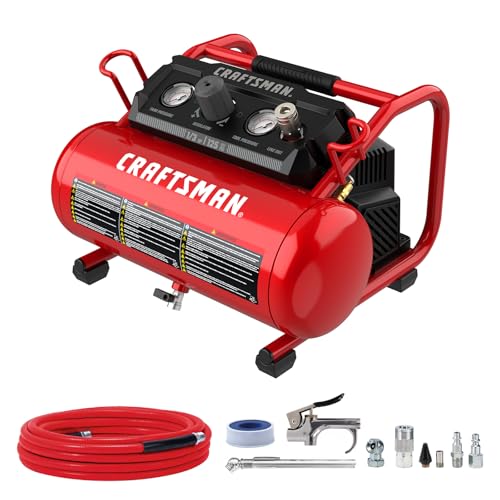
CRAFTSMAN 2-Gallon Portable Air Compressor
This CRAFTSMAN 2-gallon portable compressor package pairs a max 125 PSI oil-free pump with a versatile 10-piece pneumatic accessory kit using standard 1/4-inch NPT fittings. It is a practical, lightweight solution for DIYers and homeowners tackling tire inflation, air dusting, and light fastening.
Pros
- Complete out-of-the-box pneumatic package with air hose, blow gun, tire chuck, and 1/4-inch NPT quick-connect hardware
- Lightweight 19-pound carry weight makes moving between the garage, driveway, and workbench effortless
- Oil-free pump eliminates crankcase oil checks and prevents oil aerosol contamination in downstream air lines
- Dual quick couplings allow quick hookups without needing additional brass splitters
Cons
- Small 2-gallon receiver tank and 1/3 HP motor are limited to light-duty pneumatic tasks rather than continuous air-hungry tools
- The included starter air hose and accessories are entry-level components that high-volume shops may eventually want to upgrade
- Fittings utilize standard 1/4-inch auto profile plugs which require matching couplers if your shop uses alternate pneumatic profiles
Campbell Hausfeld 60-Gallon Air Compressor
Built for demanding garage and workshop tasks, this stationary compressor combines a 3.7 HP motor with a two-stage cast-iron pump reaching 175 PSI. It provides steady airflow to support high-demand air tools like sprayers, grinders, and sanders.
Pros
- High 175 PSI maximum output pressure
- Durable cast-iron pump rated for longevity
- Large 60-gallon capacity supports sustained pneumatic tool use
- Vertical tank design saves workshop floor space
Cons
- Requires a dedicated 230V to 240V electrical connection
- Heavy 255-pound stationary build is difficult to move
Baococo 8 Gallon Portable Air Compressor
The Baococo 8-gallon portable air compressor pairs a 2HP electric motor with a 150 PSI receiver tank, delivering 2.8 SCFM at 90 PSI. It provides a solid, accessible air source for garage DIYers tackling tire inflation, car detailing, and pneumatic finish nailing.
Pros
- Useful 8-gallon tank capacity cushions air demand better than smaller pancake style compressors
- 150 PSI peak tank pressure accommodates common automotive tire inflators and pneumatic nailers
- Standard 120V 60Hz power compatibility allows easy plug-and-play use in residential garages
- Sufficient airflow rating of 2.8 SCFM at 90 PSI for light woodworking, trim carpentry, and cleaning tasks
Cons
- Continuous high-CFM pneumatic tools like rotary sanders and heavy-duty 1/2-inch impact wrenches will quickly deplete tank reserves
- Contradictory product listing notes an oil-free tank in the title while mentioning regular oil checks in the description, requiring users to inspect pump details before first start
- Does not include an air hose, quick-connect fittings, or downstream regulator accessories in the box
NorthStar 2-Stage 24.4 CFM Compressor Pump
Built with full cast iron construction and Swedish steel valves, this NorthStar two-stage pump delivers 24.4 CFM at 90 PSI for demanding pneumatic setups. Its low-RPM operation and V-style cylinder layout prioritize cooling and mechanical durability during heavy use.
Pros
- High airflow rating of 24.4 CFM at 90 PSI
- Heavy-duty FC35 cast iron construction
- Durable Swedish steel floating valve design
- V-style cylinders promote effective heat dissipation
- Low-RPM operation minimizes wear and running temperatures
Cons
- Heavy 135-pound weight complicates mounting and handling
- Substantial 21-inch cubic dimensions require ample space
VEVOR 3HP Twin Cylinder Air Compressor Pump Head
The VEVOR 3HP Twin Cylinder Air Compressor Pump Head delivers a rated 5.8 CFM at 90 PSI with a 116 PSI maximum pressure, utilizing an oil-lubricated aluminum design with cooling fins and an integrated oil sight glass. It provides an economical replacement option for garage DIYers, woodworkers, and automotive hobbyists restoring an existing belt-driven air compressor system.
Pros
- Cost-effective solution for reviving a compressor setup with a damaged or seized pump
- Aluminum construction with pronounced cylinder head fins assists with thermal dissipation during operation
- Integrated oil sight glass simplifies routine fluid level inspections
- Supplied with an intake filter to shield internal valves and cylinders from airborne contaminants
Cons
- Requires a separate 3HP motor, drive belt, and mounting hardware as the motor is not included
- Maximum pressure is limited to 116 PSI, which is lower than standard two-stage 150 to 175 PSI industrial units
- Demands precise pulley and belt alignment during installation to prevent excessive vibration
Klutch 20-Gallon Portable Air Compressor
Featuring a 2.0 HP 120V motor and a 20-gallon tank, the Klutch portable air compressor delivers a rated 4.2 SCFM at 90 PSI for versatile workshop air. Its oil-free pump and wheeled design make it a dependable choice for garage mechanics, woodworkers, and serious DIYers needing steady air storage.
Pros
- Generous 20-gallon air storage capacity provides a substantial buffer for intermittent shop tools
- Delivers a listed 4.2 SCFM at 90 PSI, outperforming smaller pancake compressors for workshop chores
- Oil-free pump design eliminates messy oil changes and allows clean, upright transport
- Rugged rubber wheels and built-in ergonomic handle make moving the 90-pound frame manageable
- Integrated thermal overload protection helps prevent motor burnout during demanding cycles
Cons
- Substantial 90-pound weight makes lifting into truck beds or carrying up stairs difficult without assistance
- Oil-free motor configurations generally produce noticeable operating noise compared to low-RPM lubricated units
- At 4.2 SCFM at 90 PSI, high-draw continuous air tools like sanders or grinders will require recovery pauses
Ingersoll Rand 2340L5-V 5 HP Air Compressor
Built for demanding workshop environments, this two-stage compressor provides continuous duty operation through an all-cast-iron design. Its 60-gallon vertical configuration helps conserve valuable floor space while reliably sustaining high-pressure air applications.
Pros
- Durable all-cast-iron construction
- Rated for 100% continuous duty
- Vertical tank configuration saves floor space
- Individually cast cylinders ease maintenance
Cons
- Extremely heavy at 430 pounds
- Requires dedicated 230-volt single-phase power
- Tall 69-inch profile requires significant overhead clearance
Ingersoll Rand 2475N7.5 7.5 HP 80-Gallon Two-Stage
The Ingersoll Rand 2475N7.5 is an industrial-grade 7.5 HP two-stage stationary air compressor pairing an 80-gallon ASME receiver tank with a rugged cast-iron pump rated for 100% continuous duty at up to 175 psig. It provides dependable, high-capacity air storage for professional auto mechanics, commercial garages, and demanding fabrication shops.
Pros
- Durable solid cast-iron two-stage pump engineered for over 15,000 hours of heavy-duty shop service
- True 100% continuous duty rating supports non-stop production in multi-bay automotive and fabrication environments
- Spacious 80-gallon ASME-certified vertical receiver tank stores ample air volume at up to 175 psig
- Extended 2,000-hour oil service intervals when utilizing All Season Select synthetic lubricant
- Individual cylinder casting and one-piece connecting rod simplify preventative maintenance and component access
Cons
- Substantial 611-pound dry weight requires dedicated floor anchoring, mechanical lifting gear for positioning, and a permanent shop footprint
- Demands high-power dedicated electrical service and professional stationary hardwiring rather than standard outlet convenience
- Extended two-year pump warranty coverage requires the separate purchase of the official lubricant start-up kit
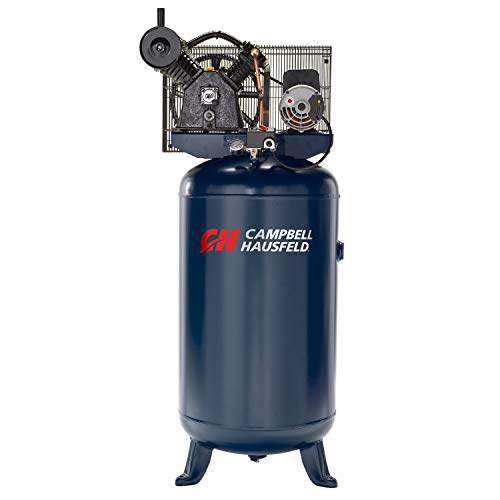
Campbell Hausfeld 80-Gallon 2-Stage Electric Air
The Campbell Hausfeld XC802100 is an 80-gallon stationary shop compressor powered by a 5 HP 230V induction motor and a heavy-duty, oil-lubricated 2-stage cast-iron pump. Delivering 11.9 SCFM at 90 PSI up to a 175 PSI maximum shutoff, it is built for auto mechanics, fabricators, and dedicated workshops running air-hungry pneumatic tools.
Pros
- High-capacity air delivery of 11.9 SCFM at 90 PSI and 11.3 SCFM at 175 PSI
- Durable oil-lubricated cast-iron 2-stage pump rated for up to 10,000 hours of bearing life
- Vertical 80-gallon ASME-certified tank stores large air reserves without taking up excess floor space
- Robust 5 HP induction motor engineered for heavy-duty 230V single-phase workshop service
Cons
- Requires a dedicated 230V, 22-amp single-phase electrical supply and hardwired installation
- Heavy 326-pound stationary unit that requires dedicated mechanical equipment for positioning and anchoring
- Demands routine crankcase oil monitoring and regular oil changes unlike maintenance-free oil-free compressors
Evaluating Two-Stage Air Compressors: Mechanics, Performance, and Shop Value
Determining whether is a 2 stage air compressor worth it begins by looking directly at the pneumatic tools you operate and the duration of your daily work sessions. Many home hobbyists assume that buying a larger tank automatically solves air delivery issues, but tank size alone cannot overcome an undersized pump mechanism. A two-stage compressor changes the operational equation by compressing air across two distinct steps to deliver higher volume, cooler operating temperatures, and maximum pressures reaching one hundred seventy-five PSI. Understanding how this compression method works helps clarify whether the performance gains justify the higher upfront investment and installation demands.
Mechanical Principles of Two-Stage Air Compression
The mechanical process inside a two-stage air compressor relies on two cylinders of differing diameters connected by an external finned intercooler tube. During the initial intake stroke, atmospheric air enters a large low-pressure cylinder where a heavy piston compresses it to an intermediate range of roughly fifty to sixty PSI. Instead of sending this hot air directly into the storage receiver, the pump discharges it through the intercooler, which uses surrounding ambient airflow to strip away substantial thermal energy. That cooled, denser air then enters a secondary, smaller high-pressure cylinder where a second piston compresses it to its final tank storage pressure of one hundred seventy-five PSI.
Intercooling plays a critical thermodynamic role in maintaining high mechanical efficiency and protecting internal pump components. Compressing atmospheric gas creates intense frictional heat, which drastically thins lubricating oil and increases thermal expansion across cylinder rings and valve assemblies. By dropping the air temperature before final compression, the second stage requires less mechanical work to achieve elevated pressures. This dual-action cycle drastically reduces thermal stress across the pump head and allows machines like the Campbell Hausfeld 60-gallon unit to operate reliably under strenuous working schedules.
Single-Stage Versus Two-Stage Pressure and Storage Capacity
Single-stage compressors typically reach a maximum shutoff pressure between one hundred twenty-five and one hundred fifty PSI because compressing air to higher levels in one piston stroke generates destructive heat. In contrast, two-stage compressors reliably push tank cut-off thresholds up to one hundred seventy-five PSI. Because air volume scales directly with pressure inside a fixed vessel, an eighty-gallon receiver pressurized to one hundred seventy-five PSI holds significantly more cubic feet of usable air than an identical vessel capped at one hundred thirty-five PSI. That greater air density creates a deep reservoir that cushions rapid pressure drops during intensive workshop tasks.
The practical benefit of this higher storage threshold becomes immediately clear when using pressure regulators set to ninety PSI. In a standard single-stage tank cutting off at one hundred thirty-five PSI, the pump must switch back on after the tank drops below ninety-five or one hundred PSI, leaving a very narrow operational window. A two-stage system operating between one hundred forty-five PSI cut-in and one hundred seventy-five PSI cut-out provides an eighty-five PSI operating buffer above standard tool line pressure. This expansive pressure margin allows air tools to maintain consistent torque and speed without experiencing dynamic line starvation.
Sustained Air Delivery and Pneumatic Tool Requirements
Air consumption varies dramatically between intermittent pneumatic tools and continuous-draw shop equipment. Fastening tools such as framing nailers, brad nailers, and standard tire inflators consume tiny bursts of air, often averaging less than one cubic foot per minute at ninety PSI. Conversely, body shop sanders, rotary die grinders, blast cabinets, and HVLP paint spray guns require continuous air volumes ranging between eight and twenty CFM. Portable single-stage compressors quickly deplete their tanks under continuous loads, forcing operators to stop and wait for slow pump recovery cycles.
Commercial two-stage systems deliver the steady airflow required to operate these demanding pneumatic tools without mid-job interruptions. Heavy pumps such as the NorthStar two-stage pump head generate over twenty-four CFM at ninety PSI, which provides adequate volume for simultaneous tool operation or intense commercial sanding. Even prosumer packages like the Campbell Hausfeld eighty-gallon model produce nearly twelve CFM at ninety PSI, comfortably handling automotive refinishing and restoration equipment. If your regular workflow involves continuous pneumatic tools, the sustained volume of a two-stage pump prevents frustrating productivity bottlenecks.
Duty Cycle Capabilities and Pump Longevity
Duty cycle defines the percentage of time an air compressor pump can safely run within a given operational window without suffering thermal damage. Most light-duty, consumer-grade compressors carry a fifty percent duty cycle, requiring thirty minutes of rest for every thirty minutes of active pumping. Forcing a low-cost pump beyond its intended duty rating accelerates piston ring wear, overheats valve plates, and quickly leads to thermal motor shutdown. Industrial two-stage units are engineered to much higher standards, frequently offering full one hundred percent continuous duty capabilities.
Pumps like the Ingersoll Rand Type 30 series utilize deep cast-iron crankcases, individually cast cylinders, and low operating speeds to dissipate friction heat efficiently. Choosing an oil lubricated air compressor design allows internal splash lubrication to protect critical crankshaft bearings and connecting rods during uninterrupted cycles. Many cast-iron two-stage pumps are engineered for over ten thousand to fifteen thousand operational hours when maintained with synthetic lubricants. This industrial longevity stands in stark contrast to consumer oil-free pumps that often have a design lifespan limited to several hundred hours.
Electrical Infrastructure and Workshop Power Requirements
Stationary two-stage compressors demand dedicated electrical installations that go well beyond a standard household wall receptacle. While compact single-stage compressors run on common one-hundred-twenty-volt fifteen-amp or twenty-amp household circuits, true two-stage systems require dedicated two-hundred-thirty-volt single-phase or three-phase power. Motors delivering between five and seven-and-a-half continuous running horsepower draw substantial current, typically requiring twenty-two to forty-amp dedicated double-pole circuit breakers. Evaluating your facility electrical panel capacity is an indispensable step before bringing a stationary commercial unit into your workshop.
Planning electrical hookups properly also prevents voltage drops that can overheat electric motor windings during initial startup cycles. Understanding single-phase versus three-phase power supply parameters ensures that your building can handle high inrush starting currents without nuisance breaker tripping. Residential shops usually rely on single-phase two-hundred-thirty-volt service, which pairs smoothly with machines like the Ingersoll Rand five-horsepower stationary model. Failing to account for professional electrical installation costs can significantly inflate your total setup budget if panel upgrades or dedicated subpanels are required.
Managing Workshop Space, Vibration, and Operational Sound
Physical footprint and workshop placement represent another major practical consideration when evaluating heavy stationary compressors. Two-stage workshop compressors typically feature vertical ASME receiver tanks holding sixty to eighty gallons, measuring over six feet in height and weighing between three hundred and five hundred pounds. These massive units require permanent floor mounting on solid concrete slabs to prevent tipping and structural strain. Installing heavy rubber vibration dampener pads under the mounting feet isolates reciprocating mechanical pulses and protects both the floor and the tank weldments.
Acoustic performance also differs considerably between heavy commercial units and compact jobsite compressors. High-speed single-stage units often run universal motors at thirty-four hundred RPM, generating loud, high-pitched noise that quickly causes operator fatigue in enclosed garages. Quality two-stage cast-iron pumps use large pulleys and belt-driven induction motors that spin the pump at much slower speeds, often between seven hundred and twelve hundred RPM. This slower rotational speed produces a deeper, lower-frequency mechanical tone that is generally much easier to tolerate during long working days.
Moisture Control and Airline Air Quality
Air moisture is an unavoidable byproduct of compressing humid atmospheric air, and managing it is crucial for protecting expensive pneumatic tools. When high compression heat enters an air tank, hot moisture vapors condense along the internal steel walls as the air cools. Because two-stage compressors utilize an intercooler to shed heat before secondary compression, the discharge air entering the tank is considerably cooler than air coming from a hard-working single-stage pump. Cooler tank intake air encourages moisture to drop out into the bottom of the receiver rather than traveling downstream into your air hoses.
Regular daily drainage remains mandatory to prevent internal tank corrosion and maintain dry air supply lines. Large stationary tanks typically include underside tank drain valves, and upgrading to a quarter-turn brass ball valve ensures fast, effortless purging after every work session. In contrast, small thumb petcocks found on portable tanks often seize from rust and discourage routine maintenance. Pairing a two-stage compressor with an effective moisture separator and refrigerated air dryer creates an exceptionally clean, dry air supply suitable for flawless spray painting and plasma cutting.
Preventative Maintenance and Long-Term Ownership Costs
Owning a commercial two-stage air compressor involves routine mechanical maintenance that portable oil-free units do not require. Regular responsibilities include checking oil sight glasses, cleaning foam or pleated intake air filters, and inspecting drive belt tension. Oil changes should be performed using non-detergent synthetic compressor lubricants, which prevent foaming and carbon buildup on internal valve reeds. Premium synthetic fluids, such as All-Season Select lubricant used in Ingersoll Rand equipment, can extend oil change intervals up to several thousand operational hours.
Although two-stage units require ongoing mechanical maintenance, their repairability makes them far more cost-effective over decades of heavy service. High-grade cast-iron models feature individually cast cylinders, overhung crankshafts, and replaceable Swedish steel valves that can be serviced without replacing the entire pump assembly. If a valve fails or an unloader valve leaks, replacement parts are readily available from major manufacturers. A budget oil-free compressor, by contrast, is generally treated as a disposable appliance once its piston seals or integrated motor windings fail.
Scenarios Where a Single-Stage Compressor Is Sufficient
A two-stage compressor is not the optimal choice for every workshop or DIY enthusiast. If your primary tasks consist of inflating vehicle tires, clearing dust with blow guns, and firing finish or framing nailers, a two-stage machine represents immense overkill. Compact single-stage models like the Stealth two-gallon or Craftsman two-gallon portable units deliver all the air volume needed for light intermittent tasks. These portable units plug into standard household wall outlets, weigh under thirty pounds, and fit easily under a workbench or in a vehicle trunk.
Budget constraints and facility limitations also make single-stage units more practical for casual users. If your garage lacks two-hundred-forty-volt power and you cannot justify professional electrical upgrades, a twenty-gallon single-stage portable compressor operating on one hundred twenty volts is a sensible compromise. A unit like the Klutch twenty-gallon model provides four CFM at ninety PSI, which supports impact wrenches and short bursts of pneumatic cutting. Purchasing an expensive two-stage setup only makes financial sense when your tools and workflow genuinely demand sustained high-volume airflow.
Purchase Decision: Determining if Two-Stage Is Worth It for You
Deciding if is a 2 stage air compressor worth it ultimately comes down to a realistic assessment of your tool inventory, production goals, and available budget. If your workshop handles auto body sanding, abrasive blasting, spray painting, or multi-operator fabrication, a two-stage compressor is worth every penny of its initial purchase price. The combination of one hundred seventy-five PSI storage capacity, continuous duty cycle reliability, and high sustained CFM output will transform your shop productivity and eliminate costly tool stalling. Investing in industrial equipment ensures your air supply matches the full mechanical capabilities of your pneumatic tools.
For casual hobbyists, general home maintainers, and mobile trim carpenters, a heavy stationary two-stage system is rarely necessary. Single-stage oil-free or compact splash-lubricated compressors handle light, intermittent pneumatic tasks with lower costs and far greater portability. Carefully tally the combined CFM requirements of your most demanding air tools at ninety PSI before making your final purchase. When your pneumatic consumption consistently exceeds eight CFM and tool downtime costs you valuable time, upgrading to a dedicated two-stage air compressor is one of the best workshop investments you can make.
About the author
Bob Beacham is an experienced tools and workshop writer with deep knowledge of power equipment, mechanical systems, and practical DIY applications. His coverage of air compressors, welding equipment, saws, and workshop tools helps translate technical specifications into useful guidance for homeowners and serious DIYers.