
How Many Watts Is a Small Air Compressor: Practical Guide for 2026
Learn how many watts is a small air compressor needs in October 2026, including running watts, startup surge amps, and generator sizing for portable workshop tools.
 By Tom Scalisi
Updated October 8, 2026
By Tom Scalisi
Updated October 8, 2026
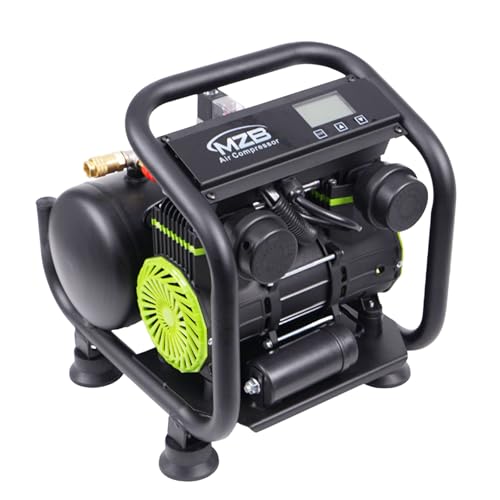
Operating pneumatic tools efficiently begins with understanding electrical power demands. Many homeowners, carpenters, and DIY enthusiasts wonder exactly how many watts is a small air compressor before plugging a unit into a garage outlet or a portable generator. A typical small air compressor designed for tire inflation, trim nailing, or airbrushing generally requires between 150 running watts for miniature hobby pumps up to 1,500 running watts for one-horsepower jobsite models. However, calculating continuous running wattage tells only half the story because electric motors demand substantial starting power to overcome stationary mechanical inertia and cylinder backpressure.
Selecting the correct power source protects your equipment and prevents frustrating circuit breaker trips. While a compact oil-free compressor like the 1.0-horsepower California Air Tools CAT-4710W specifies a manageable 7.5-amp running draw on standard 110-volt circuits, starting inrush current can briefly double or triple that load. Knowing these electrical thresholds ensures that you pair your compressor with adequate circuit breakers, appropriately sized generators, or reliable off-grid power stations. This guide breaks down exact wattage ranges across different compressor designs so you can run your pneumatic tools safely without electrical interruption.
| Award | Product | ACR Score About ACR ScoreThe ACR Score is our own rating from 0 to 10, based on performance, design and build, ease of use, and value. It reflects independent research and is never influenced by manufacturers, retailers, or affiliate commissions. Learn more › | |
|---|---|---|---|
| Best Overall |
MZB MZB-900H-6 1.6-Gallon Air Compressor
|
9.2/10 | Buy |
| Best Premium |
 MZB MZB-1100H-50 13.2-Gallon Air Compressor
|
8.8/10 | Buy |
| Best Value |
 MZB 1100H-50 13.2-Gallon Air Compressor
|
8.6/10 | Buy |
| Best Budget |
 PointZero 1/5 HP Tank Airbrush Compressor
|
8.3/10 | Buy |
 California Air Tools CAT-4710W 4.7-Gal Compressor
|
8.3/10 | Buy | |
 AstroAI Dual Power Portable Tire Inflator
|
8.1/10 | Buy | |
 BUNKER INDUST 12V Off-Road Air Compressor
|
8.0/10 | Buy | |
 ACTECMAX 12V Universal Electric AC Compressor
|
8.0/10 | Buy | |
 EVIL ENERGY 12V 1-Gallon Air Tank and Compressor
|
7.8/10 | Buy |
MZB MZB-900H-6 1.6-Gallon Air Compressor
Built for trim carpentry and light pneumatic tasks, this compact MZB unit pairs a 1.6-gallon steel tank with an oil-free pump. It produces up to 115 PSI while keeping operating sound around 70 decibels.
Pros
- Low-maintenance oil-free pump design
- Moderate 70 dB operating sound level
- Compact footprint is convenient to transport
- Sturdy steel air tank construction
Cons
- Small 1.6-gallon capacity limits continuous air tool runtimes
- Modest maximum output pressure of 115 PSI
MZB MZB-1100H-50 13.2-Gallon Air Compressor
Designed for indoor workshops and residential garages, this compressor keeps operating noise down to a manageable 70 decibels. Its 13.2-gallon steel tank and wheeled frame suit DIY woodworkers, painters, and mechanics needing reliable airflow without regular pump maintenance.
Pros
- Quiet 70dB sound level ideal for indoor spaces
- Maintenance-free oil-free pump design
- Large 13.2-gallon durable steel tank
- Wheels and handle make transport manageable
Cons
- Hefty 72-pound weight makes vehicle loading difficult
- 115 PSI maximum pressure is modest for heavy-duty pneumatic tools
MZB 1100H-50 13.2-Gallon Air Compressor
Built for auto repair and woodworking, this dual-motor unit combines a quick 60-second tank fill with a quiet 70-decibel operating level. Its oil-free 3.0 HP motor setup delivers up to 14.83 CFM of airflow to keep high-demand pneumatic tools running reliably.
Pros
- Quiet 70-decibel operation reduces indoor workshop noise
- Fast 60-second tank fill minimizes work interruptions
- Oil-free design eliminates oil maintenance and contamination
- High 14.83 CFM output supports continuous air tools
- Integrated wheels assist with moving the heavy tank
Cons
- Heavy 72-pound frame makes vehicle loading awkward
- Max 115 PSI is lower than standard 150 PSI models
- Large 26-inch profile requires significant floor space
PointZero 1/5 HP Tank Airbrush Compressor
Equipped with a 3-liter air tank, this PointZero 1/5 HP compressor delivers steady, pulse-free airflow at a low 55 dB noise level. Its oil-less setup and integrated moisture trap make it well-suited for food decorating, nail art, and hobby painting.
Pros
- Dedicated air tank prevents pressure pulsations
- Quiet 55 dB motor for indoor operation
- Integrated water trap delivers clean, dry air
- Auto-stop function reduces wear and conserves energy
- Oil-less design safe for food and body art
Cons
- Heavier than tankless models at 11.71 pounds
- Air output is limited strictly to airbrush applications
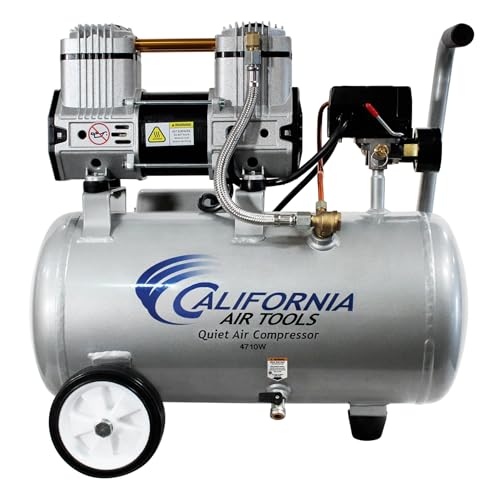
California Air Tools CAT-4710W 4.7-Gal Compressor
Built for garage workshops and DIY tasks, this mobile unit features an oil-free dual-piston pump that fills its 4.7-gallon steel tank in 78 seconds. Its low 7.5-amp motor draw ensures smooth startups on standard household circuits without tripping breakers.
Pros
- Fast 78-second tank fill time from empty
- Low 7.5-amp draw prevents tripped breakers
- Low-maintenance oil-free pump operation
- Wheels and pull handle ease transport at 35 pounds
Cons
- Delivers only 2.2 CFM at 90 PSI for demanding tools
- Steel tank construction is heavier than aluminum alternatives
AstroAI Dual Power Portable Tire Inflator
Designed for both home garages and roadside needs, this inflator operates on 120V AC and 12V DC power. It offers dual pressure modes with automatic shut-off, making it a dependable choice for standard vehicles and household inflatables.
Pros
- Runs on both home outlets and car sockets
- Dual modes handle tires and high-volume inflatables
- Accurate digital preset with automatic shut-off
- Lightweight and compact 2.6-pound design
- Built-in LED light aids emergency roadside repairs
Cons
- Not suitable for heavy-duty truck tires
- Continuous runtime capped at 15 minutes
BUNKER INDUST 12V Off-Road Air Compressor
The BUNKER INDUST 12V Air Compressor delivers a listed 12.36 CFM and up to 150 PSI through a heavy-duty dual-cylinder pump engineered for rapid truck and off-road tire inflation. Equipped with digital auto-stop pressure regulation and dual quick-connect couplers, it is a practical mobile pneumatic tool for 4x4 drivers, overland travelers, and fleet owners.
Pros
- High rated airflow of 12.36 CFM drastically cuts down airing-up time on large truck and off-road tires
- Digital auto-stop control automatically shuts down pump operation at the exact target pressure
- Dual-hose configuration with T-fitting facilitates simultaneous two-tire inflation to keep pressures balanced
- Heavy-duty Anderson-style plug ensures a secure, low-resistance connection to vehicle 12V power
- Alloy cylinders with cooling fins and cleanable intake filters offer solid protection in dusty trail environments
Cons
- Tankless direct-drive pump design is not built for sustained continuous-draw pneumatic shop tools like rotary sanders or impact wrenches
- Heavy 12V current draw requires a direct battery terminal connection and cannot operate from standard vehicle accessory sockets
- Alloy cylinder heads generate noticeable surface heat during prolonged high-pressure cycles, requiring careful handling around the cooling fins
ACTECMAX 12V Universal Electric AC Compressor
The ACTECMAX 12V Universal Electric AC Compressor provides 20cc/r displacement for R134a automotive cooling systems, featuring a separable controller with 3-gear adjustment and pre-filled POE 68 oil. It suits automotive fabricators, camper van builders, and mechanics seeking an independent 12V electric air conditioning solution.
Pros
- Electric 12V operation eliminates the need for belt-driven engine accessory brackets
- Separable controller offers adaptable placement options in tight automotive engine bays
- Factory-filled with 120 ml of POE 68 oil ready for R134a refrigerant configurations
- Three-gear speed control allows stepped management of cooling performance
Cons
- Requires careful oil compatibility checks and potential system flushing if existing lines contain PAG oil
- Straight fittings may require adapter elbows depending on vehicle firewall and engine compartment clearances
- Demands a dedicated, heavy-gauge 12V power supply setup capable of handling electric compressor draw
EVIL ENERGY 12V 1-Gallon Air Tank and Compressor
This compact 12V onboard air kit pairs a 1-gallon reinforced steel reservoir with an integrated compressor rated up to 150 PSI across five 1/4-inch NPT ports. It is well suited for truck owners, off-road enthusiasts, and DIY builders needing reliable air storage for suspension bags, air horns, and tire topping.
Pros
- Compact 1-gallon footprint fits easily into tight truck beds, trunk compartments, or undercarriage locations
- Five 1/4-inch NPT ports provide exceptional layout flexibility for custom air lines and accessories
- All-in-one kit includes compressor, tank, drain valve, air hose, and mounting brackets
- Solid steel tank construction with anti-corrosion exterior coating designed for mobile environments
Cons
- One-gallon capacity is strictly intended for intermittent air needs, not continuous-demand air tools like sanders or impact wrenches
- Airflow delivery ratings (SCFM) and decibel sound output are not explicitly specified by the manufacturer
- Requires custom 12V automotive wiring, dedicated fuse protection, and careful placement away from extreme road debris
Understanding Small Air Compressor Wattage, Electrical Draw, and Power Requirements
Every air compressor relies on an electric motor to drive reciprocating pistons or diaphragms that compress atmospheric air into a storage tank or discharge line. Determining how much electrical power this process demands requires looking at motor displacement, tank pressure ratings, and operating voltage. Small compressors span a wide spectrum of functional sizes, ranging from fractional-horsepower airbrush compressors to five-gallon jobsite trim compressors. Understanding how these mechanical components draw electricity helps you choose the right power source and avoid tripping household breakers.
Electrical wattage represents the actual rate of energy consumption and is calculated as the product of operating voltage and electrical current. When an air compressor runs, the electrical resistance in the motor windings combined with mechanical work creates a steady power draw known as running watts. But because electric motors must accelerate from a dead stop against mechanical friction and air resistance, they require a brief spike in current called starting watts. Balancing these two electrical requirements is essential whether you plug into a residential wall outlet, an automotive auxiliary port, or a portable inverter generator.
Typical Wattage Ranges Across Small Compressor Categories
Compressor wattage varies significantly based on pump mechanism, tank size, and intended trade application. Micro airbrush compressors represent the lowest end of the electrical consumption spectrum. Units such as the PointZero 1/5 HP airbrush compressor operate on miniature fractional-horsepower motors that consume between 150 and 250 running watts, with starting surges rarely exceeding 350 watts. These compact pumps deliver around 1.0 CFM at moderate pressures, making them gentle on electrical circuits and easily supported by small uninterruptible power supplies or solar generators.
Portable tire inflators and dual-voltage utility pumps form the next tier of power consumption. Compact units like the AstroAI tire inflator operate on either 12V direct current or 120V household alternating current, generally consuming between 100 and 180 watts during operation. These high-pressure inflators use small, high-speed universal motors designed for short duty cycles. Because their primary function is inflating vehicle tires or sports equipment rather than powering air tools, their steady power draw remains well below the capacity limits of standard household electrical outlets.
Standard jobsite trim compressors and pancake tanks demand significantly more electrical energy. Compressors rated between 0.75 and 1.0 continuous horsepower, such as the California Air Tools CAT-4710W, typically draw around 750 to 900 running watts on standard 110V or 120V circuits. Moving up to larger portable workshop units, such as 1.5-horsepower or twin-motor 3.0-horsepower models like the MZB 13.2-gallon quiet compressor, continuous electrical draw jumps to 1,500 watts or more. These larger portable machines approach the continuous threshold of standard household branch circuits, requiring careful electrical planning.
Running Watts Versus Starting Surge: Why Inrush Current Matters
Evaluating an air compressor purely by its running wattage can lead to severe operational issues. Electric induction motors require an initial burst of current, known as inrush current or locked-rotor amperage, to establish a magnetic field and rotate the crankshaft from a dead stop. This starting surge typically demands two to three times the running wattage of the motor. A compressor that consumes 800 running watts may briefly demand between 1,800 and 2,400 surge watts during the first few fractions of a second upon startup.
The mechanical resistance within the compressor pump intensifies this surge phenomenon. The motor must turn pistons against cylinder friction, overcome valve spring resistance, and push against residual air pressure trapped above the piston crowns. Most alternating-current compressors incorporate a start capacitor to deliver the phase-shifted burst of energy needed to start the rotor spinning quickly. If the available power supply cannot satisfy this instant surge demand, the motor stalls, hums loudly, and generates extreme heat in the copper windings.
Inrush current becomes especially critical when sizing portable generators or battery-based power stations. A generator rated for 1,200 continuous running watts will easily run a 1.0-horsepower compressor once the pump is up to speed. However, if the generator cannot deliver a momentary surge rating of 2,200 to 2,500 peak watts, the compressor will trigger the generator’s internal overload protection during motor startup. Always evaluate both continuous and surge wattage ratings before selecting an electrical power source for any motor-driven pneumatic machine.
Calculating Compressor Wattage from Nameplate Amps and Voltage
Determining the exact wattage of your specific air compressor is straightforward when using standard electrical formulas. Motor data tags typically list operating voltage and full-load amperage rather than raw wattage. According to basic electrical principles, power in watts equals voltage multiplied by current in amperes. For direct-current equipment, this formula provides an exact value, while alternating-current induction motors require a slight adjustment for motor efficiency and power factor.
To calculate electrical draw on standard alternating-current equipment, multiply the listed voltage by the full-load amperage rating. For instance, the California Air Tools CAT-4710W lists an operating current of 7.5 amps at 110 volts. Multiplying 110 volts by 7.5 amps produces 825 apparent running watts. If connected to a standard 120-volt household receptacle, that same 7.5-amp draw represents approximately 900 watts of apparent electrical power consumption during standard compression cycles.
Inductive electric motors introduce a phase difference between alternating current voltage and current waves, described as the power factor. Most single-phase compressor motors maintain a power factor between 0.80 and 0.90 under normal compression loads. While real power consumed as mechanical work and heat reflects this power factor, your electrical wiring and breaker boxes must carry the full apparent power. Sizing circuits according to total volt-amperes ensures adequate safety margins and prevents overheated conductors.
How Motor Horsepower Ratings Translate to Electrical Power
Mechanical horsepower and electrical wattage share a direct theoretical relationship, but practical motor dynamics introduce significant variance. One mechanical horsepower equals exactly 746 watts of electrical energy under theoretical conditions. Based on this conversion, a true 1.0-horsepower motor would produce 746 watts of work at the crankshaft. However, no mechanical machine operates with complete thermodynamic efficiency, meaning the electrical power consumed from the wall outlet will always exceed mechanical output.
Small electric motors typically operate at an efficiency rating between 65 percent and 80 percent. Electrical resistance in the copper windings, mechanical bearing friction, cooling fan drag, and compression heat all consume incoming energy. Consequently, delivering 1.0 true continuous mechanical horsepower to the air pump requires approximately 950 to 1,150 electrical watts drawn from the electrical receptacle. Fractional-horsepower units follow the same principle: a 1/5-horsepower motor rated for roughly 150 mechanical watts typically requires 200 to 240 electrical watts from the wall.
Beware of inflated marketing figures when evaluating motor horsepower claims on retail air compressors. In past decades, manufacturers frequently advertised peak or surge horsepower, which measured the momentary power output right before a motor stalled under catastrophic load. A standard 120-volt, 15-amp household circuit can deliver a maximum continuous load of 1,800 watts, which translates to roughly 1.5 to 1.7 true running horsepower. Any portable compressor claiming 3.0 or 4.0 horsepower while running on a standard 15-amp plug is citing deceptive peak ratings rather than true continuous operating power.
12-Volt Direct Current Compressors Versus 120-Volt Household Units
Direct-current portable compressors operate under distinct electrical parameters compared to alternating-current garage compressors. Direct-current units, such as the EVIL ENERGY 1-gallon air tank kit or high-output off-road inflators, draw power directly from vehicle electrical systems. Because direct-current systems operate at a nominal 12 volts rather than 120 volts, the current required to generate equivalent wattage increases by a factor of ten. A 360-watt load requires only 3 amps at 120 volts, but demands a massive 30 amps at 12 volts.
Heavy-duty off-road inflators demonstrate this dynamic clearly. High-airflow direct-current pumps like the BUNKER INDUST 12V air compressor deliver substantial air volumes to inflate large off-road tires quickly. Operating dual cylinders at high output requires significant motor torque, often drawing 30 to 45 amps under maximum load. At a nominal 12 to 13.8 vehicle charging voltage, this represents 360 to 620 watts of direct-current electrical energy, requiring heavy copper cables and high-amperage Anderson-style connectors instead of flimsy cigarette lighter adapters.
Standard automotive auxiliary power outlets, commonly referred to as cigarette lighter sockets, are typically protected by 10-amp or 15-amp fuses. Connecting a powerful air compressor that draws more than 120 to 180 watts into these cabin receptacles will quickly blow the vehicle fuse. High-wattage 12-volt compressors must connect directly to vehicle battery terminals using insulated alligator clamps or dedicated heavy-gauge fused wiring harnesses to handle high current safely without melting connectors or causing voltage drop.
Sizing Portable Generators and Inverters for Air Compressors
Running a small air compressor in remote jobsite locations often requires a portable generator or a battery power station. Successfully pairing these devices requires matching both running capacity and peak surge capability. To determine the minimum generator size, take your compressor’s running wattage and add an adequate starting surge buffer. If your compressor operates at 800 running watts, look for a generator capable of delivering at least 2,000 to 2,400 peak starting watts to prevent motor stall during cut-in cycles.
The type of electrical output produced by your power source is just as important as its rated wattage. Portable generators and battery power stations output alternating current as either modified sine waves or pure sine waves. Induction motors used on quiet air compressors perform poorly on modified sine wave power, which delivers stepped voltage pulses that create excessive harmonic distortion, motor humming, and intense internal heat. Always operate electric air compressors on pure sine wave inverters to ensure clean power delivery and extend motor winding longevity.
Battery-based solar generators and power stations also present surge duration limitations that require careful evaluation. While a battery station may advertise a 2,000-watt surge rating, that peak output might only last for 10 to 100 milliseconds. An air compressor starting under tank pressure can require elevated starting wattage for a full 500 milliseconds to one second until the motor achieves rated rotational speed. Selecting an inverter power station with a generous continuous rating, rather than relying solely on short-term surge specifications, guarantees reliable compressor cycling in off-grid environments.
Why Circuit Breakers Trip and How Head Pressure Multiplies Wattage
Homeowners frequently experience tripped circuit breakers when running small air compressors on standard 15-amp garage circuits. A 15-amp, 120-volt circuit breaker is designed to trip when continuous current exceeds 1,800 watts, or when short-term surge current exceeds its thermal-magnetic trip curve. If a compressor drawing 900 running watts shares an electrical circuit with garage lighting, a refrigerator, or power tool battery chargers, the combined electrical load can easily exceed the breaker threshold.
Mechanical unloader valve failures represent another major cause of electrical breaker tripping. In normal operation, when the pressure switch reaches its cut-out pressure and stops the motor, an unloader valve vents trapped compressed air from the cylinder head and discharge tube. This releases head pressure, allowing the motor to restart with zero mechanical resistance on the next cycle. If the unloader valve sticks closed, or if the tank check valve leaks air back into the discharge line, the motor must restart against 90 to 115 PSI of trapped head pressure.
Starting against trapped cylinder head pressure spikes starting current to locked-rotor levels, instantly multiplying wattage beyond 3,000 watts. Under these locked-rotor conditions, the motor cannot spin fast enough to engage its internal centrifugal run switch or disengage the start winding. The circuit breaker trips almost instantly, or the compressor’s thermal overload protector pops out to prevent fire hazards. Verifying that your compressor emits a sharp hiss of escaping air when the motor cuts off confirms that the unloader valve is depressurizing the pump head properly.
Extension Cord Voltage Drop and Its Impact on Motor Wattage
Using improper extension cords is one of the most common ways to damage a small air compressor motor. Electric power cords have inherent electrical resistance that increases with distance and smaller wire gauges. When high electrical current passes through a long, thin extension cord, a significant portion of the voltage drops across the cord itself before reaching the compressor motor. Supplying an air compressor with 105 volts instead of 120 volts severely degrades motor performance.
When voltage drops, an electric induction motor must draw more electrical current in amperes to produce the mechanical torque needed to compress air. This increase in current causes motor winding temperatures to climb exponentially, often tripping the thermal overload reset switch. Furthermore, lower line voltage drastically reduces the motor’s starting torque, making it difficult for the pump to overcome startup resistance and extending the duration of high-wattage starting surges. Over time, chronic low voltage breaks down motor winding insulation and causes premature motor failure.
Most compressor manufacturers strongly recommend plugging the machine directly into a dedicated wall receptacle rather than using an extension cord. If extra reach is required on a jobsite, the proper strategy is to plug the compressor into the wall and run a longer 50-foot or 100-foot air hose to your pneumatic tools. Air hoses do not suffer electrical voltage drop and keep your compressor motor supplied with steady, full-voltage power. When an electrical cord cannot be avoided, use a heavy-duty 12 AWG or 10 AWG outdoor cord rated for at least 20 amps and keep the overall cord length under 25 feet.
Practical Operating Guidelines for Electrical Efficiency
Maintaining your compressor in peak mechanical condition directly reduces unnecessary electrical drag and lowers operating wattage. Air intake filters gradually accumulate dust and jobsite debris, restricting airflow into the compression cylinders. When intake ports are restricted, the pump must work harder to draw in atmospheric air, increasing run time and overall watt-hour energy consumption. Periodically cleaning or replacing porous sponge or paper intake filters ensures unrestricted airflow and optimal mechanical efficiency.
Regular tank moisture maintenance also plays a critical role in compressor longevity and electrical performance. Compressing ambient air generates internal condensation that accumulates at the bottom of the steel storage vessel. If this water is not drained regularly through the tank drain valve, water volume occupies valuable storage capacity, forcing the compressor motor to cycle on and off much more frequently. Rapid cycling subjects the motor to frequent, high-wattage startup surges that heat up the motor windings and accelerate electrical component wear.
Matching your pneumatic tools to your compressor’s true output ensures that you operate within safe duty-cycle limits. Small portable compressors are designed for intermittent operation, typically rated for a 50 to 70 percent duty cycle. Attempting to run continuous, high-CFM air tools like orbital sanders or paint sprayers on a compact trim compressor forces the motor to run continuously without cooling down. Understanding your compressor’s electrical wattage ratings and duty cycles allows you to plan your pneumatic projects safely, protect your electrical circuits, and ensure reliable tool performance for years to come.
About the author
Tom Scalisi brings more than two decades of experience in construction, building maintenance, contracting, and hands-on tool use. His practical understanding of power tools, automotive work, repairs, and jobsite equipment helps readers evaluate compressors based on real workloads rather than specifications alone.