
What Does Single Stage Air Compressor Mean: Practical Guide for 2026
Understanding what does single stage air compressor mean helps you choose the right shop pump in October 2026. Learn how single-stage mechanics impact pressure, CFM, and tool runtime.
 By Bob Beacham
Updated October 8, 2026
By Bob Beacham
Updated October 8, 2026

Selecting the right workshop pneumatic power supply often comes down to deciphering pump engineering and compression mechanics. Clarifying what does single stage air compressor mean reveals how the internal piston stroke compresses ambient intake air to its final operating pressure in a single mechanical motion. Many DIY mechanics and home woodworkers rely on these systems because they deliver dependable airflow for intermittent pneumatic tools without requiring complex multi-cylinder cooling setups. Understanding baseline air compressor CFM ratings helps ensure your equipment delivers adequate volume to sustain nailers, impact wrenches, and inflators.
While single-stage units remain common in residential garages and portable jobsite compressors, their operational limits differ noticeably from multi-stage commercial machinery. Evaluating pump displacement, duty cycles, and storage volume in our compressor tank capacity guide prevents unexpected line pressure drop during demanding tasks. A single-stage design balances accessible electrical requirements with sufficient air delivery for common fabrication and repair projects. Exploring how this mechanical compression process functions allows buyers to pair their pneumatic air tools with the proper compressor configuration safely.
| Award | Product | ACR Score About ACR ScoreThe ACR Score is our own rating from 0 to 10, based on performance, design and build, ease of use, and value. It reflects independent research and is never influenced by manufacturers, retailers, or affiliate commissions. Learn more › | |
|---|---|---|---|
| Best Overall |
DEWALT 60-Gallon Stationary Air Compressor
|
9.2/10 | Buy |
| Best Premium |
 Campbell Hausfeld 60-Gallon Air Compressor
|
8.9/10 | Buy |
| Best Value |
 Metabo HPT 6-Gallon Pancake Air Compressor Review
|
8.6/10 | Buy |
| Best Budget |
 VIAIR 88P 12V Portable Air Compressor
|
8.4/10 | Buy |
 DeWalt DXCM271.COM 27-Gallon Air Compressor
|
8.4/10 | Buy | |
 CARSUN Dual Power AC/DC Portable Tire Inflator
|
8.3/10 | Buy | |
 Air Lift 25870 WirelessOne Compressor System
|
8.3/10 | Buy | |
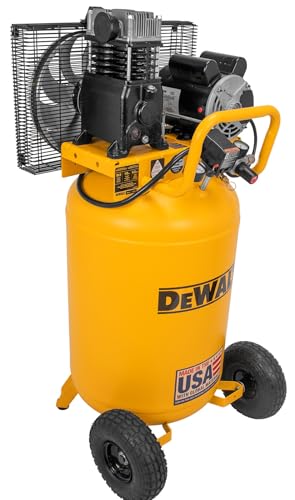 DEWALT 30-Gallon Vertical Portable Electric Air
|
8.3/10 | Buy | |
 OlarHike 6000mAh Portable Tire Inflator
|
8.1/10 | Buy | |
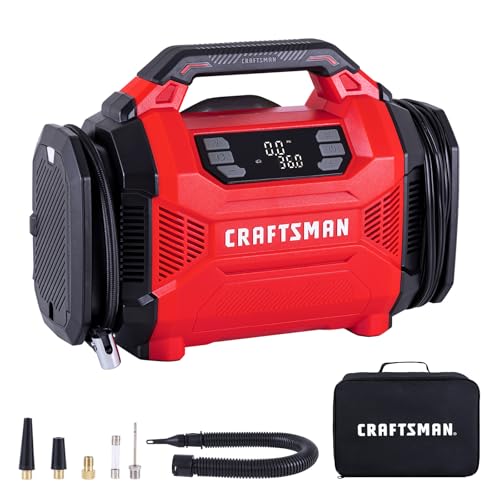 CRAFTSMAN Dual Power Tire Inflator
|
8.1/10 | Buy |
DEWALT 60-Gallon Stationary Air Compressor
The DEWALT DXCM602.COM is a heavy-duty 60-gallon vertical stationary air compressor engineered for dedicated workshops, featuring an oil-lubricated pump and a 3.7 HP motor delivering 11.5 CFM at 90 PSI up to 175 max PSI. Powered by 208V or 230V electrical service, it is an ideal stationary air source for mechanics, fabricators, and woodworkers running demanding pneumatic tools.
Pros
- High rated air output of 11.5 CFM at 90 PSI easily handles air-hungry continuous tools
- Durable oil-lubricated pump engineered for cooler operation and extended service life
- ASME-certified 60-gallon vertical steel pressure vessel ensures verified safety and high capacity
- Dual-voltage spread-volt motor simplifies integration into 208V or 230V electrical systems
Cons
- Stationary 200-pound footprint requires permanent shop placement and lacks mobility wheels
- Requires a dedicated 208V or 230V high-voltage circuit and cannot run on standard 120V household outlets
- Requires routine maintenance including oil level inspections and periodic pump oil changes
Campbell Hausfeld 60-Gallon Air Compressor
Built for demanding garage and workshop tasks, this stationary compressor combines a 3.7 HP motor with a two-stage cast-iron pump reaching 175 PSI. It provides steady airflow to support high-demand air tools like sprayers, grinders, and sanders.
Pros
- High 175 PSI maximum output pressure
- Durable cast-iron pump rated for longevity
- Large 60-gallon capacity supports sustained pneumatic tool use
- Vertical tank design saves workshop floor space
Cons
- Requires a dedicated 230V to 240V electrical connection
- Heavy 255-pound stationary build is difficult to move
Metabo HPT 6-Gallon Pancake Air Compressor Review
The Metabo HPT EC711S is a portable 6-gallon pancake air compressor delivering 2.8 CFM at 90 PSI with a 165 PSI tank ceiling and an operating sound level of 73 dB. With its quick 46-second recovery cycle and dual quick couplers, it is an excellent choice for finish carpenters, punch-list contractors, and DIYers running pneumatic nailers.
Pros
- 73 dB operational sound rating is substantially quieter than standard job-site pancake units
- 165 PSI maximum pressure provides ample air storage with a swift 46-second recovery cycle
- Two 1/4-inch universal quick couplers support multi-tool setups right out of the box
- Sturdy steel roll cage protects gauges and the manifold assembly against knocks and drops
- Oil-free 1.0 HP motor ensures low maintenance and reliable cold-weather motor startup
Cons
- At 38.5 lbs, it is slightly heavier than ultra-compact 1-to-3-gallon trim compressors
- Airflow of 2.8 CFM at 90 PSI is designed for intermittent fastening, not continuous rotary tools or paint sprayers
- Bare-tool configuration means air hoses and pneumatic fastening tools must be purchased separately
VIAIR 88P 12V Portable Air Compressor
Designed for passenger cars and light trucks with tires up to 33 inches, the VIAIR 88P delivers dependable 120 PSI output directly from a vehicle battery. Its generous 26-foot total reach, built-in gauge, and integrated work light make it a practical emergency companion for road trips and camping.
Pros
- Solid 1.47 CFM flow rate provides brisk inflation
- Generous 26-foot reach easily accesses all four tires
- Built-in LED work light aids dark roadside repairs
- Compact body weighs under five pounds for convenient storage
Cons
- Requires direct battery connection instead of standard 12V outlet
- Limited to a 25-minute duty cycle before cooling
- Not designed for tires larger than 33 inches
DeWalt DXCM271.COM 27-Gallon Air Compressor
Built for home workshops and garage tasks, this vertical compressor delivers 5.1 SCFM at 90 PSI with a low-maintenance oil-free pump. Its space-saving upright tank fits tight corners, though the 136-pound heft demands effort to transport.
Pros
- Maintenance-free oil-free pump design
- Solid airflow output of 5.1 SCFM at 90 PSI
- Space-saving vertical orientation for garages
- Reliable low-voltage start on standard 110V circuits
Cons
- Heavy 136-pound build limits quick portability
- At 78 dBA, operation remains noticeable indoors
- Tall vertical frame requires ample overhead clearance
CARSUN Dual Power AC/DC Portable Tire Inflator
The CARSUN Dual Power Tire Inflator delivers up to 150 PSI of high-pressure air running from either a 110V household outlet or a 12V vehicle socket. With digital pressure presets, automatic shutoff, and a lightweight 2.1-pound frame, it is an ideal maintenance pump for passenger vehicles, bicycles, and household inflatables.
Pros
- Versatile dual-voltage operation works seamlessly in the home garage or on the road without requiring an external converter
- Accurate auto-shutoff mechanism protects tires from accidental over-pressurization during routine top-offs
- Compact 2.1-pound build packs away easily in car trunks, under vehicle seats, or on garage shelving
- Clear digital display allows fast switching across four standard pressure measurement units
Cons
- Requires a mandatory 10-minute cooldown period after every 15 minutes of continuous operation
- Manufacturer explicitly states it does not support heavy truck tires, tractor tires, or stand-up paddleboards (SUP)
- Tankless inflator design cannot run standard workshop pneumatic air tools like brad nailers or paint sprayers
Air Lift 25870 WirelessOne Compressor System
Designed for convenient air suspension management, this single-path compressor system keeps both springs evenly inflated using three programmable memory presets. An integrated manifold streamlines setup, while an automatic low-pressure sensor guards against accidental air loss.
Pros
- Equalizes pressure across both air springs simultaneously
- Three memory presets for fast pressure changes
- Automatic low-pressure sensor prevents suspension damage
- Integrated manifold and harness streamline installation
- Customizable backlight matches vehicle cabin styling
Cons
- Single-path layout prevents independent side-to-side leveling
- Older first-generation system platform
DEWALT 30-Gallon Vertical Portable Electric Air
Delivering 6.2 SCFM at 90 PSI with a high-capacity 175 PSI max pressure rating, the DEWALT DXCM303 30-Gallon Electric Air Compressor offers substantial air reserves for demanding workshop tools. Featuring rugged pneumatic wheels and a factory high-flow regulator, it is an outstanding mobile solution for garage mechanics and serious DIY woodworkers.
Pros
- Substantial 175 PSI maximum pressure provides longer run time between motor recovery cycles
- Solid airflow output of 6.2 SCFM at 90 PSI supports a wide variety of pneumatic garage tools
- High-flow regulator supplies up to 65% more usable operating pressure to connected hoses
- Heavy-duty pneumatic wheels make rolling this 196-pound upright compressor around the garage practical
Cons
- Substantial 196-pound total weight makes vehicle loading and transport between jobsites difficult without ramps or assistance
- Large vertical shop profile is designed for roll-around floor use rather than hand-carry punch-list applications
OlarHike 6000mAh Portable Tire Inflator
Weighing just 1.2 pounds, this dual-powered portable compressor handles quick tire top-offs via an internal battery or a 12V car socket. It is well suited for passenger cars, bicycles, and emergency roadside kits, though pressure caps out at 51 PSI.
Pros
- Dual cordless and 12V corded power modes
- Compact, lightweight frame weighs only 1.2 pounds
- Fast top-offs for standard passenger vehicle tires
- Clear dual display with automatic shut-off feature
- Includes protective storage case and multiple nozzle adapters
Cons
- Maximum pressure limit is capped at 51 PSI
- Incompatible with heavy-duty pickup trucks and RVs
- Battery runtime drops significantly in colder temperatures
CRAFTSMAN Dual Power Tire Inflator
The CRAFTSMAN Dual Power Tire Inflator delivers versatile high-pressure air delivery up to 150 PSI using either a 120V AC home outlet or a 12V DC vehicle plug. Featuring digital auto shut-off presets and an integrated LED work light, it is an essential portable air solution for DIYers, garage mechanics, and road commuters.
Pros
- Dual 120V AC and 12V DC power inputs offer exceptional flexibility for both driveway maintenance and unexpected roadside flats
- Accurate digital pressure gauge with automatic shut-off prevents over-pressurizing vehicle and bicycle tires
- Capable of reaching 150 PSI, making it suitable for high-pressure road bike tires as well as passenger car tires
- Built-in LED work light enhances nighttime safety and visibility when working alongside highway traffic
- Complete package includes dedicated air hose, multiple nozzle adapters, spare fuse, and a zippered storage bag
Cons
- Tankless direct-drive mechanism is engineered for tire inflation and cannot power pneumatic air tools such as nailers or impact wrenches
- Takes longer to fill large volume leisure items like oversized air mattresses or rafts compared to dedicated high-volume blowers
- Lacks an onboard cordless tool battery dock, requiring access to an active 120V wall outlet or 12V vehicle socket
Understanding Single-Stage Air Compressor Mechanics and Capabilities
At its core, what does single stage air compressor mean describes a pneumatic pump that draws atmospheric air into a cylinder and compresses it to its final discharge pressure in a single piston stroke. The air moves past an intake filter, flows through an inlet reed valve, undergoes compression by a rising piston, and discharges directly into the air receiver tank. Unlike two-stage industrial machines, this layout completes the cycle without routing pressurized air into an intermediate cooling tube or secondary cylinder. This streamlined mechanical layout makes single-stage pumps the standard configuration across portable jobsite compressors, DIY workshops, and residential garages.
How Single-Stage Compression Operates Inside the Pump
The mechanical operation of a single-stage pump begins when the motor turns the pump crankshaft. As the piston moves downward on its intake stroke, it creates a partial vacuum inside the cylinder bore. Atmospheric air pushes through the intake filter, forcing the flexible intake reed valve open so fresh air fills the cylinder chamber. Once the piston reaches bottom dead center, the intake valve snaps shut to trap the air volume inside.
The upward stroke of the piston immediately compresses the trapped air into a smaller volume. As the air volume decreases, both pressure and temperature rise rapidly within the cylinder head. Once internal pressure exceeds the pressure held in the discharge line and receiver tank, the exhaust reed valve opens. The pressurized air then flows through a transfer tube directly into the air storage tank.
A mechanical one-way check valve at the tank inlet prevents stored air from flowing backward into the pump head when the piston begins its next intake cycle. Simultaneously, an unloader valve on the pressure switch vents residual head pressure trapped above the piston whenever the motor stops. This head depressurization ensures that the electric motor starts freely without fighting trapped cylinder resistance during subsequent cycles. Because this compression sequence finishes within a single mechanical stroke, the pump requires fewer moving parts and remains economical to maintain.
Single-Stage versus Two-Stage Air Compressor Architecture
The defining distinction between single-stage and two-stage compressors lies in how many times air undergoes compression before entering the receiver tank. In a single-stage compressor, air reaches its maximum working pressure in that initial cylinder stroke. In contrast, a two-stage compressor uses two cylinders of different sizes connected by a finned intercooler tube. The first, larger low-pressure cylinder compresses ambient air to roughly 30 to 50 PSI before passing it across the intercooler.
That intercooler tube dissipates significant heat from the partially compressed air before it enters the second, smaller high-pressure cylinder. Cooling the air between stages increases its air density, allowing the secondary piston to compress the air up to 175 PSI with high volumetric efficiency. Two-stage systems, such as stationary commercial units with cast-iron pumps, are engineered to sustain continuous production environments. They handle heavy-duty pneumatic tools like sandblasters and production spray guns where line pressure cannot drop.
Single-stage compressors typically top out between 125 and 155 PSI, although certain high-efficiency models reach up to 165 or 175 maximum PSI. Because single-stage pumps generate higher operational heat per stroke without intermediate cooling, continuous operation under high pressure causes faster valve fatigue. However, for applications requiring rapid recovery at 90 PSI rather than continuous high-pressure industrial storage, single-stage units deliver exceptional air output relative to their physical size. They represent the practical choice for home mechanics, trim carpenters, and light fabrication shops.
Single-Cylinder versus Dual-Cylinder Single-Stage Configurations
A common misconception among equipment buyers is that any compressor with two cylinders must be a two-stage machine. In reality, many single-stage compressors feature two cylinders arranged in an inline, V-twin, or horizontally opposed layout. In a multi-cylinder single-stage setup, every cylinder operates in parallel. Each piston draws in atmospheric air independently, compresses it in one stroke, and discharges it directly into the shared manifold leading to the tank.
This parallel cylinder configuration increases the delivered cubic feet per minute (CFM) without changing the single-stage operating principle. For instance, dual-piston oil-free pumps common on ultra-quiet portable compressors use two identical cylinders operating simultaneously. By splitting the intake and compression workload across two pistons, the motor can spin at a lower speed, often around 1,750 RPM, while still delivering adequate airflow. This design lowers operating noise and reduces vibration dramatically compared to single-cylinder high-speed units.
Larger stationary single-stage compressors often incorporate heavy V-twin cast-iron pump assemblies driven by induction motors. These dual-cylinder pumps deliver substantial air volume at 90 PSI to support common garage tools like impact wrenches and ratchets. Because both cylinders have an identical bore diameter, buyers can readily identify them as single-stage parallel pumps. A true two-stage pump is visually distinct because the first-stage cylinder is noticeably larger than the high-pressure second-stage cylinder.
Pressure Ceilings and Usable Air Delivery Dynamics
Operating pressure and air volume delivery are governed by physical limitations inherent to single-stage compression mechanics. When air is compressed in a single step, the heat of compression increases in direct proportion to the pressure ratio. Pushing a single piston stroke beyond 150 PSI generates intense thermal buildup inside the cylinder head, which diminishes volumetric efficiency and degrades piston ring seals over time. Consequently, manufacturers design single-stage compressors to operate within practical maximum limits, usually between 120 and 150 PSI.
The relationship between maximum tank pressure and regulated line pressure dictates the usable air reserve in any pneumatic setup. Most pneumatic tools operate at 90 PSI, meaning a single-stage compressor with a tank cut-out pressure of 135 PSI provides a usable pressure differential of 45 PSI. As you use your air tools, tank pressure drops until it reaches the cut-in threshold, typically set at 95 to 105 PSI, triggering the motor to restart. The larger this pressure differential and tank buffer, the longer your air tools can operate before the pump must cycle back on.
When selecting pneumatic machinery, buyers must evaluate delivered volume rather than relying strictly on maximum tank pressure. A single-stage compressor delivering 2.8 CFM at 90 PSI can easily keep up with finish nailers and intermittent inflation, but it will fall behind continuous rotary tools. When researching pump capacity, consult our detailed resource on sizing a compressor for air tools to prevent air starvation during sustained tasks. Matching tool consumption to pump CFM output is critical for maintaining steady workshop productivity.
Oil-Free versus Oil-Lubricated Single-Stage Pump Lifespans
Single-stage compressors are manufactured in two primary pump categories: oil-free dry pumps and oil-lubricated cast-iron pumps. Oil-free single-stage compressors utilize pistons fitted with durable polytetrafluoroethylene (PTFE) compression rings sliding inside precision aluminum cylinders. These units require no crankcase lubricant, which allows them to operate reliably in cold temperatures without sluggish starts and eliminates the risk of oil mist contaminating air lines. They are ideal for portable pancake, hot dog, and twin-stack units carried to trim carpentry jobs.
Despite their maintenance convenience, oil-free single-stage pumps have finite service lives because their piston rings and cylinder sleeves wear progressively from friction and thermal stress. In contrast, oil-lubricated single-stage compressors feature heavy cast-iron cylinders, aluminum connecting rods, and splash pins dipping into an oil bath. The lubricating oil forms a protective film across cylinder walls, reducing friction, carrying away heat, and sealing compression rings against blow-by. With proper preventative care, an oil-lubricated pump can deliver thousands of hours of reliable shop service.
Maintaining an oil-lubricated single-stage compressor requires monitoring the crankcase oil level through an integrated sight glass or dipstick and performing periodic fluid changes. Using non-detergent ISO 68 or ISO 100 compressor oil prevents internal foaming and stops carbon deposits from accumulating on hot reed valves. Reviewing comprehensive air compressor pump oil guidelines ensures you use the correct fluid viscosity without voiding pump warranties. Regular oil maintenance dramatically extends valve life and preserves peak volumetric efficiency over the life of the compressor.
Electrical Demands, Motor Horsepower, and Startup Inrush
The electrical configuration of a single-stage air compressor directly influences where and how you can operate it. Most portable and small shop compressors utilize 120-volt universal or induction motors rated to draw between 10 and 15 running amps. These units plug into standard residential branch circuits, making them versatile for mobile contractors and DIY garage enthusiasts. However, electric induction motors require an initial inrush of startup current that can momentarily reach three to five times their normal running amperage.
If you run a 120-volt compressor on a shared household circuit or connect it to an undersized extension cord, line voltage drops substantially during motor startup. This voltage drop prevents the motor from overcoming trapped cylinder resistance, causing the motor to hum and trip the circuit breaker. To prevent nuisance tripping, operators should connect portable compressors to dedicated 15-amp or 20-amp circuits using heavy-gauge cords of 10-gauge or 12-gauge thickness. Using a longer air hose rather than a long extension cord avoids line voltage drops altogether.
Larger stationary single-stage compressors, such as 60-gallon vertical shop units, typically feature heavy-duty motors operating on dedicated 208-volt or 230-volt single-phase power. These stationary induction motors produce genuine continuous running horsepower, frequently between 3.0 and 3.7 HP, without overloading residential electrical panels. Buyers should always evaluate true running horsepower rather than misleading peak surge ratings displayed on marketing labels. Continuous running horsepower accurately reflects the mechanical torque delivered to the pump crankshaft under continuous compression load.
Pneumatic Tool Compatibility and Continuous Air Demand Limits
Determining whether a single-stage compressor suits your workshop depends on the air consumption profile of your specific pneumatic tools. Pneumatic air tools fall into two distinct operational categories: intermittent-use tools and continuous-draw tools. Intermittent tools, such as 18-gauge brad nailers, framing nailers, and pneumatic staplers, consume small bursts of air ranging from 0.3 to 2.0 CFM per actuation. Even a compact 6-gallon single-stage pancake compressor easily keeps up with rapid nailing without depleting the tank.
Continuous-draw pneumatic tools present a far more demanding challenge for single-stage machinery. Tools like dual-action rotary sanders, die grinders, air cut-off tools, and HVLP paint spray guns require constant airflow ranging from 6.0 to over 15.0 CFM at 90 PSI. If a small portable single-stage pump delivers only 2.8 to 5.0 CFM at 90 PSI, the tool will consume air much faster than the pump can compress it. As a result, tank pressure rapidly drops below the working threshold, causing rotary tools to stall mid-task.
To operate continuous air tools on a single-stage system, buyers must invest in a high-output unit paired with a substantial air storage tank. A stationary 60-gallon single-stage compressor delivering 11.5 CFM at 90 PSI provides the necessary volume and buffer to handle moderate sanding, automotive grinding, and panel spraying. Furthermore, users must respect manufacturer duty cycle ratings, which typically recommend running single-stage pumps no more than 50% to 70% of each operational hour. Exceeding duty cycle limits causes excessive thermal accumulation that can bake reed valves and damage internal seals.
Matching Single-Stage Compressors to Workshop Applications
Choosing the right single-stage compressor involves balancing portability, electrical availability, noise output, and planned workshop projects. For trim carpenters, hobbyists, and punch-list contractors, a lightweight 6-gallon oil-free pancake compressor offers rapid transport and minimal maintenance. These compact units generate between 2.5 and 3.0 CFM at 90 PSI, which is sufficient for inflation, blow guns, and multiple finish nailers. Many newer models operate at quiet sound levels below 75 dBA, allowing comfortable indoor operation without disturbing clients or family members.
Home mechanics and automotive enthusiasts working in detached garages generally benefit from medium-capacity portable vertical compressors between 20 and 30 gallons. These units deliver around 5.0 to 6.5 CFM at 90 PSI on 120-volt power, providing sufficient reserve to run pneumatic impact wrenches, air ratchets, and tire inflators effectively. Their wheeled cart frames allow convenient mobility around vehicles while keeping their overall footprint compact enough for crowded garage corners. They represent an accessible middle ground between small pancake units and permanent workshop installations.
For dedicated fabricators, woodshops, and serious restoration hobbyists with 240-volt electrical circuits, a stationary 60-gallon single-stage compressor provides robust pneumatic capability. These units deliver upwards of 11.0 to 12.0 CFM at 90 PSI, supporting demanding air tools for extended intervals without severe pressure drops. Sustaining any single-stage setup also requires simple operational care, such as draining tank condensation daily through the bottom drain valve to prevent internal corrosion and keeping the air intake filter clean. By understanding your specific tool consumption profile and the mechanical boundaries of single-stage compression, you can invest in a pneumatic system that delivers reliable air power for years to come.
About the author
Bob Beacham is an experienced tools and workshop writer with deep knowledge of power equipment, mechanical systems, and practical DIY applications. His coverage of air compressors, welding equipment, saws, and workshop tools helps translate technical specifications into useful guidance for homeowners and serious DIYers.