
How Many Gallon Air Compressor for Air Tools: Sizing Guide for 2026
Calculate how many gallon air compressor for air tools for your workshop in October 2026 by balancing tool CFM draw against tank storage.
 By Bob Beacham
Updated October 8, 2026
By Bob Beacham
Updated October 8, 2026

Pneumatic equipment often sputters or loses power when an undersized air reservoir fails to supply enough sustained volume during heavy tasks. While many buyers focus strictly on maximum pressure ratings, knowing exactly how many gallon air compressor for air tools requires evaluating the difference between short bursts of air and sustained tool consumption. Intermittent fasteners like brad nailers consume minimal air per shot, but continuous tools like rotary sanders and paint sprayers quickly drain small storage tanks. Reviewing our workshop air compressor sizing guide helps clarify how air volume relates directly to continuous tool demands. Matching your setup prevents frustrating mid-job pauses and keeps equipment running smoothly.
A storage tank functions as an essential pressurized cushion between the compressor pump and your working pneumatic fittings. Without sufficient gallon capacity, the electric motor must run constantly under heavy duty cycles, which generates excess pump heat and increases the risk of tripping branch circuit breakers. Portable pancake tanks between 2 and 6 gallons deliver outstanding mobility for finish trim work, while larger 20-gallon or 30-gallon reservoirs support automotive impact wrenches and prolonged spraying. Selecting the proper tank volume ensures your tools receive steady regulated pressure without overwhelming the pump mechanism.
| Award | Product | ACR Score About ACR ScoreThe ACR Score is our own rating from 0 to 10, based on performance, design and build, ease of use, and value. It reflects independent research and is never influenced by manufacturers, retailers, or affiliate commissions. Learn more › | |
|---|---|---|---|
| Best Overall |
Goodyear 6-Gallon 150 PSI Portable Oil-Free
|
9.2/10 | Buy |
| Best Value |
 California Air Tools 2010A 2-Gallon Compressor
|
9.1/10 | Buy |
| Best Premium |
 P.T.S. 2840-20 2-Gallon Air Compressor
|
8.8/10 | Buy |
| Best Budget |
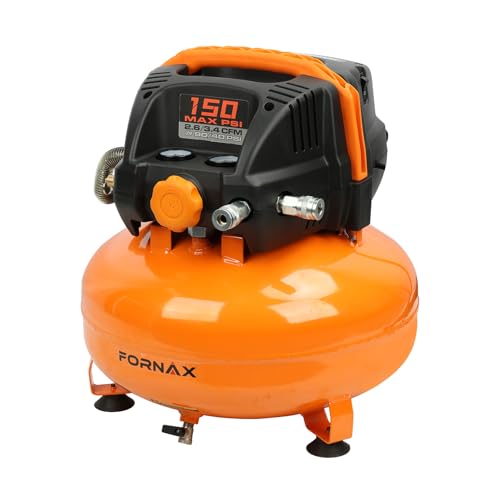 FORNAX 6-Gallon Pancake Air Compressor
|
8.4/10 | Buy |
 ECOMAX 6-Gallon 175 PSI Portable Pancake Air
|
8.4/10 | Buy | |
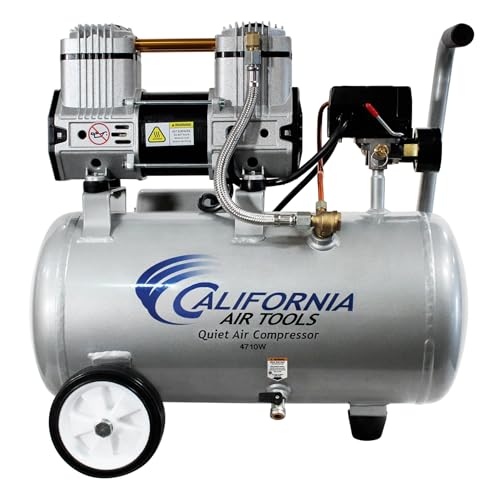 California Air Tools CAT-4710W 4.7-Gal Compressor
|
8.3/10 | Buy | |
 California Air Tools 20020AD 20-Gallon Ultra Quiet
|
8.3/10 | Buy | |
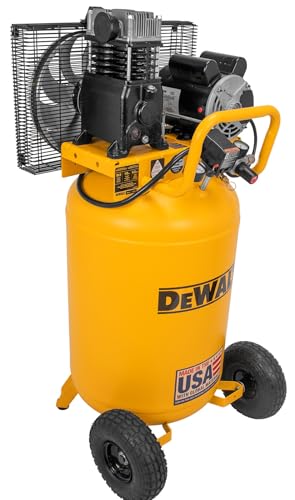 DEWALT 30-Gallon Vertical Portable Electric Air
|
8.3/10 | Buy | |
 Limodot 5-Gallon Quiet Portable Air Compressor
|
8.0/10 | Buy | |
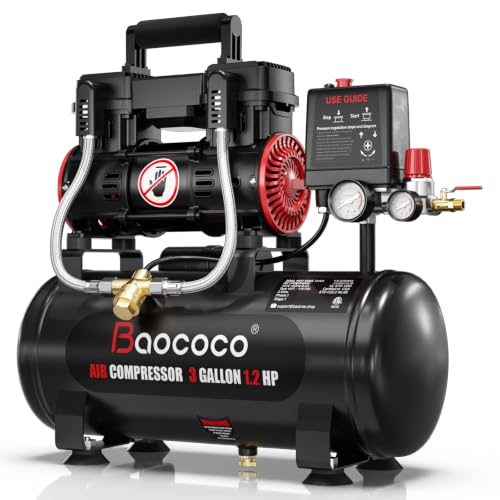 Baococo 3-Gallon Ultra Quiet Air Compressor
|
7.8/10 | Buy |
Goodyear 6-Gallon 150 PSI Portable Oil-Free
The Goodyear 6-gallon pancake air compressor delivers 3 SCFM at 90 PSI and 150 max PSI powered by a reliable 1 HP induction motor. At 32 pounds with an oil-free pump, it provides dependable portable air for trim carpenters, DIY home projects, and garage tire inflation.
Pros
- Produces 3 SCFM at 90 PSI, offering solid airflow for sequential finish nailing and light framing tasks
- Equipped with a durable 1 HP induction motor for dependable and consistent pressure build-up
- Oil-free pump mechanism requires zero ongoing lubrication maintenance and prevents oil contamination in air lines
- Two clearly visible analog pressure gauges make monitoring regulated line pressure straightforward
- Compact 32-pound pancake design is easy to lift, load into vehicles, and store on shop shelves
Cons
- Airflow rating of 3 SCFM is not designed to support continuous rotary air tools like orbital sanders or paint sprayers
- Comes with a single 1/4-inch quick-connect coupler rather than dual outlets for running two tools simultaneously
- Sold as a bare compressor without an included air hose, tire inflator chuck, or pneumatic nail guns
California Air Tools 2010A 2-Gallon Compressor
Operating at just 60 decibels, this compact unit delivers reliable airflow with minimal noise disruption. Its rust-free aluminum tank and oil-free dual-piston pump make it well suited for indoor trim work and noise-sensitive spaces.
Pros
- Exceptionally quiet operation at only 60 decibels
- Lightweight rust-free aluminum tank design
- Low-maintenance oil-free dual-piston system
- Quick 14-second recovery time between cycles
Cons
- Modest 2-gallon tank limits continuous heavy tool use
- 120 PSI maximum pressure is below heavy-duty standards
- Air output is insufficient for sustained high-demand air tools
P.T.S. 2840-20 2-Gallon Air Compressor
Built for trim carpentry and indoor jobs, this cordless compressor runs at a quiet 68 dB(A) and drives up to 1,600 brad nails per charge. Its stackable frame operates on Milwaukee M18 batteries, making it a solid option for finish work on quiet jobsites.
Pros
- Quiet operation at 68 dB(A)
- Fires up to 1,600 nails per charge
- Compact and stackable roll-cage design
- Compatible with Milwaukee M18 battery system
Cons
- Battery and charger sold separately
- Relatively heavy at 36 pounds
FORNAX 6-Gallon Pancake Air Compressor
The FORNAX 6-Gallon Pancake Air Compressor delivers 2.6 CFM at 90 PSI and up to 150 PSI of maximum pressure, featuring dual couplers and a lightweight 28.8-pound portable footprint. It is a practical pneumatic power source for DIY homeowners, finish carpenters, and garage hobbyists driving nailers or managing tire inflation.
Pros
- Dual quick-connect couplers allow two nailers to operate simultaneously without adding an external splitter manifold
- Generous 6-gallon air tank capacity with a 150 PSI maximum pressure ceiling provides a dependable air reserve
- Lightweight 28.8-pound profile simplifies one-handed carrying up stairs and transport into work vans
- Maintenance-free oil-free pump eliminates oil checks, oil changes, and mess around finished work surfaces
Cons
- Operating sound output rated at 95 dBA is loud and makes hearing protection necessary, especially in closed rooms
- Airflow output of 2.6 CFM at 90 PSI cannot support continuous-demand tools like sanders, grinders, or paint sprayers
- Supplied as a bare-tool compressor without an included air hose, tire inflator chuck, or pneumatic nailers
ECOMAX 6-Gallon 175 PSI Portable Pancake Air
The ECOMAX 6-Gallon Pancake Air Compressor delivers up to 175 PSI and 3 CFM at 90 PSI, providing dependable recovery and dual quick couplers for trim fastening and garage tasks. Weighing approximately 31.5 pounds and featuring cold-weather start capability, it suits DIY homeowners and punch-list contractors seeking a complete portable air setup.
Pros
- High 175 PSI maximum tank pressure provides substantial usable air volume in a compact 6-gallon footprint
- Rated 3 CFM at 90 PSI supports quick pressure recovery between fastening cycles and tire inflation tasks
- Dual quick-connect couplers support running two pneumatic hoses without adding aftermarket splitters
- Comes complete with a 25-foot hose and essential pneumatic accessories for immediate out-of-the-box utility
- Oil-free pump design ensures low ongoing maintenance with no oil levels to monitor or change
Cons
- Output of 3 CFM at 90 PSI is unsuited for continuous high-consumption air tools like sanders or grinders
- Included 25-foot PVC air hose can be stiff and retain tight coils in cold working environments
- Manufacturer does not publish an official dBA rating, and standard oil-free pancake pumps can be loud indoors
California Air Tools CAT-4710W 4.7-Gal Compressor
Built for garage workshops and DIY tasks, this mobile unit features an oil-free dual-piston pump that fills its 4.7-gallon steel tank in 78 seconds. Its low 7.5-amp motor draw ensures smooth startups on standard household circuits without tripping breakers.
Pros
- Fast 78-second tank fill time from empty
- Low 7.5-amp draw prevents tripped breakers
- Low-maintenance oil-free pump operation
- Wheels and pull handle ease transport at 35 pounds
Cons
- Delivers only 2.2 CFM at 90 PSI for demanding tools
- Steel tank construction is heavier than aluminum alternatives
California Air Tools 20020AD 20-Gallon Ultra Quiet
Delivering 5.30 CFM at 90 PSI with a quiet 70 dB sound profile, the California Air Tools 20020AD features a 2.0 HP low-RPM motor, oil-free dual-piston pump, and automatic drain valve. It is an outstanding pick for home garage mechanics and workshop woodworkers needing clean, high-volume air on standard 120V power.
Pros
- Remarkably quiet 70 dB operating volume suitable for residential garages and enclosed woodshops
- Delivers 5.30 CFM at 90 PSI to easily support impact wrenches, ratchets, nail guns, and inflation chores
- Automated moisture drain valve simplifies routine condensation maintenance
- Low 1680 RPM motor speed reduces pump heat, vibration, and mechanical wear
- Oil-free pump architecture ensures clean discharge air without oil residue
Cons
- Substantial 115-pound overall weight makes vehicle transport and stair climbing difficult
- Sustained continuous tools like production sandblasters or rotary sanders can outpace the pump recovery rate
- Requires a dedicated 15-amp or 20-amp outlet to handle the 14-amp continuous electrical draw
DEWALT 30-Gallon Vertical Portable Electric Air
Delivering 6.2 SCFM at 90 PSI with a high-capacity 175 PSI max pressure rating, the DEWALT DXCM303 30-Gallon Electric Air Compressor offers substantial air reserves for demanding workshop tools. Featuring rugged pneumatic wheels and a factory high-flow regulator, it is an outstanding mobile solution for garage mechanics and serious DIY woodworkers.
Pros
- Substantial 175 PSI maximum pressure provides longer run time between motor recovery cycles
- Solid airflow output of 6.2 SCFM at 90 PSI supports a wide variety of pneumatic garage tools
- High-flow regulator supplies up to 65% more usable operating pressure to connected hoses
- Heavy-duty pneumatic wheels make rolling this 196-pound upright compressor around the garage practical
Cons
- Substantial 196-pound total weight makes vehicle loading and transport between jobsites difficult without ramps or assistance
- Large vertical shop profile is designed for roll-around floor use rather than hand-carry punch-list applications
Limodot 5-Gallon Quiet Portable Air Compressor
The Limodot 5-Gallon Quiet Air Compressor delivers 2.8 CFM at 90 PSI with an operating noise level of just 68 dB, making it a great match for indoor trim work, tire maintenance, and home workshops. With an 80-second full tank fill time, an oil-free pump, and an included 13-piece accessory kit, this wheeled unit offers solid utility for DIYers seeking quiet performance without routine oil changes.
Pros
- Quiet 68 dB operational sound level suitable for indoor spaces and attached garages
- Strong airflow rating of 2.8 CFM at 90 PSI with rapid 25-second recovery duration
- Maintenance-free oil-free pump ensures hassle-free operation and easy vehicle transport
- Integrated wheel assembly improves mobility around the shop, garage, and jobsite
- Bundled package includes a 25-foot air hose and a 13-piece starter accessory collection
Cons
- Continuous air-hungry tools like rotary sanders or spray equipment will quickly exceed the 2.8 CFM output
- Included PVC air hose can be stiff and prone to kinking in cold garage environments compared to hybrid polymer hoses
- At 5 gallons with a wheeled frame, it has a larger storage footprint than compact pancake or twin-stack trim compressors
Baococo 3-Gallon Ultra Quiet Air Compressor
The Baococo 3-Gallon Ultra Quiet Air Compressor delivers up to 115 PSI at approximately 70dB, powered by a 1.2HP copper motor and an oil-free pump. With a 20-second recovery cycle, dual quick couplers, and integrated transport wheels, it is a practical, budget-friendly choice for indoor trim work, DIY repairs, and garage tire maintenance.
Pros
- Operates at roughly 70dB, allowing conversation and indoor use without deafening noise
- Rapid 20-second tank recovery cycle helps keep intermittent nailing projects moving
- Dual quick-connect couplers allow quick tool changes or running two air lines at once
- Built-in wheels and sturdy carry handle make rolling or lifting across the workspace easy
- Oil-free pump eliminates messy crankcase checks and prevents oil leaks during vehicle transport
Cons
- Maximum tank pressure tops out at 115 PSI, lower than 135 to 175 PSI contractor-grade units
- Manufacturer does not publish continuous CFM at 90 PSI, making it unsuited for continuous air tools like sanders or grinders
- Compact 3-gallon air reserve requires frequent motor cycling under rapid pneumatic demand
Sizing Compressor Tank Capacity for Pneumatic Equipment
Determining the right receiver tank volume is a critical decision when setting up any pneumatic system. Air tools operate on compressed air volume delivered at specific pressures, but the tank itself stores air rather than generating it. An undersized tank forces the compressor pump to start and stop frequently, which causes severe pressure fluctuations and accelerates mechanical wear. Matching the tank volume to your specific pneumatic tools ensures consistent airflow and protects your compressor motor over time.
Different pneumatic tools impose vastly different demands on an air reservoir. Finish nailers and tire inflators require only brief, intermittent bursts of air, allowing small portable tanks to keep up easily. In contrast, automotive sanders and paint sprayers draw continuous streams of pressurized air that rapidly empty compact reservoirs. Understanding the relationship between storage capacity and air tool consumption prevents costly mismatches and frustrating downtime in the shop.
Tank Gallons Versus Delivered CFM: The Vital Distinction
Tank volume, measured in gallons, indicates how much pressurized air reserve is immediately available in the receiver vessel. Delivered airflow, measured in cubic feet per minute (CFM) at a specified pressure such as 90 PSI, indicates how fast the pump generates fresh compressed air. A large tank cannot compensate indefinitely for an undersized pump that produces low CFM output. Once the stored air buffer is exhausted, tool performance drops directly to whatever volume the pump can supply in real time.
Think of the air receiver tank like a storage battery and the pump like an electrical alternator. If an air tool consumes 8 CFM at 90 PSI while the pump only generates 3 CFM, the tool will quickly deplete the stored air in the tank. A small 6-gallon tank will run out of air in seconds under that load, causing line pressure to plummet. A larger 30-gallon tank provides a much longer operational buffer before line pressure drops below the tool operating threshold.
Sizing for Intermittent Air Tools: Nailers and Staplers (1 to 6 Gallons)
Pneumatic fastening tools represent the least demanding category in terms of total air volume. Brad nailers, finish nailers, and pin nailers consume tiny fractions of a cubic foot of air per actuation. Because the tool only draws air for a fraction of a second when fired, the compressor pump has ample time between shots to recover tank pressure. Even compact portable units with 2-gallon to 3-gallon tanks handle finish carpentry and trim work without hesitation.
Units such as the California Air Tools 2010A 1.0 HP Ultra Quiet compressor feature a 2-gallon aluminum tank that provides ample reserve for intermittent trim nailing. Similarly, cordless options like the 2840-20 2 Gallon Compact Quiet Compressor can drive hundreds of brad nails on a single charge while maintaining a compact footprint. The small tank keeps the entire machine lightweight and easy to carry between rooms or up staircases. For punch-list carpenters and hobby woodworkers, a 2-gallon or 3-gallon reservoir is practical and easily transported.
Framing nailers and roofing coil nailers require slightly more air volume per shot than finish nailers, particularly during rapid bump-firing. A 6-gallon pancake compressor, such as the Goodyear 6 Gallon 150 PSI Oil Free Electric or the FORNAX Pancake Air Compressor with two couplers, provides the ideal buffer for jobsite framing. The 6-gallon capacity prevents immediate motor restarts during sequential nailing sequences while keeping the machine portable. Models like the ECOMAX Air Compressor 6 Gallon 175 PSI Pancake also offer dual quick-connect couplers, allowing two light nailers to operate from the same portable tank.
Sizing for Intermittent High-Torque Tools: Impact Wrenches and Ratchets (10 to 20 Gallons)
Automotive pneumatic tools present an intermediate air consumption profile that catches many DIY mechanics off guard. A standard 1/2-inch pneumatic impact wrench may consume between 4 and 6 CFM at 90 PSI during heavy operation. While lug nuts are typically removed in short bursts of several seconds, stubborn suspension bolts require sustained torque. Running an impact wrench on a small 6-gallon pancake tank often leads to rapid pressure drops that leave the tool powerless mid-fastener.
A 10-gallon to 20-gallon receiver tank provides the necessary volume buffer for home garage automotive repair. The larger volume allows the impact gun to deliver its rated break-away torque without triggering an immediate drop in line pressure. Intermediate tanks also give the compressor pump sufficient breathing room so it does not cycle constantly during a tire rotation or brake job. This reserve capacity ensures that regulated line pressure remains stable throughout heavy mechanical work.
A model like the California Air Tools 20020AD 2.0 HP Ultra Quiet compressor features a 20-gallon steel tank that delivers 5.30 CFM at 90 PSI. That combination provides both the CFM volume and the physical storage cushion required for automotive impact wrenches, ratchets, and air chisels. The 20-gallon tank stores enough compressed volume to handle multiple wheel changes before the pump needs to cycle back on. Mounted on wheels, these medium-capacity units remain manageable in residential garages while supporting demanding pneumatic tasks.
Sizing for Continuous-Consumption Tools: Sanders, Grinders, and Paint Sprayers (30 to 60+ Gallons)
Continuous pneumatic tools are the most demanding equipment you can connect to an air compressor. Rotary orbital sanders, die grinders, needle scalers, and HVLP paint spray guns draw compressed air continuously without natural pauses. A dual-action sander can easily consume 8 to 12 CFM at 90 PSI, while HVLP sprayers require constant airflow to maintain an even spray pattern. Attempting to run these continuous tools on a small portable compressor results in immediate tool stalling and severe pressure drop.
Stationary and large portable setups with 30-gallon tanks or larger are essential for sustained continuous operation. A vertical compressor like the DEWALT 30-Gallon Vertical Portable Electric Air Compressor delivers 6.2 SCFM at 90 PSI with a 175 PSI maximum tank reserve. That substantial tank buffer provides 2.5 times longer tool run time compared to smaller units before the motor cuts in. For serious bodywork, cabinetry finishing, or continuous metal grinding, having at least 30 gallons of storage capacity is necessary to prevent finish defects.
When work requires running multiple high-draw tools simultaneously or sandblasting for hours, commercial workshops move beyond portable units into dedicated stationary equipment. Consulting an industrial air compressor guide provides helpful perspective on two-stage cast-iron pumps paired with 60-gallon or 80-gallon vertical receivers. These high-capacity systems deliver 15 CFM or more and operate on a 100 percent continuous duty cycle. Sizing for continuous tools means matching both high pump displacement and large receiver storage to avoid pump overheating.
How Operating Pressure and Usable Air Buffer Impact Tank Requirements
Maximum tank operating pressure plays a major role in determining how much usable air a receiver actually holds. Standard compressors operate with cut-off pressures between 120 PSI and 150 PSI, while higher-pressure units reach 175 PSI. Because Boyle’s Law dictates that air volume scales with pressure, a 6-gallon tank pressurized to 175 PSI holds significantly more cubic feet of standard air than the same 6-gallon tank at 120 PSI. This higher pressure threshold extends tool run time before the tank drops down to the regulator cut-in point.
For example, the ECOMAX Air Compressor 6 Gallon pancake delivers a maximum pressure of 175 PSI, which provides up to 40 percent more usable air compared to traditional 135 PSI models. That extra stored energy delays the moment when line pressure drops below your tool operating requirement. However, a higher-pressure tank still cannot overcome low pump CFM when using continuous tools. High tank pressure is most valuable for stretching the operating window of medium-demand tools on portable jobsite compressors.
Pump Recovery Time and Motor Duty Cycles
The cut-in and cut-out settings of the factory pressure switch determine when the compressor motor activates and deactivates. When tank pressure falls below the cut-in threshold, typically around 90 to 105 PSI, the pressure switch engages the motor to rebuild pressure back to cut-out. The time required to restore that pressure is known as recovery time. Small tanks recover quickly because their internal volume is modest, with units like the California Air Tools 2010A recovering from 90 to 120 PSI in roughly 14 seconds.
Motor duty cycle dictates what percentage of time a compressor pump can safely run without risking thermal overload or premature wear. Most consumer and light-commercial oil-free compressors carry a 50 percent duty cycle, meaning the pump should rest for at least as much time as it runs during an operating hour. If an undersized tank forces the motor to run continuously for twenty minutes straight, internal pump temperatures will spike dramatically. Choosing an adequate tank size allows the motor to complete short recovery cycles and rest between tool operations.
Noise Levels and Workspace Placement
The physical size of the tank directly affects how frequently you hear the compressor motor cycle in your workspace. A smaller tank cycles on and off repeatedly, creating a persistent acoustic disruption in enclosed garages, basements, or client homes. Traditional universal-motor compressors generate noise levels between 80 and 95 decibels, which can cause severe ear fatigue during long working sessions. For indoor woodworking or home workshops, reviewing a low-noise air compressor guide highlights the advantage of quiet dual-piston pump technology.
Low-RPM dual-piston models operate at dramatically lower sound levels, often between 60 and 70 decibels. The California Air Tools 2010A operates at just 60 dBA, while the Limodot Quiet Oil-Free Air Compressor produces 68 dBA with a 5-gallon tank. Even larger units like the California Air Tools 20020AD 20-gallon compressor keep noise down to 70 dB through an induction motor turning at 1680 RPM. Selecting a quiet compressor paired with a sufficient tank reservoir ensures a calm working environment without repetitive, piercing motor starts.
Electrical Demands and Startup Circuit Safety
Compressor motors draw substantial electrical current, particularly during the initial startup phase when overcoming head pressure. A 1.0 HP or 2.0 HP electric motor operating on 120-volt household current can draw 7.5 to 14 running amps and significantly higher surge amps at startup. Plugging a high-draw compressor into a shared 15-amp branch circuit that also powers shop lights or power tools frequently trips the circuit breaker. Ensuring your compressor operates on an appropriate circuit prevents unexpected shutoffs during critical tasks.
Using undersized or long electrical extension cords causes voltage drop, which starves the motor of required voltage and overheats the electrical windings. If your jobsite or garage workspace requires mobility, it is always safer to run a longer air hose rather than extending the power cord. Air hoses maintain pressure efficiently over distance, while heavy-duty motors remain securely plugged directly into wall receptacles. Units like the California Air Tools CAT-4710W draw only 7.5 amps, making them exceptionally forgiving on standard 110-volt outlets.
Tank Maintenance and Condensation Management
Compressing ambient air inevitably squeezes moisture out of the air, causing water condensation to pool at the bottom of the receiver tank. In humid environments, an active compressor can accumulate several ounces of moisture during a single afternoon of pneumatic tool work. If left unmanaged, standing water leads to internal tank rust, which weakens the pressure vessel walls and contaminates downstream air tools. Draining the receiver tank at the end of every work session is essential for equipment longevity and operator safety.
Tank material and drain valve design significantly impact maintenance convenience. Aluminum tanks, such as the 2-gallon reservoir on the California Air Tools 2010A, naturally resist internal rust and provide clean air for sensitive tools. Steel tanks require consistent purging through underside drain valves to prevent scale and corrosion from entering air hoses. Premium units like the California Air Tools 20020AD even feature automatic drain valves that purge moisture electronically, removing the hassle of manual petcock adjustments.
Practical Sizing Summary Across Pneumatic Tool Categories
Selecting the right air compressor gallon capacity comes down to realistic assessment of your primary pneumatic tools. For trim carpentry, brad nailing, and bicycle or automotive tire inflation, a 2-gallon to 6-gallon portable tank is completely adequate. For framing nailers, roofing crews, and light garage maintenance, a 6-gallon pancake or hot-dog tank delivers the ideal balance of volume and portability. These compact options fit easily in vehicle trunks and require minimal storage footprint in crowded shops.
When your projects expand to automotive lug nut removal, impact ratchets, and intermittent die grinding, step up to a 10-gallon to 20-gallon wheeled reservoir. For continuous tasks like random orbital sanding, HVLP automotive spray painting, and abrasive blasting, choose a 30-gallon or larger compressor delivering at least 6 to 10 CFM at 90 PSI. Investing in the correct tank volume upfront protects your pneumatic tools from pressure starvation and ensures your compressor motor operates within safe thermal boundaries.
Matching your pneumatic tool air consumption to the proper tank capacity eliminates frustration and ensures consistent tool power. Always evaluate the CFM requirements of your most demanding tool alongside the storage capacity of the compressor receiver. A well-sized air tank maintains stable line pressure, reduces frequent motor cycling, and delivers reliable performance across all your workshop projects.
About the author
Bob Beacham is an experienced tools and workshop writer with deep knowledge of power equipment, mechanical systems, and practical DIY applications. His coverage of air compressors, welding equipment, saws, and workshop tools helps translate technical specifications into useful guidance for homeowners and serious DIYers.