
How to Use 12 Volt Air Compressor: Practical Guide for 2026
Learn how to use 12 volt air compressor safely and efficiently in October 2026 with step-by-step instructions for power setups, tire inflation, and duty cycle care.
 By Tony Carrick
Updated October 8, 2026
By Tony Carrick
Updated October 8, 2026

A flat tire or an unexpected pressure warning on a dark highway quickly turns an ordinary drive into a stressful roadside delay. Carrying a compact direct-current inflator in your trunk provides immediate independence from out-of-order gas station air pumps and expensive tow trucks. Learning how to use 12 volt air compressor hardware properly protects your vehicle battery, prevents blown cabin fuses, and ensures your tires reach their exact factory specification. Before connecting your hardware, reviewing essential portable air compressor concepts helps you understand how portable direct-drive pumps manage air delivery and electrical loads.
Most portable 12V compressors rely on either an interior auxiliary power socket or direct battery terminal clamps to power their compact electric motors. While modern digital inflators offer automated shutoff presets, small operational oversights can still overheat the pump cylinder or drain your vehicle starting battery. Taking a few moments to inspect your valve stems, secure electrical leads, and confirm factory pressure ratings makes tire maintenance completely painless. This operational guide walks through each phase of connecting, running, and storing your portable compressor with confidence.
| Award | Product | ACR Score About ACR ScoreThe ACR Score is our own rating from 0 to 10, based on performance, design and build, ease of use, and value. It reflects independent research and is never influenced by manufacturers, retailers, or affiliate commissions. Learn more › | |
|---|---|---|---|
| Best Overall |
GSPSCN 12V Double Cylinder Tire Inflator
|
9.2/10 | Buy |
| Best Premium |
 DEWALT Cordless Tire Inflator Portable Air
|
9.1/10 | Buy |
| Best Budget |
 AstroAI Dual Power 110V/12V Tire Inflator
|
8.9/10 | Buy |
 CARSUN AC/DC Portable Tire Inflator
|
8.8/10 | Buy | |
| Best Value |
 GSPSCN 12V Portable Tire Inflator
|
8.8/10 | Buy |
 GSPSCN Dual-Cylinder 12V Tire Inflator
|
8.8/10 | Buy | |
 CARSUN 12V DC Portable Tire Inflator
|
8.6/10 | Buy | |
 AstroAI AIRUN H 12V DC Portable Air Compressor
|
8.4/10 | Buy | |
 VIAIR 88P 12V Portable Air Compressor
|
8.4/10 | Buy | |
 UUP 150 PSI Dual Cylinder Air Compressor
|
8.3/10 | Buy |
GSPSCN 12V Double Cylinder Tire Inflator
Built with a dual-cylinder direct drive motor, the GSPSCN delivers 70 liters per minute of airflow for fast inflation up to 150 PSI. Its all-metal internal build and 23 feet of total reach make it practical for larger vehicles like SUVs and trucks.
Pros
- Rapid 70L/min airflow from dual cylinders
- Long 23-foot combined cord and hose reach
- Durable all-metal motor and cylinder construction
- Quiet operation rated at 70dB
- Complete accessory set including storage case and adapters
Cons
- Heavier than compact alternatives at 6 pounds
- Relies on battery clamps rather than standard outlets
DEWALT Cordless Tire Inflator Portable Air
This compact DEWALT portable tire inflator delivers up to 150 PSI with smart auto shut-off, powered by an internal rechargeable battery or an included 10-foot 12V car plug. It provides an efficient, pocket-sized solution for vehicle owners, cyclists, and DIYers wanting rapid roadside top-offs without hauling a bulky tank compressor.
Pros
- True cordless freedom with an internal rechargeable battery plus a 10-foot 12V DC vehicle plug backup
- Accurate digital pressure gauge with 5 smart presets and automatic shut-off to eliminate overinflation
- Ultra-compact handheld design weighing just 0.63 kg for easy storage in glove boxes or saddlebags
- Integrated LED work light and emergency USB power bank functionality for travel safety
- Generous accessory bundle backed by a 3-year limited warranty
Cons
- Engineered exclusively for high-pressure inflation rather than operating pneumatic air tools or nailers
- Does not include a 120V AC residential wall outlet power adapter
- Compact tankless pump requires periodic cooling breaks during heavy multi-tire inflation runs
AstroAI Dual Power 110V/12V Tire Inflator
Versatile dual-power support lets this lightweight inflator run from either a garage wall outlet or a vehicle cigarette lighter. An automatic shutoff and onboard cord storage make routine tire top-offs straightforward for any driver.
Pros
- Flexible dual AC and DC power options
- Automatic shutoff prevents over-inflation
- Compact and lightweight at 2.2 pounds
- Integrated cord and nozzle storage
Cons
- Requires a 10-minute cooldown after 15 minutes of runtime
- Must be plugged into a power source to operate
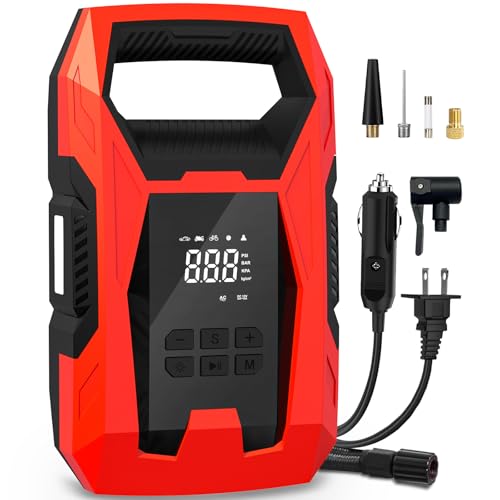
CARSUN AC/DC Portable Tire Inflator
Equipped with dual power inputs for 110V household outlets and 12V car sockets, this portable compressor delivers up to 150 PSI with auto-shutoff presets. It is a practical solution for drivers, cyclists, and households needing dependable inflation for standard vehicle tires and sports gear.
Pros
- Dual 110V AC and 12V DC power compatibility
- Automatic shutoff with memory preset function
- Clear backlit screen visible in direct sunlight
- Integrated LED light for nighttime emergencies
- Includes multiple adapters and dedicated carrying bag
Cons
- Not compatible with truck, tractor, or SUP board tires
- Requires 10-minute cooldown after 15 minutes of use
GSPSCN 12V Portable Tire Inflator
The GSPSCN 12V Heavy Duty Tire Inflator delivers a robust 70 L/min airflow with its direct-drive dual-cylinder metal pump and 150 PSI maximum pressure rating. Built for pickup trucks, SUVs, and trailer owners, it operates at a manageable 70 dB and includes battery clamps for reliable 12V direct connection.
Pros
- Fast 70 L/min air volume output powered by a dual-cylinder direct-drive metal pump mechanism
- Generous 23-foot total working reach across the 11.5-foot 12V power cord and 11.5-foot air hose
- Direct battery clamps deliver dependable 12V DC power without risking internal vehicle fuse blowouts
- Remarkably manageable 70 dB sound level compared to standard high-pitch emergency tire pumps
Cons
- Requires direct 12V car battery terminal connection, which necessitates opening the vehicle hood
- Lacks an integrated air storage tank, so it is strictly intended for direct inflation rather than air tools
- No built-in digital automatic shutoff target pressure stop, requiring manual gauge monitoring
GSPSCN Dual-Cylinder 12V Tire Inflator
Built with an all-metal dual-cylinder motor, this 12V portable compressor delivers a fast 70 L/Min airflow alongside a digital auto shut-off gauge. It is an ideal roadside tool for drivers needing rapid inflation for cars, SUVs, and light trucks without excessive vibration.
Pros
- Fast 70 L/Min dual-cylinder airflow
- Durable all-metal motor and cylinder construction
- Automatic shut-off prevents accidental over-inflation
- Includes 11.5-foot extension hose and carry bag
- Anti-slip base stabilizes pump during operation
Cons
- Relatively heavy to carry at 6.5 pounds
- Requires a wired 12V connection without cordless option
CARSUN 12V DC Portable Tire Inflator
The CARSUN 12V DC portable tire inflator delivers a listed 35 L/min airflow with automatic digital shut-off up to 150 PSI. It is an ideal, budget-friendly roadside emergency pump for passenger car owners, cyclists, and weekend campers.
Pros
- Automatic shut-off prevents accidental tire over-inflation by cutting power at the preset target pressure
- Lightweight 1.9-pound frame and compact dimensions fit neatly into vehicle trunks or roadside emergency kits
- Capable 35 L/min air volume airs up standard passenger tires quickly during routine seasonal pressure top-offs
- Bright integrated LED lighting assists with safe valve connection along dark roadways and unlit driveways
- Four included adapter nozzles expand utility across bicycles, sporting balls, and recreational air mattresses
Cons
- Powered exclusively via 12V DC vehicle sockets and does not include a 120V AC household electrical plug
- Manufacturer explicitly notes the unit is not suitable for heavy commercial trucks or large motor lorries
- Tankless high-pressure inflator design is not engineered to operate pneumatic workshop air tools
AstroAI AIRUN H 12V DC Portable Air Compressor
The AstroAI AIRUN H is a compact 12V DC tire inflator delivering up to 35 L/min airflow with automatic shut-off and digital pressure presets. It is an ideal portable emergency compressor for drivers, commuters, and garage hobbyists seeking fast tire top-offs.
Pros
- Automatic shut-off stops pumping reliably once target PSI is reached
- High-airflow 120W motor provides rapid top-offs for daily driver tires
- Long 9.84-foot power cord reaches all passenger vehicle wheels with ease
- Bright built-in LED flashlight and backlit display assist during night repairs
- Lightweight 2.2-pound form factor stores neatly in glove boxes and trunks
Cons
- Requires a 12V DC vehicle outlet and does not include a 120V AC household plug
- Mandates a 10-minute cool-down interval after 15 minutes of continuous operation
- Not intended for high-volume inflatables like large pool floats or air mattresses
VIAIR 88P 12V Portable Air Compressor
Designed for passenger cars and light trucks with tires up to 33 inches, the VIAIR 88P delivers dependable 120 PSI output directly from a vehicle battery. Its generous 26-foot total reach, built-in gauge, and integrated work light make it a practical emergency companion for road trips and camping.
Pros
- Solid 1.47 CFM flow rate provides brisk inflation
- Generous 26-foot reach easily accesses all four tires
- Built-in LED work light aids dark roadside repairs
- Compact body weighs under five pounds for convenient storage
Cons
- Requires direct battery connection instead of standard 12V outlet
- Limited to a 25-minute duty cycle before cooling
- Not designed for tires larger than 33 inches
UUP 150 PSI Dual Cylinder Air Compressor
Built with dual cylinders and a 70L/min flow rate, this portable 12V inflator delivers fast tire fills for trucks, SUVs, and outdoor inflatables. Its integrated LED light and included battery clamps make roadside top-offs straightforward.
Pros
- High 70L/min airflow for rapid inflation
- Capable of reaching up to 150 PSI
- Built-in emergency LED work light
- Includes comprehensive adapter kit and storage bag
Cons
- Weighs over 6.6 pounds
- Requires direct car battery connection with clamps
Complete Step-by-Step Guide to Operating a 12-Volt Air Compressor
Operating a portable 12V air compressor is straightforward once you understand how direct-current power supplies and small reciprocating pumps interact. These compact inflators pack reliable performance into lightweight housings, making them essential roadside safety equipment for daily commuters and off-road travelers alike. Following a methodical operational sequence protects your vehicle electrical system, prevents premature pump failure, and yields accurate tire pressure every single time.
Locating Cold Tire Specifications and Preparing Wheels
Every successful tire inflation begins with identifying the correct cold inflation pressure specified by your vehicle manufacturer. You can locate this PSI rating on the driver door pillar placard or inside the vehicle owner manual rather than on the tire sidewall. Sidewall markings state the maximum permissible pressure under full load, which is rarely the appropriate setting for daily driving comfort and balanced tire wear. Always check your tires before driving, as road friction rapidly heats the air inside the rubber and produces artificially high pressure readings.
Unpack your portable compressor on a flat, dry surface beside the wheel you plan to service first. Inspect the power cable and air hose for sharp kinks, cracked insulation, or damaged fittings before connecting anything to your car. Remove the plastic dust cap from the tire valve stem and place it in your pocket or a secure tray so it does not get lost in roadside gravel. Wipe away any accumulated dirt, mud, or road salt from the exposed valve stem threads using a clean shop rag.
Selecting and Connecting the Correct 12-Volt Power Source
Portable 12V compressors receive direct-current electricity through either an interior cigarette lighter socket or heavy-duty alligator clamps attached to the car battery. Compact single-cylinder models from brands like AstroAI and CARSUN run comfortably through standard 12V cabin outlets protected by 15-amp vehicle fuses. High-output dual-cylinder models like the GSPSCN Heavy Duty or the VIAIR 88P draw higher continuous amperage and require direct battery terminal connections to prevent electrical overloads. Check the manufacturer label on your pump to confirm its rated amp draw before plugging it into an interior cabin outlet.
When using battery clamps, switch off the vehicle ignition, open the hood, and locate the primary 12-volt battery posts. Connect the red alligator clamp firmly to the positive battery post, followed by clamping the black lead to the negative post or a solid unpainted metal chassis ground. Ensure the spring-loaded metal jaws bite firmly through any surface oxidation to create a clean connection without electrical sparking. Keep the power wiring routed well clear of moving engine drive belts, alternator pulleys, and hot exhaust parts.
Start your car engine and allow it to idle in park with the emergency handbrake engaged before activating the air pump. Running the engine enables the alternator to supply a steady 13.8 to 14.4 volts directly to the compressor motor. This higher operating voltage maximizes inflation speed and prevents the continuous electric motor draw from draining your starter battery. Running an electric air pump on a resting battery can quickly deplete starting reserves, particularly in cold winter weather.
Attaching the Air Chuck to the Valve Stem
Establishing an airtight connection between the compressor chuck and the tire valve stem is critical for accurate operation. Most 12V inflators utilize either a solid brass threaded twist-on connector or a quick-attach thumb-lock clamp. Threaded brass chucks screw clockwise directly onto the valve threads until you hear a momentary hiss that stops as the chuck seals against the valve core. Learning connecting air lines properly prevents stripped valve threads and eliminates false pressure readings caused by air leaking past the fitting.
When working with a thumb-lock lever chuck, keep the lever open, push the nozzle straight onto the valve stem, and press the lever down firmly. A tilted chuck allows pressurized air to leak past the internal rubber seal, which drops line pressure and disrupts digital gauge sensors. Never force a stubborn locking lever down if the chuck is cocked at an angle across the brass threads. Once clamped, gently pull the hose to confirm that the chuck remains locked squarely against the stem.
Long extension hoses, like the extended coiled lines included with dual-cylinder metal compressors, provide ample reach around large pickup trucks, RVs, and travel trailers. Lay the hose out smoothly along the ground rather than pulling it tight between the vehicle wheel and the compressor housing. Excessive line tension can pull the compressor over or bend the rubber valve stem, causing dangerous rim leaks. Keep the compressor resting upright on level ground so motor vibration does not bounce the unit against painted body panels.
Setting Target Pressure on Digital Displays and Gauges
Modern digital tire inflators simplify inflation by allowing you to program your exact target pressure before starting the motor. Press the unit selection button on models like the DEWALT or AstroAI inflators to toggle between PSI, BAR, KPA, or KG/CM units until PSI appears. Use the plus and minus adjustment buttons to set your required pressure, matching the number indicated on your vehicle door pillar. The digital screen will display the current tire pressure as soon as the chuck connects, allowing you to assess how much air is needed.
Inflators equipped with analog mechanical dial gauges require diligent visual monitoring because they lack automatic shutoff switches. Keep your eyes on the dial needle as pressure rises, and switch the motor off momentarily to read the true static tire pressure. The mechanical pulses of a reciprocating piston create dynamic line pressure spikes that push the gauge needle slightly higher while the motor runs. Pausing the pump provides an accurate resting pressure reading and prevents unintentional over-inflation.
Gaining insight into understanding working pressure ratings clarifies how backpressure behaves inside small single-stage portable inflators. If you accidentally exceed your recommended tire pressure, you do not need to unscrew the entire chuck assembly. Many brass chucks include a small integrated brass bleeder valve, or you can tap the valve core pin with the back of a pressure gauge to release surplus air. Always double check your final reading with a reliable pencil gauge or digital tire gauge before moving on to the next tire.
Managing Pump Duty Cycles and Dissipating Operational Heat
Portable direct-drive compressors generate substantial thermal energy inside their compact, oil-free metal cylinders during inflation. Most consumer inflators feature a duty cycle rating between 10 and 20 minutes before requiring a full cooldown period. Pushing an inflator past its rated duty cycle can degrade the internal Teflon piston rings and trip the thermal overload protector. Dual-cylinder units move higher airflow volumes, filling standard vehicle tires in just a couple minutes and significantly cutting overall run time.
The metal cylinder head, aluminum cooling fins, and brass hose connectors become extremely hot after several minutes of steady compression. Never touch the bare metal motor housing or the metal fitting near the air discharge outlet with bare fingers immediately after pumping. Always carry the compressor by its insulated plastic handle or molded rubber grip to avoid accidental burns. Allow the compressor to rest on the ground for a few minutes after finishing so residual heat can safely dissipate into the open air.
Pay close attention to the pitch and cadence of the electric motor as air pressure inside the tire cavity increases. A distinct drop in motor pitch or an audible mechanical struggle indicates that the pump is working against high backpressure. If the motor begins to slow dramatically, vibrate excessively, or emit an acrid electrical odor, immediately shut the main power switch off. Giving the internal components five to ten minutes to cool preserves motor windings and ensures dependable performance on future trips.
Inflating Bicycles, Sports Balls, and Camping Inflatables
Most 12V air compressors come equipped with specialized accessory nozzles that store neatly inside the compressor handle or travel case. Thin metal inflation needles thread onto the standard chuck to inflate basketballs, soccer balls, and footballs without damaging the internal rubber bladders. Narrow tapered plastic nozzles fit securely into the push-in vinyl valves found on air mattresses, river tubes, and camping gear. Ensure every nozzle screws tightly into the chuck fitting to prevent pressurized air from whistling out around the base.
Bicycles often feature slender Presta valves that require a brass adapter before they can accept a standard automotive Schrader chuck. Thread the included brass Presta adapter onto the valve stem after opening the small knurled nut at the tip of the valve core. Because bicycle tires contain minimal air volume compared to car tires, pressure rises rapidly in just a few seconds of continuous inflation. Set your digital target pressure carefully or pump in short two-second bursts to prevent blowing the bicycle tire bead off the rim.
Never leave sports gear or lightweight camping mattresses unattended while your 12V compressor is running. Inflatables lack the rigid internal steel belts of automotive radial tires and can rupture catastrophically if exposed to excessive air pressure. Most camping mattresses and pool floats require only a small fraction of a single PSI to reach their proper operating firmness. Monitor the firmness of the item with your hands throughout the filling process and turn off the pump the moment the vinyl surface stretches smooth.
Troubleshooting Power Failures, Blown Fuses, and Air Leaks
The most common electrical glitch encountered when using a 12V compressor is a blown interior fuse caused by motor startup inrush current. An electric motor draws significantly more current during its initial startup surge than it does while spinning freely at running speed. If your vehicle accessory socket abruptly stops providing electrical power, locate the cabin fuse panel and replace the blown 15-amp fuse with an identical rating. You can avoid this initial current spike by switching the compressor on before attaching the chuck to a pressurized tire valve.
If the compressor motor runs at full speed but the tire shows zero pressure gain, a misaligned valve seal is almost always responsible. Remove the chuck completely, inspect the internal rubber sealing washer for tears or debris, and reconnect it squarely onto the valve stem. Listen carefully for faint hissing sounds near the base of the valve stem, where cracked or aged rubber stems can leak under high pressure. Replacing weathered rubber valve stems with sturdy brass stems during routine tire rotations avoids unexpected roadside air leaks.
In sub-freezing winter weather, direct-drive inflator motors often feel sluggish because cold temperatures stiffen grease and electrical wiring. Placing the compressor in your heated vehicle cabin for five minutes before use helps the motor turn smoothly without drawing excessive starting current. If the unit fails to illuminate or power on at all, unscrew the tip of the 12V accessory plug to check the internal glass cylinder fuse. Replacing a broken or scorched glass fuse with a fresh spare will immediately restore operational power to the unit.
Safe Storage Practices and Field Maintenance Routines
Packing your 12V air compressor away systematically ensures it remains clean, protected, and fully operational for the next roadside situation. Loop the high-pressure rubber hose and 12-volt power cord loosely around the housing rather than winding them tightly around sharp plastic corners. Store all small valve adapters, Presta connectors, and spare fuses in the zipper compartments of your storage bag so they never scatter under seats. Keeping the unit zipped inside a heavy-duty fabric bag prevents trunk dust, sand, and moisture from clogging the sensitive air intake vents.
Ongoing maintenance for portable direct-drive pumps is minimal but vital for long service life. Inspect the brass threads of your air chuck periodically and wipe away any accumulated grit or road grime with a clean microfiber cloth. Never spray penetrating oils or petroleum lubricants into the air intake or valve chuck, as these chemicals can degrade internal synthetic rubber seals. Storing your portable inflator securely in a dedicated trunk organizer keeps the housing safe from heavy tools and sliding cargo on long road trips.
About the author
Tony Carrick is an experienced product researcher and writer specializing in tools, home improvement, automotive maintenance, and consumer equipment. With extensive experience reviewing tools and tackling hands-on renovation projects, he brings a buyer-focused perspective to compressor performance, usability, and overall value.