
What Is the Power Output of an Air Compressor: A Practical Guide for 2026
Understand what is the power output of an air compressor, from CFM and PSI to motor horsepower ratings, updated for October 2026.
 By Bob Beacham
Updated October 8, 2026
By Bob Beacham
Updated October 8, 2026

Operating pneumatic tools effectively begins with understanding how motor mechanical force converts into usable compressed air. Many workshop owners, automotive hobbyists, and contractors find themselves asking what is the power output of an air compressor after dealing with stalling tools or nuisance electrical breaker trips. True output is not merely a single horsepower number printed on a plastic motor housing, but rather a dynamic balance between delivered airflow volume, working pressure, and pump efficiency. Determining the practical capability of any pneumatic machine requires looking beyond marketing labels to evaluate the actual volume of pressurized air delivered to your tool line.
Pneumatic equipment spans a broad spectrum of configurations, from compact 12V direct-current tire inflators to dual-cylinder gas-driven jobsite units. Smaller portable pumps are engineered to generate high operating pressure for topping off vehicle tires and recreational gear, whereas workshop compressors depend on larger storage reservoirs and continuous displacement to drive air-hungry tools. Understanding how flow volume, storage capacity, and motor torque interact enables buyers to match equipment to specific projects without risking motor burnout or stalling mid-task.
| Award | Product | ACR Score About ACR ScoreThe ACR Score is our own rating from 0 to 10, based on performance, design and build, ease of use, and value. It reflects independent research and is never influenced by manufacturers, retailers, or affiliate commissions. Learn more › | |
|---|---|---|---|
| Best Overall |
AstroAI H2 Pro Cordless Tire Inflator 150 PSI
|
9.2/10 | Buy |
| Best Premium |
 Albott 6.5HP 8-Gallon Gas Air Compressor
|
9.1/10 | Buy |
| Best Budget |
 Ipflin 160 PSI Portable Tire Inflator and Air
|
8.9/10 | Buy |
| Best Value |
 Joltekon VP20 5000A Jump Starter & Compressor
|
8.8/10 | Buy |
 MZB MZB-1100H-50 13.2-Gallon Air Compressor
|
8.8/10 | Buy | |
 OlarHike Dual-Power Tire Inflator
|
8.6/10 | Buy | |
 OlarHike Portable Tire Inflator Air Compressor
|
8.3/10 | Buy | |
 OlarHike 12000mAh Cordless Tire Inflator
|
8.3/10 | Buy | |
 AstroAI Portable Tire Inflator Air Compressor
|
8.1/10 | Buy | |
 CRAFTSMAN Dual Power Tire Inflator
|
8.1/10 | Buy |
AstroAI H2 Pro Cordless Tire Inflator 150 PSI
The AstroAI H2 Pro is a versatile dual-power portable tire inflator delivering up to 150 PSI via an internal rechargeable lithium battery or 12V DC vehicle plug. Featuring digital auto shut-off, accurate dual pressure displays, and onboard accessory storage, it is an ideal roadside emergency and garage solution for vehicle owners and cyclists.
Pros
- Dual power supply provides cordless convenience with a 12V DC vehicle fallback for roadside emergencies.
- Automatic shut-off and dual digital display prevent overinflation and eliminate manual pressure monitoring.
- ToughUltra internal components improve mechanical durability compared to standard plastic gear assemblies.
- Integrated nozzle storage compartment keeps bicycle adapters and ball needles organized inside the unit.
Cons
- Tankless high-pressure inflator design is not compatible with pneumatic workshop air tools like nailers or impact wrenches.
- Cordless runtime is limited to approximately 18 minutes before requiring a recharge or switching to the 12V DC vehicle cord.
- Direct-drive high-pressure pump requires cool-down pauses during continuous multi-tire inflation tasks.
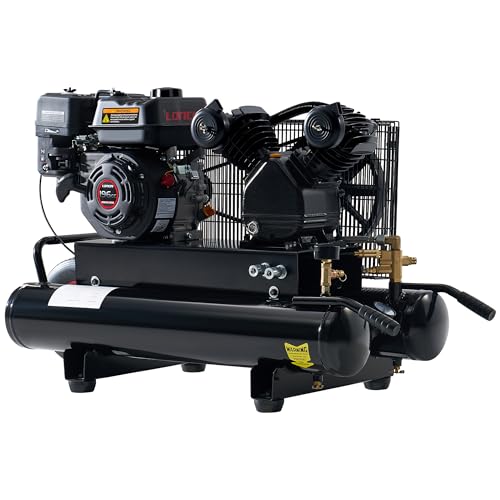
Albott 6.5HP 8-Gallon Gas Air Compressor
Built for off-grid job sites, this gas-powered unit delivers reliable pneumatic power with a 6.5 HP engine and a two-cylinder cast iron pump. Dual air outlets let two operators run tools simultaneously without depending on electrical hookups.
Pros
- Rugged cast iron pump and frame construction
- Dual air outlets support two simultaneous tools
- Gas-powered design eliminates need for electrical outlets
- Automatic safety valve ensures steady pressure management
Cons
- Very heavy at 166 pounds
- Modest 115 PSI maximum working pressure
- Substantial footprint requires ample vehicle cargo space
Ipflin 160 PSI Portable Tire Inflator and Air
The Ipflin portable air compressor provides up to 160 PSI and 30 L/min airflow with a built-in 9600mAh battery and 12V DC vehicle backup. It is an ideal emergency inflator for motorists, garage DIYers, and cyclists who need quick tire pressure adjustments without hauling a heavy air tank.
Pros
- True dual-power flexibility allows cordless battery operation or direct 12V DC automotive corded power during roadside emergencies
- High 160 PSI maximum pressure rating handles high-pressure bike tires, trailer tires, and passenger vehicle inflation
- Automatic shutoff system prevents over-inflation by stopping airflow as soon as the preset pressure target is reached
- Built-in 9600mAh battery eliminates the need for separate external power tool batteries or standalone chargers
Cons
- High-pressure tire inflator design is strictly intended for inflation and cannot operate pneumatic tools like brad nailers or air ratchets
- Cordless lithium-ion battery requires periodic top-off charging during storage to maintain emergency readiness
- Continuous inflation runtime is capped at 30 minutes before requiring a short cool-down period
Joltekon VP20 5000A Jump Starter & Compressor
Packing a robust 5000A peak current and an integrated 150 PSI air pump, the Joltekon VP20 easily handles large gas and diesel engines alongside routine tire care. Its clear 3.3-inch display and multi-mode emergency light make it a versatile roadside companion for long commutes.
Pros
- Strong 5000A output starts large gas and diesel engines
- Built-in 150 PSI compressor includes auto-shutoff function
- Clear 3.3-inch LCD provides easy-to-read operational status
- Ten integrated safety protections guard against sparks and overheating
Cons
- Wall power adapter is not included in the box
- Operates exclusively with standard 12V vehicle battery systems
- Turning off the flashlight requires a three-second button hold
MZB MZB-1100H-50 13.2-Gallon Air Compressor
Designed for indoor workshops and residential garages, this compressor keeps operating noise down to a manageable 70 decibels. Its 13.2-gallon steel tank and wheeled frame suit DIY woodworkers, painters, and mechanics needing reliable airflow without regular pump maintenance.
Pros
- Quiet 70dB sound level ideal for indoor spaces
- Maintenance-free oil-free pump design
- Large 13.2-gallon durable steel tank
- Wheels and handle make transport manageable
Cons
- Hefty 72-pound weight makes vehicle loading difficult
- 115 PSI maximum pressure is modest for heavy-duty pneumatic tools
OlarHike Dual-Power Tire Inflator
Equipped with both an internal 9000mAh battery and a 12V car adapter, this portable compressor delivers dependable inflation for standard cars, SUVs, and bicycles. Its clear digital screen and automatic shut-off simplify pressure checks, though vehicle pressure tops out at 51 PSI.
Pros
- Flexible dual power via battery or 12V cord
- Auto shut-off prevents over-inflation errors
- Doubles as an emergency power bank and flashlight
- Lightweight, compact footprint fits easily in trunks
Cons
- Maximum vehicle pressure is limited to 51 PSI
- Not compatible with heavy-duty trucks or RVs
- Recharging requires specific low-power 5V adapters
OlarHike Portable Tire Inflator Air Compressor
The OlarHike Portable Tire Inflator delivers dependable dual-power flexibility using three internal 2000mAh batteries or an included 12V DC vehicle adapter, topping off standard car tires in under a minute with digital auto shut-off precision. It is an ideal glovebox or trunk companion for drivers, cyclists, and DIY garage owners needing quick tire maintenance without hauling heavy shop tanks.
Pros
- Dual power versatility provides cordless portability alongside standard 12V vehicle cord backup
- Digital display with target pressure auto-shutoff helps avoid guesswork and over-pressurization
- Compact 1.2-pound handheld design stows effortlessly in door pockets, glove boxes, or backpacks
- Built-in LED work light and power bank USB output offer practical utility during nighttime roadside stops
Cons
- Operating threshold tops out at 51 PSI for automotive tires, making it unsuitable for commercial trucks, heavy-duty pickups, or RVs
- Compact piston displacement is designed for tire top-offs rather than driving pneumatic shop tools or framing nailers
- Requires a dedicated 5V 2A or 3A charging adapter (not included) to properly recharge the internal lithium cells
OlarHike 12000mAh Cordless Tire Inflator
The OlarHike Heavy Duty Tire Inflator is a compact 3.2-pound mobile air compressor featuring a twin-cylinder motor, integrated 12,000mAh battery, and 12V DC vehicle adapter. It provides rapid roadside inflation with auto-shutoff convenience, making it a dependable emergency tool for drivers, mechanics, and off-roaders.
Pros
- Twin-cylinder pump configuration delivers faster inflation times than typical single-piston mini inflators
- True dual-power flexibility prevents downtime by running via battery or vehicle 12V DC outlet
- Compact, lightweight 3.2-pound body offers exceptional portability without eating up cargo space
- 45W USB-C Power Delivery port provides practical utility beyond tire maintenance
- Auto-stop feature eliminates pressure guessing and prevents dangerous over-inflation
Cons
- Tankless mobile design is strictly intended for inflation and cannot operate continuous-draw pneumatic air tools
- Extended continuous runtime on large truck or RV tires will cause heat buildup that requires brief cool-down intervals
- Does not include a standard 120V AC household wall plug for direct residential outlet use
AstroAI Portable Tire Inflator Air Compressor
The AstroAI Dual Power Tire Inflator combines a 12V DC vehicle plug and 120V AC household cord, delivering up to 150 PSI for car tires and a 350 L/min high-volume mode for rafts and mattresses. It is a dependable, compact choice for garage mechanics, road-trippers, and homeowners wanting versatile inflation without needing a bulky air tank.
Pros
- Dual 12V DC and 120V AC power cords offer genuine versatility for garage benches, driveways, and roadside emergencies
- Two dedicated inflation modes handle high-pressure tires up to 150 PSI as well as high-volume camping gear at 350 L/min
- Digital auto-shutoff stops pumping once target pressure is reached, preventing accidental over-inflation
- Integrated cord and air hose storage compartments maintain a clean, compact footprint in vehicle trunks
- Dual metal motor build provides reliable output with up to 15 minutes of continuous run time per cycle
Cons
- Not designed to support heavy-duty commercial truck tires or high-volume commercial vehicle applications
- Requires a mandatory 10-minute cooling rest after 15 minutes of continuous high-pressure pumping
- Tankless electric inflator design cannot drive pneumatic air tools such as brad nailers or impact wrenches
CRAFTSMAN Dual Power Tire Inflator
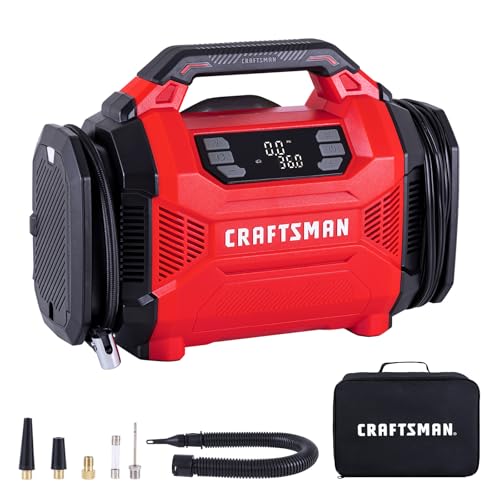
The CRAFTSMAN Dual Power Tire Inflator delivers versatile high-pressure air delivery up to 150 PSI using either a 120V AC home outlet or a 12V DC vehicle plug. Featuring digital auto shut-off presets and an integrated LED work light, it is an essential portable air solution for DIYers, garage mechanics, and road commuters.
Pros
- Dual 120V AC and 12V DC power inputs offer exceptional flexibility for both driveway maintenance and unexpected roadside flats
- Accurate digital pressure gauge with automatic shut-off prevents over-pressurizing vehicle and bicycle tires
- Capable of reaching 150 PSI, making it suitable for high-pressure road bike tires as well as passenger car tires
- Built-in LED work light enhances nighttime safety and visibility when working alongside highway traffic
- Complete package includes dedicated air hose, multiple nozzle adapters, spare fuse, and a zippered storage bag
Cons
- Tankless direct-drive mechanism is engineered for tire inflation and cannot power pneumatic air tools such as nailers or impact wrenches
- Takes longer to fill large volume leisure items like oversized air mattresses or rafts compared to dedicated high-volume blowers
- Lacks an onboard cordless tool battery dock, requiring access to an active 120V wall outlet or 12V vehicle socket
Evaluating Air Compressor Power Output: CFM, PSI, and Horsepower Explained
Determining the actual power output of an air compressor requires separating mechanical or electrical input from the pneumatic output delivered at the regulator. A motor consumes electrical current from a wall outlet or burns gasoline in a small engine, but the real pneumatic work capacity is defined by airflow volume delivered at a specific working pressure. Confusing electrical input ratings with delivered airflow is the primary reason users purchase undersized machines that fail under load. Evaluating equipment accurately means examining cubic feet per minute, pounds per square inch, and continuous mechanical ratings together.
The Core Distinction Between Power Input and Pneumatic Delivery
Electric motors and combustion engines supply input energy to turn an internal crankshaft, which moves pistons to compress ambient air inside cylinders. An electric motor might draw 15 amps of alternating current on a standard 120-volt line, or a gas engine might produce 6.5 horsepower, but that input represents raw mechanical effort rather than delivered air volume. Significant energy losses occur during compression through mechanical friction, heat generation, and valve restriction. Evaluating pneumatic performance requires focusing on the output volume discharged through the air coupler rather than simply measuring electrical wattage drawn from the wall.
Pneumatic power is fundamentally a product of volumetric flow and pressure working together. Airflow volume allows pneumatic motors to spin, while pressure provides the driving force needed to turn fasteners or drive nails into dense lumber. When either component is insufficient, pneumatic tools lose operating speed and torque. Understanding this relationship helps buyers avoid the mistake of choosing a compressor based solely on peak motor numbers.
Air Volume Delivery: Deciphering CFM and SCFM at Working Pressure
Cubic feet per minute, commonly abbreviated as CFM, measures the volume of air an air compressor discharges at a specified operating pressure. Most pneumatic tools specify their air consumption at 90 PSI, which serves as the industry standard benchmark for tools like impact wrenches, ratchets, and framing nailers. A pump delivering 4 CFM at 90 PSI can easily keep up with intermittent nailing, but continuous tools like dual-action sanders or paint sprayers often demand 8 to 15 CFM to run continuously. Checking tool specifications before choosing a compressor ensures the pump can sustain required airflow.
Manufacturers frequently list Standard Cubic Feet per Minute, or SCFM, which normalizes flow measurements to standardized atmospheric conditions. Standard conditions typically assume sea-level barometric pressure, 68 degrees Fahrenheit, and 36 percent relative humidity. Because air density decreases at higher altitudes and warmer temperatures, SCFM provides a reliable standard for comparing pneumatic performance across different models. Reviewing these figures helps buyers evaluate true pump displacement across changing environments.
Looking at air delivery across multiple pressures reveals how a pump responds to increasing working resistance. A compressor might deliver 5.0 CFM at 40 PSI, but that volume often drops to 3.5 CFM when pressure climbs to 90 PSI. Tools with high volume requirements quickly exhaust undersized compressors, leading to sudden pressure drops and interrupted work cycles. Matching tool CFM ratings with pump delivery ensures smooth, reliable pneumatic operation.
Operating Pressure: Understanding the Role of PSI in Tool Cycling
Pounds per square inch measures the concentration of force exerted by compressed air within the storage tank and distribution lines. Consumer and jobsite compressors typically provide maximum operating pressures ranging between 115 PSI and 160 PSI. Higher maximum tank pressure allows a smaller tank to store a greater mass of compressed air, creating a denser reserve that helps buffer short tool bursts. This storage density enables portable units to handle quick fastening tasks without needing massive tanks.
Maximum tank pressure must not be confused with regulated working line pressure. Fastening tools, automotive ratchets, and tire chucks typically require working pressures between 70 and 100 PSI. An adjustable pressure regulator reduces tank pressure down to the safe operating limit recommended by the tool manufacturer, protecting internal seals and mechanical components from excessive stress. Keeping line pressure properly adjusted also conserves stored air volume during extended use.
Horsepower Ratings: Continuous Running HP Versus Peak Surge Marketing
Motor horsepower ratings have long been a source of confusion due to aggressive marketing practices across consumer power equipment. In past decades, manufacturers frequently emphasized peak horsepower, which represented the brief surge power produced when a motor stalled or started under heavy load. A motor labeled as five peak horsepower might only produce 1.5 to 1.8 continuous running horsepower during standard operation. Savvy buyers ignore peak surge marketing and check the electrical amperage draw instead.
Continuous running horsepower indicates the sustainable mechanical output an electric motor can generate indefinitely without overheating or tripping an electrical breaker. Standard 120-volt household circuits equipped with 15-amp breakers can realistically support up to approximately 2.0 continuous running horsepower under ideal conditions. Any consumer compressor claiming five or six horsepower from a standard household outlet is citing surge capacity rather than true operational power. Reliable sizing starts with acknowledging the physical limits of residential branch circuits.
Power Platforms: Gas Engines, AC Electric Motors, and 12V DC Inflators
Compressors utilize several distinct power platforms to meet different portability and performance requirements. Compact portable tire inflators rely on 12V direct-current power supplies or integrated rechargeable lithium batteries. These lightweight units use high-speed miniature motors designed to reach pressures up to 150 or 160 PSI, delivering precise airflow measured in liters per minute for vehicle tires and sports equipment. Their design prioritizes glovebox storage and roadside convenience over heavy air tool operation.
Mid-sized garage compressors run on standard 120-volt household electricity, driving oil-free dual-piston or oil-lubricated pumps connected to steel storage tanks. A 13.2-gallon quiet workshop compressor operates at around 115 PSI with noise levels suppressed to approximately 70 decibels, using low-RPM motors to minimize garage sound levels while supplying steady air for carpentry and light automotive maintenance. These electric units offer a clean, reliable balance of air delivery and residential convenience. They plug into standard outlets and require minimal electrical modification.
Gas-powered jobsite compressors, such as an 8-gallon unit equipped with a 6.5 horsepower engine, deliver genuine continuous mechanical power on remote work sites. Gasoline engines avoid the strict amperage limits of household electrical wiring, allowing heavy cast-iron pumps to operate at high displacement rates. Dual air outlets on these machines let contractors run multiple framing nailers simultaneously. This makes gas equipment the standard choice for exterior construction where grid power is unavailable.
Air Tank Reserves and Their Impact on Usable Pneumatic Output
The air receiver tank acts as a mechanical energy reservoir, storing compressed air until connected tools call for flow. A direct-drive inflator without an air tank must generate all delivered air in real time, restricting its use to inflation tasks where low continuous flow is acceptable. When a storage tank is present, the compressor can discharge air at a rate much higher than the pump can produce, provided the tool draw is intermittent. This storage buffer allows smaller pumps to operate demanding tools during short bursts.
Tank size dictates how long a high-demand air tool can run before working line pressure collapses below the required threshold. An intermittent tool like a brad nailer consumes small bursts of air that an 8-gallon or 6-gallon tank can buffer without frequent motor cycling. If you connect a continuous-draw tool such as a rotary sander or high-volume paint sprayer, the air tank quickly depletes, forcing the pump to run nonstop without regaining cut-out pressure. Sizing the tank to match tool consumption patterns prevents frustrating workflow interruptions.
Pump Mechanics: Single-Stage, Two-Stage, and Cylinder Design
Pump architecture determines compression efficiency, thermal management, and volumetric output over time. Single-stage compressors draw atmospheric air into a cylinder and compress it directly to final tank pressure in one piston stroke. Single-stage designs are common in portable consumer and jobsite compressors, delivering operating pressures up to 135 or 150 PSI for general trim work and tire maintenance. They offer compact dimensions and straightforward mechanical maintenance.
Two-stage compressors divide compression between two cylinders of different sizes connected by a finned intercooler line. The larger cylinder performs initial compression before routing cooled air into the smaller cylinder, which compresses it to final tank pressures reaching 175 PSI. This multi-stage process reduces compression heat, improves volumetric efficiency, and provides greater air density for demanding commercial workshop systems. The lower thermal stress also extends pump cylinder and valve reed life.
Duty Cycle Limits and Thermal Overload Management
Compressor power output is limited by thermal duty cycle ratings, which specify the proportion of time a pump can operate safely within a given time frame. A compressor with a 50 percent duty cycle should run for no more than five minutes out of every ten, spending the remaining time cooling down to dissipate heat. Exceeding rated duty cycles causes internal temperatures to spike, which degrades lubricant and accelerates valve reed fatigue. Respecting these operational limits keeps the pump performing reliably over years of service.
Commercial compressors and gas-driven models are often engineered for 70 to 100 percent continuous duty, supported by cast-iron cooling fins, large fan blades, and oil reservoirs that dissipate heat. Conversely, compact 12V portable tire inflators feature duty cycles limited to 15 to 30 minutes of continuous runtime, requiring cool-down periods between extended tire inflation tasks. Built-in thermal overload protection switches protect motors by disconnecting electrical power when internal operating temperatures exceed safe limits. Allowing overheated units to cool completely before restarting prevents permanent motor insulation damage.
Electrical Considerations: Running Amps, Inrush Current, and Voltage Drop
Electric compressor output depends directly on the stability of the electrical circuit powering the motor. When an electric motor starts against internal head pressure, it draws a momentary surge known as inrush current, which can reach three to five times its continuous running amperage. On a standard 120-volt, 15-amp household circuit, this electrical spike can cause circuit breakers to trip or workshop lights to dim. Installing a dedicated 20-amp branch circuit wired with heavy-gauge conductors resolves most cold-start tripping issues.
Running a compressor on a lightweight extension cord causes noticeable voltage drop between the wall outlet and the motor. Low operating voltage forces the motor to draw higher current to generate required starting torque, leading to motor overheating, sluggish pump speed, and blown fuses. Workshop owners can prevent voltage drop issues by plugging the compressor directly into a wall receptacle and extending air hoses rather than electrical cords. Pressure loss across a 50-foot air hose creates zero electrical hazards and protects motor longevity.
Calculating Tool Air Consumption to Match Compressor Output
Selecting an air compressor with adequate power output requires auditing the air volume demands of your specific tools. Begin by identifying the tool that consumes the highest CFM at 90 PSI, noting whether that tool operates intermittently or continuously. Fastening tools like brad nailers and framing guns consume brief bursts of air, whereas die grinders, orbital sanders, and paint sprayers demand constant airflow throughout operation. Calculating these requirements in advance prevents purchasing an undersized unit that stalls during critical tasks.
A practical guideline is to select a compressor that delivers at least 1.25 times the CFM rating of your highest-demand tool. If an automotive spray gun requires 6 CFM at 40 PSI, the compressor should deliver at least 7.5 CFM at that pressure to avoid mid-job pressure drops. If multiple operators will draw air simultaneously from a dual-outlet manifold, individual tool air requirements must be combined to calculate total demand. Factoring in adequate capacity headroom ensures consistent air pressure under varying workshop workloads.
Routine Maintenance to Preserve Pneumatic Power Output
Maintaining consistent compressor power output requires regular, straightforward maintenance practices. Atmospheric air contains humidity that condenses inside the receiver tank during the compression cycle. If moisture is allowed to accumulate, it reduces usable air storage volume, accelerates internal tank corrosion, and carries rust particles into connected air tools. Draining the receiver tank after every operating session using the bottom drain valve purges trapped moisture and protects storage capacity.
Quarter-turn brass ball valves make regular draining fast and simple compared to stiff threaded petcocks that can seize or clog over time. Additionally, inspecting and cleaning the air intake filter ensures the pump draws an unrestricted volume of air, maintaining high volumetric efficiency. Checking air regulators, safety relief valves, and quick-connect couplers prevents subtle leaks that cause unnecessary pump cycling. Performing routine visual inspections keeps air delivery strong and extends the operational lifespan of your pneumatic equipment.
About the author
Bob Beacham is an experienced tools and workshop writer with deep knowledge of power equipment, mechanical systems, and practical DIY applications. His coverage of air compressors, welding equipment, saws, and workshop tools helps translate technical specifications into useful guidance for homeowners and serious DIYers.