
What Viscosity Is Air Compressor Oil: A Practical Guide for 2026
Understand what viscosity is air compressor oil for your workshop pump in October 2026, comparing ISO grades, SAE ratings, and synthetic blends.
 By Tom Scalisi
Updated October 8, 2026
By Tom Scalisi
Updated October 8, 2026
Sluggish pump startup in an unheated workshop or excessive valve carbonization often traces back to pouring the wrong lubricant into a compressor crankcase. Unlike internal combustion automobile engines that rely on high-detergent multi-grade motor oils, stationary and portable reciprocating air pumps require specialized lubrication to manage severe compression heat, prevent mechanical friction, and maintain proper cylinder sealing. Home mechanics, woodworkers, and automotive technicians frequently ask what viscosity is air compressor oil when establishing preventative maintenance routines or preparing for seasonal climate changes. Choosing the correct weight ensures that splash-lubricated dippers atomize oil effectively without creating excessive fluid drag on the electric motor during startup.
Selecting the proper fluid depends largely on pump engineering, ambient operating temperatures, and manufacturer guidelines. Using an improper viscosity can lead to rapid valve-plate carbon accumulation, blown head gaskets, or hard starting that repeatedly trips household circuit breakers. Understanding how standard viscosity ratings correlate across industrial and automotive grading scales is essential for protecting your equipment and maximizing the operational lifespan of your air tools and compressor pump.
| Award | Product | ACR Score About ACR ScoreThe ACR Score is our own rating from 0 to 10, based on performance, design and build, ease of use, and value. It reflects independent research and is never influenced by manufacturers, retailers, or affiliate commissions. Learn more › | |
|---|---|---|---|
| Best Overall |
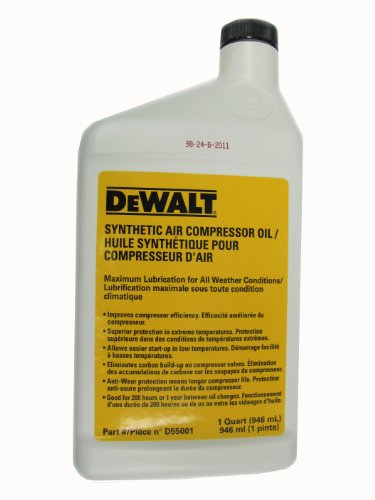
DeWalt D55001 1-Quart Compressor Oil
|
9.1/10 | Buy |
| Best Budget |
 Valvoline Non-Detergent SAE 30 Motor Oil
|
8.9/10 | Buy |
| Best Premium |
 Compressed Air USA XL 8000-Hour Oil, 1 Gal
|
8.9/10 | Buy |
| Best Value |
 TRIAX Kompressor ISO 46 SAE 20 Full Synthetic Air
|
8.8/10 | Buy |
 Ingersoll Rand All Season Select Lubricant, 1L
|
8.6/10 | Buy | |
 Mobil Rarus 427 ISO 100 Compressor Oil, 1 Qt
|
8.3/10 | Buy | |
 Silentaire Synthetic Compressor Oil, 24 oz
|
8.0/10 | Buy |
DeWalt D55001 1-Quart Compressor Oil
Formulated for regular air compressor maintenance, the DeWalt D55001 comes in a handy one-quart bottle to keep pump components operating smoothly. It is a solid choice for workshops and job sites running oil-lubricated compressors that require dedicated manufacturer-grade fluid.
Pros
- Convenient 1-quart size for routine maintenance
- OEM formulation from an established tool brand
- Compact bottle design stores easily
Cons
- Not applicable for oil-free compressor models
- May require multiple bottles for high-capacity industrial tanks
Valvoline Non-Detergent SAE 30 Motor Oil
Tailored for specialized equipment, this SAE 30 formulation uses oxidation inhibitors to prevent fluid thickening and minimize deposit buildup. It delivers dependable wear defense for air compressors, older engine designs, and hydraulic systems requiring non-detergent lubricant.
Pros
- Durable anti-wear additives provide long-lasting component protection
- Enhanced oxidation control prevents fluid thickening
- Helps minimize deposit formation in critical areas
- Compatible with various compressors and vane pumps
- Meets API SB and Denison HF-2 requirements
Cons
- Restricted to equipment requiring non-detergent fluid
- Straight SAE 30 weight lacks multi-grade cold versatility
- API SB rating is not for modern automotive engines
Compressed Air USA XL 8000-Hour Oil, 1 Gal
Formulated for rotary screw compressors, this synthetic blend delivers up to 8,000 hours of service life at elevated discharge temperatures. It mixes directly with existing OEM or aftermarket lubricants, eliminating the need for a full system drain before topping off.
Pros
- Long 8,000-hour service life under normal discharge heat
- No drain or flush required for system top-offs
- Broad compatibility with OEM and aftermarket equivalents
- Protects against wear, varnish, and moisture buildup
- Non-toxic and non-hazardous formulation
Cons
- Synthetic blend rather than a pure synthetic base
- Designed specifically for rotary screw air compressors
- One-gallon container may require multiple bottles for large units
TRIAX Kompressor ISO 46 SAE 20 Full Synthetic Air
TRIAX Kompressor ISO 46 SAE 20 is a commercial-grade, full-synthetic non-detergent lubricant engineered for oil-lubricated reciprocating, rotary screw, and vane air compressors. It provides reliable extreme-temperature wear protection and multi-viscosity all-season performance, making it an excellent maintenance choice for auto shops, contractors, and home garage workshops.
Pros
- Full synthetic non-detergent formulation extends pump life across severe operating conditions
- True all-season multi-viscosity rating maintains fluid flow from -49 deg F up to 140 deg F+
- Formulated to lower operating temperatures by up to 30% and eliminate oil vapor odor
- Compatible with a wide array of compressor pumps including reciprocating and rotary screw designs
Cons
- Not formulated for oil-free air compressors, breathing air systems, oxygen setups, or LPG gas pipelines
- Users must verify whether their pump manufacturer specifically calls for ISO 46 (SAE 20) rather than heavier ISO 68 or ISO 100 weights
- Requires careful manual crankcase draining and filling without an included pour spout
Ingersoll Rand All Season Select Lubricant, 1L
Engineered as an all-weather OEM fluid, this synthetic lubricant protects reciprocating compressors during continuous duty while resisting carbon buildup on critical valves. It is a solid pick for equipment owners who want fewer oil changes and reliable year-round operation.
Pros
- Maintains stable viscosity in hot and cold seasons
- Lasts four times longer than petroleum oil
- Keeps valves and rings free of carbon deposits
- Protects bearings under continuous duty cycles
Cons
- Formulated specifically for reciprocating compressor systems
- One-liter bottle requires buying multiples for large pumps
Mobil Rarus 427 ISO 100 Compressor Oil, 1 Qt
Mobil Rarus 427 provides an ISO 100 viscosity grade lubricant designed for compressor applications. Packaged in a 1-quart container and made in the United States, it suits routine automotive and shop maintenance jobs.
Pros
- Convenient 1-quart volume for routine top-offs
- Standard ISO 100 viscosity formulation
- Manufactured in the United States
- Lightweight and easy to store
Cons
- Limited 1-quart volume for large compressor reservoirs
- ISO 100 viscosity is not universally compatible with all compressors
Silentaire Synthetic Compressor Oil, 24 oz
Silentaire offers this 24-ounce synthetic lubricant to keep compatible air compressors operating smoothly. The container includes a dedicated pouring tip and cap to assist with clean, precise refills during maintenance.
Pros
- Special pouring tip enables neat dispensing
- Included cap seals bottle securely
- Synthetic formulation suited for compressor upkeep
- Convenient 24-ounce size for standard maintenance
Understanding Air Compressor Oil Viscosity and Pump Lubrication
Determining the right lubricant viscosity is one of the most critical maintenance steps for any oil-lubricated air compressor. For the vast majority of reciprocating piston air compressors, manufacturers specify an oil viscosity of either ISO 100, which corresponds roughly to an SAE 30 weight, or ISO 68, which matches an SAE 20 weight. Rotary screw compressors, by contrast, feature tighter internal tolerances and continuous oil-injection cycles, typically demanding thinner fluids such as ISO 32 or ISO 46. Pouring the correct fluid preserves the hydrodynamic oil film between moving metal components while keeping operating temperatures within safe limits.
Standard Viscosity Ratings for Reciprocating and Rotary Compressors
Reciprocating piston compressors rely primarily on splash lubrication, where a connecting rod dipper splashes oil onto cylinder walls, wrist pins, and crankshaft bearings. In these splash-lubricated pumps, ISO 100 non-detergent oil, equivalent to SAE 30, represents the historical standard for moderate to warm operating environments. This viscosity provides sufficient film strength to cushion heavy reciprocating loads and seal the gap between the piston rings and cast-iron cylinder walls. When ambient shop temperatures remain between 40 degrees and 100 degrees Fahrenheit, an ISO 100 fluid delivers stable thermal resistance and steady compression output.
When operating in colder conditions below 40 degrees Fahrenheit, an ISO 100 fluid can become overly thick and sluggish. This increased fluid thickness creates severe viscous drag against the pump crankshaft, frequently causing the electric motor to draw excessive startup inrush amperage and trip standard 15-amp or 20-amp breakers. In unheated winter garages or cold jobsites, switching to an ISO 68 compressor oil, equivalent to SAE 20, allows the pump to turn over smoothly and reach operating speed without motor stalling. Rotary screw compressors require an entirely different approach because they circulate fluid through internal cooling circuits, filtration canisters, and air-oil separator elements, where lighter ISO 32 or ISO 46 oils flow rapidly to prevent localized cavitation.
Decoding Viscosity Scales: ISO Viscosity Grades Versus SAE Ratings
Confusion surrounding compressor oil viscosity frequently stems from the coexistence of two distinct measurement systems. Industrial lubricants follow the International Organization for Standardization Viscosity Grade system, commonly abbreviated as ISO VG, which measures kinematic viscosity in centistokes at exactly 40 degrees Celsius. In contrast, automotive engine oils utilize the Society of Automotive Engineers grading system, which evaluates fluid flow across both low-temperature cranking and high-temperature operating thresholds. Because compressor pumps do not experience internal fuel combustion, industrial ISO grading offers a more consistent benchmark for pneumatic equipment.
Translating between these scales helps operators select the correct fluid when a manual specifies one standard and the bottle displays another. An ISO 32 lubricant aligns closely with an SAE 10W automotive oil, while an ISO 46 grade corresponds to an SAE 15 or light SAE 20 fluid. Moving up the scale, an ISO 68 compressor lubricant equates to a standard SAE 20 weight, and an ISO 100 product matches an SAE 30 weight. Industrial single-stage and two-stage reciprocating pumps almost universally call for ISO 68 or ISO 100, ensuring the oil possesses adequate body at operating temperature without creating unnecessary pumping losses.
Relying on multi-grade automotive labels like 5W-30 or 10W-40 can introduce severe complications inside a compressor pump crankcase. Multi-viscosity automotive oils contain polymeric viscosity index improvers that shear down mechanically under the intense shearing forces encountered in a reciprocating air compressor. Once these polymer chains break down under high mechanical shear, the base oil thins out prematurely, leaving critical bearing surfaces vulnerable to metal-to-metal contact during extended run cycles. Sticking to straight-grade industrial ISO lubricants or dedicated synthetic compressor fluids avoids this rapid viscosity degradation.
Why Non-Detergent Chemistry Matters More Than Viscosity Alone
Viscosity alone does not determine whether an oil is safe for pneumatic pump service. The presence or absence of detergent additives represents the most crucial chemical distinction between automotive motor oil and genuine compressor lubricant. Standard automobile engine oils contain aggressive detergent packages formulated to scavenge combustion soot, hold contaminants in continuous suspension, and transport debris to a replaceable full-flow oil filter. In a vehicle engine, this suspension prevents sludge from settling into quiet oil galleys.
Most portable and workshop reciprocating air compressors lack a full-flow pressurized oil filter. In a splash-lubricated sump, detergent oil keeps atmospheric dust, wear metals, and condensed ambient water suspended throughout the fluid rather than allowing them to settle harmlessly to the bottom of the crankcase. This suspended moisture forms a milky emulsion that degrades lubricity and accelerates bearing pitting. Furthermore, detergent additives tend to froth under rapid crankshaft agitation, creating air bubbles that collapse under load and leave bearing surfaces temporarily unlubricated.
Extreme discharge heat creates another severe hazard when detergent oils enter a compressor pump. As air is compressed to 135 PSI or 175 PSI, discharge temperatures inside the cylinder head can exceed 300 degrees Fahrenheit. Detergent compounds bake onto hot reed valves, valve plates, and discharge ports, creating brittle, hardened carbon deposits. These carbon crusts prevent the thin steel reed valves from seating cleanly, leading to compressed air blow-by, excessive pump cycle times, severe overheating, and eventual valve breakage. A genuine non-detergent compressor oil resists carbonization and allows water condensation to separate cleanly at the base of the sump.
Ambient Operating Temperatures and Seasonal Viscosity Selection
Ambient climate plays a dominant role in determining how oil behaves inside a compressor crankcase. Liquid lubricants naturally thicken as temperatures decline, which increases the torque required to spin the pump flywheel during initial startup. When an operator attempts to run a compressor filled with heavy ISO 100 oil in a freezing garage, the electric motor draws massive inrush current to overcome cold fluid drag. This high current draw frequently trips the branch circuit breaker or activates the motor internal thermal overload switch before the tank reaches cut-out pressure.
For operations exposed to cold ambient conditions between 32 degrees and 50 degrees Fahrenheit, transitioning to an ISO 68 or SAE 20 non-detergent oil reduces initial rotational resistance. The lower viscosity allows the dippers to distribute fluid across cylinder walls immediately, preventing dry-start wear on the connecting rod journal. Once the compressor runs for several minutes, compression friction naturally warms the pump casting, but starting with a lighter fluid prevents electrical circuit overloads during the crucial initial revolutions.
In high-temperature summer environments or enclosed utility sheds where temperatures exceed 90 degrees Fahrenheit, oil thins out considerably under continuous duty cycles. Under severe heat, an undersized or lightweight fluid can drop below its minimum required film thickness, resulting in micro-welding between piston rings and the cylinder bore. In sustained hot climates, using an ISO 100 or SAE 30 oil provides the necessary thermal reserve to maintain adequate hydrodynamic separation. Operators working across multiple seasons often find that high-performance synthetic lubricants resolve this dilemma by maintaining stable flow across broad thermal spectrums.
Mineral-Based Blends Versus Full Synthetic Compressor Lubricants
Standard mineral-based compressor lubricants are refined directly from crude petroleum stocks and blended with anti-wear and anti-oxidation additives. These conventional non-detergent oils provide cost-effective protection for light-duty hobbyists, tire inflation tasks, and intermittent trim carpentry where the pump runs for brief intervals. However, petroleum-based oils have limited oxidation lifespans, typically requiring complete crankcase drainage and replacement every 100 to 300 operating hours to prevent sludge formation and viscosity breakdown.
Full synthetic compressor lubricants utilize chemically synthesized base stocks, such as polyalphaolefins or synthetic esters, engineered specifically for high thermal stability. Synthetics exhibit a significantly higher viscosity index, meaning their viscosity changes far less across temperature extremes compared to standard mineral oils. A quality synthetic fluid flows readily during freezing winter mornings yet maintains robust film strength during high-pressure continuous sandblasting or automotive paint spraying. Synthetics also feature elevated flash points, which substantially lowers the risk of oil vapor ignition in high-pressure discharge piping.
Service life represents another distinct advantage of synthetic formulations over mineral alternatives. While conventional petroleum oils darken and oxidize rapidly under heat, synthetic fluids resist varnish formation and valve lacquering over extended run intervals. Many industrial synthetic lubricants offer operating lifespans between 2,000 and 8,000 hours under rated discharge temperatures. For busy automotive restoration shops and commercial fabrication bays, the extended drain interval reduces maintenance downtime and minimizes the volume of hazardous waste oil requiring disposal.
Analyzing Specific Lubricant Formulations and Applications
Examining common market options illustrates how viscosity and chemical formulation align with specific compressor architectures. For general workshop reciprocating units, DEWALT Compressor Oil, 1-Quart (D55001) provides a dedicated reciprocating formulation engineered to protect portable contractor pumps and stationary cast-iron pumps. Its balanced viscosity facilitates smooth splash lubrication across typical construction jobsite environments, helping contractors avoid startup hiccups when framing or installing trim.
For budget-conscious garage owners and vintage machinery restoration, Valvoline Daily Protection Non-Detergent 30 Oil 1 offers a dependable mineral-based SAE 30 formulation. Meeting API SB standards, this oil contains targeted anti-wear additives without detergents, making it well suited for older splash-lubricated reciprocating pumps, hydraulic cylinders, and light industrial equipment where non-detergent chemistry is mandatory. It resists thermal thickening and prevents sludge formation when changed at manufacturer-recommended intervals.
Demanding industrial applications requiring continuous duty cycles demand specialized synthetic engineering. The TRIAX Kompressor ISO 46 SAE 20, Full Synthetic demonstrates how modern multi-viscosity synthetic fluids serve severe-duty applications across rotary screw, vane, and reciprocating systems. Its advanced formulation maintains fluid film durability from sub-zero Arctic conditions up to high operational heat, effectively eliminating the need for seasonal oil swaps while actively repelling water condensation. In rotary screw compressors operating under continuous factory loads, Premium 8000 Hour Rotary Screw Air Compressor lubricating oil from CompressedAirUSA provides an extended-life synthetic blend engineered to withstand high discharge temperatures without carbon or varnish formation.
Reciprocating shop compressors benefit equally from purpose-built synthetic fluids. The Ingersoll Rand All Season Select Synthetic Air lubricant represents an all-temperature synthetic blend designed specifically to hold viscosity across hot summers and cold winters. Formulated to resist valve carbonization and wear on cylinder walls under continuous loads, this OEM lubricant is rated for up to four times the operational life of conventional petroleum oil. For high-pressure reciprocating units demanding an ISO 100 viscosity grade, Mobil – 100870 Rarus 427, Compressor, 1 qt, ISO100 provides exceptional thermal stability and deposit resistance. Specialty medical, dental, and art studio setups utilize ultra-quiet hermetic pumps, where Silentaire Compressor Oil delivers the tailored synthetic lubrication necessary for sealed, whisper-quiet motor assemblies.
Symptoms of Incorrect Viscosity in Compressed Air Systems
Recognizing the warning signs of incorrect oil viscosity helps prevent catastrophic mechanical failure before costly pump damage occurs. When the oil inside a compressor crankcase is excessively viscous, the most immediate symptom is electrical distress during startup. The electric motor will hum loudly, struggle to reach operational RPM, and frequently blow fuses or trip circuit breakers. Internally, thick oil cannot easily navigate past connecting rod clearances, leaving upper wrist pins and cylinder walls momentarily starved of lubrication while the pump runs under heavy startup load.
Conversely, operating a compressor with oil that is too thin produces subtle but severe long-term wear. An undersized viscosity rating fails to maintain boundary layer separation between piston rings and cast-iron cylinder walls under full operating pressure. Operators may notice increased metallic clatter, higher pump operating temperatures, and accelerated oil consumption. When thin oil slips past the compression rings, it vaporizes in the discharge stream, leading to excessive oil carryover that fouls pneumatic hoses, clogs pressure regulators, and ruins automotive paint finishes.
Monitoring the appearance and odor of the oil provides vital diagnostic clues regarding pump health. If the lubricant turns dark black and emits a sharp acrid or burned smell, the fluid has exceeded its thermal breakdown threshold, indicating an insufficient viscosity or an overextended duty cycle. If the oil takes on a creamy, opaque, or milky appearance, condensed atmospheric water has emulsified within the sump. Emulsification indicates that the compressor is not running long enough to reach full operating temperature or that a detergent oil was mistakenly added to the pump.
Safe Maintenance Procedures: Checking, Draining, and Refilling Pump Oil
Maintaining proper oil level and viscosity requires simple, methodical shop procedures. Always begin by shutting down the compressor, disconnecting electrical power from the wall outlet or breaker panel, and opening the tank drain valve to depressurize the air receiver completely. Never service oil plugs, sight glasses, or crankcase breathers while the air receiver or pump head holds stored pneumatic pressure. Wear suitable safety glasses to protect against accidental fluid splashes or residual air bursts.
Check the oil level through the clear crankcase sight glass before every major operating session. On most modern reciprocating pumps, the proper resting oil level sits squarely in the center of the sight glass, marked by a printed red bullseye or dot. If the compressor utilizes a dipstick rather than a sight glass, ensure the level rests between the designated crosshatched fill marks without exceeding the upper limit. Overfilling the crankcase causes the connecting rod dippers to churn the oil into froth, which drastically reduces lubricating efficacy and drives excess oil past the piston rings into the air lines.
When changing pump oil, running the compressor for five to ten minutes beforehand warms the fluid, allowing suspended contaminants and accumulated water to drain out swiftly. Place a dedicated catch pan beneath the crankcase drain plug, remove the breather cap on top to vent the sump, and unthread the drain fitting completely. Inspect the drained fluid for fine metallic flakes or water separation before reinstalling the drain plug with fresh thread sealant. Refill slowly through the top breather port using a clean funnel, allowing air bubbles to settle until the fluid rests precisely at the midpoint of the sight glass. Following these steps and matching the correct ISO or SAE viscosity to your operational environment ensures consistent air delivery, protects critical pump components, and extends the working life of your pneumatic equipment.
About the author
Tom Scalisi brings more than two decades of experience in construction, building maintenance, contracting, and hands-on tool use. His practical understanding of power tools, automotive work, repairs, and jobsite equipment helps readers evaluate compressors based on real workloads rather than specifications alone.