
How Big of an Air Compressor Do I Need: Sizing Guide for 2026
Determining how big of an air compressor do i need depends on tool CFM and tank size. Match your garage tools and air demands for October 2026.
 By Tony Carrick
Updated October 7, 2026
By Tony Carrick
Updated October 7, 2026
Pneumatic tools quickly lose torque and stall when an air supply cannot deliver enough volume under continuous operating pressure. Running a high-demand sander or paint sprayer on an undersized motor causes severe line pressure drop, forcing the pump to cycle nonstop while the air tank struggles to recover. Homeowners, woodworkers, and automotive enthusiasts often wonder how big of an air compressor do i need to power their specific workshop equipment reliably. Choosing the right setup requires balancing delivered CFM at 90 PSI, storage tank capacity, and electrical circuit capacity to prevent tripped household breakers.
Small inflation jobs and intermittent finish nailers draw minimal air volume, functioning smoothly on compact, portable tanks drawing under ten amps. In contrast, heavy-duty automotive impact wrenches, rotary grinders, and dual-action sanders require substantial continuous airflow and larger storage buffers. Evaluating actual tool consumption alongside pump motor horsepower, operating decibels, and recovery speed ensures smooth operation across different jobs. A properly matched compressor maintains consistent working pressure, prevents premature pump fatigue, and keeps workshop noise manageable during demanding projects.
| Award | Product | ACR Score About ACR ScoreThe ACR Score is our own rating from 0 to 10, based on performance, design and build, ease of use, and value. It reflects independent research and is never influenced by manufacturers, retailers, or affiliate commissions. Learn more › | |
|---|---|---|---|
| Best Overall |
California Air Tools 20040C 20-Gallon Compressor
|
9.2/10 | Buy |
| Best Budget |
 California Air Tools CAT-4610S Ultra-Quiet 1.0 HP
|
9.1/10 | Buy |
| Best Value |
 California Air Tools 4620AC 2.0 HP Ultra-Quiet Air
|
8.1/10 | Buy |
| Best Premium |
 California Air Tools 20015HP 20-Gallon Quiet Air
|
8.1/10 | Buy |
 BUNKER INDUST 12V Off-Road Air Compressor
|
8.0/10 | Buy | |
 California Air Tools 20020 Ultra-Quiet 2.0 HP
|
7.8/10 | Buy |
California Air Tools 20040C 20-Gallon Compressor
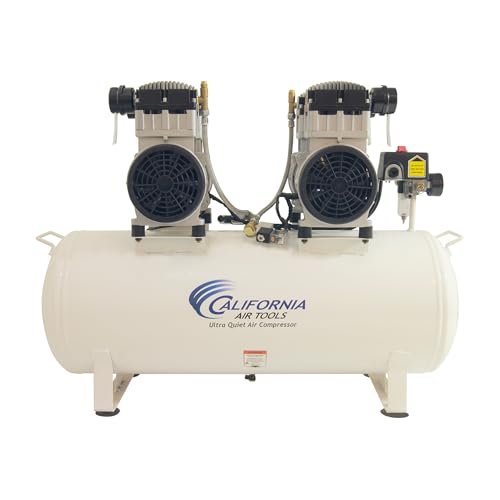
Built for workshops needing serious airflow without extreme noise, this unit pushes 10.60 CFM at 90 PSI while maintaining a moderate 75 dB sound level. Its oil-free dual-piston pump and 20-gallon steel tank handle demanding air tools smoothly, provided you have a 220V power supply.
Pros
- Quiet 75 dB output for enclosed shops
- Strong 10.60 CFM delivery at 90 PSI
- Low-maintenance oil-free dual piston pump design
- Extended pump life cycle exceeding 3000 hours
Cons
- Requires a 220V electrical outlet
- Heavy 140-pound weight reduces portability
- Large physical footprint demands dedicated floor space
California Air Tools CAT-4610S Ultra-Quiet 1.0 HP
The California Air Tools CAT-4610S delivers a remarkably quiet 60 dB sound profile with 2.20 CFM at 90 PSI from an oil-free dual-piston pump and a 4.6-gallon steel twin tank. Drawing only 8.5 amps, it is an excellent pneumatic choice for trim carpenters, woodworkers, and garage hobbyists working in noise-sensitive spaces.
Pros
- Ultra-quiet 60 dB sound level allows normal conversation while the pump runs
- Low 8.5-amp electrical draw prevents nuisance circuit breaker trips on 110V household lines
- Oil-free dual-piston pump requires no crankcase oil changes and boasts a 3000-plus hour life cycle
- Durable 4.6-gallon steel twin-tank configuration delivers steady air storage for sequential fastening
Cons
- Rated 2.20 CFM @ 90 PSI is insufficient for continuous-demand pneumatic tools like sanders or paint sprayers
- Weighs 56.2 pounds without transport wheels, requiring a solid two-handed carry between work areas
California Air Tools 4620AC 2.0 HP Ultra-Quiet Air
Delivering an impressive 5.30 CFM at 90 PSI with an operating noise level of just 70 dB, the California Air Tools 4620AC provides robust pneumatic output without deafening workshop noise. Its 4.6-gallon aluminum twin-tank design and low-maintenance dual-piston pump make it an outstanding pick for indoor woodworkers, auto hobbyists, and finish carpenters.
Pros
- Delivers 5.30 CFM at 90 PSI, providing higher sustained airflow than standard compact pancake units
- Operates at a low 70 dB sound level that significantly reduces hearing fatigue in enclosed workshops
- Rust-resistant aluminum twin tanks reduce overall weight and prevent premature corrosion from tank moisture
- Low-RPM oil-free dual-piston pump requires no oil additions and is rated for over 3000 operating hours
- Compatible with standard 110V electrical outlets thanks to its manageable 14-amp draw
Cons
- Weighing between 64 and 68 pounds without integrated wheels, moving the unit requires dedicated two-handed lifting
- The 14-amp draw operates near the capacity of standard 15-amp household breakers during continuous running cycles
- A 4.6-gallon air reserve is not designed for continuous high-demand airflow applications like production media blasting or continuous rotary sanding
California Air Tools 20015HP 20-Gallon Quiet Air
The California Air Tools 20015HP delivers 3.80 CFM at 90 PSI with a 175 PSI maximum tank pressure and an ultra-quiet 70 dB sound profile from its low-RPM dual-piston pump. It is an ideal 20-gallon rolling workshop compressor for garage hobbyists, auto restorers, and woodworkers needing clean air without high noise levels.
Pros
- Remarkably quiet 70 dB acoustic output powered by a slow-turning 1750 RPM motor
- High 175 PSI pressure ceiling provides a substantial stored air buffer in a compact vertical footprint
- Oil-free two-stage pump design offers an extended 3000-plus hour life cycle with zero oil changes
- Low 12-amp electrical draw runs reliably on standard 110V household circuits
Cons
- Delivered 3.80 CFM at 90 PSI is limited for continuous-draw air tools such as rotary sanders or sandblasting equipment
- Heavier 113-pound dry weight requires using the transport wheels rather than manual lifting for vehicle transit
BUNKER INDUST 12V Off-Road Air Compressor
The BUNKER INDUST 12V Air Compressor delivers a listed 12.36 CFM and up to 150 PSI through a heavy-duty dual-cylinder pump engineered for rapid truck and off-road tire inflation. Equipped with digital auto-stop pressure regulation and dual quick-connect couplers, it is a practical mobile pneumatic tool for 4x4 drivers, overland travelers, and fleet owners.
Pros
- High rated airflow of 12.36 CFM drastically cuts down airing-up time on large truck and off-road tires
- Digital auto-stop control automatically shuts down pump operation at the exact target pressure
- Dual-hose configuration with T-fitting facilitates simultaneous two-tire inflation to keep pressures balanced
- Heavy-duty Anderson-style plug ensures a secure, low-resistance connection to vehicle 12V power
- Alloy cylinders with cooling fins and cleanable intake filters offer solid protection in dusty trail environments
Cons
- Tankless direct-drive pump design is not built for sustained continuous-draw pneumatic shop tools like rotary sanders or impact wrenches
- Heavy 12V current draw requires a direct battery terminal connection and cannot operate from standard vehicle accessory sockets
- Alloy cylinder heads generate noticeable surface heat during prolonged high-pressure cycles, requiring careful handling around the cooling fins
California Air Tools 20020 Ultra-Quiet 2.0 HP
The California Air Tools 20020 provides a 20-gallon air reserve powered by a low-RPM 2.0 HP motor, delivering 5.30 CFM at 90 PSI at an ultra-quiet 70 dB sound level. Featuring an oil-free dual-piston pump and a 14-amp draw on standard 110V power, it suits home garage hobbyists and woodworkers seeking quiet, dependable pneumatic volume.
Pros
- Quiet 70 dB acoustic rating makes indoor garage and residential basement operation comfortable without extreme ear fatigue
- Strong air delivery of 5.30 CFM at 90 PSI effortlessly handles finish nailers, impact wrenches, and common pneumatic garage tools
- Long-life dual-piston oil-free pump is rated for over 3,000 hours of operation with zero crankcase oil maintenance
- Low 14-amp draw is compatible with standard 110V household power under proper dedicated circuit conditions
- Vertical 20-gallon steel tank with no-flat wheels combines substantial air storage with a compact shop footprint
Cons
- At 114 pounds, loading this vertical compressor into a pickup truck bed or moving it upstairs requires two people
- Not intended for continuous-duty high-consumption tools like uninterrupted sandblasters or production rotary sanders
- The tall 45-inch vertical profile requires deliberate handling when rolling across uneven outdoor terrain
Sizing Your Air Compressor: Airflow, Tank Volume, and Power Demands
Selecting the correct air compressor size comes down to matching air production with the pneumatic tools you plan to operate. Many buyers mistakenly focus only on tank gallon capacity while overlooking cubic feet per minute, which measures actual volume output. A compressor that cannot generate enough continuous airflow leaves tools underpowered, regardless of how large the storage vessel looks. Understanding how air pressure, flow volume, and electrical limits interact helps you pick the right machine without overspending or facing frustrating work stoppages.
Understanding CFM at 90 PSI Versus Tank Capacity
Cubic feet per minute, abbreviated as CFM, represents the rate of compressed air volume delivered to a connected tool. Most pneumatic equipment specifies an air consumption rating measured at 90 pounds per square inch, which is the standard working pressure for heavy tools. Tank size, measured in gallons, acts as an air storage buffer rather than an indicator of how fast the pump generates air. If a tool consumes six CFM at 90 PSI but the compressor only delivers two CFM, the storage tank empties quickly and forces you to pause work while the motor recharges the vessel.
Storage tank capacity determines how long you can operate an air tool before the pump motor kicks in to restore system pressure. A small receiver tank cycling under heavy demand creates severe pressure fluctuations at the tool fitting. In contrast, a twenty-gallon tank provides a sustained buffer that smooths out pressure drops during short bursts of high consumption. When selecting a compressor, always prioritize the pump CFM rating first to satisfy tool volume needs, and then select tank capacity to handle your expected operating intervals.
Intermittent Fasteners Versus Continuous Air Tools
Pneumatic tools fall into two distinct air consumption categories: intermittent tools and continuous tools. Intermittent tools, such as brad nailers, framing nailers, and staplers, consume compressed air in brief, isolated pulses. A finish nailer might consume only 0.5 to 1.5 CFM at 90 PSI per firing cycle, giving a compact compressor plenty of time to replenish the receiver between actuations. A portable twin-tank unit with a modest output of 2.20 CFM at 90 PSI easily handles trim carpentry, light framing, and tire top-offs without stalling.
Continuous tools present a much steeper challenge for pneumatic systems because they demand a constant flow of high-volume air. Rotary sanders, die grinders, needle scalers, and HVLP paint spray guns draw compressed air continuously as long as the trigger remains depressed. A typical random orbital sander can easily consume six to nine CFM at 90 PSI, which quickly exhausts a compact pump and small tank. To operate continuous tools effectively, you need a heavy-duty pump that delivers at least five to ten CFM at 90 PSI paired with a substantial receiver tank.
Calculating Total Air Demand for Multi-Tool Use
Determining your required compressor capacity starts with cataloging every pneumatic tool you plan to run. Check the manufacturer specification tag or manual for each tool to find its rated CFM consumption at 90 PSI. As a practical sizing guideline, experienced tradespeople multiply the highest tool consumption figure by 1.25 to create a safety margin. This twenty-five percent buffer accounts for normal line friction through air hoses and ensures the pump does not operate constantly at its absolute physical limit.
Operating multiple air tools simultaneously on a shared manifold requires adding the individual CFM ratings together. If two framing carpenters each run a nailer demanding two CFM, the compressor must deliver at least four CFM at 90 PSI to prevent line starvation during rapid bump-fire cycles. For mixed workshops where an air blow gun or impact wrench might run while another tool is active, undersized pumps cause noticeable pressure drops. Calculating peak simultaneous demand prevents tool hesitation and protects sensitive mechanical fasteners from seating unevenly.
Portable Twin-Tanks Versus Large Stationary Reservoirs
Form factor plays a decisive role in matching compressor capacity to jobsite or garage workflows. Compact portable models, such as units featuring 4.6-gallon steel or aluminum twin tanks, weigh between fifty-five and sixty-five pounds for straightforward transport in work vehicles. These units fit easily under workbenches or in tight residential spaces where mobility remains the top priority. However, their smaller receiver capacity means the pump must cycle frequently when running tools that demand more than brief intermittent bursts.
Large rolling units featuring twenty-gallon steel tanks offer far greater air reserves for stationary garage maintenance and workshop production. Weighing over one hundred pounds, these wheeled compressors remain maneuverable around a concrete shop floor while providing the reserve volume needed for impact wrenches and spray equipment. The extra air stored inside a twenty-gallon vessel prevents rapid cut-in cycling, allowing the motor to rest between recovery phases. For fixed garage setups where tools operate within hose reach, the larger tank capacity creates a much more stable pneumatic system.
Single-Stage Versus Two-Stage Pressure Dynamics
Compressor pump staging directly influences the maximum working pressure stored inside the receiver tank. Single-stage compressors draw atmospheric air into the cylinder and compress it directly into the storage vessel in a single stroke, typically reaching maximum pressures between 125 and 150 PSI. These models provide plenty of force for general fasteners, inflation tasks, and standard garage air tools. Single-stage dual-piston designs operate smoothly at modest RPM levels while delivering reliable volume across moderate pressure ranges.
Two-stage compressors use two separate cylinders of different sizes to compress air in sequential steps, reaching maximum operating pressures up to 175 PSI. The first cylinder compresses ambient air before routing it through an intercooler into a smaller high-pressure cylinder that completes the stroke. Storing air at 175 PSI packs significantly more usable air volume into the same twenty-gallon tank compared to a 135 PSI system. This higher pressure storage reserve provides longer tool operating times and greater sustained torque before the motor reaches its cut-in threshold.
Motor Horsepower and Electrical Circuit Requirements
Electrical circuit limitations often dictate how large an air compressor you can safely install in a home garage. Standard household wall outlets provide 110-volt or 120-volt power on fifteen-amp or twenty-amp branch circuits. Compact 1.0 HP motors drawing around 8.5 amps start easily on typical household lines without causing light flicker or nuisance breaker trips. However, larger 2.0 HP single-phase motors drawing fourteen amps push close to the continuous threshold of a standard fifteen-amp circuit, especially during cold-weather startups.
High-capacity compressors equipped with 4.0 HP motors demand dedicated 220-volt electrical circuits to deliver substantial airflow without overheating. A commercial-grade 4.0 HP pump drawing fourteen amps on a 220-volt line generates over ten CFM at 90 PSI, easily handling serious shop demands. Using an undersized extension cord on any electric compressor causes severe voltage drops that overheat the motor windings and trip thermal overload protectors. Always plug the machine directly into a properly rated wall receptacle and run longer air hoses rather than long electrical cords to reach distant work areas.
Buyers must also distinguish between true running horsepower and inflated peak horsepower numbers often found on consumer packaging. Peak horsepower reflects the momentary surge power a motor draws just as it stalls, which does not reflect sustainable mechanical output. True continuous running horsepower accurately indicates the steady work the motor and pump assembly can perform over extended run cycles. Checking the stated motor amperage rating and CFM output provides a far more reliable indicator of actual mechanical power than deceptive marketing claims.
Managing Duty Cycles, Heat Buildup, and Noise Levels
Duty cycle describes the percentage of time an air compressor pump can safely run within a given operating window without overheating. Most consumer-grade and light commercial compressors carry a fifty percent to seventy percent duty cycle rating. This means a pump running for ten minutes should ideally rest for five to ten minutes to dissipate friction heat from the cylinders. If an undersized compressor runs continuously at one hundred percent capacity, excess heat degrades internal seals, thin valve plates, and piston rings prematurely.
Operating sound levels present another critical factor when choosing compressor size for indoor workshops, basements, or attached garages. Traditional high-RPM universal motors spin at over 3,400 RPM, producing harsh noise levels between 78 and 85 decibels that cause rapid ear fatigue. In contrast, modern ultra-quiet dual-piston pumps operate at a relaxed 1,680 RPM, generating low noise outputs ranging from 60 to 75 decibels. A low-noise compressor allows normal conversation nearby, creating a much safer and more comfortable work environment during lengthy assembly projects.
Specialty Applications: High-Output 12V Systems for Mobile Off-Road Tire Inflation
Not all air compressor needs involve stationary garage tanks or standard alternating current household power. Off-road enthusiasts, overland travelers, and fleet drivers frequently require portable direct-current systems capable of rapid tire inflation in remote locations. Compact 12-volt inflators equipped with dual cylinders and heavy-duty alloy cooling fins can deliver over twelve CFM of free airflow directly from vehicle batteries. These tankless systems rely on continuous high-volume displacement and integrated automatic shutoff controls to air up large all-terrain tires from trail pressures to highway levels in minutes.
Using a dedicated 12-volt dual-cylinder compressor eliminates the need to haul a bulky steel receiver tank into remote backcountry terrain. Sturdy Anderson-style power connectors and inline leader hoses withstand extreme heat while isolating the main pump assembly from tire vibration. Digital pressure gauges with automatic target shutoff prevent accidental over-inflation when servicing light trucks, commercial trailers, and utility vehicles. While these tankless 12-volt pumps are not designed to operate pneumatic impact wrenches or spray guns, they represent the ideal sizing solution for dedicated mobile inflation tasks.
Tank Condensation Management and Regular Maintenance Practices
Compressing ambient air inevitably generates moisture because air loses its capacity to hold water vapor as its pressure rises. Condensation collects at the bottom of the steel receiver vessel during normal operation, creating a persistent risk of internal tank corrosion. Opening the tank drain valve at the end of every work session purges accumulated water and prevents rust from eating through the tank walls. Choosing a compressor with an accessible drain valve simplifies this daily chore and extends the overall service life of the pressure vessel.
Modern oil-free dual-piston pump mechanisms utilize durable Teflon piston sleeves that require zero crankcase oil changes, providing clean air for painting and finish woodworking. Many of these oil-free dual-piston pumps offer rated life cycles exceeding 3,000 operating hours while functioning smoothly across extreme temperature shifts. Routine maintenance on these systems involves cleaning intake air sponge filters, checking fittings for small air bleeds, and verifying the ASME safety relief valve ring. Depressurizing the tank fully before performing inspections protects the operator and keeps the pneumatic manifold operating within safe parameters.
Practical Sizing Checklist for Your Garage or Jobsite
Selecting your final compressor model requires balancing tool demand, electrical wiring, available floor space, and mobility needs. Begin by identifying the single highest-demand pneumatic tool you intend to operate on a regular basis. If you only plan to fire finish nailers, top off car tires, and blow dust off work surfaces, a compact 1.0 HP twin-tank unit provides ample capacity. This lightweight configuration keeps electrical draw low, remains easy to carry between rooms, and produces minimal operational noise in residential spaces.
If your future plans include automotive air ratchets, impact wrenches, or continuous sanders, invest in a wheeled twenty-gallon unit delivering at least five CFM at 90 PSI. Verify that your garage outlet can support a fourteen-amp draw on an isolated branch circuit without triggering breaker interruptions during heavy load cycles. For full-scale production shops running commercial sanders or multiple spray guns, stepping up to a dedicated 220-volt system provides the unrestricted airflow needed for nonstop productivity. Matching the compressor specifications directly to your daily workload ensures dependable air delivery for years to come.
About the author
Tony Carrick is an experienced product researcher and writer specializing in tools, home improvement, automotive maintenance, and consumer equipment. With extensive experience reviewing tools and tackling hands-on renovation projects, he brings a buyer-focused perspective to compressor performance, usability, and overall value.