
What Tools Can You Use With an Air Compressor: Tool Compatibility Guide for 2026
Learn what tools can you use with an air compressor, from nailers to impact wrenches, with airflow requirements for October 2026.
 By Tony Carrick
Updated October 8, 2026
By Tony Carrick
Updated October 8, 2026

Pneumatic power transforms ordinary workshop tasks by replacing heavy electric motors with lightweight, responsive air mechanisms. When discovering what tools can you use with an air compressor, many owners realize that pneumatic tools span everything from delicate pin nailers and high-velocity cleaning nozzles to heavy automotive impact wrenches and professional spray guns. The capability of any air tool depends directly on whether your pump can generate sufficient air volume at the required working pressure. Consulting an air compressor CFM rating guide helps clarify how airflow output dictates tool compatibility across different tank sizes.
Intermittent tools like finish nailers and tire chucks demand very modest air reserves, making them suitable for compact pancake or portable inflator setups. In contrast, continuous air tools like random orbital sanders, die grinders, and paint sprayers consume huge volumes of compressed air every second. Running a high-draw tool on an undersized compressor leads to rapid pressure drops, sluggish tool speed, and constant motor cycling that can trigger thermal overload protection. Understanding the operational divide between intermittent air consumption and continuous CFM demand ensures your pneumatic setup delivers reliable power without frustrating workflow interruptions.
| Award | Product | ACR Score About ACR ScoreThe ACR Score is our own rating from 0 to 10, based on performance, design and build, ease of use, and value. It reflects independent research and is never influenced by manufacturers, retailers, or affiliate commissions. Learn more › | |
|---|---|---|---|
| Best Overall |
CRAFTSMAN 12V Portable Tire Inflator with
|
9.2/10 | Buy |
| Best Premium |
 BOSTITCH BTFP02012 6-Gallon Pancake Air Compressor
|
9.2/10 | Buy |
 CRAFTSMAN 2-Gallon Portable Air Compressor
|
9.1/10 | Buy | |
| Best Budget |
 JASTIND Industrial Air Blow Gun Kit
|
8.8/10 | Buy |
 OlarHike Portable Tire Inflator Air Compressor
|
8.8/10 | Buy | |
| Best Value |
 ECOMAX 3-Gallon Portable Pancake Air Compressor
|
8.8/10 | Buy |
 ECOMAX 6-Gallon 175 PSI Portable Pancake Air
|
8.4/10 | Buy | |
 OlarHike 12000mAh Cordless Tire Inflator
|
8.3/10 | Buy | |
 AstroAI L7 Cordless Tire Inflator Portable Air
|
8.0/10 | Buy | |
 ROCGORLD R8 12V Portable Tire Inflator
|
7.8/10 | Buy |
CRAFTSMAN 12V Portable Tire Inflator with
The CRAFTSMAN 12V Portable Tire Inflator is an ultra-compact 1.9-pound roadside unit delivering up to 150 PSI with digital auto shut-off and built-in cord storage. Powered via a standard 12V car accessory plug, it offers fast tire top-offs and dependable emergency inflation without crowding trunk space.
Pros
- Weighs only 1.9 pounds for effortless glove box, under-seat, or trunk storage during road trips
- Digital auto shut-off prevents accidental over-inflation without requiring constant manual gauge monitoring
- Bright three-mode LED light provides critical illumination during nighttime roadside emergencies
- Comes fully equipped with multi-valve adapters, a replacement fuse, and a tailored carry pouch
Cons
- Requires a 12V DC vehicle accessory socket and does not include a 120V AC household outlet adapter
- Compact tankless pump is built strictly for tire inflation and cannot drive pneumatic nailers or air tools
- The 2.17-foot air hose length means the compressor must sit on the ground adjacent to the wheel valve stem
BOSTITCH BTFP02012 6-Gallon Pancake Air Compressor
Delivering 2.6 SCFM at 90 PSI from a 6-gallon 150 max PSI tank, the Bostitch BTFP02012 provides reliable pneumatic output in a 29-pound portable design. It is an ideal match for DIY homeowners, finish carpenters, and punch-list contractors needing low-maintenance air power for trim nailers and inflation tasks.
Pros
- Delivers a steady 2.6 SCFM at 90 PSI with a 150 max PSI ceiling for sequential finish fastening
- Portable 29-pound build and balanced center handle simplify jobsite mobility and vehicle loading
- Dual universal couplers allow two users to run separate nailers without aftermarket splitters
- High-efficiency motor starts smoothly in cold conditions and on properly rated extension cords
Cons
- Airflow output of 2.6 SCFM is not suited for continuous high-demand tools like sanders or spray guns
- Operational sound level of 78.5 dBA is louder than ultra-quiet low-RPM dual-piston models
- Ships as a bare tool without an air hose, blow gun, or pneumatic finish nailers included
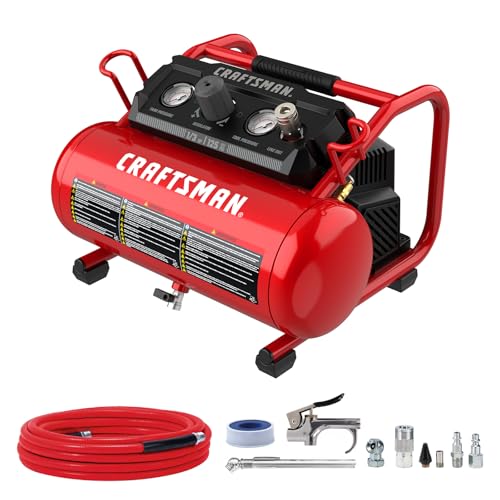
CRAFTSMAN 2-Gallon Portable Air Compressor
This CRAFTSMAN 2-gallon portable compressor package pairs a max 125 PSI oil-free pump with a versatile 10-piece pneumatic accessory kit using standard 1/4-inch NPT fittings. It is a practical, lightweight solution for DIYers and homeowners tackling tire inflation, air dusting, and light fastening.
Pros
- Complete out-of-the-box pneumatic package with air hose, blow gun, tire chuck, and 1/4-inch NPT quick-connect hardware
- Lightweight 19-pound carry weight makes moving between the garage, driveway, and workbench effortless
- Oil-free pump eliminates crankcase oil checks and prevents oil aerosol contamination in downstream air lines
- Dual quick couplings allow quick hookups without needing additional brass splitters
Cons
- Small 2-gallon receiver tank and 1/3 HP motor are limited to light-duty pneumatic tasks rather than continuous air-hungry tools
- The included starter air hose and accessories are entry-level components that high-volume shops may eventually want to upgrade
- Fittings utilize standard 1/4-inch auto profile plugs which require matching couplers if your shop uses alternate pneumatic profiles
JASTIND Industrial Air Blow Gun Kit
The JASTIND Industrial Air Blow Gun delivers powerful workshop blow-off performance with a durable chromed zinc alloy body, an adjustable brass airflow nozzle, and two protective-tipped extensions. It is an affordable, metal-built pneumatic accessory ideal for DIYers, mechanics, and woodworkers needing versatile cleanup reach.
Pros
- Solid all-metal zinc alloy and copper construction resists cracking compared to plastic blow guns
- Adjustable brass nozzle provides convenient airflow throttling right at the tool tip
- Protective rubber tips on extension wands help prevent scratching delicate finishes and sensitive components
- Integrated top hook makes bench and wall storage simple and accessible
Cons
- Does not state OSHA safety relief bypass compliance, so line pressure should be regulated safely before use
- All-metal zinc alloy body can transfer cold to the hand during extended continuous blowing sessions
- Specific quick coupler interchange style is not detailed in specifications, requiring fit verification for some shop air lines
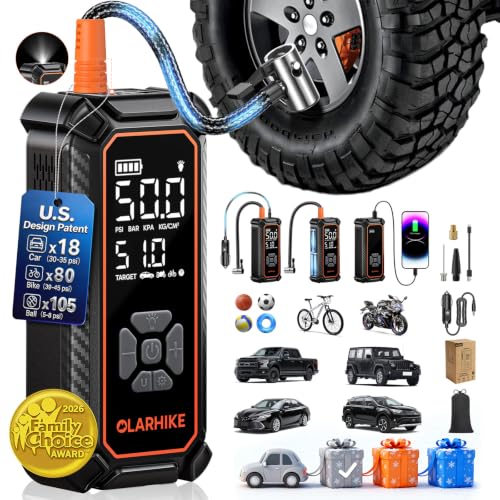
OlarHike Portable Tire Inflator Air Compressor
The OlarHike Portable Tire Inflator combines dual-power versatility via a 12V DC vehicle plug or built-in rechargeable battery with an automatic shut-off digital display. It provides dependable roadside tire top-offs and inflation for passenger cars, crossovers, motorcycles, and bicycles.
Pros
- Dual-power design allows cordless field operation or continuous power through any standard vehicle 12V DC port
- Automatic shut-off technology stops the motor precisely at preset pressure to prevent over-inflation
- Integrated 6000mAh battery reserve doubles as an emergency phone charger and includes an LED work light
- Pocket-sized footprint weighs well under two pounds for convenient transport in center consoles or backpacks
Cons
- Maximum vehicle pressure rating of 51 PSI is not suitable for heavy-duty commercial trucks, RVs, or high-pressure trailer tires
- Compact tankless inflator mechanism cannot power workshop pneumatic tools such as nail guns or air ratchets
- Recharging requires a standard 5V 2A or 5V 3A adapter and is not compatible with high-wattage fast chargers
ECOMAX 3-Gallon Portable Pancake Air Compressor
Delivering 0.6 SCFM at 90 PSI with a 110 max PSI 3-gallon tank, this ultra-lightweight 16.3-pound pancake compressor is built for light-duty DIY tasks and tire inflation. It provides a convenient, low-maintenance air source complete with an 11-piece accessory kit for homeowners and hobbyists.
Pros
- Extremely lightweight at only 16.3 pounds with a balanced flip-up carry handle for easy mobility
- Generous 11-piece accessory pack provides immediate utility for tire filling, blow-off tasks, and air connections
- Oil-free pump design ensures simple, maintenance-free operation for casual home users
- Dual quick-connect couplers allow flexible setups without needing aftermarket splitters
Cons
- Rated airflow delivery of 0.6 SCFM at 90 PSI is strictly limited to intermittent fastening and inflation
- Maximum pressure threshold of 110 PSI provides less air reserve than larger 150-165 PSI contractor compressors
- Not suitable for continuous high-demand air tools like paint sprayers, sanders, or heavy impact wrenches
ECOMAX 6-Gallon 175 PSI Portable Pancake Air
The ECOMAX 6-Gallon Pancake Air Compressor delivers up to 175 PSI and 3 CFM at 90 PSI, providing dependable recovery and dual quick couplers for trim fastening and garage tasks. Weighing approximately 31.5 pounds and featuring cold-weather start capability, it suits DIY homeowners and punch-list contractors seeking a complete portable air setup.
Pros
- High 175 PSI maximum tank pressure provides substantial usable air volume in a compact 6-gallon footprint
- Rated 3 CFM at 90 PSI supports quick pressure recovery between fastening cycles and tire inflation tasks
- Dual quick-connect couplers support running two pneumatic hoses without adding aftermarket splitters
- Comes complete with a 25-foot hose and essential pneumatic accessories for immediate out-of-the-box utility
- Oil-free pump design ensures low ongoing maintenance with no oil levels to monitor or change
Cons
- Output of 3 CFM at 90 PSI is unsuited for continuous high-consumption air tools like sanders or grinders
- Included 25-foot PVC air hose can be stiff and retain tight coils in cold working environments
- Manufacturer does not publish an official dBA rating, and standard oil-free pancake pumps can be loud indoors
OlarHike 12000mAh Cordless Tire Inflator
The OlarHike Heavy Duty Tire Inflator is a compact 3.2-pound mobile air compressor featuring a twin-cylinder motor, integrated 12,000mAh battery, and 12V DC vehicle adapter. It provides rapid roadside inflation with auto-shutoff convenience, making it a dependable emergency tool for drivers, mechanics, and off-roaders.
Pros
- Twin-cylinder pump configuration delivers faster inflation times than typical single-piston mini inflators
- True dual-power flexibility prevents downtime by running via battery or vehicle 12V DC outlet
- Compact, lightweight 3.2-pound body offers exceptional portability without eating up cargo space
- 45W USB-C Power Delivery port provides practical utility beyond tire maintenance
- Auto-stop feature eliminates pressure guessing and prevents dangerous over-inflation
Cons
- Tankless mobile design is strictly intended for inflation and cannot operate continuous-draw pneumatic air tools
- Extended continuous runtime on large truck or RV tires will cause heat buildup that requires brief cool-down intervals
- Does not include a standard 120V AC household wall plug for direct residential outlet use
AstroAI L7 Cordless Tire Inflator Portable Air
The AstroAI L7 is a lightweight, handheld cordless air compressor delivering up to 150 PSI with an integrated 4000mAh rechargeable battery and precise auto-shutoff. It provides dependable, pocket-sized inflation performance for motorists, cyclists, and DIYers needing quick roadside tire top-offs.
Pros
- Weighs only 0.96 pounds for effortless storage in vehicle consoles, toolbags, or cycling packs
- High-speed digital sensor samples tire pressure at 200 times per second to prevent over-inflation
- Internal 4000mAh battery provides cordless freedom without tangling 12V cigarette lighter cords
- Versatile secondary utility as an emergency LED flashlight and portable USB power bank
Cons
- Not intended for heavy-duty truck tires or commercial tires larger than 25 inches in diameter
- Duty cycle requires allowing the unit to cool for 10 minutes after 15 minutes of continuous run time
- Tankless micro-compressor design cannot power workshop pneumatic air tools
ROCGORLD R8 12V Portable Tire Inflator
The ROCGORLD R8 is an ultra-compact 12V DC mobile tire inflator delivering up to 40 L/Min airflow and 150 PSI with an intuitive dual digital display and automatic shutoff. It is an exceptional, budget-friendly roadside emergency tool for everyday drivers, commuters, and cyclists who need quick, dependable tire top-offs.
Pros
- Fast 40L/Min rated cylinder tops off passenger car and EV tires in just 1 to 1.5 minutes
- Clear dual digital readout displays target PSI and actual tire pressure simultaneously
- Automatic shutoff with memory function prevents tire over-inflation and simplifies monthly checks
- Featherweight 2.16-pound design with included storage bag fits easily in any trunk emergency kit
- Backed by a two-year manufacturer warranty with included Presta and sports ball adapters
Cons
- Operates strictly on 12V DC vehicle power and cannot plug directly into standard 120V AC household wall outlets
- Does not include an internal rechargeable battery, requiring an active 12V vehicle connection for power
- Short 2-foot air hose requires resting the compressor on the ground or holding it close to the tire stem
Matching Pneumatic Tools to Compressor Capacity: A Complete Practical Guide
Determining what tools can you use with an air compressor requires matching the tool’s volume appetite against the compressor’s sustained airflow output. Compressed air equipment does not operate on a universal standard where any air tank can drive any pneumatic attachment. Instead, tools fall into distinct categories based on whether they require short bursts of air or continuous, uninterrupted airflow. Looking closely at mechanical demands, operating pressures, and duty cycles allows you to assemble an effective pneumatic tool collection without overwhelming your equipment.
Fastening and Carpentry Tools: Brad Nailers, Finish Nailers, and Framing Guns
Pneumatic fastening tools represent the most accessible and widely utilized category for portable air compressors. Brad nailers firing 18-gauge wire brads and finish nailers driving 16-gauge or 15-gauge nails require minuscule amounts of air per shot. Because these tools consume air only during the split-second stroke of the internal driver blade, they require less than 0.5 to 1.0 CFM at 90 PSI under standard working paces. A compact 2-gallon or 3-gallon oil-free pancake compressor provides ample storage buffer for hanging interior door trim, installing baseboards, or assembling cabinetry without lagging behind.
Larger carpentry tools such as framing nailers and pneumatic roofing guns operate on the same intermittent principle but require slightly greater air volume per cycle. Driving a 3.5-inch framing nail into dense framing lumber demands higher line pressure, typically between 90 and 120 PSI, along with a larger reservoir to prevent rapid pressure decay. A portable 6-gallon unit delivering between 2.6 and 3.0 CFM at 90 PSI provides the necessary recovery speed for solo framing tasks or punch-list repairs. If multiple carpenters fire framing guns simultaneously off dual couplers, the compressor pump must cycle frequently to replenish the tank pressure.
Pneumatic pin nailers and narrow-crown staplers are even gentler on air supplies than standard finish nailers. These lightweight fastening tools work reliably even on small portable tanks with modest pump outputs of 0.6 CFM at 90 PSI. Woodworkers frequently prefer pneumatic staplers and nailers over battery-powered cordless alternatives because pneumatic tools are noticeably lighter and exert less wrist fatigue over long workdays. As long as you maintain proper regulated line pressure, your nailers will consistently sink fasteners flush without damaging delicate wood grain.
Workshop Maintenance and Cleaning Tools: Air Blow Guns and Inflation Chucks
Maintenance tools provide some of the most versatile everyday uses for any residential garage or professional workshop air compressor. Dedicated tire inflators, locking ball-foot air chucks, and digital pressure gauges allow rapid inflation of vehicle tires, bicycle tubes, and sports equipment. Specialized 12-volt and cordless portable inflators handle routine tire maintenance effortlessly through targeted cylinder displacement and automatic shut-off sensors. When connected to a standard tank compressor, tire chucks draw air in brief surges, enabling quick top-offs on passenger vehicles and utility trailers.
High-performance industrial air blow guns serve as indispensable cleaning devices for blowing away sawdust, metal shavings, and surface moisture from workpieces. These tools feature tapered nozzles and adjustable airflow throttles that channel stored air into a concentrated, high-velocity stream. Because blow guns release a steady stream of air while the trigger is held, they consume between 2.5 and 5.0 CFM depending on nozzle design and regulated pressure. Intermittent dusting tasks are easily handled by 2-gallon to 6-gallon tanks, though holding the trigger down continuously will quickly deplete stored tank reserves.
Operating cleaning nozzles safely requires attention to regulated line pressure and workshop safety guidelines. Connecting an unrestricted blow gun directly to full tank pressure exceeding 100 PSI creates safety hazards from flying debris and high line backpressure. Many modern blow guns feature safety bypass vents and brass flow-adjustment valves to keep effective nozzle pressure at controlled, safe levels. Utilizing clean, dry compressed air for machinery maintenance extends the operational lifespan of power tools by purging abrasive particulate from motor housings.
Automotive Pneumatic Tools: Impact Wrenches, Air Ratchets, and Cut-Off Tools
Automotive repair tasks frequently demand tools that generate immense torque or rapid rotational motion. Pneumatic 1/2-inch impact wrenches produce high breakaway torque to bust loose stubborn lug nuts and suspension fasteners using internal hammer-and-anvil mechanisms. Because impact wrenches fire short rotational bursts during fastener removal, they can operate from smaller tanks for brief tasks like changing a flat tire. However, performing continuous suspension work or rotating four vehicle tires requires substantial tank volume, which is explored in our guide on air compressor sizing for impact wrenches to prevent severe torque loss.
Pneumatic air ratchets provide nimble access to recessed fasteners in tight engine bays where swinging a manual hand ratchet is cumbersome. These tools spin at several hundred RPM and consume continuous airflow between 3.0 and 4.5 CFM during active trigger engagement. While an air ratchet does not produce the intense impact force of a heavy wrench, its continuous motor operation drains small 2-gallon and 3-gallon tanks within seconds. Using an air ratchet efficiently requires at least a 6-gallon reservoir with a pump capable of rapid recovery to sustain line pressure above 90 PSI.
High-speed pneumatic cut-off wheels and air chisels push portable air compressors beyond their practical operational limits. An air chisel hammering continuously through rusted sheet metal consumes a steady stream of compressed air that quickly pulls line pressure below operating thresholds. A 3-inch pneumatic cut-off tool spinning at 20,000 RPM demands between 4.0 and 6.0 CFM continuously, creating intense friction and thermal heat inside undersized pumps. Attempting to run continuous cutting or grinding tools on light-duty pancake compressors results in lagging tool speeds and frequent work stoppages.
High-Demand Finishing Tools: Paint Sprayers and Rotary Sanders
Surface preparation and finishing tools represent the most demanding category of pneumatic equipment. High-Volume Low-Pressure (HVLP) spray guns atomize paint, stains, and clear finishes by passing large quantities of air across a fluid tip at low nozzle pressures. A standard professional HVLP spray gun requires between 8.0 and 15.0 CFM at 30 to 40 PSI of regulated operating pressure. Small portable jobsite compressors producing 2.6 to 3.0 CFM at 90 PSI simply cannot supply the steady airflow necessary to atomize paint consistently, leading to splattering and uneven coats.
Dual-action (DA) orbital sanders and pneumatic die grinders are notorious for their massive, continuous air consumption. A typical 6-inch random orbital air sander consumes between 10.0 and 14.0 CFM at 90 PSI while running continuously across wood panels or vehicle bodywork. When an operator runs an orbital sander on an undersized 6-gallon compressor, the stored air empties in less than thirty seconds. The compressor pump then runs continuously without catching up, causing air pressure to plunge from 90 PSI down to 40 PSI while the sander bogs down completely.
Operating continuous finishing tools successfully requires stationary workshop compressors equipped with large 30-gallon to 60-gallon tanks and multi-horsepower motors. These stationary units feature cast-iron pumps capable of generating 10 to 18 CFM at 90 PSI with 100 percent continuous duty cycles. Woodworkers and auto restorers who rely on portable compressors can use compact touch-up detail spray guns or pneumatic airbrushes, which draw modest airflow under 2.0 CFM. For full-scale spray painting and extensive sanding, matching the tool’s CFM appetite to a commercial-grade compressor is essential.
Air Delivery Fundamentals: Understanding CFM at 90 PSI Versus Peak Pressure
Evaluating tool compatibility requires understanding the critical distinction between air pressure and air delivery volume. Pressure, measured in Pounds per Square Inch (PSI), represents the mechanical force exerted by the compressed air inside the lines. Most pneumatic tools are engineered to operate within a specific pressure window, usually between 70 and 120 PSI. Air delivery, measured in Cubic Feet per Minute (CFM), represents the actual volume of air flowing through the system to keep the tool working at full power.
Maximum tank pressure ratings often mislead buyers into believing a small compressor can power demanding tools. A portable compressor boasting 150 PSI or 175 PSI maximum pressure can store air at high density, but high storage pressure does not equal continuous airflow. When a high-draw tool opens the regulator, the air volume inside the tank drops rapidly unless the pump can generate equivalent CFM in real time. Comparing the tool’s required CFM at 90 PSI against the compressor’s delivered CFM at 90 PSI is the single most accurate test of equipment compatibility.
A reliable operational rule of thumb involves applying a thirty-percent safety margin to any pneumatic tool’s listed air consumption. If an air tool specifies an average demand of 4.0 CFM at 90 PSI, pairing it with a compressor producing at least 5.2 to 5.5 CFM at 90 PSI ensures smooth performance. This buffer accounts for line friction, hose restrictions, and the reality that manufacturer ratings often reflect intermittent bench tests rather than sustained heavy use. Following this guideline prevents pump overheating and protects electric motors from running past their rated duty cycle.
Tank Volume, Recovery Rates, and Intermittent Versus Continuous Duty Cycles
Air tank volume serves as an essential storage reservoir that cushions the pneumatic system against sudden surges in air demand. Small tanks ranging from 2 to 3 gallons store enough air to fire dozens of finish nails or inflate several tires before the motor restarts. A 6-gallon pancake tank provides double the storage capacity, creating a noticeable cushion for light ratchet use, intermittent framing, or cleaning passes. The tank acts as a temporary buffer, allowing tools to draw air faster than the pump can produce it for brief, controlled intervals.
Once stored tank pressure falls below the factory cut-in threshold, the compressor motor starts up to rebuild pressure up to the cut-out limit. The time required for the compressor to cycle from cut-in to cut-out is known as the recovery rate. A compressor with high CFM output and efficient staging recovers pressure rapidly, minimizing downtime between work cycles. If you use a tool whose air consumption exceeds the pump’s CFM output, the tank pressure will continue dropping even while the motor runs continuously, forcing you to stop and wait for recovery.
Compressor pump duty cycle ratings dictate how long an electric motor and pump assembly can run without risking thermal shutdown. Most consumer and jobsite oil-free compressors feature a 50 percent duty cycle, meaning the pump should rest for equal durations to dissipate operating heat. Running a continuous-demand tool on a 50 percent duty cycle compressor forces the pump to run non-stop, overheating piston rings and degrading valve seals. For continuous pneumatic tools, investing in a commercial pump with a 75 to 100 percent duty cycle prevents premature mechanical failure.
Air Delivery Hardware: Regulators, Hoses, Couplers, and Moisture Traps
Delivering compressed air efficiently from the storage tank to your pneumatic tool requires high-quality pneumatic distribution hardware. The pressure regulator controls line pressure, stepping down high tank pressure to the specific working level needed by your attached tool. Learning the proper technique for monitoring dual air compressor gauges allows you to distinguish stored tank pressure from regulated tool pressure accurately. Maintaining this balance ensures that sensitive tools like brad nailers receive consistent pressure without blowing out internal O-rings.
Air hose diameter plays a massive role in preventing dynamic pressure drops during tool operation. Standard 1/4-inch inner diameter (ID) air hoses are lightweight and flexible, making them ideal for trim nailers, blow guns, and tire chucks over short distances. However, running high-draw tools like 1/2-inch impact wrenches through a 50-foot 1/4-inch hose causes noticeable airflow restriction and power loss. Upgrading to a 3/8-inch ID hybrid polymer hose significantly reduces friction loss, delivering maximum CFM and responsiveness directly to high-torque tools.
Moisture management is equally critical for protecting the internal mechanisms of expensive pneumatic tools. Compressing ambient air naturally squeezes out atmospheric humidity, which condenses into liquid water inside the bottom of the steel tank. Installing an in-line moisture filter or water separator traps liquid droplets before they travel down the air hose into your tools. Regular tank maintenance, including purging condensation daily through the bottom drain valve after releasing stored pressure, prevents internal tank rust and keeps your pneumatic tools lubricated and clean.
Practical Rules for Selecting the Right Compressor for Your Tool Arsenal
Building an efficient workshop requires aligning your compressor’s capabilities with the specific tools you plan to operate most frequently. If your primary tasks involve inflating tires, blowing away shop dust, and installing interior woodwork, a portable 2-gallon to 6-gallon oil-free compressor provides exceptional convenience and mobility. These compact machines start easily in cold weather, require zero pump oil maintenance, and store neatly on garage shelves while handling all light-duty pneumatic demands. They deliver reliable power for casual DIYers and finish carpenters without overwhelming electrical circuits or storage spaces.
When your goals expand into heavy mechanical restoration, continuous spray finishing, or professional shop production, transitioning to a high-capacity stationary system becomes necessary. Sizing your compressor based on sustained CFM delivery rather than tank pressure ensures every pneumatic tool performs at its engineered peak. Always inspect tool manufacturer specification sheets to confirm required operating pressures, CFM volume thresholds, and duty cycle expectations before starting major projects. Taking a methodical approach to matching air tools with compressor capacity guarantees dependable performance and years of trouble-free pneumatic operation.
About the author
Tony Carrick is an experienced product researcher and writer specializing in tools, home improvement, automotive maintenance, and consumer equipment. With extensive experience reviewing tools and tackling hands-on renovation projects, he brings a buyer-focused perspective to compressor performance, usability, and overall value.