
What Does Free Air Delivery Mean on a Compressor: Practical Guide for 2026
Learn what does free air delivery mean on a compressor, how FAD impacts pneumatic tool airflow, and how to size equipment in October 2026.
 By Tony Carrick
Updated October 7, 2026
By Tony Carrick
Updated October 7, 2026
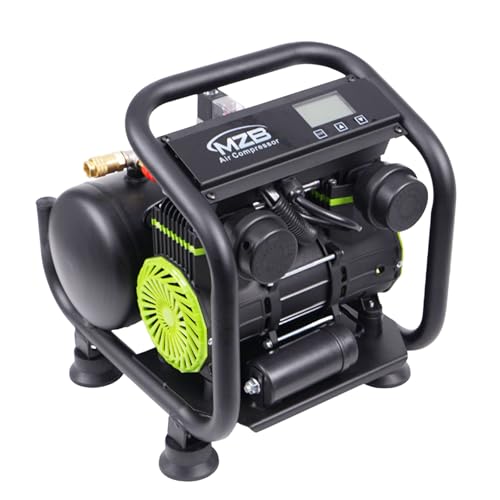
Pneumatic tools frequently stall or lose torque when an air supply cannot keep up with real-world consumption demands. When shopping for workshop power equipment or troubleshooting underperforming spray guns, buyers often encounter confusing airflow specifications printed across motor labels and marketing brochures. Understanding what does free air delivery mean on a compressor provides the baseline clarity needed to match continuous air tools with a reliable pump mechanism. This critical metric strips away theoretical manufacturer ratings to reveal the true volume of usable air delivered under actual working conditions.
Unlike theoretical pump displacement, which simply measures cylinder geometry without accounting for heat or mechanical resistance, true discharge flow reflects what actually reaches your air line. Many workshop owners evaluate equipment using air compressor SCFM rating guide standards, but discharge delivery ratings define the actual boundary between smooth tool operation and frustrating pressure drops. By focusing on genuine airflow measurements rather than inflated peak horsepower claims, you can select equipment capable of handling demanding workshop duties. Proper air sizing ensures your pneumatic wrenches, sanders, and nailers maintain consistent operational torque without straining your electrical circuits.
| Award | Product | ACR Score About ACR ScoreThe ACR Score is our own rating from 0 to 10, based on performance, design and build, ease of use, and value. It reflects independent research and is never influenced by manufacturers, retailers, or affiliate commissions. Learn more › | |
|---|---|---|---|
| Best Overall |
MZB MZB-900H-6 1.6-Gallon Air Compressor
|
9.2/10 | Buy |
| Best Premium |
 California Air Tools 2010A 2-Gallon Compressor
|
9.1/10 | Buy |
| Best Value |
 MZB MZB-1100H-50 13.2-Gallon Air Compressor
|
8.8/10 | Buy |
| Best Budget |
 MZB MZB-900H-24 6.4-Gallon Air Compressor
|
8.6/10 | Buy |
 MZB 1100H-50 13.2-Gallon Air Compressor
|
8.6/10 | Buy | |
 VIAIR 150 PSI On-Board Air Source Kit
|
8.6/10 | Buy | |
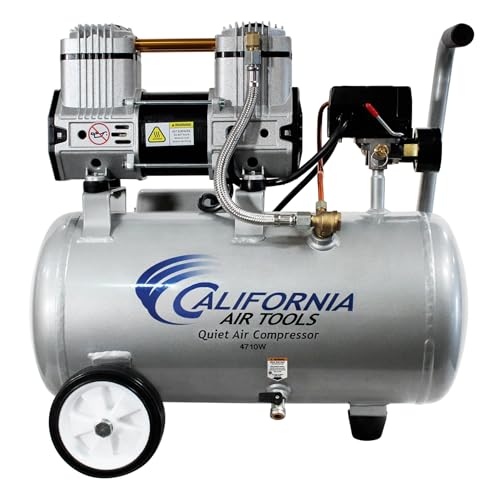 California Air Tools CAT-4710W 4.7-Gal Compressor
|
8.3/10 | Buy | |
 MZB MZB-850H-9 2.4-Gallon Air Compressor
|
8.1/10 | Buy | |
 VEVOR 14-Gallon 2HP Portable Air Compressor
|
8.0/10 | Buy | |
 MZB MZB-1100H-24 6.4-Gallon Air Compressor
|
7.8/10 | Buy |
MZB MZB-900H-6 1.6-Gallon Air Compressor
Built for trim carpentry and light pneumatic tasks, this compact MZB unit pairs a 1.6-gallon steel tank with an oil-free pump. It produces up to 115 PSI while keeping operating sound around 70 decibels.
Pros
- Low-maintenance oil-free pump design
- Moderate 70 dB operating sound level
- Compact footprint is convenient to transport
- Sturdy steel air tank construction
Cons
- Small 1.6-gallon capacity limits continuous air tool runtimes
- Modest maximum output pressure of 115 PSI
California Air Tools 2010A 2-Gallon Compressor
Operating at just 60 decibels, this compact unit delivers reliable airflow with minimal noise disruption. Its rust-free aluminum tank and oil-free dual-piston pump make it well suited for indoor trim work and noise-sensitive spaces.
Pros
- Exceptionally quiet operation at only 60 decibels
- Lightweight rust-free aluminum tank design
- Low-maintenance oil-free dual-piston system
- Quick 14-second recovery time between cycles
Cons
- Modest 2-gallon tank limits continuous heavy tool use
- 120 PSI maximum pressure is below heavy-duty standards
- Air output is insufficient for sustained high-demand air tools
MZB MZB-1100H-50 13.2-Gallon Air Compressor
Designed for indoor workshops and residential garages, this compressor keeps operating noise down to a manageable 70 decibels. Its 13.2-gallon steel tank and wheeled frame suit DIY woodworkers, painters, and mechanics needing reliable airflow without regular pump maintenance.
Pros
- Quiet 70dB sound level ideal for indoor spaces
- Maintenance-free oil-free pump design
- Large 13.2-gallon durable steel tank
- Wheels and handle make transport manageable
Cons
- Hefty 72-pound weight makes vehicle loading difficult
- 115 PSI maximum pressure is modest for heavy-duty pneumatic tools
MZB MZB-900H-24 6.4-Gallon Air Compressor
Delivering 5.65 CFM at 115 psi, this 1.2 HP oil-free unit rapidly pressurizes its 6.4-gallon tank in about one minute while maintaining a low 70-decibel noise output. It serves well for home garages and workshops handling nail guns, air tools, and light painting.
Pros
- Quiet 70 dB operating volume
- Fast tank recovery under 65 seconds
- Generous 5.65 CFM output at 115 psi
- Low-maintenance oil-free motor design
- Integrated wheels assist mobility
Cons
- Steel construction adds significant carrying weight
- Tank capacity limits continuous heavy spraying sessions
- Corded operation requires standard electrical outlet
MZB 1100H-50 13.2-Gallon Air Compressor
Built for auto repair and woodworking, this dual-motor unit combines a quick 60-second tank fill with a quiet 70-decibel operating level. Its oil-free 3.0 HP motor setup delivers up to 14.83 CFM of airflow to keep high-demand pneumatic tools running reliably.
Pros
- Quiet 70-decibel operation reduces indoor workshop noise
- Fast 60-second tank fill minimizes work interruptions
- Oil-free design eliminates oil maintenance and contamination
- High 14.83 CFM output supports continuous air tools
- Integrated wheels assist with moving the heavy tank
Cons
- Heavy 72-pound frame makes vehicle loading awkward
- Max 115 PSI is lower than standard 150 PSI models
- Large 26-inch profile requires significant floor space
VIAIR 150 PSI On-Board Air Source Kit
The VIAIR 150 PSI Air Source Kit combines a 280C electric compressor with a 2-gallon, 5-port air tank to deliver a 1.59 CFM flow rate and quick recovery times. Built with an IP54 weather rating for internal or chassis mounting, it serves as a dependable onboard pneumatic supply for air horns, suspension leveling, and emergency tire top-offs.
Pros
- Pre-assembled compressor and 2-gallon tank package significantly cuts down on custom fabrication and wiring setup time
- IP54-rated environmental sealing protects electrical and mechanical parts from road dust, splash, and weather when chassis-mounted
- Five dedicated tank ports offer convenient routing options for safety relief valves, drain lines, pressure switches, and air accessories
- Swift tank recovery cycle fills the reservoir from 0 to 145 PSI in under 4 minutes
Cons
- Rated at 1.59 CFM with a 30 percent duty cycle, making it unsuitable for continuous high-demand air tools like sanders or grinders
- Not intended for airing up completely flat large truck tires from zero, functioning primarily as an auxiliary supply and top-off system
- Requires regular manual access to the bottom drain cock to purge condensation and prevent internal tank rust
California Air Tools CAT-4710W 4.7-Gal Compressor
Built for garage workshops and DIY tasks, this mobile unit features an oil-free dual-piston pump that fills its 4.7-gallon steel tank in 78 seconds. Its low 7.5-amp motor draw ensures smooth startups on standard household circuits without tripping breakers.
Pros
- Fast 78-second tank fill time from empty
- Low 7.5-amp draw prevents tripped breakers
- Low-maintenance oil-free pump operation
- Wheels and pull handle ease transport at 35 pounds
Cons
- Delivers only 2.2 CFM at 90 PSI for demanding tools
- Steel tank construction is heavier than aluminum alternatives
MZB MZB-850H-9 2.4-Gallon Air Compressor
Built for carpentry, auto repair, and painting tasks, this compact compressor pairs a 1.2 HP oil-free motor with rapid 30-second tank recovery. Its steel frame and dual silencers balance durability with manageable 70 dB operation for portable workshop use.
Pros
- Fast 28 to 32 second tank fill time
- Maintenance-free oil-free motor design
- Solid 5.65 CFM output for its footprint
- Durable three-layer rust-resistant steel construction
Cons
- Maximum pressure is limited to 115 PSI
- Modest 2.4-gallon tank limits continuous heavy airflow
VEVOR 14-Gallon 2HP Portable Air Compressor
Built for garage workshops, this vertical unit pairs a low-maintenance oil-free motor with a 14-gallon carbon steel tank. It delivers a steady 4.3 SCFM at 90 PSI, making it a reliable match for DIYers using air nailers, sprayers, and tire inflators.
Pros
- Oil-free pump requires minimal ongoing maintenance
- Generates 4.3 SCFM at 90 PSI for steady airflow
- Two wheels and handle ensure smooth mobility
- Durable 2.5 mm carbon steel tank resists corrosion
Cons
- Heavier build at 63 pounds to lift manually
- 125 PSI ceiling is limited to light-duty pneumatic tasks
MZB MZB-1100H-24 6.4-Gallon Air Compressor
Built with an oil-free 1.5 HP motor and a 6.4-gallon steel tank, this compressor delivers 7.41 CFM at 115 PSI while keeping operating noise down to 70 decibels. It is a solid choice for workshops, auto detailing, and spray painting where quick recovery and quiet operation matter.
Pros
- Fast 60-second tank recovery time
- Quiet 70 dB operation with dual silencers
- High 7.41 CFM output at 115 PSI
- Low-maintenance oil-free motor design
- Durable three-layer coated steel tank
Cons
- Maximum 115 PSI limits high-pressure tools
- Steel tank adds weight compared to aluminum
Demystifying Free Air Delivery in Pneumatic Systems
Selecting pneumatic machinery requires looking past flashy decals and focus on the fundamental physics of air compression. Workshop tools depend on a sustained volume of air molecules under pressure to spin impellers, drive pistons, and atomize liquids. When a compressor cannot supply that volume, system line pressure plummets and tools grind to a halt. Free air delivery represents the ultimate measure of whether a machine can actually fulfill your daily shop workload.
The Core Definition of Free Air Delivery
Free air delivery refers to the actual volume of air that a compressor discharges into the downstream line, measured and expressed at the ambient atmospheric conditions of the intake. In practical engineering terms, this measurement calculates the volume of free atmospheric air compressed and delivered per unit of time. It accounts for atmospheric barometric pressure, ambient temperature, and relative humidity at the machine location. Standard testing protocols established by international bodies ensure this figure reflects genuine volumetric output rather than an idealized theoretical calculation.
During standardized testing under protocols such as ISO 1217, technicians place a calibrated flow measurement device directly at the discharge outlet of the compressor. The compressed air exiting the pump expands back toward atmospheric conditions within the calculation model to determine how much raw atmospheric air was successfully processed. This distinction matters because air compresses and heats up significantly during mechanical reduction inside the cylinder. By translating the high-pressure discharge volume back to ambient intake conditions, technicians and buyers obtain an objective standard for comparison.
FAD Versus Piston Displacement: Why Theoretical Output Misleads
Many retail compressors proudly highlight piston displacement on their packaging because it generates an impressive, inflated specification. Piston displacement measures the purely geometric swept volume of the pump cylinders multiplied by the rotational speed of the motor. For example, a dual-piston pump running at high revolutions sweeps a calculated volume of air through its bores on paper. This theoretical figure represents an impossible ideal because it assumes one hundred percent volumetric efficiency with zero internal losses.
In actual operation, physical limitations immediately reduce the volume of air that exits the cylinder head into the receiver tank. Every reciprocating pump contains clearance volume between the top of the piston crown and the valve plate that cannot be physically evacuated. As the piston begins its downward stroke, the high-pressure air trapped in this dead space re-expands and delays the opening of the intake reed valves. In addition, valve throttling, piston ring blow-by, and severe thermal expansion of the incoming air further degrade the pump output.
Because of these unavoidable mechanical losses, a compressor’s actual delivered airflow is consistently lower than its calculated displacement. In standard single-stage workshop compressors, volumetric efficiency often hovers between sixty and seventy-five percent under normal working pressures. A machine boasting ten cubic feet per minute of theoretical displacement might only deliver six or seven cubic feet of usable air to the tool line. Relying on displacement figures alone frequently leads buyers to purchase underpowered equipment that struggles during demanding tasks.
Navigating Airflow Metrics: FAD, CFM, SCFM, and ACFM
Navigating the alphabet soup of airflow metrics requires understanding the conditions under which air volume is measured. The generic term CFM simply stands for cubic feet per minute, but without a specified pressure or condition, the number has little practical meaning. Actual cubic feet per minute, abbreviated as ACFM, measures the air volume flowing at a specific point in the system under the exact temperature and pressure present at that moment. Because air volume fluctuates drastically under varying pressures, ACFM values must always be tied to a specific operational pressure point.
To establish a reliable baseline across varying operating environments, industry engineers developed the standard cubic feet per minute rating. Standard CFM normalizes airflow measurements to a set reference point, typically sea-level atmospheric pressure of 14.7 PSI, an ambient temperature of 68 degrees Fahrenheit, and zero percent relative humidity. This standardized metric ensures that a compressor rated in an arid high-altitude workshop can be fairly compared against one operating at sea level. While SCFM provides a uniform laboratory benchmark, free air delivery focuses specifically on the air ingested and discharged under local ambient conditions.
Industrial manufacturers and commercial engineering standards rely heavily on ISO 1217 Annex C to verify accurate compressor delivery ratings. This rigorous testing standard measures the compressor operating under full load while factoring in electric motor efficiency, drive losses, and thermal saturation. When a manufacturer publishes verified delivery specifications adhering to this standard, buyers receive an honest assessment of sustained working capability. Equipment evaluated under loose marketing formulas rarely matches the sustained performance of units certified through formal delivery benchmarks.
How Operating Pressure Changes Delivered Airflow
A compressor’s delivered air volume changes constantly as pressure builds inside the storage tank or working line. As system pressure increases, the pump must overcome greater backpressure to push air past the discharge reed valves and into the tank. This increased compression ratio elevates operational temperatures, expands the trapped air in the clearance volume, and increases blow-by around the piston rings. Consequently, a compressor always delivers more cubic feet per minute at lower pressures than it does at elevated working pressures.
Reviewing manufacturer performance curves clearly illustrates this mechanical relationship across different pressure levels. For instance, the California Air Tools 2010A dual-piston compressor specifies an airflow rating of 3.10 CFM at 40 PSI, but that volume drops to 2.20 CFM at 90 PSI. Similarly, the California Air Tools CAT-4710W model delivers 3.00 CFM at 40 PSI and decreases to 2.20 CFM when operating against 90 PSI of backpressure. Units engineered for higher continuous volumes, like the VEVOR 14-Gallon model delivering 4.3 SCFM at 90 PSI, demonstrate how motor horsepower and cylinder bore sizing work together to maintain delivery at heavy working pressures.
As a compressor approaches its maximum operating pressure, such as 115 PSI or 125 PSI, the rate of air delivery slows down noticeably. The final pounds of pressure take significantly longer to accumulate because the volumetric efficiency of the pump drops to its lowest point. This explains why tank fill times stretch out during the final twenty percent of the compression cycle before the pressure switch trips. Understanding this dynamic helps operators set their regulators appropriately rather than demanding unnecessarily high line pressure that starves tool airflow.
Matching Delivered Air Volume to Pneumatic Tools
Matching air delivery to pneumatic tools requires evaluating the duty cycle and consumption patterns of your specific equipment. Intermittent tools, such as brad nailers, finish staplers, and framing nailers, consume brief bursts of compressed air and allow the pump time to recover between cycles. In contrast, continuous tools, including dual-action sanders, rotary die grinders, and HVLP paint spray guns, demand a relentless stream of air volume to operate effectively. If your compressor’s sustained delivery cannot match the continuous CFM rating of the tool, the system will immediately lose working pressure.
When calculating your shop air requirements, always apply a realistic buffer above the manufacturer tool consumption rating. Industry best practice recommends selecting a compressor that delivers at least thirty to fifty percent more CFM at 90 PSI than your highest-consuming pneumatic tool requires. For example, if an HVLP spray gun specifies eight CFM at 40 PSI, choosing a compressor that delivers ten to twelve CFM at that pressure prevents pressure drop during critical finishing passes. This safety margin keeps the motor from running continuously at its thermal limit and extends the operational lifespan of the pump.
A common misconception among buyers is that a larger receiver tank can compensate for a compressor with an inadequate air delivery rating. While a substantial tank stores an air buffer that allows short bursts of high-draw tool operation, it cannot create additional air volume once the stored reserve is exhausted. If a continuous sander consumes eight CFM while the pump only produces four CFM, the tank pressure will steadily collapse until the tool stalls. When outfitting a dedicated workshop for sustained fabrication, installing stationary workshop air compressor tanks paired with a high-output pump provides both the storage buffer and the continuous airflow needed for industrial workloads.
Operating pneumatic equipment on an undersized compressor leads to severe operational headaches and damaged workpieces. Pneumatic impact wrenches lose their torque capacity when line pressure drops, leading to improperly tightened fasteners or stalled lug nuts. Paint sprayers experience spitting, uneven atomization, and orange peel finishes when air delivery dips below the required atomizing pressure. Furthermore, starving your tools forces the compressor motor to run without cycling off, leading to rapid heat buildup and tripping thermal overload switches.
Pump Architectures and Their Air Delivery Characteristics
The mechanical design of the compressor pump directly influences its airflow delivery characteristics and operational longevity. Modern ultra-quiet compressors frequently utilize dual-piston oil-free pump mechanisms featuring Teflon-coated cylinder sleeves. These units operate at lower motor speeds around 1680 to 2880 RPM, delivering clean, oil-free air with remarkably low operating noise levels between 60 and 70 decibels. When transporting equipment between jobsites, transporting oil-free air compressors is significantly simpler because there is no crankcase oil to spill or migrate into the cylinder heads.
Traditional workshops and commercial auto repair shops often favor oil-lubricated cast-iron pump assemblies for heavy-duty applications. Splash-lubricated designs dissipate friction and operational heat more effectively across prolonged duty cycles, maintaining tighter ring seals and higher volumetric efficiency over thousands of hours. The presence of oil creates a fluid barrier along the cylinder walls that minimizes blow-by under intense backpressure. While oil-lubricated compressors require regular maintenance including oil checks and oil changes, their sustained air delivery under heavy workloads remains highly consistent.
Compressor architecture also branches into single-stage and two-stage designs, which fundamentally alter how air volume is delivered at higher pressures. Single-stage compressors draw atmospheric air into the cylinder and compress it to final working pressure in a single stroke, typically topping out around 125 to 150 PSI. Two-stage compressors compress air to an intermediate pressure in a large low-pressure cylinder, cool it through an intercooler, and then compress it to final pressure in a smaller high-pressure cylinder. This staged approach reduces compression heat, boosts volumetric efficiency, and allows commercial machines to deliver steady airflow at working pressures up to 175 PSI.
Environmental and Piping Factors That Reduce Delivery
Environmental conditions exert a direct physical effect on the volume of air your compressor can ingest and discharge. At higher elevations, atmospheric air density decreases, meaning fewer air molecules occupy each cubic foot of swept cylinder volume. A compressor operating in a mountain shop will experience a noticeable drop in mass airflow delivery compared to identical equipment running at sea level. Similarly, operating in extremely hot ambient environments warms the incoming air charge, reducing air density and diminishing overall pump efficiency.
The cleanliness and condition of the intake air filter represent another critical factor in maintaining rated air delivery. A clogged, dust-laden air filter acts as a severe restriction on the pump intake, forcing the cylinders to draw against a vacuum. This intake starvation reduces the mass of air entering the compression chamber on every stroke, drastically lowering the delivered discharge volume. Routinely inspecting, cleaning, and replacing intake filter elements ensures the compressor operates at its designed volumetric capacity without unnecessary motor strain.
Even when a compressor pump produces excellent air delivery, improper delivery piping can ruin performance at the tool connection. Undersized air hoses, restrictive quick-connect fittings, and long hose runs generate severe friction loss that drops working pressure dramatically. Using a thirty-foot length of 1/4-inch internal diameter hose can rob a high-flow tool of several CFM compared to a 3/8-inch hose. To preserve the compressor’s delivered air volume, route air through adequately sized rigid piping or heavy-gauge hoses paired with high-flow couplers.
Practical Tank Pump-Up Testing to Measure Actual Delivery
Workshop operators can verify their compressor’s actual air delivery by performing a straightforward tank pump-up test. This empirical measurement requires only a stopwatch, the exact water volume of the storage tank in gallons, and the cut-in and cut-out pressure settings. By tracking how many seconds the pump takes to fill the receiver tank across a known pressure rise, you can calculate delivered CFM mathematically. This test strips away marketing claims and reveals exactly how much air your machine generates under real-world conditions.
To perform the calculation, drain the tank completely to zero PSI, close the drain petcock, and prepare your timer. Turn on the compressor and start the stopwatch the exact moment the motor begins turning, then stop the timer when the unit automatically shuts off at its cut-out pressure. Convert your tank volume in gallons to cubic feet by dividing gallons by 7.48. Multiply that cubic volume by the difference between cut-out and starting pressure divided by atmospheric pressure (14.7), and then multiply by sixty divided by the fill time in seconds to determine delivered CFM.
Running a pump-up test periodically serves as an outstanding diagnostic tool for monitoring compressor health over time. If a machine that originally filled its tank in sixty seconds now requires ninety seconds to reach the same cut-out pressure, volumetric efficiency has degraded. Sluggish recovery times typically point to leaking intake or discharge reed valves, worn piston rings, or leaking check valve assemblies. Identifying these performance drops early allows you to replace inexpensive wear parts before thermal stress damages the electric motor.
Strategic Equipment Selection Based on True Air Output
When evaluating air delivery specifications on prospective machinery, always scrutinize motor horsepower ratings alongside airflow metrics. Decades of misleading retail marketing have led to inflated peak horsepower claims that do not correspond to continuous electrical power. A standard 120-volt 15-amp household circuit can realistically supply only about 1.5 to 2.0 continuous running horsepower without tripping the circuit breaker. If a compressor claims five horsepower while running on a standard household outlet, the rating represents transient peak surge rather than sustained compression capability.
Matching your air delivery requirements with your available electrical infrastructure prevents constant circuit breaker trips and motor stalling. High-output compressors delivering five or more CFM at 90 PSI typically require dedicated 20-amp 120-volt circuits or 240-volt electrical connections. Operating an undersized extension cord causes voltage drop under heavy starting inrush amperage, overheating the motor windings and reducing pump speed. Providing clean, dedicated electrical power ensures the motor maintains rated RPM and achieves its full rated air delivery under maximum pressure loads.
Understanding the true meaning of free air delivery transforms how you select, configure, and maintain pneumatic workshop equipment. By prioritizing verified discharge airflow over theoretical piston displacement and exaggerated horsepower marketing, you protect your investment and avoid frustrating tool stalls. Always calculate tool CFM requirements with a healthy buffer, inspect intake filters regularly, and size your air delivery hoses appropriately. Investing in a compressor that supplies genuine, sustained air delivery ensures reliable pneumatic power for every project in your workspace.
About the author
Tony Carrick is an experienced product researcher and writer specializing in tools, home improvement, automotive maintenance, and consumer equipment. With extensive experience reviewing tools and tackling hands-on renovation projects, he brings a buyer-focused perspective to compressor performance, usability, and overall value.