
What Is a Two Stage Air Compressor: Practical Workshop Guide for 2026
Understand what is a two stage air compressor and how dual compression stages deliver reliable high pressure for workshop air tools in October 2026.
 By Clint DeBoer
Updated October 7, 2026
By Clint DeBoer
Updated October 7, 2026

Air-hungry tools like dual-action sanders, high-flow paint sprayers, and heavy impact wrenches quickly overwhelm compact portable units by pulling more continuous volume than small pumps can generate. When workshop demands shift toward sustained pneumatic power and storage pressures reaching 175 PSI, understanding what is a two stage air compressor becomes essential for setting up an efficient air delivery system. Unlike basic units that compress atmospheric air in a single stroke, dual-stage engineering divides the compression workload between two distinct cylinders connected by an intercooler. Readers exploring basic configurations can compare this design against our guide to single-stage air compressor mechanics to see how single-stroke piston cycles handle lighter pneumatic demands.
Operating a high-pressure system provides a substantial buffer of stored air, allowing high-draw pneumatic equipment to run without triggering immediate motor cycling or sudden line pressure drop. Selecting a dependable stationary compressor requires evaluating continuous airflow delivery, true running horsepower, motor voltage demands, and pump construction. Reliable models from manufacturers like Ingersoll Rand, Campbell Hausfeld, and EMAX rely on heavy cast-iron pumps to dissipate thermal buildup across extended duty cycles. Choosing the correct setup prevents frustrating tool stalling while protecting your electrical service from unnecessary overload.
| Award | Product | ACR Score About ACR ScoreThe ACR Score is our own rating from 0 to 10, based on performance, design and build, ease of use, and value. It reflects independent research and is never influenced by manufacturers, retailers, or affiliate commissions. Learn more › | |
|---|---|---|---|
| Best Overall |
DEWALT 60-Gallon Stationary Air Compressor
|
9.2/10 | Buy |
| Best Premium |
 EMAX 80-Gallon Stationary Air Compressor
|
9.2/10 | Buy |
| Best Value |
 Campbell Hausfeld 60-Gallon Air Compressor
|
8.9/10 | Buy |
| Best Budget |
 NorthStar 2-Stage 24.4 CFM Compressor Pump
|
8.6/10 | Buy |
 Ingersoll Rand 2340N5-V 5 HP Air Compressor
|
8.4/10 | Buy | |
 Ingersoll Rand 2340L5-V 5 HP Air Compressor
|
8.3/10 | Buy | |
 Ingersoll Rand 2475N7.5 7.5 HP 80-Gallon Two-Stage
|
8.1/10 | Buy | |
 VEVOR 10HP 3-Cylinder Air Compressor Pump Head
|
8.0/10 | Buy | |
 Baococo 3-Gallon Ultra Quiet Air Compressor
|
7.8/10 | Buy | |
 Compressor Source 2-3 HP Replacement Cast Iron Air
|
7.8/10 | Buy |
DEWALT 60-Gallon Stationary Air Compressor
The DEWALT DXCM602.COM is a heavy-duty 60-gallon vertical stationary air compressor engineered for dedicated workshops, featuring an oil-lubricated pump and a 3.7 HP motor delivering 11.5 CFM at 90 PSI up to 175 max PSI. Powered by 208V or 230V electrical service, it is an ideal stationary air source for mechanics, fabricators, and woodworkers running demanding pneumatic tools.
Pros
- High rated air output of 11.5 CFM at 90 PSI easily handles air-hungry continuous tools
- Durable oil-lubricated pump engineered for cooler operation and extended service life
- ASME-certified 60-gallon vertical steel pressure vessel ensures verified safety and high capacity
- Dual-voltage spread-volt motor simplifies integration into 208V or 230V electrical systems
Cons
- Stationary 200-pound footprint requires permanent shop placement and lacks mobility wheels
- Requires a dedicated 208V or 230V high-voltage circuit and cannot run on standard 120V household outlets
- Requires routine maintenance including oil level inspections and periodic pump oil changes
EMAX 80-Gallon Stationary Air Compressor
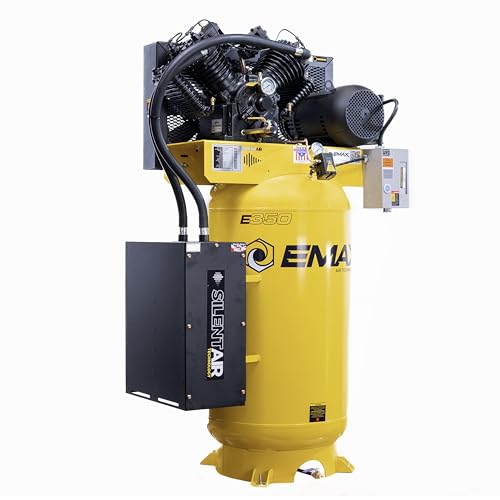
The EMAX 80-Gallon E350 stationary air compressor delivers 31 CFM using a 7.5 HP single-phase, two-stage pump paired with Silent Air technology that lowers sound by up to 50 percent. It is built for commercial workshops and auto garages needing high-volume air without overwhelming noise.
Pros
- Delivers a robust 31 CFM airflow to handle high-demand pneumatic equipment without stalling
- Silent Air technology lowers operating noise by up to 50 percent for a much quieter shop floor
- Pressure lubrication ensures dependable oil distribution across critical pump components
- Four-stage low-profile air filtration helps protect internal pump hardware from workshop dust
Cons
- Weighing 956 pounds, this massive stationary unit requires heavy equipment and dedicated space for delivery and placement
- The 7.5 HP single-phase motor requires dedicated electrical wiring suited for heavy workshop machinery
- Stationary design offers zero portability and must be anchored permanently in one work area
Campbell Hausfeld 60-Gallon Air Compressor
Built for demanding garage and workshop tasks, this stationary compressor combines a 3.7 HP motor with a two-stage cast-iron pump reaching 175 PSI. It provides steady airflow to support high-demand air tools like sprayers, grinders, and sanders.
Pros
- High 175 PSI maximum output pressure
- Durable cast-iron pump rated for longevity
- Large 60-gallon capacity supports sustained pneumatic tool use
- Vertical tank design saves workshop floor space
Cons
- Requires a dedicated 230V to 240V electrical connection
- Heavy 255-pound stationary build is difficult to move
NorthStar 2-Stage 24.4 CFM Compressor Pump
Built with full cast iron construction and Swedish steel valves, this NorthStar two-stage pump delivers 24.4 CFM at 90 PSI for demanding pneumatic setups. Its low-RPM operation and V-style cylinder layout prioritize cooling and mechanical durability during heavy use.
Pros
- High airflow rating of 24.4 CFM at 90 PSI
- Heavy-duty FC35 cast iron construction
- Durable Swedish steel floating valve design
- V-style cylinders promote effective heat dissipation
- Low-RPM operation minimizes wear and running temperatures
Cons
- Heavy 135-pound weight complicates mounting and handling
- Substantial 21-inch cubic dimensions require ample space
Ingersoll Rand 2340N5-V 5 HP Air Compressor
Built for demanding shop environments, this stationary compressor pairs an 80-gallon tank with a 100% continuous duty rating for uninterrupted airflow. Its durable cast iron pump delivers 14.3 CFM at 90 PSI to power heavy-duty pneumatic machinery.
Pros
- Continuous duty cycle supports non-stop commercial workloads
- Rugged cast iron pump engineered for long operational life
- Generous 80-gallon tank maintains ample air reserves
- Strong 14.3 CFM output at 90 PSI
Cons
- Extremely heavy at 435 pounds, making installation difficult
- Requires dedicated 230-volt single-phase electrical wiring
- Tall 68.5-inch height requires ample vertical workshop clearance
Ingersoll Rand 2340L5-V 5 HP Air Compressor
Built for demanding workshop environments, this two-stage compressor provides continuous duty operation through an all-cast-iron design. Its 60-gallon vertical configuration helps conserve valuable floor space while reliably sustaining high-pressure air applications.
Pros
- Durable all-cast-iron construction
- Rated for 100% continuous duty
- Vertical tank configuration saves floor space
- Individually cast cylinders ease maintenance
Cons
- Extremely heavy at 430 pounds
- Requires dedicated 230-volt single-phase power
- Tall 69-inch profile requires significant overhead clearance
Ingersoll Rand 2475N7.5 7.5 HP 80-Gallon Two-Stage
The Ingersoll Rand 2475N7.5 is an industrial-grade 7.5 HP two-stage stationary air compressor pairing an 80-gallon ASME receiver tank with a rugged cast-iron pump rated for 100% continuous duty at up to 175 psig. It provides dependable, high-capacity air storage for professional auto mechanics, commercial garages, and demanding fabrication shops.
Pros
- Durable solid cast-iron two-stage pump engineered for over 15,000 hours of heavy-duty shop service
- True 100% continuous duty rating supports non-stop production in multi-bay automotive and fabrication environments
- Spacious 80-gallon ASME-certified vertical receiver tank stores ample air volume at up to 175 psig
- Extended 2,000-hour oil service intervals when utilizing All Season Select synthetic lubricant
- Individual cylinder casting and one-piece connecting rod simplify preventative maintenance and component access
Cons
- Substantial 611-pound dry weight requires dedicated floor anchoring, mechanical lifting gear for positioning, and a permanent shop footprint
- Demands high-power dedicated electrical service and professional stationary hardwiring rather than standard outlet convenience
- Extended two-year pump warranty coverage requires the separate purchase of the official lubricant start-up kit
VEVOR 10HP 3-Cylinder Air Compressor Pump Head
Built for demanding pneumatic applications, this heavy-duty cast-iron pump head delivers 17.5 CFM at 90 PSI with a two-stage compression system. It serves as a solid replacement unit for workshops and auto repair facilities running high-pressure air tools.
Pros
- High 185 PSI maximum working pressure
- Rugged cast-iron construction resists wear
- Strong 17.5 CFM airflow output at 90 PSI
- Integrated sight glass simplifies oil level monitoring
Cons
- Drive motor is not included
- Heavy unit weighing over 72 pounds
- Requires precise pulley alignment to reduce vibration
Baococo 3-Gallon Ultra Quiet Air Compressor
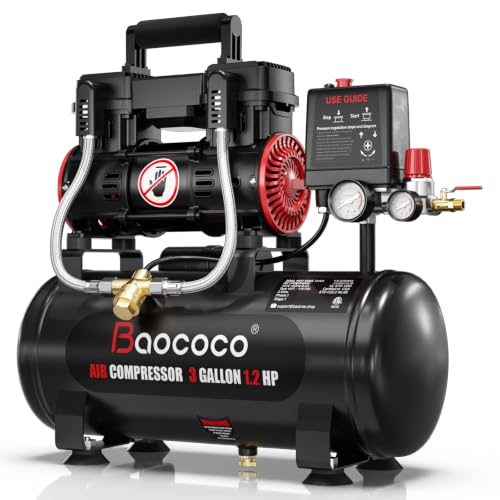
The Baococo 3-Gallon Ultra Quiet Air Compressor delivers up to 115 PSI at approximately 70dB, powered by a 1.2HP copper motor and an oil-free pump. With a 20-second recovery cycle, dual quick couplers, and integrated transport wheels, it is a practical, budget-friendly choice for indoor trim work, DIY repairs, and garage tire maintenance.
Pros
- Operates at roughly 70dB, allowing conversation and indoor use without deafening noise
- Rapid 20-second tank recovery cycle helps keep intermittent nailing projects moving
- Dual quick-connect couplers allow quick tool changes or running two air lines at once
- Built-in wheels and sturdy carry handle make rolling or lifting across the workspace easy
- Oil-free pump eliminates messy crankcase checks and prevents oil leaks during vehicle transport
Cons
- Maximum tank pressure tops out at 115 PSI, lower than 135 to 175 PSI contractor-grade units
- Manufacturer does not publish continuous CFM at 90 PSI, making it unsuited for continuous air tools like sanders or grinders
- Compact 3-gallon air reserve requires frequent motor cycling under rapid pneumatic demand
Compressor Source 2-3 HP Replacement Cast Iron Air
The Compressor Source CS2065A is a heavy-duty two-cylinder cast iron replacement pump delivering 7 CFM at 1180 RPM for 2 to 3 horsepower compressor setups. It offers garage DIYers and automotive mechanics a practical, budget-conscious way to rebuild failed compressor heads on tanks under 40 gallons.
Pros
- Durable cast iron twin-cylinder construction designed for steady garage and shop use
- Convenient oil sight glass eliminates guesswork during routine crankcase maintenance checks
- Delivers 7 CFM at 1180 RPM to support common automotive air tools and garage maintenance tasks
- Versatile electrical motor compatibility spanning 110V and 220V motors rated between 2 and 3 HP
Cons
- Bare pump configuration requires adapting your own discharge line, air intake filter, and drive belt setup
- Single-stage 7 CFM output is best suited for intermittent shop tools rather than continuous high-draw sandblasting
- At 37 pounds, mounting and shimming the pump on existing base plates requires careful mechanical alignment
Understanding Dual-Stage Air Compression Mechanics and Workshop Performance
A two-stage air compressor is a reciprocating pneumatic machine that compresses air in two distinct steps using separate cylinder bores to reach elevated operating pressures. Rather than forcing atmospheric air into a storage receiver in a single stroke, the pump utilizes an initial low-pressure cylinder followed by a secondary high-pressure stage. This progressive compression method enables stationary workshop units to reliably generate maximum operating pressures of 175 PSI or higher. Understanding this mechanical sequence clarifies why industrial workshops, automotive restoration bays, and production facilities rely on these robust systems over entry-level compressors.
How the Dual-Cylinder Compression Cycle Operates
Atmospheric air first enters the primary stage through an external intake filter where the larger cylinder bore performs initial compression. During the downward intake stroke, ambient air fills the chamber before the rising piston compresses it to an intermediate pressure ranging between 40 and 60 PSI. This intermediate pressure remains far below final tank storage levels, but it significantly concentrates air molecules before secondary compression begins. The primary piston displaces a substantial volume of air, making its bore diameter visibly larger than the secondary piston on the pump head.
After exiting the primary cylinder through Swedish steel or disc discharge valves, the warmed air passes directly into an external finned intercooler tube. This copper or aluminum cooling line allows ambient air generated by the pump flywheel fan to pull thermal energy out of the compressed stream before it reaches the secondary chamber. Lowering the air temperature increases its density while reducing the mechanical work required by the smaller secondary piston. Without this crucial intercooling step, the excessive heat of secondary compression would degrade pump oil, accelerate valve wear, and drastically reduce overall volumetric efficiency.
Once cooled, the denser air enters the secondary high-pressure cylinder, which features a narrower bore designed to handle significantly higher resistance. The secondary piston completes the final compression stroke, elevating line pressure to 175 PSI before directing the airflow into the stationary receiver tank. A spring-loaded discharge check valve prevents stored tank pressure from forcing air backward into the pump head once the stroke finishes. This progressive mechanical workload distributes mechanical stress evenly across the crankshaft, connecting rods, and piston wrist pins.
Single-Stage Versus Two-Stage Performance Tradeoffs
Single-stage compressors finish the compression cycle in a single stroke per cylinder, which naturally limits their efficient output ceiling to approximately 135 to 150 PSI. When a single-stage pump attempts to push beyond 150 PSI, internal cylinder heat increases exponentially, causing rapid thermal expansion and significant CFM delivery loss. Exploring our practical guide to two-stage air compressor mechanics illustrates how separating compression into distinct chambers overcomes this physical pressure threshold. Dual-stage pumps easily sustain 175 PSI, which provides a denser reserve of usable air inside stationary storage tanks.
Higher maximum tank pressure directly translates into an expanded volume of usable air before the motor pressure switch triggers cut-in cycles. A 60-gallon or 80-gallon tank pressurized to 175 PSI stores approximately one-third more air volume than the exact same tank filled to only 135 PSI. This massive energy cushion allows high-draw pneumatic tools to operate smoothly without suffering from immediate line pressure drops. While portable single-stage units serve small jobsite nailers effectively, demanding pneumatic tools require the sustained airflow volume that dual-stage engineering reliably supplies.
Thermal Management and the Critical Role of Intercooling
Compressing atmospheric air naturally generates intense heat as gas molecules are forced into tighter physical spaces under mechanical load. Single-stage pumps concentrate all of this thermal stress inside one cylinder head, which can lead to oil vaporization, piston ring scorching, and reed valve failure during heavy cycles. Two-stage pumps mitigate this thermal hazard by dividing total compression heat across two separate physical housings and an intermediate heat exchanger. Finned intercoolers expose the moving air column to the forced airflow of the pump pulley, shedding vital heat between compression strokes.
Cooler operating temperatures dramatically extend the working life of lubricating fluids, internal gaskets, and precision metal valves inside the pump. Operators should always consult our detailed guide on proper air compressor oil to ensure their dual-stage pump receives non-detergent synthetic lubricant capable of handling high compression loads. Quality lubricants like Ingersoll Rand All Season Select synthetic oil help maintain tight piston seal tolerances and prevent carbon buildup on valve plates across thousands of operating hours. Maintaining low pump head temperatures also reduces water condensation downstream by precipitating moisture before air reaches the distribution piping.
High-Demand Pneumatic Applications That Require Two-Stage Power
Pneumatic workshop tools operate under two distinct air consumption categories known as intermittent demand and continuous demand. Intermittent tools like framing nailers, brad nailers, and grease guns consume brief bursts of air and operate comfortably on small portable compressors. Continuous tools such as dual-action orbital sanders, die grinders, abrasive sandblasters, and HVLP paint spray guns pull continuous airflow measuring between 8 and 20 CFM at 90 PSI. Single-stage compressors quickly starve under this relentless draw, causing tool stalls, motor overheating, and uneven finish quality on workpieces.
Automotive repair bays and fabrication shops rely on dual-stage systems to keep multiple air tools functioning simultaneously across multiple service lines. For instance, heavy-duty 1/2-inch and 3/4-inch pneumatic impact wrenches require consistent line pressure above 90 PSI to break loose seized suspension components without hesitation. Dual-stage compressors supply both the required cubic feet per minute and the high-pressure head needed to drive air through long overhead piping networks. Consistent delivery prevents shop mechanics from waiting for small tanks to rebuild pressure between routine repair procedures.
Motor Horsepower, Electrical Demands, and Workshop Wiring
Industrial two-stage compressors require serious electrical power to turn heavy cast-iron flywheels against high cylinder backpressures. Most stationary models feature induction motors ranging from 3.7 continuous running horsepower up to 7.5 or 10 running horsepower. Unlike portable compressors that run on standard 120V household outlets, dual-stage systems almost universally require dedicated 208V, 230V, or 240V single-phase or three-phase electrical circuits. Attempting to run a heavy induction motor on an undersized electrical supply will cause frequent breaker trips, excessive motor heat, and eventual capacitor failure.
Understanding the difference between true continuous running horsepower and deceptive peak surge horsepower is critical when evaluating compressor specifications. Inexperienced buyers often fall for exaggerated consumer marketing that claims five or six horsepower from a standard 120V plug. High-capacity units like the Ingersoll Rand 2340N5-V feature a verified 5 HP continuous duty motor designed to draw appropriate amperage on a dedicated 230V service. Proper electrical installation ensures sufficient startup inrush current to overcome cold pump head pressures without damaging circuit components.
Cast-Iron Pump Construction, Valve Design, and Lubrication Systems
Heavy cast-iron pump heads provide the rigid structural mass necessary to absorb mechanical vibration and distribute operating heat safely. Premium replacement pumps like the NorthStar two-stage unit utilize FC35 grade cast iron for the pump head and cylinders to guarantee long-term wear resistance. High-grade Swedish steel floating valves resist fatigue and metal deformation caused by thousands of rapid flex cycles per minute. In contrast, lightweight aluminum pumps with thin steel liners wear out rapidly when subjected to demanding shop duty cycles.
Lubrication mechanisms also vary significantly between entry-level workshop compressors and high-end industrial systems. Most standard two-stage pumps utilize splash lubrication, where dippers attached to the connecting rods sling oil onto the cylinder walls and crankshaft bearings. Advanced industrial units, such as the EMAX 80-gallon stationary compressor, feature pressurized lubrication systems that pump oil directly into critical friction points. Controlled oil delivery minimizes mechanical friction, lowers internal operating temperatures, and extends overall bearing life under continuous industrial workloads.
Storage Receiver Capacity and Usable Air Buffer
Dual-stage pumps are almost exclusively mounted on large stationary vertical or horizontal receiver tanks ranging from 60 to 80 gallons or larger. Vertical tank configurations are especially popular in personal garages and professional repair shops because their compact upright footprint preserves valuable floor space. The Campbell Hausfeld 60-gallon vertical compressor, for example, occupies a modest 23-by-23-inch floor footprint while storing substantial air reserves. These tanks must carry ASME certification to guarantee that the steel vessel meets rigorous wall thickness and safety standards under 175 PSI pressures.
Storing air at 175 PSI creates an expansive buffer zone above the standard 90 PSI operating threshold required by most pneumatic tools. When air lines operate at regulated 90 PSI, the compressor tank can discharge pressure from 175 PSI down to its cut-in setting around 135 PSI before the pump motor even engages. This extensive buffer allows operators to finish critical sanding or spraying passes without experiencing fluctuating line pressures. Larger 80-gallon receivers provide even greater stability for facilities operating multiple pneumatic drops simultaneously across large shop layouts.
Comparing Complete Compressor Systems to Standalone Pump Heads
Workshop owners frequently face the choice of purchasing a complete factory turnkey compressor or assembling a custom unit using a standalone pump head. Complete turnkey packages from brands like DEWALT and Ingersoll Rand arrive with matched motors, pre-wired pressure switches, belts, and certified ASME receiver tanks ready for electrical hookup. These all-in-one machines eliminate guesswork regarding pulley sizing, motor RPM alignment, and safety valve ratings. They represent the most straightforward route for workshop owners who want immediate, reliable pneumatic power without complex mechanical assembly.
Experienced mechanics and shop builders often prefer sourcing replacement pump heads like the VEVOR 10HP dual-stage pump to rebuild existing stationary tanks. Installing a bare pump head allows custom tuning of motor pulley diameters, operating speeds, and CFM delivery curves to suit specific shop needs. However, custom installations require careful attention to belt alignment, flywheel rotation direction, and motor horsepower compatibility to prevent early mechanical failure. Ensuring that the electric motor can deliver sufficient running torque at operating RPM remains essential when building a custom setup.
Essential Routine Maintenance for Dual-Stage Compressors
Operating a high-pressure dual-stage compressor requires consistent preventative maintenance to preserve mechanical efficiency and protect the steel storage receiver. Compressing large volumes of ambient air generates substantial condensation inside the tank as warm air cools against the steel receiver walls. Operators should purge moisture daily through the bottom drain valve to prevent internal tank corrosion and keep liquid water out of pneumatic lines. Upgrading from a stiff factory thumb petcock to an accessible quarter-turn brass ball valve simplifies this daily draining chore significantly.
Regular pump maintenance involves inspecting the oil sight glass, cleaning intake air filters, and verifying V-belt tension across the motor and flywheel pulleys. Dust, overspray, and airborne debris can clog paper intake elements, restricting incoming air and starving the primary cylinder of necessary volume. Inspecting the mechanical unloader valve on the pressure switch ensures that head pressure releases cleanly whenever the motor cycles off. If the unloader valve fails, the motor will struggle against trapped head pressure during its next startup cycle, potentially tripping the main electrical breaker.
Practical Workshop Selection and Sizing Considerations
Selecting the correct dual-stage compressor depends directly on the CFM ratings of the most demanding pneumatic tools you intend to run. Calculate total air demand by summing the CFM requirements of all tools that will operate at the same time, then add a thirty percent safety margin. If your automotive spray gun demands 10 CFM and an orbital sander pulls 12 CFM, your shop requires a compressor delivering at least 28 CFM at 90 PSI. Oversizing your air delivery system slightly ensures the pump cycles periodically rather than running at continuous thermal redline throughout the workday.
Evaluating noise output, shop footprint, and electrical infrastructure will finalize your purchase decision and ensure a seamless installation process. Premium models like the EMAX Silent Air series incorporate specialized intake mufflers and lower pump RPMs to maintain conversation-level sound inside enclosed garages. Ensuring your workshop electrical panel can support a dedicated 230V 30-amp or 50-amp circuit will prevent costly wiring modifications down the road. Investing in a properly sized dual-stage air compressor delivers decades of dependable pneumatic power, making it the ultimate mechanical cornerstone of any serious workshop.
About the author
Clint DeBoer is an experienced tool-industry specialist with decades of involvement in technical media, hands-on product evaluation, and testing methodology. His focus on performance, practical usability, and data-driven comparisons makes his expertise highly relevant to professional air compressors, pneumatic tools, and workshop equipment.