
How to Determine Air Compressor Size: Sizing Guide for 2026
Learn how to determine air compressor size for tools and projects in October 2026 with practical CFM, PSI, and tank capacity calculations.
 By Kenny Koehler
Updated October 7, 2026
By Kenny Koehler
Updated October 7, 2026

Matching pneumatic tools to the wrong power source often leads to sudden pressure drop, continuous motor cycling, or complete tool stalls in the middle of a project. Operating a framing nailer or tire chuck requires only short bursts of air, but continuous tools like rotary sanders or paint sprayers rapidly drain stored tank air if the pump cannot maintain adequate volume. Learning how to determine air compressor size requires evaluating the relationship between delivered cubic feet per minute, maximum operating pressure, and storage tank buffer capacity. Understanding these fundamental mechanical ratings helps prevent equipment mismatch, tripped household circuit breakers, and premature pump motor wear.
Compressor manufacturers often highlight maximum pressure and storage volume on product packaging, yet air delivery measured in standard cubic feet per minute at operating pressure remains the true governing benchmark. A small portable trim compressor delivering 3.0 SCFM at 90 PSI handles brad nailers and tire inflation effortlessly, but running continuous shop tools requires a significantly larger air delivery system. Evaluating your highest-demand pneumatic tool and calculating adequate buffer margins ensures your compressor maintains reliable performance across daily garage tasks and demanding jobsite applications.
| Award | Product | ACR Score About ACR ScoreThe ACR Score is our own rating from 0 to 10, based on performance, design and build, ease of use, and value. It reflects independent research and is never influenced by manufacturers, retailers, or affiliate commissions. Learn more › | |
|---|---|---|---|
| Best Overall |
DEWALT Cordless Tire Inflator Portable Air
|
9.1/10 | Buy |
| Best Value |
 CARSUN AC/DC Portable Tire Inflator
|
8.8/10 | Buy |
| Best Premium |
 GSPSCN Dual-Cylinder 12V Tire Inflator
|
8.8/10 | Buy |
 DEWALT DXCM024-0443 21-Piece Accessory Kit
|
8.6/10 | Buy | |
| Best Budget |
 WYNNsky 7-Piece Air Blow Gun Accessory Kit
|
8.4/10 | Buy |
 DEWALT DWFP55130 2.5-Gallon 200 PSI Quiet Trim Air
|
8.4/10 | Buy | |
 AZUNO 200 PSI Digital Tire Inflator Gauge
|
8.0/10 | Buy | |
 Hausse 1/4-Inch NPT Air Compressor Kit
|
7.8/10 | Buy |
DEWALT Cordless Tire Inflator Portable Air
This compact DEWALT portable tire inflator delivers up to 150 PSI with smart auto shut-off, powered by an internal rechargeable battery or an included 10-foot 12V car plug. It provides an efficient, pocket-sized solution for vehicle owners, cyclists, and DIYers wanting rapid roadside top-offs without hauling a bulky tank compressor.
Pros
- True cordless freedom with an internal rechargeable battery plus a 10-foot 12V DC vehicle plug backup
- Accurate digital pressure gauge with 5 smart presets and automatic shut-off to eliminate overinflation
- Ultra-compact handheld design weighing just 0.63 kg for easy storage in glove boxes or saddlebags
- Integrated LED work light and emergency USB power bank functionality for travel safety
- Generous accessory bundle backed by a 3-year limited warranty
Cons
- Engineered exclusively for high-pressure inflation rather than operating pneumatic air tools or nailers
- Does not include a 120V AC residential wall outlet power adapter
- Compact tankless pump requires periodic cooling breaks during heavy multi-tire inflation runs
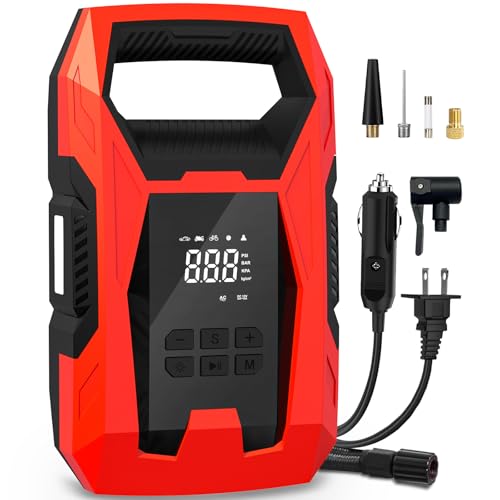
CARSUN AC/DC Portable Tire Inflator
Equipped with dual power inputs for 110V household outlets and 12V car sockets, this portable compressor delivers up to 150 PSI with auto-shutoff presets. It is a practical solution for drivers, cyclists, and households needing dependable inflation for standard vehicle tires and sports gear.
Pros
- Dual 110V AC and 12V DC power compatibility
- Automatic shutoff with memory preset function
- Clear backlit screen visible in direct sunlight
- Integrated LED light for nighttime emergencies
- Includes multiple adapters and dedicated carrying bag
Cons
- Not compatible with truck, tractor, or SUP board tires
- Requires 10-minute cooldown after 15 minutes of use
GSPSCN Dual-Cylinder 12V Tire Inflator
Built with an all-metal dual-cylinder motor, this 12V portable compressor delivers a fast 70 L/Min airflow alongside a digital auto shut-off gauge. It is an ideal roadside tool for drivers needing rapid inflation for cars, SUVs, and light trucks without excessive vibration.
Pros
- Fast 70 L/Min dual-cylinder airflow
- Durable all-metal motor and cylinder construction
- Automatic shut-off prevents accidental over-inflation
- Includes 11.5-foot extension hose and carry bag
- Anti-slip base stabilizes pump during operation
Cons
- Relatively heavy to carry at 6.5 pounds
- Requires a wired 12V connection without cordless option
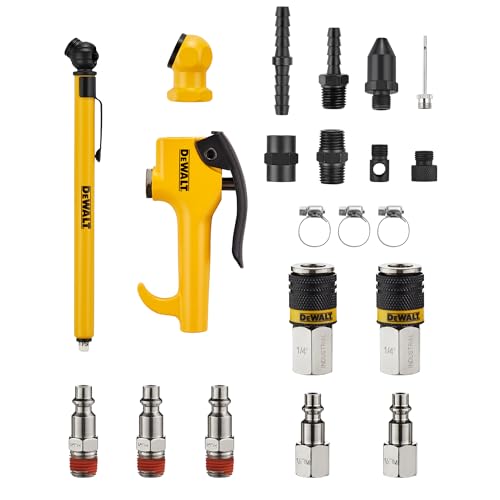
DEWALT DXCM024-0443 21-Piece Accessory Kit
Equipped with essential pneumatic fittings, this starter set pairs an OSHA-compliant blowgun with standard industrial couplers and tire inflation accessories. It is well suited for workshop owners and DIYers needing basic connection and maintenance hardware.
Pros
- OSHA-compliant venturi tip enhances blowgun safety
- Broad compatibility with 1/4-inch industrial connections
- Includes hardware for quick air hose repairs
- Versatile assortment covers cleaning and basic inflation
Cons
- Pencil pressure gauge limited to 60 PSI
- Does not include a main air hose
WYNNsky 7-Piece Air Blow Gun Accessory Kit
Equipped with five interchangeable nozzles and an extension tube, this pneumatic kit handles detailed cleaning and inflation around workshops and garages. The trigger-operated air gun includes a soft rubber tip that safeguards finished surfaces while clearing dust from narrow gaps.
Pros
- Versatile nozzle set handles varied inflation and cleaning needs
- Soft rubber tip prevents scratching delicate surfaces
- Extended tube reaches recessed spaces easily
- Extremely lightweight construction reduces hand fatigue
Cons
- Maximum working pressure capped at 90 PSI
- Not suited for high-pressure industrial compressor setups
DEWALT DWFP55130 2.5-Gallon 200 PSI Quiet Trim Air
The DEWALT DWFP55130 delivers a capable 3.0 SCFM at 90 PSI with a 200 max PSI 2.5-gallon tank, running at a quiet 71.5 dBA on an efficient 12-amp motor. It is an ideal pneumatic power source for trim carpenters, punch-list contractors, and DIYers working on residential circuits.
Pros
- Delivers 3.0 SCFM at 90 PSI with a high 200 max PSI ceiling for rapid pressure recovery during sequential fastening
- Quiet 71.5 dBA sound output makes indoor trim carpentry and remodeling far less disruptive to homeowners
- Low 12-amp draw reduces breaker trips when running on shared 15-amp household circuits
- Integrated roll cage and console protect critical components while supporting horizontal or vertical operation
- Dual quick couplers allow two trim carpenters to connect and work off a single compressor
Cons
- Bare-tool configuration means you must supply your own air hoses, couplers, and pneumatic nail guns
- At 36 pounds, it is heavier to haul up flights of stairs than ultra-compact 1-gallon finish compressors
- Air output of 3.0 SCFM is built for intermittent finish fastening and will not support continuous tools like rotary sanders or sprayers
AZUNO 200 PSI Digital Tire Inflator Gauge
The AZUNO Digital Tire Inflator Gauge is a heavy-duty pneumatic accessory rated up to 200 PSI with 0.1 PSI resolution, designed to attach directly to your workshop air compressor. It offers single-handed inflate and deflate control with a backlit display, making it a reliable tool for DIY mechanics and home garage owners.
Pros
- Clear digital readout with 0.1 PSI resolution and 1 percent rated precision eliminates guesswork.
- Integrated deflation valve allows quick tire pressure adjustment without disconnecting the chuck.
- Heavy-duty brass and steel construction stands up well to regular garage workshop use.
- Hands-free lock-on chuck secures firmly to valve stems to stop annoying air leakage during inflation.
Cons
- Requires an active air compressor air supply to inflate tires; only functions as a pressure gauge without shop air.
- Digital display depends on internal batteries that require periodic replacement over time.
- The attached rubber whip hose is standard length and may require bringing your main air hose closer to the wheel.
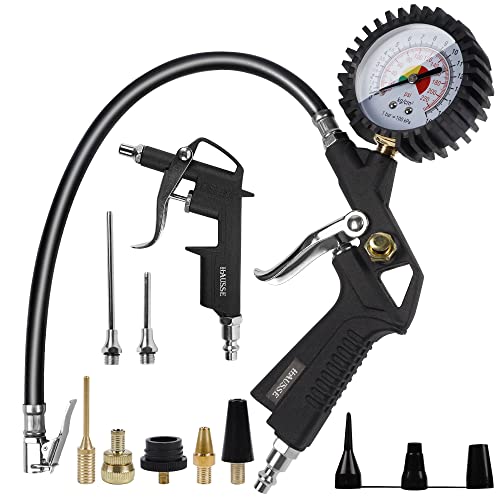
Hausse 1/4-Inch NPT Air Compressor Kit
This versatile accessory bundle combines an all-metal blow gun with a dial-gauge tire inflator designed for standard 1/4-inch NPT compressor connections. It is well suited for routine workshop maintenance, filling vehicle tires, and inflating sports gear.
Pros
- Durable, corrosion-resistant all-metal construction
- Gauge displays pressure even when unhooked from air
- Built-in release valve bleeds excess air easily
- Comprehensive accessory set fits bikes, tires, and balls
- Compatible with standard 1/4-inch NPT fittings
Cons
- Operating pressure capped at 140 PSI
- Analog dial gauge lacks digital precision
Practical Engineering Guide to Sizing an Air Compressor for Any Application
Determining the right air compressor size is the single most critical step in establishing a functional pneumatic setup for home workshops, garages, or jobsites. Selecting an undersized compressor causes frequent motor cycling, frustrating tool stalling, and severe line pressure drop, while an oversized model wastes valuable floor space. Accurately sizing a compressor requires evaluating three primary technical factors: air delivery volume, operating pressure, and storage tank buffer capacity.
Understanding CFM and SCFM Air Delivery at Operating Pressure
Air delivery volume is the primary metric that dictates which pneumatic tools a compressor can successfully operate. Air flow is measured in cubic feet per minute (CFM), indicating the volume of compressed air delivered under specific pressure conditions. Manufacturers typically rate performance in standard cubic feet per minute (SCFM), which standardizes measurements based on sea-level barometric pressure, standard temperature, and relative humidity.
The critical factor in CFM ratings is the pressure at which the pump delivers that volume. Most pneumatic tools operate at 90 PSI, making it the universal benchmark for automotive wrenches, framing nailers, and grinders. A pump producing 4.0 CFM at 40 PSI might deliver only 2.8 CFM at 90 PSI. When evaluating pump capabilities, always verify the delivered CFM specifically measured at 90 PSI rather than zero-pressure displacement ratings.
Calculating Air Tool CFM Requirements and the Safety Margin
To calculate needed compressor capacity, identify the tool in your collection requiring the highest sustained air consumption. Intermittent tools such as brad nailers consume minimal air, typically requiring between 0.3 and 1.0 CFM at 90 PSI during standard firing. Continuous-draw tools such as dual-action orbital sanders and HVLP spray guns demand between 8.0 and 15.0 CFM at 90 PSI. Automotive impact wrenches occupy a middle tier, generally consuming between 4.0 and 6.0 CFM at 90 PSI during fastener removal.
After identifying your highest-demand pneumatic tool, apply a sizing safety buffer to determine minimum pump output. Multiply the tool rated CFM at 90 PSI by 1.25 for intermittent use, or by 1.5 for continuous workshop applications. An impact wrench requiring 5.0 CFM at 90 PSI multiplied by 1.25 yields a target compressor output of at least 6.25 CFM at 90 PSI. This buffer accounts for line friction, minor hose leaks, and temperature variations that reduce volumetric efficiency.
If you plan to run multiple pneumatic tools simultaneously, add their individual CFM ratings together before calculating your safety buffer. Two framing nailers operating simultaneously on a jobsite draw approximately 4.0 to 5.0 CFM combined during rapid bump-firing. Sizing the compressor to exceed combined air consumption prevents line starvation and ensures consistent fastener driving across all connected tools.
The Function of Tank Capacity and Usable Storage Buffers
Compressor tank capacity is measured in gallons and represents stored air reserve rather than continuous air generation. A common misconception is that a large tank compensates for an undersized motor. A large tank permits high-draw tools to operate for short bursts, but an undersized pump cannot refill the reservoir quickly enough during continuous work. The pump produces the air, while the tank functions strictly as a storage buffer.
Tank volume becomes critical when running tools with intermittent demand spikes that momentarily exceed pump output. A trim compressor with a 2.5-gallon tank and 3.0 SCFM delivery handles finish nailers easily because the pump recovers between cycles. Using a high-draw sander on that small tank depletes stored air in seconds, causing immediate pressure drop and continuous pump cycling. Fastening tasks work well on 1 to 6-gallon tanks, whereas continuous tools require 20 to 60-gallon reservoirs.
Maximum tank pressure also dictates how much usable air a tank holds before the motor cycles on. A high-pressure unit operating up to 200 PSI stores substantially more air in a 2.5-gallon tank than a standard 135 PSI unit of identical size. This higher pressure increases the differential between tank cut-out and regulated tool pressure, extending runtime between motor recovery cycles.
Operating Pressure, Regulator Stability, and Line Friction
Pneumatic equipment requires regulated air pressure matched to manufacturer specifications for proper operation and tool protection. Most compressors include a dual-gauge manifold displaying internal tank pressure alongside regulated working pressure. Working pressure is dialed in using an adjustable regulator knob controlling line output. While standard shop accessories operate near 90 PSI, delicate finish nailers may need 70 PSI, and heavy truck tires require over 100 PSI.
Friction inside air delivery lines causes dynamic pressure drops that reduce tool performance during trigger pull. Air moving through a standard 50-foot hose encounters internal resistance that drops pressure at the tool inlet. Narrow 1/4-inch inner diameter hoses over long distances can produce pressure drops of 10 to 15 PSI under load. Upgrading to a 3/8-inch inner diameter air hose reduces flow resistance, delivering full regulated pressure to the tool.
Couplers, manifold fittings, and blow gun nozzles also create flow restrictions if undersized. Standard 1/4-inch NPT couplers work well for light fastening and basic tire inflators. High-draw pneumatic tools perform better with high-flow couplers that preserve internal orifice diameter and maintain steady line pressure.
Duty Cycle Ratings and Pump Thermal Management
Every air compressor pump operates under a duty cycle rating defining how long the motor can run safely under load. Most consumer portable compressors feature a 50 percent duty cycle, meaning the pump should run no more than 30 minutes per hour. Operating a 50 percent duty cycle unit continuously generates intense friction heat that degrades piston seals. Commercial two-stage compressors often feature 75 to 100 percent ratings for continuous shop operation.
An undersized compressor risks premature failure because continuous tool demand forces the pump beyond its engineered duty cycle. Constant running creates extreme cylinder head temperatures that can trigger thermal overload protectors and damage motor windings. Sizing the pump properly allows the unit to reach cut-out pressure quickly and rest between work cycles.
Pump mechanism design directly affects heat dissipation and maintenance requirements. Modern oil-free dual-piston pumps use Teflon-coated compression rings that eliminate oil changes while operating at lower motor speeds. Oil-free units excel in cold-weather conditions and light residential use, but cast-iron oil-lubricated pumps remain superior for heavy shop duty. Splash-lubricated cast-iron cylinders dissipate operational heat efficiently, providing durable performance under frequent cycling.
Electrical Circuit Requirements and Motor Power Draw
Electrical power availability is a major factor when sizing an air compressor for residential garages or jobsites. Standard household outlets supply 120 volts on 15-amp branch circuits, limiting continuous motor wattage. Electric motors produce substantial inrush current when starting under load, which can trip standard household circuit breakers. Portable compressors engineered with low-draw 12-amp motors ensure reliable startup on shared 15-amp household circuits.
Larger compressors delivering 10 CFM or more at 90 PSI generally require dedicated 240-volt circuits with 20-amp or 30-amp breakers. Running a large motor on an inadequate circuit leads to voltage drop, motor humming, and tripped breakers. Using long, light-gauge extension cords worsens voltage drop and risks motor damage. Plug the compressor directly into a wall outlet and use longer air hoses to reach your work area.
When tasks are limited to tire maintenance or roadside inflation, dedicated 12V DC inflators offer a practical sizing alternative. High-pressure portable inflators with dual-cylinder metal motors connect to vehicle accessory sockets, delivering up to 150 PSI without garage storage demands. While 12V inflators cannot drive air tools due to the lack of a storage tank, they handle tires and sports equipment efficiently. Choosing a compact inflator prevents overspending on a bulky workshop compressor when inflation is your only requirement.
Matching Compressor Form Factors to Specific Applications
Compressor form factor dictates portability, workspace footprint, and storage convenience. Compact pancake and trim compressors weighing under 40 pounds feature low-profile tanks and protective roll cages, making them ideal for mobile carpenters. Their 2 to 6-gallon tanks fit easily into vehicles and provide ample air for brad nailers, tire topping, and blow gun dusting. Their compact size limits continuous CFM output, making them unsuitable for continuous sanding or automotive grinding.
For automotive maintenance and garage tasks, mid-sized horizontal or vertical wheeled compressors with 10 to 30-gallon tanks offer balanced versatility. These units deliver between 4.0 and 6.0 CFM at 90 PSI, allowing mechanics to run 1/2-inch impact wrenches and air ratchets. Integrated wheels facilitate easy movement around work bays, while larger tanks stabilize line pressure during mechanical jobs. Vertical tanks minimize floor footprint, preserving valuable garage space while storing substantial air reserves.
Stationary upright compressors with 60 to 80-gallon vertical tanks represent the benchmark for dedicated production shops and auto restoration. Equipped with heavy single-stage or two-stage pumps, these units generate 12 to 18 CFM at 90 PSI to support continuous sanders and spray guns. Stationary units require dedicated 240-volt electrical wiring and permanent air delivery plumbing. Sizing up to a stationary system is necessary only when daily workloads exceed the capabilities of portable 120-volt equipment.
Condensation Management and Tank Drainage Maintenance
Compressing ambient air naturally generates moisture that condenses inside the steel tank as pressure rises. Standing moisture inside the vessel reduces usable air volume and accelerates internal rust that can weaken tank walls. Condensation entering air lines also washes away tool lubricants, causing premature wear in pneumatic ratchets and nailers. Sizing a compressor with an easily accessible drain valve makes regular moisture draining a simple daily routine.
Modern compressors utilize either quarter-turn brass ball valves or threaded needle petcocks on the tank bottom. Quarter-turn ball valves open easily by hand, allowing fast and thorough drainage without needing pliers. Depressurize the tank to approximately 10 to 20 PSI before opening the valve to eject moisture cleanly. Installing an in-line moisture separator on your air line provides added protection for sensitive spray finishing and air tools.
Step-by-Step Compressor Sizing Checklist for Buyers
To finalize your sizing calculation, begin by listing every pneumatic tool you plan to operate. Record each tool operating pressure and maximum CFM consumption rating, focusing on high-demand equipment. Identify the highest CFM requirement on your list and multiply by 1.25 for intermittent use or 1.5 for continuous tools. This calculated figure represents your minimum required CFM delivery at 90 PSI, establishing the core pump rating you need.
Next, evaluate your available electrical circuits to verify whether your garage supports a 120-volt 15-amp unit or requires a dedicated line. Select a tank size based on tool usage patterns, opting for 1 to 6-gallon tanks for nailing or 20 to 60-gallon tanks for automotive tools. Factor in noise requirements, choosing quiet models operating near 70 dBA for indoor residential workspaces. Following this systematic process guarantees your selected air compressor provides reliable power without frustrating performance limits.
About the author
Kenny Koehler is a power-tool specialist with more than a decade of hands-on evaluation experience and a science-based approach to product testing. His expertise in repeatable testing, tool performance, impact wrenches, and professional equipment brings a practical, data-focused perspective to compressor and pneumatic-tool comparisons.