
Do Air Compressors Come With Hoses? What You Need to Know for 2026
Do air compressors come with hoses? Explore what comes in the box in October 2026 and how to choose the right pneumatic line for your tools.
 By Kenny Koehler
Updated October 7, 2026
By Kenny Koehler
Updated October 7, 2026

Opening a fresh compressor box often brings an unexpected surprise when buyers find an empty manifold port staring back at them. Many first-time buyers naturally wonder, do air compressors come with hoses straight from the factory? In most cases, standalone portable and stationary compressors ship as bare units without an air line, quick-connect couplers, or pneumatic tools. Manufacturers leave the discharge port bare because pneumatic applications vary wildly, meaning a finish carpenter running a 23-gauge pin nailer needs a completely different setup than an automotive mechanic powering a high-torque impact wrench. Understanding what arrives in the package helps prevent unexpected jobsite delays and ensures you acquire the right fittings before turning on the pressure switch.
While select multi-tool starter kits package an entry-level recoil line, standard workshop and jobsite compressors require you to supply your own delivery hose and couplers. Getting your pneumatic setup running smoothly involves mastering the air compressor hose connection process and matching line diameter to your tool CFM demand. Using an undersized or restrictive air line chokes airflow, creating dynamic pressure drop that stalls continuous tools like sanders and paint sprayers. Equipping your tank with a durable hybrid polymer or reinforced polyurethane line ensures reliable pressure delivery right where the work happens.
| Award | Product | ACR Score About ACR ScoreThe ACR Score is our own rating from 0 to 10, based on performance, design and build, ease of use, and value. It reflects independent research and is never influenced by manufacturers, retailers, or affiliate commissions. Learn more › | |
|---|---|---|---|
| Best Overall |
SARDVISA 22-Piece Kit with 25-Ft PU Hose
|
9.2/10 | Buy |
| Best Budget |
 YOTOO 1/4-Inch x 25-Foot Polyurethane Recoil Air
|
9.2/10 | Buy |
| Best Value |
 YOTOO 3/8-Inch x 50-Foot Hybrid Air Hose
|
8.6/10 | Buy |
 FYPower 18-Piece Air Compressor Accessories Kit
|
8.6/10 | Buy | |
| Best Premium |
 Flexzilla 3/8 in. x 50 ft. Hybrid Polymer Air Hose
|
8.6/10 | Buy |
 ELEGICKLIP 25ft Coiled Air Compressor Hose
|
8.4/10 | Buy | |
 WYNNsky 3/8-Inch x 25ft PVC Air Hose Kit
|
8.4/10 | Buy | |
 RainBello 25-Ft 1/4-Inch Polyurethane Air Hose
|
8.3/10 | Buy | |
 FYCQER 25-Foot Coiled Air Hose (1/4 Inch)
|
8.1/10 | Buy | |
 YOTOO 3/8-Inch x 50-Foot Hybrid Air Hose
|
8.1/10 | Buy |
SARDVISA 22-Piece Kit with 25-Ft PU Hose
This 22-piece accessory bundle equips home garages and workshops with standard 1/4-inch NPT fittings, dual chucks, and a metal blow gun. Its standout component is a 25-foot coiled PU hose featuring detachable ends that allow easy trimming and repair if damaged.
Pros
- Repairable PU hose design saves replacement costs
- Comprehensive 22-piece selection for inflation and cleaning
- Sturdy metal blow gun supports high air capacity
- Universal 1/4-inch NPT fittings ensure wide compatibility
Cons
- Recommended working pressure is capped at 120 PSI
- Coiled spring hose can limit practical working reach
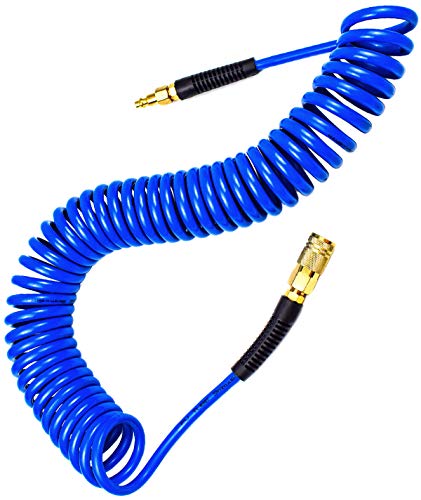
YOTOO 1/4-Inch x 25-Foot Polyurethane Recoil Air
The YOTOO 1/4-inch by 25-foot polyurethane recoil air hose provides a lightweight, tangle-resistant pneumatic connection rated for up to 150 PSI. Equipped with pre-installed 1/4-inch industrial quick-connect fittings and flexible operation down to -40 degrees Fahrenheit, it is a convenient, space-saving accessory for garage hobbyists, trim carpenters, and workbench setups.
Pros
- Self-retracting coil design eliminates manual hose winding and prevents messy shop floor clutter
- Comes ready to work with factory-installed 1/4-inch industrial quick-connect coupler and plug
- Retains pliability in freezing conditions down to -40 degrees Fahrenheit
- Durable bend restrictors protect high-wear junction points from premature cracking or kinking
- Lightweight polyurethane build significantly minimizes hand and wrist fatigue during detailed tool work
Cons
- 1/4-inch inner diameter restricts airflow volume required for continuous high-demand tools like dual-action sanders or spray guns
- Coil tension increases when stretched near the full 25-foot reach, which can pull back against lightweight pneumatic tools
- Not intended for severe rough-framing jobsite abuse where heavy-duty reinforced rubber hoses are typically preferred
YOTOO 3/8-Inch x 50-Foot Hybrid Air Hose
The YOTOO 3/8-inch by 50-foot hybrid air hose combines rubber flexibility with lightweight PVC durability, handling up to 300 PSI for high-demand shop tools. Equipped with pre-installed 1/4-inch brass fittings and bend restrictors, it is an ideal upgrade for DIYers, garage mechanics, and woodworkers looking to minimize line pressure drop.
Pros
- 3/8-inch inner diameter supplies greater air volume to impact wrenches, inflators, and nailers than narrower hoses
- Comes ready to use straight from the box with pre-installed brass coupler and industrial plug fittings
- Hybrid construction resists kinks and coils flatter than rigid PVC air hoses
- Bend restrictors protect the hose ends from bending fatigue near tool connections
Cons
- Hybrid polymer can still experience slight stiffness in near-freezing winter garage temperatures compared to premium 100% rubber hoses
- Factory-installed 1/4-inch standard industrial couplers may need replacement if your shop runs dedicated high-flow V-style fittings
- At 50 feet, it requires thoughtful coiling or an air hose reel to prevent workshop floor clutter
FYPower 18-Piece Air Compressor Accessories Kit
The FYPower 18-Piece Air Compressor Accessories Kit combines a 25-foot recoil poly hose rated at 120 PSI with standard Industrial Type M brass and steel fittings, a 100 PSI tire gauge, and multi-tip blow gun attachments. It serves as an accessible starter set for garage DIYers and homeowners handling benchtop cleanups and routine tire maintenance.
Pros
- Comprehensive all-in-one starter bundle covers inflation, dusting, and standard airline connections
- Self-coiling 25-foot polyurethane recoil design retracts automatically to prevent shop floor clutter
- Standard 1/4-inch Industrial Type M couplers and plugs match standard American garage air setups
- Supplied with solid brass fittings and thread sealing tape to help prevent immediate airline leaks
Cons
- The 120 PSI maximum working pressure rating is unsuitable for high-pressure systems operating above standard home compressor thresholds
- The 1/4-inch inner diameter recoil hose introduces airflow restriction that may starve continuous high-CFM air tools like impact wrenches or grinders
- Recoil polyurethane hoses pull back with spring tension during extended reaching across large work areas
Flexzilla 3/8 in. x 50 ft. Hybrid Polymer Air Hose
The Flexzilla 3/8 in. x 50 ft. air hose combines an all-weather hybrid polymer build with a 300 PSI working pressure rating, remaining completely flexible from -40°F to 140°F. It is an exceptional upgrade for woodworkers, trim carpenters, auto mechanics, and DIY homeowners seeking kink-free pneumatic performance.
Pros
- Lays flat immediately with zero memory, making uncoiling and end-of-day cleanup effortless
- Maintains full flexibility in sub-freezing temperatures down to -40 degrees Fahrenheit without cracking or stiffening
- Larger 3/8-inch internal diameter reduces line restriction compared to common 1/4-inch hoses
- Aircraft-grade aluminum fittings resist crushing and feature durable protective bend restrictors
Cons
- Vibrant green exterior readily shows oil, grease, and shop grime over extended garage use
- Aluminum threads require careful hand-threading to avoid cross-threading compared to traditional heavy brass
- Requires separate quick-connect couplers and plugs to connect to an air compressor and pneumatic tools
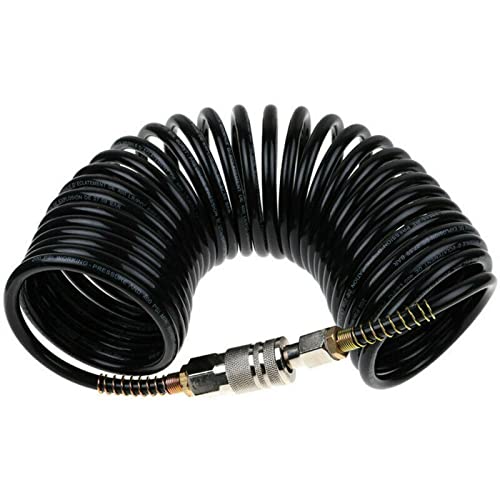
ELEGICKLIP 25ft Coiled Air Compressor Hose
Equipped with solid copper connectors and bend restrictors, this coiled PE hose delivers tangle-free flexibility for workshop air tools. Its standard quarter-inch quick coupler provides immediate compatibility for automotive and home garage projects.
Pros
- Solid copper connectors offer durable connections
- Bend restrictors reduce strain at the joints
- Coiled profile keeps work areas clear
- Pre-attached quick coupler allows immediate use
Cons
- Polyethylene hose material is stiffer than rubber
- Narrow 5mm diameter limits high-volume air tools
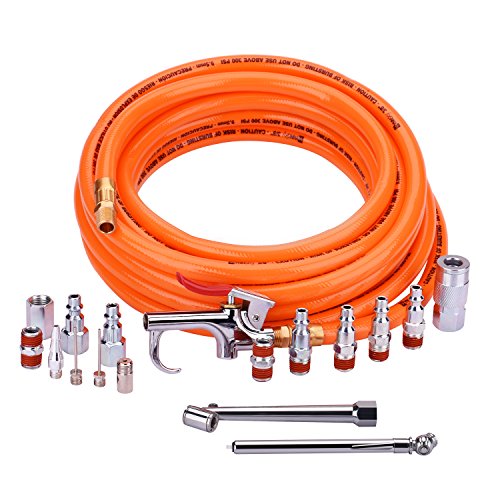
WYNNsky 3/8-Inch x 25ft PVC Air Hose Kit
Equipped with a lightweight PVC hose and a 17-piece accessory bundle, this package delivers the essential fittings needed for home workshop DIY projects. Solid brass connections ensure dependable seals, supported by a 300 PSI maximum working pressure.
Pros
- Solid brass fittings resist corrosion and seal reliably
- Complete accessory set provides essential starter fittings
- Lightweight hose design allows easy transport and handling
- Handles up to 300 PSI maximum working pressure
Cons
- 25-foot length provides limited reach across larger workshops
- PVC construction is typically less flexible than rubber hoses
RainBello 25-Ft 1/4-Inch Polyurethane Air Hose
The RainBello 25-foot 1/4-inch reinforced polyurethane air hose delivers high flexibility and a 300 PSI working pressure rating for garage workshops and trim jobs. Equipped with factory brass swivel fittings and quick-connect hardware, it provides a reliable, kink-resistant connection for DIYers and finish carpenters.
Pros
- Braided polyurethane outer jacket resists scuffing, kinking, and twisting
- Factory-installed 1/4-inch brass swivel fittings and quick-connect couplers save setup time
- Substantial 300 PSI working pressure rating handles common pneumatic tasks
- Remains pliable in sub-freezing temperatures down to -40°F
Cons
- A 1/4-inch internal diameter restricts airflow volume for continuous high-CFM tools like dual-action sanders
- The 25-foot length may limit reach across larger multi-bay automotive garages without an additional extension
FYCQER 25-Foot Coiled Air Hose (1/4 Inch)
Built from flexible polyurethane, this self-storing coiled hose extends your reach up to 25 feet without tangling. Its 300 PSI rating and pre-sealed brass fittings make it a dependable pick for light garage work and tire inflation.
Pros
- Pre-sealed brass fittings ensure secure, leak-resistant connections
- Compact coil profile snaps back quickly for easy storage
- Rated up to 300 PSI for high-pressure tools
- Wide operating temperature range prevents cold-weather kinking
Cons
- Coil tension may pull back when stretched near 25 feet
- 1/4-inch inner diameter limits high-CFM air tools
- 25-foot length may feel short for larger workshop layouts
YOTOO 3/8-Inch x 50-Foot Hybrid Air Hose
The YOTOO 3/8-inch by 50-foot hybrid air hose combines blended rubber and PVC for flexible, kink-resistant performance up to 300 PSI working pressure. Equipped with 1/4-inch industrial quick couplers and protective bend restrictors, it offers DIYers, finish carpenters, and garage mechanics an accessible, ready-to-work pneumatic upgrade.
Pros
- Pre-assembled with 1/4-inch industrial quick-connect fittings for direct out-of-the-box operation
- Substantial 300 PSI maximum working pressure easily accommodates standard 90 to 150 PSI compressor setups
- Larger 3/8-inch inner diameter helps maintain steady airflow to high-draw pneumatic tools
- Integrated bend restrictors protect hose ends from bending fatigue and premature cracking
- Hybrid polymer blend offers a lightweight balance between rugged rubber durability and PVC maneuverability
Cons
- Standard 1/4-inch end fittings create a slight flow constriction on high-volume 3/8-inch air lines
- Hybrid material can feel somewhat stiffer in freezing winter temperatures compared to pure vulcanized rubber
- Lacks swivel fittings, which may require manual uncoiling to prevent line twist during extended runs
The Complete Guide to Air Compressor Hose Inclusion, Sizing, and Setup
Unpacking a brand-new air compressor often brings an immediate surprise when buyers find an open discharge port on the regulator manifold. Standalone air compressors generally do not come with hoses, leaving operators to supply their own pneumatic delivery lines. Only select multi-tool starter combo kits and compact emergency tire inflators package an air line inside the carton. Understanding how manufacturers distribute pneumatic equipment helps you avoid project delays and ensures you acquire the proper hose, fittings, and couplers for your specific air tools.
What Ships in the Box with a New Air Compressor?
Standalone air compressors designed for residential workshops, construction sites, and automotive garages arrive as bare machines. When you purchase an individual pancake, hot dog, twin-stack, or upright stationary compressor, the carton contains only the compressor pump and tank assembly, an air intake filter, rubber isolator feet, and the instruction manual. The discharge manifold typically ends in an open regulator port or a single uncoupled brass fitting. You will not find an air line, blow gun, tire chuck, or pneumatic nailer inside the carton of a standalone machine.
Combo kits represent the primary exception to this bare-machine packaging standard across the tool industry. Manufacturers frequently bundle compact 6-gallon pancake compressors with one to three finish nailers, adding a basic 25-foot air hose and entry-level steel couplers into the box. These all-in-one bundles cater to DIY homeowners and trim carpenters seeking an immediate starter solution without purchasing fittings separately. However, the included lines in these kits are usually basic PVC or thin recoil hoses intended strictly for light fastening rather than demanding garage tools.
Why Manufacturers Omit Air Hoses from Standalone Units
Equipment manufacturers omit air lines from standalone units because pneumatic requirements differ dramatically across distinct trades and applications. A finish carpenter installing baseboards in a finished home demands a lightweight, highly flexible, non-marring hose that will not scratch delicate woodwork. Conversely, an automotive technician running a high-torque impact wrench requires a wide-diameter, abrasion-resistant line that minimizes dynamic friction drop under continuous air consumption. Supplying one default hose model in the box would inevitably fail to satisfy the diverse needs of different buyers.
Fitting profiles and workshop air distribution layouts also vary widely among pneumatic equipment users. While the 1/4-inch Industrial Milton M-style coupler remains standard for residential hobbyists, automotive repair bays often run high-flow V-style fittings to maximize tool power. Including a pre-crimped hose with factory fittings would force experienced buyers to cut lines or install adapters to match their existing tools. Omitting the air hose allows manufacturers to keep compressor purchase prices competitive while giving craftspeople the freedom to choose their preferred line diameter, length, and coupler standard.
Comparing Modern Air Hose Materials for Workshop Use
Selecting an aftermarket air line requires understanding how different construction materials behave under workshop conditions. Traditional PVC hoses offer an economical, lightweight option that resists water and common shop lubricants well. However, standard PVC possesses stiff material memory that makes the line coil stubbornly during daily use. It also becomes remarkably rigid in cold ambient temperatures, making it awkward to unroll and maneuver across unheated garage floors during winter projects.
Hybrid polymer air lines, constructed from blended rubber and PVC compounds, have quickly become the preferred choice for versatile home and jobsite use. Premium hybrid hoses, like the Flexzilla and YOTOO models, maintain exceptional all-weather flexibility from negative 40 degrees up to 140 degrees Fahrenheit. Because hybrid polymer has zero memory, the hose uncoils easily and lays completely flat on the floor without kinking under full tank pressure. Technicians appreciate this pliable behavior when maneuvering around automotive lifts, tight engine bays, and finished residential interiors.
Reinforced polyurethane provides another high-performance option by combining extreme abrasion resistance with remarkably low carry weight. Braided polyurethane hoses, such as the RainBello 25-foot line, handle up to 300 PSI working pressure while weighing far less than traditional rubber lines. Polyurethane resists scuffing across rough concrete, gravel, and subflooring without developing surface cracks or pinhole leaks. For mobile repair technicians and roofing crews who carry air lines up ladders, polyurethane delivers long-lasting durability without adding unnecessary physical fatigue.
How Hose Diameter and Length Dictate Air Tool Performance
Matching the inner diameter of your air hose to your pneumatic tool air volume consumption is critical for avoiding power loss. Air lines for consumer compressors generally feature either a 1/4-inch or 3/8-inch inner diameter. A 1/4-inch hose works exceptionally well for low-demand, intermittent tools like finish nailers, brad nailers, air blow guns, and small inflation chucks. If your primary goal involves filling vehicle tires with a small compressor, a 1/4-inch line provides ample airflow while remaining light and compact to store.
Continuous air tools demand a larger 3/8-inch inner diameter line to prevent severe pressure drop at the tool intake. Air-hungry equipment, including dual-action sanders, pneumatic die grinders, cut-off tools, and paint sprayers, consume high volumes of air measured in CFM at 90 PSI. Forcing this sustained volume through a narrow 1/4-inch line creates intense friction along the inner tube walls, causing working pressure to plummet during operation. Moving up to a 3/8-inch hybrid polymer hose ensures adequate airflow reaches continuous-draw tools without starving the pneumatic motor.
Hose length also introduces cumulative flow restriction that affects terminal pressure delivered at your workstation. A 25-foot air hose creates minimal flow resistance and fits nicely into compact garage work areas and assembly benches. Extending to a 50-foot or 100-foot hose grants valuable reach around driveways and construction sites, but longer distances naturally increase dynamic friction loss. When extended reach is required for high-draw pneumatic tools, stepping up to a 3/8-inch line helps counteract friction loss and ensures consistent operational power across the entire distance.
Essential Thread Standards, Quick Couplers, and Connectors
Connecting an air hose to your compressor requires standard threaded fittings and quick-disconnect hardware. Most portable and workshop compressors feature 1/4-inch National Pipe Taper threads on their regulator outlets and hose ends. Because NPT threads seal along tapered metal flanks, wrapping male threads with PTFE thread tape or applying liquid pipe sealant is necessary to prevent persistent air leaks. Solid brass fittings provide superior corrosion resistance and thread sealing integrity compared to softer aluminum or stamped zinc alternatives.
Quick couplers allow operators to attach and swap pneumatic tools instantly without depressurizing the main air line. The 1/4-inch Industrial Type M coupler profile serves as the standard quick-connect platform across residential and light commercial equipment. Accessory kits from brands such as SARDVISA, FYPower, and WYNNsky supply female quick couplers along with matching male and female threaded plugs. Equipping all your pneumatic tools with compatible industrial plugs makes transitioning between a blow gun, tire chuck, and nail gun seamless.
Bend restrictors installed on both hose ends protect the vital connection between flexible tubing and rigid brass fittings. The section immediately adjacent to a threaded fitting experiences severe bending stress whenever an operator drags a hose sideways or drops a tool. Quality air lines incorporate heavy-duty molded rubber or plastic bend restrictors that spread bending stress over several inches of tubing. This protective reinforcement prevents sharp kinking, shields the inner tube from fatigue cracks, and significantly extends hose operating life.
Straight Hoses versus Coiled Recoil Lines for Workshop Utility
Deciding between a conventional straight hose and a self-coiling recoil line depends on your workshop layout and primary tasks. Recoil hoses made from spring-tempered polyurethane or nylon snap back automatically into compact coils when released. Models like the YOTOO Polyurethane Recoil Air Hose and the FYCQER 25-foot coiled line excel in dedicated garage workbenches and clean assembly stations. Because the coiled line retracts automatically, it stays suspended off the floor, eliminating tripping hazards and keeping the hose free from greasy floor debris.
Despite their neat storage, coiled lines present practical drawbacks that make them inconvenient for larger workspaces. Pulling a 25-foot recoil hose to its maximum reach creates persistent spring tension that tugs uncomfortably on the operator’s wrist during fine carpentry or auto body sanding. Tight coils can also snag around ladder rungs, sawhorses, and vehicle tires when pulled across open shop floors. For projects requiring broad mobility and unrestricted movement, a flat-laying straight hose made from hybrid polymer or braided polyurethane remains the superior choice.
How to Select the Ideal Air Line for Your Setup
Selecting an aftermarket air line starts with verifying its maximum working pressure rating against your compressor output. Most single-stage portable compressors operate between 120 and 150 PSI cut-out pressure, while heavy-duty units can push up to 175 or 200 PSI. Quality pneumatic hoses, such as those from Flexzilla and YOTOO, provide a robust 300 PSI working pressure rating and burst ratings up to 1,200 PSI. Choosing an air line rated for 300 PSI ensures a dependable safety margin well above factory regulator settings.
Field repairability is another practical feature to consider when investing in a durable air hose kit. Factory-crimped hose ends require specialized crimping machinery or total hose replacement if the line develops a split near the fitting. Kits like the SARDVISA 22-piece package feature detachable brass fittings that let you trim damaged tubing and reattach the connector in minutes using standard hand wrenches. Repairable ends save money over time, eliminate jobsite downtime, and allow you to salvage high-quality tubing after accidental damage.
Reviewing your compressor pump design also helps determine proper pneumatic filtration and line care. Understanding the maintenance requirements of oil-free and oil-lubricated compressors ensures you keep your air delivery clean and effective. Oil-lubricated pumps can occasionally discharge trace oil mist if internal piston rings wear, which can contaminate rubber hoses and spoil fine automotive paint spraying. Adding an in-line moisture and oil separator protects your air hose interior and ensures clean, dry air reaches your precision tools.
Best Practices for Preventing Leaks and Protecting Air Flow
Maintaining an airtight seal across all pneumatic fittings prevents unnecessary motor wear and protects your electrical circuits. Continuous air leaks at threaded joints or worn coupler seals cause the compressor pump to cycle repeatedly, shortening pump life and drawing unnecessary power. Always wrap male pipe threads clockwise with two to three layers of PTFE sealant tape before tightening fittings securely with wrenches. Performing a quick soapy water bubble check across newly installed couplers confirms a leak-free seal before you pressurize your system.
Purging moisture from your compressor tank after every session protects your receiver tank and your downstream air lines. Atmospheric compression naturally creates condensation that settles at the bottom of the steel receiver vessel. Opening the tank drain valve at the end of every work session releases accumulated moisture, preventing internal rust and stopping water from spraying through your hose. Depressurize lines before uncoupling tools, store hoses loosely coiled away from direct sunlight, and enjoy dependable pneumatic power across all your projects.
About the author
Kenny Koehler is a power-tool specialist with more than a decade of hands-on evaluation experience and a science-based approach to product testing. His expertise in repeatable testing, tool performance, impact wrenches, and professional equipment brings a practical, data-focused perspective to compressor and pneumatic-tool comparisons.