
Can I Use Tire Inflator as Air Compressor: Practical Guide for 2026
Can I Use Tire Inflator As Air Compressor? Explore CFM limitations, tank volume, duty cycles, and tool compatibility in this October 2026 workshop guide.
 By Glenda Taylor
Updated October 7, 2026
By Glenda Taylor
Updated October 7, 2026

Pneumatic tools and inflation equipment both rely on pressurized air, but their mechanical output serves fundamentally different purposes in a garage or workshop. Many homeowners wondering can i use tire inflator as air compressor setups discover that high working pressure does not automatically translate into usable pneumatic volume. A compact tire pump focuses on building steady pressure inside a closed vessel, whereas standard pneumatic power equipment demands high airflow to operate mechanical mechanisms. Drivers frequently explore using a small air compressor to fill car tires when managing basic maintenance, but attempting the reverse process introduces severe performance bottlenecks. Understanding these core mechanical boundaries prevents damaged equipment and wasted effort on everyday automotive projects.
Tire inflators generally lack the pressurized storage tanks, high volumetric flow rates, and heavy-duty cooling assemblies found on standard utility compressors. While an inflator excels at maintaining correct vehicle tire pressures or topping off sports balls, its miniature direct-drive motor cannot supply continuous volume for air tools or garage dusting. Forcing a compact emergency pump into continuous workshop duty leads to rapid motor overheating and early component failure. By evaluating the mechanical distinctions between maximum pressure and continuous airflow delivery, you can determine exactly when an inflator succeeds and when a dedicated compressor is necessary.
| Award | Product | ACR Score About ACR ScoreThe ACR Score is our own rating from 0 to 10, based on performance, design and build, ease of use, and value. It reflects independent research and is never influenced by manufacturers, retailers, or affiliate commissions. Learn more › | |
|---|---|---|---|
| Best Overall |
CRAFTSMAN 12V Portable Tire Inflator with
|
9.2/10 | Buy |
| Best Premium |
 DEWALT Cordless Tire Inflator Portable Air
|
9.1/10 | Buy |
| Best Value |
 AstroAI Dual Power 110V/12V Tire Inflator
|
8.9/10 | Buy |
 Ipflin 160 PSI Portable Tire Inflator and Air
|
8.9/10 | Buy | |
| Best Budget |
 QYQBOON Portable Tire Inflator 150 PSI Cordless
|
8.8/10 | Buy |
 OlarHike Portable Tire Inflator Air Compressor
|
8.8/10 | Buy | |
 AstroAI Cordless Tire Inflator 160 PSI
|
8.8/10 | Buy | |
 CARSUN 12V DC Portable Tire Inflator
|
8.6/10 | Buy | |
 AstroAI 12V DC Portable Air Compressor Tire
|
8.4/10 | Buy | |
 AstroAI AIRUN H 12V DC Portable Air Compressor
|
8.4/10 | Buy |
CRAFTSMAN 12V Portable Tire Inflator with
The CRAFTSMAN 12V Portable Tire Inflator is an ultra-compact 1.9-pound roadside unit delivering up to 150 PSI with digital auto shut-off and built-in cord storage. Powered via a standard 12V car accessory plug, it offers fast tire top-offs and dependable emergency inflation without crowding trunk space.
Pros
- Weighs only 1.9 pounds for effortless glove box, under-seat, or trunk storage during road trips
- Digital auto shut-off prevents accidental over-inflation without requiring constant manual gauge monitoring
- Bright three-mode LED light provides critical illumination during nighttime roadside emergencies
- Comes fully equipped with multi-valve adapters, a replacement fuse, and a tailored carry pouch
Cons
- Requires a 12V DC vehicle accessory socket and does not include a 120V AC household outlet adapter
- Compact tankless pump is built strictly for tire inflation and cannot drive pneumatic nailers or air tools
- The 2.17-foot air hose length means the compressor must sit on the ground adjacent to the wheel valve stem
DEWALT Cordless Tire Inflator Portable Air
This compact DEWALT portable tire inflator delivers up to 150 PSI with smart auto shut-off, powered by an internal rechargeable battery or an included 10-foot 12V car plug. It provides an efficient, pocket-sized solution for vehicle owners, cyclists, and DIYers wanting rapid roadside top-offs without hauling a bulky tank compressor.
Pros
- True cordless freedom with an internal rechargeable battery plus a 10-foot 12V DC vehicle plug backup
- Accurate digital pressure gauge with 5 smart presets and automatic shut-off to eliminate overinflation
- Ultra-compact handheld design weighing just 0.63 kg for easy storage in glove boxes or saddlebags
- Integrated LED work light and emergency USB power bank functionality for travel safety
- Generous accessory bundle backed by a 3-year limited warranty
Cons
- Engineered exclusively for high-pressure inflation rather than operating pneumatic air tools or nailers
- Does not include a 120V AC residential wall outlet power adapter
- Compact tankless pump requires periodic cooling breaks during heavy multi-tire inflation runs
AstroAI Dual Power 110V/12V Tire Inflator
Versatile dual-power support lets this lightweight inflator run from either a garage wall outlet or a vehicle cigarette lighter. An automatic shutoff and onboard cord storage make routine tire top-offs straightforward for any driver.
Pros
- Flexible dual AC and DC power options
- Automatic shutoff prevents over-inflation
- Compact and lightweight at 2.2 pounds
- Integrated cord and nozzle storage
Cons
- Requires a 10-minute cooldown after 15 minutes of runtime
- Must be plugged into a power source to operate
Ipflin 160 PSI Portable Tire Inflator and Air
The Ipflin portable air compressor provides up to 160 PSI and 30 L/min airflow with a built-in 9600mAh battery and 12V DC vehicle backup. It is an ideal emergency inflator for motorists, garage DIYers, and cyclists who need quick tire pressure adjustments without hauling a heavy air tank.
Pros
- True dual-power flexibility allows cordless battery operation or direct 12V DC automotive corded power during roadside emergencies
- High 160 PSI maximum pressure rating handles high-pressure bike tires, trailer tires, and passenger vehicle inflation
- Automatic shutoff system prevents over-inflation by stopping airflow as soon as the preset pressure target is reached
- Built-in 9600mAh battery eliminates the need for separate external power tool batteries or standalone chargers
Cons
- High-pressure tire inflator design is strictly intended for inflation and cannot operate pneumatic tools like brad nailers or air ratchets
- Cordless lithium-ion battery requires periodic top-off charging during storage to maintain emergency readiness
- Continuous inflation runtime is capped at 30 minutes before requiring a short cool-down period
QYQBOON Portable Tire Inflator 150 PSI Cordless
The QYQBOON portable cordless tire inflator provides up to 150 PSI and a listed 35 L/min airflow with dual internal battery and 12V DC car cord power options. It is a compact, dependable roadside solution for drivers, cyclists, and DIYers seeking quick tire top-offs with automatic pressure shutoff.
Pros
- Dual-power design works via cordless battery or standard 12V DC vehicle plug so you are never stranded without power
- Automatic shutoff system reliably stops inflation at your chosen target pressure
- Extremely compact 1-pound footprint fits easily in a glove compartment, door pocket, or tool bag
- Integrated LED work light and USB power bank add valuable roadside emergency functionality
Cons
- Tankless mini pump design cannot operate workshop air tools or pneumatic finish nailers
- The 35 L/min airflow rate is intended for passenger tires and top-offs rather than rapid inflation of large commercial truck tires
- Does not include a 120V AC household wall adapter for running directly from standard residential wall outlets
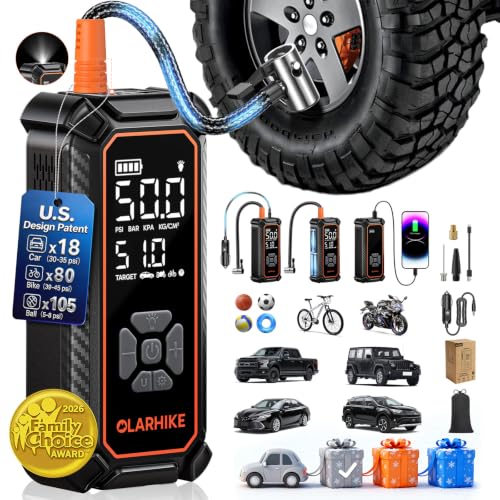
OlarHike Portable Tire Inflator Air Compressor
The OlarHike Portable Tire Inflator combines dual-power versatility via a 12V DC vehicle plug or built-in rechargeable battery with an automatic shut-off digital display. It provides dependable roadside tire top-offs and inflation for passenger cars, crossovers, motorcycles, and bicycles.
Pros
- Dual-power design allows cordless field operation or continuous power through any standard vehicle 12V DC port
- Automatic shut-off technology stops the motor precisely at preset pressure to prevent over-inflation
- Integrated 6000mAh battery reserve doubles as an emergency phone charger and includes an LED work light
- Pocket-sized footprint weighs well under two pounds for convenient transport in center consoles or backpacks
Cons
- Maximum vehicle pressure rating of 51 PSI is not suitable for heavy-duty commercial trucks, RVs, or high-pressure trailer tires
- Compact tankless inflator mechanism cannot power workshop pneumatic tools such as nail guns or air ratchets
- Recharging requires a standard 5V 2A or 5V 3A adapter and is not compatible with high-wattage fast chargers
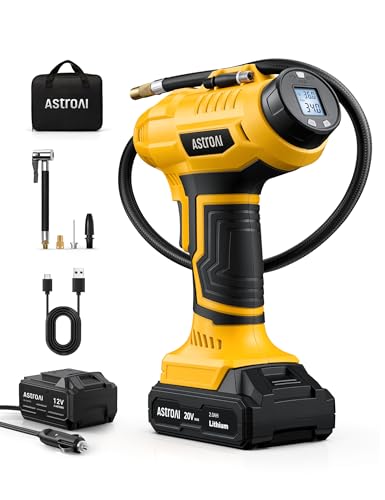
AstroAI Cordless Tire Inflator 160 PSI
The AstroAI Cordless Tire Inflator is a compact 160 PSI handheld air compressor featuring dual power via a 20V rechargeable battery and a 12V DC car adapter. Delivering digital auto shut-off and up to 20 minutes of continuous runtime, it is an ideal emergency tool for garage mechanics, commuters, and road-trippers.
Pros
- Dual-power versatility allows cordless battery operation at home or 12V DC vehicle plug-in on the road
- Reaches up to 160 PSI with automatic shut-off to prevent accidental tire over-pressurization
- Compact 2.54-pound footprint provides effortless trunk or glove-box storage for emergency readiness
- Backlit digital LCD screen provides clear readouts in PSI, BAR, and KPA units
- Integrated front LED light illuminates tire valve stems during dark roadside emergencies
Cons
- Includes a USB-C charging cable but requires an external USB power block to recharge the battery
- Designed specifically for tire and sports inflation rather than driving pneumatic workshop air tools
- Continuous runtime is limited to 20 minutes before requiring a cool-down pause
CARSUN 12V DC Portable Tire Inflator
The CARSUN 12V DC portable tire inflator delivers a listed 35 L/min airflow with automatic digital shut-off up to 150 PSI. It is an ideal, budget-friendly roadside emergency pump for passenger car owners, cyclists, and weekend campers.
Pros
- Automatic shut-off prevents accidental tire over-inflation by cutting power at the preset target pressure
- Lightweight 1.9-pound frame and compact dimensions fit neatly into vehicle trunks or roadside emergency kits
- Capable 35 L/min air volume airs up standard passenger tires quickly during routine seasonal pressure top-offs
- Bright integrated LED lighting assists with safe valve connection along dark roadways and unlit driveways
- Four included adapter nozzles expand utility across bicycles, sporting balls, and recreational air mattresses
Cons
- Powered exclusively via 12V DC vehicle sockets and does not include a 120V AC household electrical plug
- Manufacturer explicitly notes the unit is not suitable for heavy commercial trucks or large motor lorries
- Tankless high-pressure inflator design is not engineered to operate pneumatic workshop air tools
AstroAI 12V DC Portable Air Compressor Tire
The AstroAI 12V DC Portable Tire Inflator delivers a listed 25 L/min flow rate for fast roadside top-offs, featuring an auto-shutoff digital gauge and an 11.1-foot total reach. Powered strictly via 12V automotive sockets, it offers dependable emergency inflation for drivers, garage hobbyists, and compact vehicle owners.
Pros
- Quick roadside top-offs with manufacturer-rated 25 L/min pump speed
- Accurate digital display with auto-stop prevents over-pressurizing tires
- Long 11.1-foot combined cord and hose reaches all four vehicle tires
- Compact, sub-1.5-pound chassis with built-in cord and nozzle storage
- Integrated LED work light for roadside emergencies at night
Cons
- Restricted to 12V DC automotive sockets only with no direct 120V AC household plug included
- Requires a cool-down pause after 15 minutes of continuous run time
- Tankless design cannot operate pneumatic nailers, air ratchets, or automotive shop air tools
AstroAI AIRUN H 12V DC Portable Air Compressor
The AstroAI AIRUN H is a compact 12V DC tire inflator delivering up to 35 L/min airflow with automatic shut-off and digital pressure presets. It is an ideal portable emergency compressor for drivers, commuters, and garage hobbyists seeking fast tire top-offs.
Pros
- Automatic shut-off stops pumping reliably once target PSI is reached
- High-airflow 120W motor provides rapid top-offs for daily driver tires
- Long 9.84-foot power cord reaches all passenger vehicle wheels with ease
- Bright built-in LED flashlight and backlit display assist during night repairs
- Lightweight 2.2-pound form factor stores neatly in glove boxes and trunks
Cons
- Requires a 12V DC vehicle outlet and does not include a 120V AC household plug
- Mandates a 10-minute cool-down interval after 15 minutes of continuous operation
- Not intended for high-volume inflatables like large pool floats or air mattresses
Understanding Mechanical Differences Between Tire Inflators and Workshop Air Compressors
The short answer to whether you can use a tire inflator as an air compressor is technically yes for basic low-volume inflation, but strictly no for operating pneumatic tools or general workshop air lines. Both machines generate compressed air by drawing in ambient atmosphere and compressing it with a motorized piston. However, the internal engineering, airflow capacity, and thermal tolerances of these two devices differ completely. Exploring how these machines operate reveals why an inflator cannot replace a traditional workshop compressor for demanding garage tasks.
Direct Capabilities and Limitations of a Tire Inflator
A standard portable tire inflator is engineered for a single primary task: pushing air into a closed pneumatic tire until it reaches a specific target pressure. Units like the CRAFTSMAN 12V inflator or the AstroAI portable pump achieve pressure ratings reaching 150 to 160 PSI. However, reaching that target pressure requires several minutes of steady pumping into an enclosed chamber. The internal cylinder and piston are compact, allowing easy storage inside a glove box or vehicle trunk. Because the pump operates without an intermediate reservoir, it delivers output directly to the tire valve stem.
When users ask if an inflator can serve as a workshop compressor, they usually want to know if it can blow off workbenches, operate nailers, or run impact wrenches. In those scenarios, a portable inflator fails immediately because it cannot discharge stored air in sudden, high-volume bursts. Opening a standard air nozzle on a tire inflator simply releases a weak stream of air comparable to a steady breath. The motor lacks the displacement needed to sustain pneumatic velocity once the air pathway is open to ambient atmospheric pressure. Consequently, an inflator remains restricted to sealed objects that build pressure gradually over time.
Airflow Delivery Versus Maximum Pressure
The most confusing specification for many garage owners is maximum operating pressure, measured in pounds per square inch (PSI). Consumers often see a compact 12V inflator rated at 150 PSI and assume it is just as powerful as a 150 PSI pancake air compressor. Operating pressure only measures the maximum resistance the pump can overcome inside an enclosed vessel. The critical metric that governs pneumatic tool operation is airflow delivery, measured in cubic feet per minute (CFM) or standard cubic feet per minute (SCFM). Without sufficient CFM, pressure alone cannot do mechanical work on pneumatic motors or pistons.
A typical portable tire inflator produces between 20 and 35 liters of air per minute at open discharge, roughly 0.7 to 1.2 CFM at zero resistance. As pressure inside the tire increases toward 30 or 40 PSI, that flow rate drops significantly below 0.5 CFM. In contrast, a modest 6-gallon workshop compressor produces around 2.6 to 3.5 CFM at 90 PSI. Pneumatic fasteners, ratchets, and sprayers require substantial CFM ratings to actuate their internal mechanisms. When researching proper compressor sizing for framing nailers, you will discover that even an intermittent nail gun requires rapid air displacement that a miniature 12V motor cannot generate.
The Mechanical Necessity of an Air Storage Tank
The presence of an air storage tank represents the most significant physical divide between a tire inflator and a workshop air compressor. Dedicated compressors use steel or aluminum pressure vessels ranging from 1 gallon on ultra-portable units to 60 gallons on stationary shop systems. The electric motor and pump work ahead of time to compress air and store it inside the tank under high pressure. When you trigger an air tool, the tool draws energy directly from that accumulated reserve rather than waiting on the pump. This stored energy allows a standard compressor to deliver massive CFM bursts far beyond the instantaneous displacement of its pump.
Tire inflators operate as tankless, direct-displacement devices that push compressed air directly into the workpiece in real time. Because there is no storage buffer, the inflator cannot supply a surge of energy when demand spikes. Connecting an inflator to a tool requiring 4 CFM at 90 PSI causes pressure to drop instantly to zero as the tool exhausts air faster than the piston delivers it. Even small finish nailers rely on the expansion of stored tank air to drive a fastener with sufficient force. Operating pneumatic tools without an accumulator tank to buffer line pressure is mechanically impossible.
Duty Cycle Limits and Thermal Overload Risks
Compressor longevity and reliability depend heavily on duty cycle ratings, which define how long a motor can run before requiring a cooling rest period. Most consumer tire inflators feature intermittent duty cycles, typically specified by manufacturers as 10 to 15 minutes of continuous operation followed by a mandatory 10 to 15 minute cool-down window. Devices like the AstroAI AIRUN H explicitly highlight integrated thermal management to prevent motor burnout during prolonged tire fills. These miniature pumps rely on small internal cooling fans and compact heat sinks that quickly saturate during extended running sessions.
Workshop tasks like spray painting, surface sanding, or running grinding wheels require continuous airflow over extended work sessions. If an operator attempts to use a tire inflator continuously to maintain pressure for workshop activities, the unit will rapidly overheat. High thermal buildup degrades synthetic piston cup seals, accelerates internal wear, and eventually trips the thermal overload fuse or burns the motor windings. Workshop compressors, particularly oil-lubricated or heavy-duty dual-piston oil-free models, feature larger finned aluminum or cast-iron cylinders designed to dissipate heat over substantially longer duty cycles.
Coupler Standards and Hose Compatibility Differences
Plumbing connections highlight another immediate barrier between roadside inflators and garage pneumatic systems. A portable tire inflator comes equipped with a small-diameter rubber hose terminating in a brass threaded Schrader chuck or a thumb-lock quick-clamp fitting. These fittings are purpose-built to attach directly to automotive, motorcycle, or bicycle tire valve stems. The internal bore diameter of these hoses is narrow, which creates substantial frictional flow restriction. This restriction is acceptable when delivering 1 CFM into a tire, but it chokes high-velocity air movement.
Workshop pneumatic systems utilize standard quick-connect industrial couplers, typically featuring 1/4-inch NPT threads and 1/4-inch or 3/8-inch inner diameter flexible air hoses. These wider hoses minimize friction loss and ensure that full tank pressure reaches the tool without dynamic drop. Anyone familiar with connecting an air hose to a workshop compressor knows that standard pneumatic couplers require dedicated male and female quick-disconnect fittings. While brass adapter fittings can theoretically connect a Schrader valve to a 1/4-inch industrial plug, the underlying airflow restriction through the inflator hose remains severe enough to prevent normal tool operation.
Approved Inflatable Tasks for Portable Tire Pumps
While an inflator cannot power workshop pneumatic tools, it remains an exceptionally versatile tool for many non-automotive inflation duties. Models like the DEWALT portable inflator and the OlarHike dual-power pump include specialized nozzle accessories that broaden their utility around the home. Standard needle adapters allow users to inflate basketballs, soccer balls, and footballs to precise regulation pressures in seconds. The built-in digital gauges and auto shut-off features make tire inflators far more accurate for sports balls than guessing with a manual hand pump.
Bicycle tires represent another ideal application where tire inflators excel, especially road bikes requiring high pressures between 80 and 110 PSI. Included Presta valve adapters allow seamless connection to performance bicycle tubes without requiring bulky garage compressors. Small inflatable items like pool floats, swim rings, and lawn tractor tires also fall well within the operational sweet spot of these units. However, high-volume items like large air mattresses or inflatable kayaks take a long time to fill with a tire inflator because the pump prioritizes pressure over volume. Dedicated high-volume low-pressure blowers are far better suited for large camping rafts than high-pressure tire pumps.
Workshop Tasks That Strictly Require a Dedicated Compressor
Attempting to handle mechanical workshop duties with a tire inflator quickly illustrates the boundary between inflation and pneumatic power. Operating air tools such as impact wrenches, air ratchets, die grinders, and orbital sanders requires a continuous supply of air at 90 PSI. An impact wrench relies on sudden bursts of high CFM to spin internal vanes and strike an anvil with rotational torque. A tire inflator cannot turn the rotor of an impact wrench even for a fraction of a second because the air volume instantly vanishes the moment the trigger is pulled.
Similarly, surface preparation tasks like air blowing, sandblasting, and HVLP spray painting are completely out of reach for a tire inflator. A simple garage blow gun used to clear metal shavings, wood dust, or clean engine bays requires at least 2 to 4 CFM of continuous airflow at 40 to 60 PSI. An inflator attached to a blow nozzle produces an ineffective hiss that cannot clear debris off a workbench. Spray painting requires perfectly stable line pressure regulated to the gun to atomize paint droplets evenly. Without a tank and a precision diaphragm regulator, an inflator produces fluctuating pulses that ruin paint finishes.
Electrical Draw and Power Source Realities
Power supply engineering further separates portable inflators from standard workshop air compressors. Most portable inflators operate on 12V DC vehicle accessory outlets drawing between 10 and 15 amps of direct current. Other modern variations, such as cordless AstroAI and Ipflin units, utilize internal rechargeable lithium-ion battery packs ranging from 12V to 20V. These low-voltage motors are optimized for energy efficiency and portability, allowing drivers to inflate tires on remote highways without finding an electrical outlet. However, a 120W DC motor can only produce a small fraction of one horsepower.
In contrast, standard workshop air compressors operate on 120V or 240V alternating current, pulling anywhere from 12 to 15 amps on a standard household branch circuit. A typical 6-gallon pancake compressor utilizes a universal or induction motor producing approximately 0.8 to 1.5 continuous running horsepower. That electrical draw is hundreds of watts higher than what a 12V vehicle socket can deliver without blowing a car fuse. The substantial electrical wattage consumed by a shop compressor is precisely what drives the larger mechanical piston and compresses gallons of atmospheric air in minutes.
Evaluating Cost, Portability, and Garage Utility
Deciding whether to buy a tire inflator, a portable air compressor, or both depends primarily on your intended tasks and portability requirements. A compact tire inflator weighs between 1 and 3 pounds, fits neatly into an emergency roadside kit, and requires zero maintenance. For drivers whose only need is monitoring tire health and handling seasonal pressure drops, an inflator provides unmatched convenience and digital accuracy. The auto shut-off function eliminates guesswork by stopping the pump the instant target pressure is reached.
If your garage projects involve woodworking nailers, mechanical tool operation, blowing out lawn sprinkler lines, or dusting workshop equipment, a portable pancake or hot-dog compressor is mandatory. Portable 120V compressors weigh between 25 and 35 pounds, which makes them less convenient for roadside tire emergencies but indispensable for workshop fabrication. Many homeowners ultimately choose to own both tools to cover different needs. Keeping a compact 12V or cordless inflator in the trunk guarantees roadside safety, while maintaining an oil-free pancake compressor in the garage ensures readiness for pneumatic tools and workshop maintenance.
Safe Operation and Equipment Maintenance Takeaways
Regardless of which equipment you operate, following manufacturer safety guidelines protects both your tools and your vehicle electrical system. When operating a 12V DC inflator plugged into a car cigarette lighter socket, keeping the vehicle engine running prevents the pump from draining the automotive battery. Always allow the pump to cool completely between consecutive tire fills to prevent thermal fatigue on internal gears and piston seals. Regularly inspect the air hose and valve chuck for thread wear or cracking, which can cause sudden pressure leaks during inflation.
For workshop air compressors, daily moisture drainage remains the single most important maintenance routine. Compressing ambient air forces atmospheric humidity to condense inside the steel tank, creating liquid water that promotes internal corrosion if left unmanaged. Opening the bottom drain valve after every work session expels accumulated condensation and preserves the integrity of the pressure vessel. Operating pneumatic equipment within its rated duty cycle and matching tool consumption to certified compressor output ensures reliable performance across all automotive and home improvement tasks.
Understanding the distinct capabilities of tire inflators and workshop compressors ensures that you select the right machine for every pneumatic task. While a tire inflator cannot replace a compressor for air tools or high-volume cleaning, it remains an indispensable, accurate tool for tires and small inflatables. Matching your equipment to the specific CFM, pressure, and duty cycle requirements of the job guarantees efficient results and extends the operating life of your garage equipment.
About the author
Glenda Taylor has extensive experience in residential construction, remodeling, home improvement, and tool use. Her practical approach to equipment evaluation focuses on usability, performance, safety, and value—helping DIYers and workshop users make better-informed decisions about compressors and related tools.