
Can a Small Air Compressor Run an Impact Wrench: Practical Guide for 2026
Can A Small Air Compressor Run An Impact Wrench facts for October 2026: explore CFM demand, tank buffer capacity, and key air line setups for home mechanics.
 By Kenny Koehler
Updated October 7, 2026
By Kenny Koehler
Updated October 7, 2026
Breaking loose stubborn vehicle lug nuts and rusted suspension bolts requires immediate, concentrated torque from a pneumatic tool. Many garage hobbyists and home mechanics naturally wonder: can a small air compressor run an impact wrench without stalling or running out of pressure halfway through a job? The short answer is yes, but only under specific operating conditions that rely on brief fastener bursts rather than sustained run time. While a compact compressor can deliver sufficient working pressure to spin a tool briefly, sustained mechanical performance requires understanding how air volume and stored receiver pressure interact during heavy fastening tasks.
Pneumatic tools like 1/2-inch impact wrenches consume a significant volume of compressed air that quickly drains portable air receivers. When tank pressure plunges below the operating threshold, the wrench loses its breakaway power, forcing the operator to pause while the motor recharges the tank. Sizing your system requires looking past simple maximum pressure figures to examine CFM at 90 PSI, receiver capacity, and hose airflow restrictions. Balancing these factors helps protect your compressor motor from premature wear while ensuring your pneumatic equipment performs reliably.
| Award | Product | ACR Score About ACR ScoreThe ACR Score is our own rating from 0 to 10, based on performance, design and build, ease of use, and value. It reflects independent research and is never influenced by manufacturers, retailers, or affiliate commissions. Learn more › | |
|---|---|---|---|
| Best Overall |
Ingersoll Rand Edge Series 2317G 1/2-Inch Air
|
9.1/10 | Buy |
| Best Premium |
 Ingersoll Rand 231C 1/2-Inch Air Impact Wrench
|
8.9/10 | Buy |
| Best Value |
 Dynamic Power 50-Piece Pneumatic Air Tool Kit
|
8.8/10 | Buy |
| Best Budget |
 AEROPRO 1/2-Inch Air Impact Wrench
|
8.6/10 | Buy |
 BESWELL BW-112BN 1/2-Inch Air Impact Wrench
|
8.3/10 | Buy | |
 AEROPRO A398 1/2-Inch Air Impact Wrench
|
8.3/10 | Buy | |
 Trivd Frol 1/2-Inch Air Impact Wrench
|
8.3/10 | Buy | |
 Ingersoll Rand 231HA-2 1/2-Inch Drive Air Impact
|
8.3/10 | Buy | |
 BESWELL 1/2-Inch Air Impact Wrench Socket Set
|
8.0/10 | Buy |
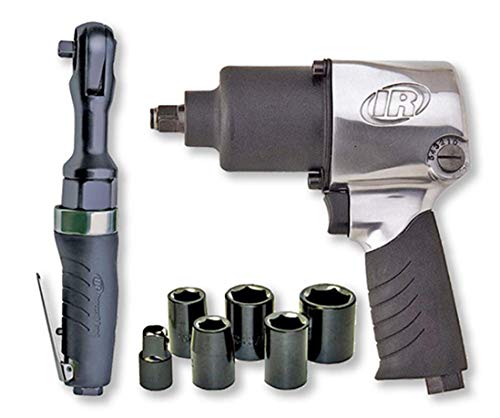
Ingersoll Rand Edge Series 2317G 1/2-Inch Air
The Ingersoll Rand Edge Series 2317G combo kit pairs a 500 ft-lb 1/2-inch impact wrench and a 2.6-pound air ratchet for dependable vehicle maintenance. It is a practical, durable pneumatic package for garage hobbyists and DIY mechanics with a capable air supply.
Pros
- Delivers up to 500 ft-lbs of maximum torque to break loose stubborn vehicle lug nuts and suspension bolts
- Lightweight 2.6-pound air ratchet maneuvers easily inside cramped engine bays and beneath dashboards
- Twin hammer mechanism provides smooth, balanced impact force with reduced internal vibration
- Complete kit includes five utility sockets and a durable blow-molded carrying case
Cons
- High rotary airflow demand exceeds the continuous capacity of compact 1-gallon to 6-gallon pancake air compressors
- Does not include quick-connect air fittings, whip hoses, or thread sealant out of the box
- Air ratchet top speed of 170 RPM requires manual initial breakaway for extremely over-torqued fasteners
Ingersoll Rand 231C 1/2-Inch Air Impact Wrench
The Ingersoll Rand 231C is a classic 1/2-inch pneumatic impact wrench delivering up to 600 foot-pounds of reverse torque with a durable twin-hammer mechanism. Requiring a minimum 90 PSI air supply and a 3/8-inch hose, it is an ideal choice for DIY mechanics and garage workshops tackling tire rotations and bolt extraction.
Pros
- Up to 600 foot-pounds of reverse breakaway torque easily removes stubborn vehicle lug nuts and seized bolts
- Durable twin-hammer mechanism delivers smooth, reliable impacts with reduced tool vibration
- Adjustable power regulator offers precise forward power selection to prevent over-tightening
- Manageable 5.8-pound weight and 7.3-inch length allow convenient access in tight automotive spaces
- Pressure-fed lubrication system promotes long-term mechanical reliability in busy garage settings
Cons
- Requires an air compressor capable of maintaining at least 90 PSI and a 3/8-inch air hose (sold separately)
- Small portable or pancake air compressors will quickly deplete their air reserve during extended burst cycles
- Front exhaust port can blow loose dust and debris forward toward the work surface if positioned close to dirty components
Dynamic Power 50-Piece Pneumatic Air Tool Kit
The Dynamic Power D-W3-50K 50-piece pneumatic air tool kit bundles an impact wrench, ratchet wrench, air hammer with chisels, and a blow gun into a portable 17-pound organized case. It is a practical starter set for DIY garage owners and home mechanics who need versatile air tools for fastening, cutting, and workshop cleanup.
Pros
- Comprehensive 50-piece pneumatic tool and accessory selection for diverse garage and DIY jobs
- Includes core air tools: an impact wrench, ratchet wrench, air hammer with 5 chisels, and a blow gun
- Sturdy organized blow-molded carrying case ensures quick access and secure vehicle transport
- Practical all-in-one value for home mechanics setting up their first pneumatic workshop collection
Cons
- Requires pairing with an adequately sized workshop air compressor to sustain continuous tool operation
- Compact pancake air compressors may struggle to supply sufficient continuous CFM for the impact wrench and air hammer
- Does not include an air hose inside the carrying case
AEROPRO 1/2-Inch Air Impact Wrench
The AEROPRO 1/2-inch air impact wrench delivers up to 1,200 ft-lbs of loosening torque with a lightweight 4.64-pound housing and twin hammer mechanism operating at 90 PSI. It is an ideal addition for garage workshop owners and DIY mechanics who already maintain a reliable pneumatic air supply and need serious breakaway force for vehicle maintenance.
Pros
- High 1,200 ft-lbs loosening torque breaks free stubborn vehicle lug nuts and rusted suspension bolts
- Lightweight 4.64-pound body substantially reduces arm fatigue compared to traditional all-metal impact wrenches
- Three-speed forward dial provides regulated speed control to prevent over-torquing during initial fastener seating
- Rear exhaust port keeps air blast and debris directed away from the technician
Cons
- Requires an external air compressor with sufficient air volume delivery that is not included with the bare tool
- Not practical for small 1-to-6 gallon pancake compressors due to the high intermittent CFM demand of 1/2-inch rotary air tools
- Bare-tool configuration requires users to supply their own 1/4-inch quick-connect fitting, 3/8-inch air hose, and impact sockets
BESWELL BW-112BN 1/2-Inch Air Impact Wrench
Built for heavy-duty automotive and industrial jobs, this pneumatic wrench delivers 1,180 ft-lbs of nut-busting torque in a manageable 4.62-pound composite frame. Its twin-hammer mechanism and three-speed forward regulator give mechanics balanced power and vibration control for all-day use.
Pros
- High breakaway torque quickly frees seized fasteners
- Lightweight composite frame reduces arm fatigue
- Smooth twin-hammer design dampens operating vibration
- Internal cooling system supports prolonged heavy use
Cons
- Requires a compatible high-pressure shop air compressor
- Full-size housing can be cumbersome in tight clearances
AEROPRO A398 1/2-Inch Air Impact Wrench
The AEROPRO A398 is a 1/2-inch pneumatic impact wrench delivering up to 1380 ft-lbs of loosening torque and 810 ft-lbs of working torque at 90 PSI via a twin-hammer mechanism. Weighing 5.28 pounds with an aluminum body, it suits DIY mechanics and garage hobbyists who have an air compressor capable of supplying steady 90 PSI pneumatic line pressure.
Pros
- High breakaway power with up to 1380 ft-lbs of loosening torque at 90 PSI
- Twin-hammer design delivers balanced, smooth impact strikes on heavy fasteners
- Manageable 5.28-pound aluminum body reduces fatigue during vehicle maintenance
- Rear exhaust directs exhaust air and debris away from the immediate work area
- Includes a 1/4-inch NPT air fitting, spanner, and oil bottle out of the box
Cons
- Requires a dedicated air compressor with sufficient CFM reserves, as small pancake units can only manage very short bursts
- Pneumatic tool oil is not pre-installed, requiring routine manual oiling before each use
- High torque output demands caution on smaller automotive fasteners to avoid stripped threads
Trivd Frol 1/2-Inch Air Impact Wrench
The Trivd Frol 1/2-inch air impact wrench combines a twin-hammer mechanism with a lightweight 4.73-pound composite body, delivering up to 1500 ft-lbs of advertised torque at 90 PSI. It is a practical, budget-conscious choice for garage hobbyists and DIY auto mechanics tackling lug nuts and suspension hardware with a capable pneumatic air setup.
Pros
- High advertised torque output of up to 1500 ft-lbs for breaking loose seized vehicle fasteners and stubborn lug nuts
- Lightweight 4.73-pound composite housing reduces user arm and wrist strain compared to heavier all-metal impact guns
- Twin-hammer impact mechanism and 45mm cylinder provide balanced, smooth blows during heavy fastener work
- Multi-speed adjustment knob offers three forward speeds and full reverse power for precise fastening control
Cons
- Requires a substantial air supply at 90 PSI; compact pancake compressors will struggle to sustain air volume during continuous impact use
- Manufacturer indicates reaching maximum torque requires higher airflow and pressure than standard 90 PSI regulation
- Bare-tool package requires users to provide their own air hose, quick-connect fittings, and pneumatic tool oil
Ingersoll Rand 231HA-2 1/2-Inch Drive Air Impact
The Ingersoll Rand 231HA-2 is a heavy-duty 1/2-inch pneumatic impact wrench delivering up to 600 ft-lbs of reverse torque with an extended 2-inch anvil and twin-hammer mechanism. Designed for automotive garages and workshop tire service, it requires an air compressor supplying at least 90 PSI through a 3/8-inch air hose.
Pros
- Delivers up to 600 ft-lbs of reverse torque for breaking loose stubborn lug nuts and heavy chassis hardware.
- Twin-hammer mechanism and pressure-fed lubrication provide reliable durability and smooth power delivery.
- The 2-inch extended anvil offers practical clearance when servicing deep wheel wells and automotive rims without extra adapters.
- Adjustable power regulator gives operators straightforward forward torque management.
Cons
- Requires a minimum of 90 PSI and a 3/8-inch air hose, demanding more continuous air volume than standard compact pancake compressors can typically sustain.
- Sold as a bare tool without pneumatic couplers, air hose, or air compressor included.
- At 6.1 pounds, extended one-handed overhead use under a vehicle lift may contribute to arm fatigue.
BESWELL 1/2-Inch Air Impact Wrench Socket Set
The BESWELL BW-112BN 1/2-inch pneumatic impact wrench delivers up to 1,180 ft-lbs of loosening torque with a durable twin hammer mechanism in a compact 4.62-pound composite frame. Complete with 13 impact sockets and essential fittings, it is a practical pneumatic kit for DIY mechanics, garage owners, and maintenance technicians using capable garage air systems.
Pros
- High loosening torque rated at 1,180 ft-lbs handles tough automotive lug nuts and rusted suspension fasteners
- Rugged twin hammer mechanism with powder metal cylinder delivers smooth, balanced impact cycling
- Lightweight 4.62-pound composite body and centered grip minimize hand fatigue compared to traditional all-metal guns
- Generous 20-piece kit includes popular SAE and deep metric sockets, an extension bar, and lubrication accessories
- Forward three-speed power regulator and full-power reverse offer straightforward control over drive force
Cons
- High air consumption requires a capable air compressor; small compact pancake compressors will struggle beyond brief bursts
- Pneumatic vane motor requires regular manual oiling or an inline oiler to maintain internal durability
- Total kit weight in the blow-molded case is approximately 11 pounds, adding heft during transport
Realistic Performance: Operating an Impact Wrench on a Small Compressor
Operating pneumatic impact tools on compact air systems represents one of the most common compromises in home garages. Small portable compressors, including common pancake, hot dog, and twin-stack designs, are engineered primarily for intermittent tools like finish nailers or tire inflators rather than high-volume air motors. To determine whether your existing machine can handle automotive fasteners, you must examine how pneumatic air volume, storage capacity, and tool duty cycles interact. Understanding these core mechanics prevents tool stalling and protects your compressor from severe overheating.
The Direct Answer: What Happens When You Pull the Trigger
Connecting a pneumatic impact gun to a small compressor yields immediate results for the first few seconds of operation. When the storage tank is fully pressurized to its automatic shut-off limit, the air regulator delivers full working pressure directly to the tool inlet. The internal twin-hammer mechanism spins rapidly, delivering crisp, high-frequency blows that can break loose a standard automotive lug nut. During this initial burst, the tool performs exactly as intended because it draws from the stored pressure reserve.
Trouble begins once the trigger stays depressed for more than four or five seconds. Small receivers, such as three-gallon to six-gallon tanks, deplete their high-pressure reserve almost immediately under the heavy draw of an air motor. As line pressure drops below the recommended operating threshold of 90 PSI, the rotational speed slows down noticeably. The hammering blows soften, and fastener removal grinds to a halt until the compressor motor recharges the tank.
CFM Delivery vs. Tank Reserve: The Mechanical Physics of Air Delivery
Understanding why small compressors struggle requires looking at the mathematical difference between air volume and air pressure. Air delivery volume is measured in cubic feet per minute, commonly abbreviated as CFM, while pressure is measured in pounds per square inch. Most compact portable compressors feature small pump mechanisms that deliver between 2.0 and 2.8 CFM at 90 PSI. These output ratings are ideal for cycling a small pneumatic cylinder on a nail gun, but they pale in comparison to rotary air motors.
A standard 1/2-inch air impact wrench consumes between 4.0 and 5.5 CFM under an average duty cycle of 25 percent. When the trigger is held wide open during continuous operation, that consumption figure spikes to 15 to 25 CFM. This means an active impact gun consumes air four to eight times faster than a compact compressor pump can produce it. The pump simply cannot keep up with real-time air consumption during continuous fastener removal.
Because the pump mechanism produces less air than the tool requires, the entire operation depends entirely on stored buffer volume. Once the buffer of compressed air in the tank is exhausted, the tool stalls down to whatever tiny volume the pump provides. The tool is effectively starved of air, leaving stubborn or rusted fasteners stuck in place.
Burst Operations vs. Continuous Run Time in Automotive Work
The practical feasibility of using a small air compressor depends heavily on the type of mechanical task you perform. Removing a properly torqued lug nut from a passenger vehicle typically requires a single burst of power lasting one to three seconds. In this specific scenario, a small compressor works adequately because the stored air volume can supply the brief burst without a severe pressure drop. You can remove a fastener, let the tool rest, and move to the next lug nut.
Continuous mechanical operations present a completely different challenge for small equipment. Tasks like disassembling rusted suspension components, driving long lag bolts, or running farm equipment repairs require extended trigger time. If a bolt requires continuous hammering for ten or fifteen seconds, a small tank will run out of usable pressure mid-stroke. The operator is forced to wait twenty to forty seconds between fasteners for the motor to reach cut-out pressure again.
Why Tank Size and Geometry Limit Fastener Breakaway Torque
Pneumatic impact wrenches rely on air velocity to drive their internal rotor vanes and generate dynamic breakaway torque. When tank volume is limited, the pressure drop across the entire system happens precipitously rather than gradually. A six-gallon pancake tank holds a very limited physical reserve of air between its cut-out pressure and its cut-in pressure. Once that differential is crossed, line pressure falls rapidly toward unusable levels.
Manufacturers design impact tools to achieve their maximum torque ratings specifically at a constant 90 PSI dynamic operating pressure. If the tank pressure drops to 70 PSI, the torque output of the wrench drops by a substantial margin. A tool rated for 600 foot-pounds of reverse torque may only generate a fraction of that power when air volume drops. That loss of rotational force prevents the tool from breaking loose rusted or over-torqued hardware.
Air Line Restrictions: How Hoses and Fittings Choke Impact Wrenches
The air compressor itself is only one part of the pneumatic power delivery system. Many homeowners purchase portable compressor kits that come bundled with thin 1/4-inch inner diameter air hoses. While a 1/4-inch hose works fine for low-draw finish nailers, it acts as a massive bottleneck for high-draw impact guns. The narrow hose diameter creates severe friction, causing dynamic pressure to drop sharply over long distances.
Industrial impact guns require a minimum 3/8-inch inner diameter air hose to deliver sufficient volume to the tool inlet. Tools like the Ingersoll Rand 231C 1/2″ Drive Air Impact Wrench and the AEROPRO TOOLS 1/2-Inch Air Impact Wrench explicitly specify a 3/8-inch hose for proper operation. Pairing a small compressor with a narrow 1/4-inch hose starves the tool twice: first at the tank, and second through the air line itself. Upgrading to a short 3/8-inch hose with high-flow couplers helps preserve whatever air volume your small tank can provide.
Duty Cycle Demands and Preventing Thermal Overload
Duty cycle ratings dictate how long an air compressor pump can safely run within a given period without overheating. Most consumer-grade portable compressors feature universal motors and oil-free pumps rated for a 50 percent duty cycle. This means the pump is designed to run for five minutes and rest for five minutes to dissipate compression heat. Exceeding this duty cycle places severe thermal stress on internal pump components.
When you attempt to run an impact wrench on an undersized compressor, the pressure drops constantly, forcing the pump to run without stopping. Continuous operation causes the cylinder head to heat up rapidly, which accelerates wear on Teflon piston rings and valve plates. Eventually, the thermal overload protection switch will trip, shutting down the compressor entirely to prevent motor burnout. Pacing your work is critical if you choose to operate an impact wrench on a compact machine.
Impact Wrench Specifications and Matching Air Demands
Examining the engineering profiles of available impact wrenches reveals why they place such heavy demands on air systems. Classic automotive tools like the Ingersoll Rand 2317G 1/2″ Drive Air Impact Wrench kit combine a 231G impact gun delivering 500 foot-pounds of torque with a compact 3/8-inch air ratchet. Similarly, the extended anvil design on the Ingersoll Rand 231HA-2 1/2″-Drive Air Impact utilizes an industrial twin-hammer mechanism designed for 90 PSI operation. These metal-bodied tools require consistent air mass to drive their multi-vane motors effectively.
Modern composite tools push torque numbers even higher while maintaining standard pressure requirements. The BESWELL® BW-112BN 1/2-Inch Air Impact Wrench and the packaged BESWELL 20-PCS 1/2″ Air Impact Wrench Socket Set deliver up to 1180 foot-pounds of loosening torque. Meanwhile, high-power options such as the Trivd Frol Air Impact Wrench 1/2“ and AEROPRO TOOLS 1/2-Inch Aluminum Air Impact incorporate massive 45mm cylinder designs to maximize rotational inertia. These large internal cylinders consume significant volumes of air on every rotation, meaning a small air reservoir empties faster with high-torque composite models than with older, lower-output designs.
Comprehensive bundles like the DYNAMIC POWER 50 Pieces Air Tool Kit. 1-1/2” highlight the broader spectrum of workshop pneumatic tools. This package includes an impact gun alongside pneumatic ratchets, chisels, and blow guns. While ratchets and air hammers consume slightly less volume than heavy-duty impact wrenches, they all require substantial air buffers to sustain productive shop work. Connecting any of these rotary tools to a compact tank demands careful operational discipline.
Practical Setup Adjustments to Maximize Small Tank Performance
If you must use a small compressor for automotive work, specific adjustments can help you maximize performance. First, adjust the output regulator to deliver full operating pressure, typically 90 to 100 PSI, while the tool is running. Setting the regulator lower than the tool specification reduces fastener breakaway torque, while setting it too high wastes valuable air volume. Always check your tool manual to ensure you do not exceed rated inlet pressure limits.
Second, minimize line losses by connecting a short 3/8-inch inner diameter rubber or hybrid hose directly to the tank. Avoid using extension hoses or narrow coiled lines that introduce friction and restrict volume. Keep the hose length under twenty-five feet whenever possible to maintain dynamic line pressure. High-flow quick-connect couplers can also reduce pressure drop across fittings compared to restrictive automotive-style couplers.
Finally, practice strict electrical precautions to ensure your compressor pump starts smoothly under pressure. Avoid long, lightweight extension cords that cause line voltage drop and trigger household circuit breakers. Plug the compressor directly into a dedicated 15-amp or 20-amp wall outlet so the motor receives full power during its recharge cycle. If you need extra reach, use a longer air hose rather than an electrical cord.
Maintenance Considerations: Moisture Control and Daily Purging
Small compressors running under heavy workloads generate substantial internal heat, which causes rapid moisture condensation. When ambient air is compressed rapidly into a small receiver, moisture vapor cools and collects at the bottom of the tank. If the compressor cycles continuously while powering an impact wrench, that water gets pulled directly into the air delivery hose. Moisture entering an impact tool strips away internal lubrication, corrodes steel rotor vanes, and causes premature motor failure.
To protect both your compressor and your pneumatic tools, drain the tank moisture after every work session using the bottom drain valve. Installing an in-line moisture filter or desiccator between the regulator and the air hose helps catch liquid water before it reaches the tool. Additionally, always add four to six drops of non-detergent pneumatic tool oil directly into the tool inlet before connecting the air line. Regular lubrication protects internal cylinder walls and keeps the hammer mechanism hitting cleanly.
When You Need a Larger Compressor: Recognizing the Boundaries
Small air compressors have clear functional limits that home mechanics must recognize. If your garage projects involve seasonal tire rotations or occasional brake jobs, a small compressor can suffice if you work patiently. Loosening four or five lug nuts with pauses between wheels is entirely manageable with a six-gallon receiver. The tool provides enough short-burst power to break the nuts free before you spin them off by hand.
When tasks expand to full automotive restoration, rusted suspension teardowns, or continuous shop use, an upgrade becomes necessary. Continuous tools like die grinders, dual-action sanders, and heavy impact wrenches demand a compressor with at least a twenty-gallon to thirty-gallon tank. Upgrading to a cast-iron, oil-lubricated pump delivering 5.0 to 6.0 CFM at 90 PSI provides the sustained air volume required for seamless mechanical work. Recognizing these equipment boundaries saves time, prevents frustration, and ensures your air tools perform at their full design potential.
Operating an impact wrench on a compact compressor is entirely possible when you understand the physical limitations of your air system. By prioritizing short bursts, upgrading to a 3/8-inch air hose, and allowing the pump to complete its recovery cycles, you can tackle basic fastener removal safely. For larger mechanical jobs, stepping up to a dedicated workshop compressor delivers the continuous power and speed that demanding automotive projects require.
About the author
Kenny Koehler is a power-tool specialist with more than a decade of hands-on evaluation experience and a science-based approach to product testing. His expertise in repeatable testing, tool performance, impact wrenches, and professional equipment brings a practical, data-focused perspective to compressor and pneumatic-tool comparisons.