
Is a 20 Gallon Air Compressor Big Enough? Practical Sizing Guide for 2026
Learn whether is a 20 gallon air compressor big enough for your workshop tools, automotive projects, and garage pneumatic tasks in October 2026.
 By Tom Scalisi
Updated October 7, 2026
By Tom Scalisi
Updated October 7, 2026

Garage mechanics and woodworkers frequently face a common dilemma when evaluating workshop equipment. A small six-gallon pancake tank often runs out of breath quickly during tire changes or rapid nailing, while a massive eighty-gallon stationary unit consumes valuable floor space and demands dedicated 240-volt wiring. Sizing a mid-sized system requires understanding how air storage interacts with motor recovery speed and tool consumption. For many garage enthusiasts, determining whether is a 20 gallon air compressor big enough comes down to the specific pneumatic tools they intend to power.
Air storage in a receiver tank acts as an energy buffer, allowing short bursts of high-volume air delivery before the pump must cycle on to restore system pressure. If you are assessing pneumatic demands across multiple projects, our sizing an air compressor for pneumatic tools guide breaks down the distinction between tank volume and flow rate. Understanding how intermittent tools perform compared to continuous tools prevents costly purchasing mistakes. In fact, many hobbyists looking into operating an impact wrench on a mid-sized compressor discover that a 20-gallon reservoir provides an ideal balance of portability, footprint, and reserve capacity.
| Award | Product | ACR Score About ACR ScoreThe ACR Score is our own rating from 0 to 10, based on performance, design and build, ease of use, and value. It reflects independent research and is never influenced by manufacturers, retailers, or affiliate commissions. Learn more › | |
|---|---|---|---|
| Best Overall |
Klutch 29-Gallon Portable Air Compressor - 2.5 HP
|
8.9/10 | Buy |
| Best Budget |
 California Air Tools 20013 20-Gal Compressor
|
8.6/10 | Buy |
 Klutch 20-Gallon Portable Air Compressor
|
8.4/10 | Buy | |
| Best Premium |
 Craftsman 20-Gallon Oil-Free Air Compressor
|
8.4/10 | Buy |
 Albott 20 Gallon Vertical Electric Air Compressor
|
8.3/10 | Buy | |
| Best Value |
 VEVOR 20-Gallon 2 HP Air Compressor
|
8.3/10 | Buy |
 California Air Tools 20020AD 20-Gallon Ultra Quiet
|
8.3/10 | Buy | |
 VEVOR 80-Gallon Stationary Air Compressor
|
8.1/10 | Buy | |
 Stealth 20-Gallon 1.8 HP Air Compressor
|
7.8/10 | Buy | |
 California Air Tools 20020 Ultra-Quiet 2.0 HP
|
7.8/10 | Buy |
Klutch 29-Gallon Portable Air Compressor - 2.5 HP
The Klutch 29-Gallon Air Compressor pairs a 2.5 HP 120V motor with a 175 PSI maximum tank pressure and 5.1 CFM at 90 PSI, providing reliable air reserve for garage mechanics and serious DIY woodworkers. Its oil-free pump eliminates messy maintenance while large flat-free tires provide dependable mobility across busy workshop floors.
Pros
- Generous 29-gallon tank reserve coupled with high 175 PSI maximum storage pressure
- Solid airflow output delivering 5.1 CFM at 90 PSI on standard 120V power
- Maintenance-free oil-free pump design removes the hassle of oil checks and messy spills
- Durable flat-free wheels make maneuvering the 127-pound upright unit around the garage manageable
- Factory-installed brass quick-connect fitting allows easy one-handed hose connections
Cons
- Substantial 127-pound weight makes lifting the unit into a truck bed or up stairs a two-person job
- Oil-free direct pumps typically generate higher operational sound levels than slow-turning belt-drive compressors
- Continuous air-hungry tools like dual-action rotary sanders will outpace the 5.1 CFM pump delivery during extended sessions
California Air Tools 20013 20-Gal Compressor
Built for demanding pneumatic applications, this unit provides up to 195 PSI of working pressure alongside a low-maintenance, oil-free 1.3 HP motor. It is a solid choice for workshops and jobsites requiring reliable high-pressure air delivery.
Pros
- Delivers high working pressure up to 195 PSI
- Oil-free pump eliminates oil checks and maintenance
- Long-lasting pump rated for over 1,000 hours
- Wheel kit aids in repositioning across jobsites
Cons
- Heavy 82-pound build makes lifting into vehicles difficult
- Tall vertical profile takes up considerable shop floor space
Klutch 20-Gallon Portable Air Compressor
Featuring a 2.0 HP 120V motor and a 20-gallon tank, the Klutch portable air compressor delivers a rated 4.2 SCFM at 90 PSI for versatile workshop air. Its oil-free pump and wheeled design make it a dependable choice for garage mechanics, woodworkers, and serious DIYers needing steady air storage.
Pros
- Generous 20-gallon air storage capacity provides a substantial buffer for intermittent shop tools
- Delivers a listed 4.2 SCFM at 90 PSI, outperforming smaller pancake compressors for workshop chores
- Oil-free pump design eliminates messy oil changes and allows clean, upright transport
- Rugged rubber wheels and built-in ergonomic handle make moving the 90-pound frame manageable
- Integrated thermal overload protection helps prevent motor burnout during demanding cycles
Cons
- Substantial 90-pound weight makes lifting into truck beds or carrying up stairs difficult without assistance
- Oil-free motor configurations generally produce noticeable operating noise compared to low-RPM lubricated units
- At 4.2 SCFM at 90 PSI, high-draw continuous air tools like sanders or grinders will require recovery pauses
Craftsman 20-Gallon Oil-Free Air Compressor
The Craftsman CMXECXA0232043 pairs a large 20-gallon tank with a 1.8 HP oil-free pump to deliver 4 SCFM at 90 PSI and up to 175 PSI of maximum storage pressure. It offers dependable air reserves and dual quick couplers for home garage mechanics, woodworkers, and DIYers tackling intermittent pneumatic tasks.
Pros
- Generous 20-gallon air storage capacity paired with an elevated 175 PSI maximum shutoff pressure
- Solid 4 SCFM output at 90 PSI handles intermittent automotive fastening and rapid framing nailer cycling
- Convenient maintenance-free oil-free pump eliminates crankcase oil changes and cold-weather oil thickening
- Outfitted with dual quick couplers and an easily operated quarter-turn ball drain valve at the tank base
- Sturdy upright wheeled frame saves garage floor space while remaining easy to tilt and roll
Cons
- Continuous high-demand tools such as rotary sanders or production paint sprayers will exceed the 4 SCFM continuous threshold
- Oil-free direct-drive pump assemblies typically generate higher operating noise levels than low-RPM induction models
- Vertical footprint standing over 41 inches high requires dedicated clearance in compact utility spaces or vehicles
Albott 20 Gallon Vertical Electric Air Compressor
The Albott 20 Gallon Electric Air Compressor pairs a space-saving upright tank with a 1.8 HP copper motor and an oil-free dual-piston pump reaching up to 120 PSI. It offers DIY homeowners and garage hobbyists an ample air buffer for nail guns and tire inflation without taking up excessive workshop floor space.
Pros
- Vertical 20-gallon footprint maximizes floor space in crowded home garages and workshops
- Oil-free dual-piston pump eliminates routine lubricant maintenance and oil spills
- Equipped with dual cooling fans and thermal overheat protection for motor longevity
- Integrated wheel kit and pull handle make moving the 101-pound chassis manageable
Cons
- Maximum operating threshold tops out at 120 PSI, which is lower than the 150 to 175 PSI common on heavy-duty shop units
- Manufacturer does not publish official SCFM airflow ratings at 40 or 90 PSI for precise tool matching
- Weighing roughly 101 pounds, lifting the compressor into a truck bed requires two people
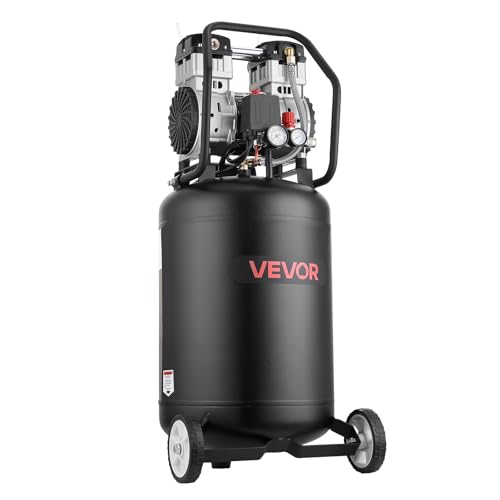
VEVOR 20-Gallon 2 HP Air Compressor
Built for home workshops and auto DIYers, this vertical unit pairs an oil-free 2 HP motor with steady 4.5 SCFM output at 90 PSI. Its wheeled upright design saves floor space while supplying reliable airflow for tire inflation, nailing, and light spray painting.
Pros
- Zero-maintenance oil-free motor design
- Fast tank fill time under four minutes
- Solid 4.5 SCFM flow at 90 PSI
- Heavy-gauge carbon steel tank construction
- Compact vertical profile saves shop floor space
Cons
- Heavy unit weighing nearly 91 pounds
- Max pressure limited to 125 PSI
- Targeted primarily at light-duty pneumatic tasks
California Air Tools 20020AD 20-Gallon Ultra Quiet
Delivering 5.30 CFM at 90 PSI with a quiet 70 dB sound profile, the California Air Tools 20020AD features a 2.0 HP low-RPM motor, oil-free dual-piston pump, and automatic drain valve. It is an outstanding pick for home garage mechanics and workshop woodworkers needing clean, high-volume air on standard 120V power.
Pros
- Remarkably quiet 70 dB operating volume suitable for residential garages and enclosed woodshops
- Delivers 5.30 CFM at 90 PSI to easily support impact wrenches, ratchets, nail guns, and inflation chores
- Automated moisture drain valve simplifies routine condensation maintenance
- Low 1680 RPM motor speed reduces pump heat, vibration, and mechanical wear
- Oil-free pump architecture ensures clean discharge air without oil residue
Cons
- Substantial 115-pound overall weight makes vehicle transport and stair climbing difficult
- Sustained continuous tools like production sandblasters or rotary sanders can outpace the pump recovery rate
- Requires a dedicated 15-amp or 20-amp outlet to handle the 14-amp continuous electrical draw
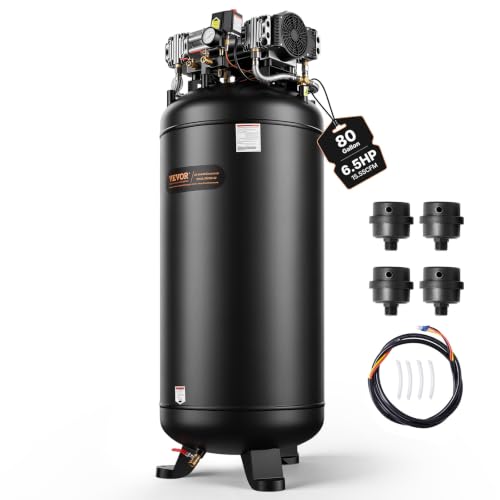
VEVOR 80-Gallon Stationary Air Compressor
The VEVOR 80-Gallon Stationary Air Compressor delivers an impressive 15.5 SCFM at 90 PSI with a maintenance-free 6.5 HP oil-free motor and 145 PSI maximum pressure. Operating on 220V single-phase power with an 86 dB sound profile, it provides dependable, high-volume air storage for serious woodworkers, commercial auto shops, and industrial facilities.
Pros
- High airflow rating of 15.5 SCFM at 90 PSI supports continuous and intermittent pneumatic tools alike
- Oil-free pump architecture eliminates messy oil changes and oil mist in downstream air lines
- Generous 80-gallon tank capacity creates an extensive pressurized air reserve for high-volume tasks
- Space-saving vertical tank footprint fits cleanly against shop walls and in dedicated utility corners
Cons
- The 86 dB sound output is relatively loud for tight, enclosed residential garages without hearing protection
- Heavy 264.6-pound stationary design requires dedicated equipment placement and appropriate transport planning
- Requires a 220V single-phase electrical connection, making it incompatible with standard 120V household outlets
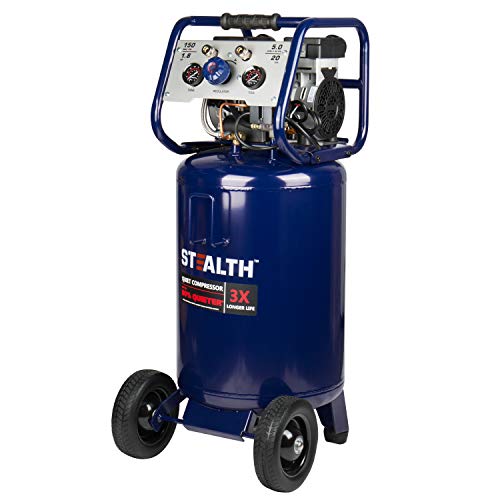
Stealth 20-Gallon 1.8 HP Air Compressor
Delivering 5 CFM at 90 PSI at an ultra-quiet 68 decibels, this oil-free machine is tailored for home garages and noise-sensitive workshops. Its generous 20-gallon tank supports high-demand pneumatic tools, though the 121-pound build limits effortless transport.
Pros
- Quiet 68-decibel sound output protects hearing
- Reliable 5 CFM delivery at 90 PSI
- Maintenance-free oil-free pump design
- Dual couplers streamline multi-tool setups
- Substantial 20-gallon tank capacity
Cons
- Hefty 121-pound weight hampers vehicle loading
- Tall 42-inch frame demands dedicated storage space
California Air Tools 20020 Ultra-Quiet 2.0 HP
The California Air Tools 20020 provides a 20-gallon air reserve powered by a low-RPM 2.0 HP motor, delivering 5.30 CFM at 90 PSI at an ultra-quiet 70 dB sound level. Featuring an oil-free dual-piston pump and a 14-amp draw on standard 110V power, it suits home garage hobbyists and woodworkers seeking quiet, dependable pneumatic volume.
Pros
- Quiet 70 dB acoustic rating makes indoor garage and residential basement operation comfortable without extreme ear fatigue
- Strong air delivery of 5.30 CFM at 90 PSI effortlessly handles finish nailers, impact wrenches, and common pneumatic garage tools
- Long-life dual-piston oil-free pump is rated for over 3,000 hours of operation with zero crankcase oil maintenance
- Low 14-amp draw is compatible with standard 110V household power under proper dedicated circuit conditions
- Vertical 20-gallon steel tank with no-flat wheels combines substantial air storage with a compact shop footprint
Cons
- At 114 pounds, loading this vertical compressor into a pickup truck bed or moving it upstairs requires two people
- Not intended for continuous-duty high-consumption tools like uninterrupted sandblasters or production rotary sanders
- The tall 45-inch vertical profile requires deliberate handling when rolling across uneven outdoor terrain
Evaluating 20-Gallon Air Compressor Capacity and Capabilities
A 20-gallon air compressor provides sufficient capacity for nearly all common household, woodworking, and routine automotive maintenance tasks. Home mechanics can comfortably rotate tires, run pneumatic impact wrenches in short bursts, install trim with finish nailers, and operate air ratchets without stalling the system. The 20-gallon vessel acts as a generous storage buffer that bridges the performance gap between small six-gallon pancake units and massive commercial tanks. For typical weekend DIYers and hobbyists, this mid-sized capacity strikes a practical balance between operational capability and floor space efficiency.
Operational limits become apparent when pairing a 20-gallon compressor with continuous-draw air tools. Heavy pneumatic consumers such as dual-action rotary sanders, die grinders, abrasive sandblasting cabinets, and production paint sprayers consume air faster than a standard single-stage pump can replenish it. In these heavy continuous scenarios, the tank will eventually depressurize below the tool’s operating threshold, forcing the user to stop working while the pump catches up. Determining whether a 20-gallon receiver is adequate ultimately depends on matching your specific tool duty cycles to the compressor’s air delivery rate.
Storage Volume Versus Air Delivery: Decoupling Gallons from CFM Output
A frequent misconception among air tool users is equating receiver tank volume with total air delivery power. Tank size, measured in gallons, dictates only how much compressed air is stored in reserve before the electric motor must restart. The true indicator of sustained pneumatic performance is flow rate, measured in cubic feet per minute (CFM) or standard cubic feet per minute (SCFM) at a specific pressure such as 90 PSI. A large reservoir simply gives you a temporary buffer of run time, whereas pump displacement determines whether a tool can operate indefinitely without pressure drops.
Most portable 20-gallon electric compressors designed for standard 120-volt circuits generate between 4.0 and 5.3 CFM at 90 PSI. For instance, models such as the Craftsman 20-Gallon compressor deliver 4 SCFM at 90 PSI, while the California Air Tools 20020AD produces 5.3 CFM at 90 PSI. When a pneumatic tool consumes less CFM than the pump produces, the compressor easily maintains operating pressure and can even shut off while you work. When a tool demands 10 CFM, however, it draws down the stored 20-gallon volume until line pressure drops to the pump’s continuous output level.
Understanding cut-in and cut-out pressure switch differentials clarifies how this storage buffer operates during active use. The cut-out threshold is the maximum pressure where the motor shuts down, while the cut-in threshold is the lower pressure that triggers the motor to restart. In a 20-gallon vessel, this pressure window represents several minutes of intermittent tool use before the motor restarts. Having that volume prevents the pump from cycling constantly on short tasks, which reduces mechanical wear on internal valves and extends overall motor life.
Pneumatic Tool Compatibility: Intermittent Fasteners to Automotive Maintenance
Intermittent pneumatic fasteners represent the ideal workload for a 20-gallon compressor. Framing nailers, roofing nailers, finish nailers, and crown staplers consume compressed air in distinct, fractional pulses rather than a sustained stream. A typical finish nailer might require less than 1.0 CFM at 90 PSI during rapid firing, which barely makes a dent in a 20-gallon air reserve. Woodworkers and finish carpenters can fire hundreds of nails before the pump even triggers its pressure switch to begin a recovery cycle.
Automotive repair tasks also fit neatly within the operating profile of a 20-gallon compressor. Impact wrenches used to remove stubborn lug nuts or suspension bolts require massive airflow, often demanding 4 to 6 CFM or more, but only for three to five seconds at a time. The 20-gallon air tank stores ample energy to supply that sudden burst of volume without suffering an instantaneous drop in dynamic line pressure. After the bolt spins free, the operator pauses to inspect the assembly, giving the 2.0 HP motor plenty of time to replenish the receiver tank back to cut-out pressure.
Convenience features found on modern 20-gallon units further improve versatility during automotive maintenance. Models like the Stealth 20-Gallon compressor and Craftsman units include dual quick-connect couplers right on the primary manifold. This arrangement allows mechanics to keep an impact wrench connected to one line while attaching a tire inflator or blow gun to the second line. You can transition smoothly between tasks without depressurizing the main air hose or wasting stored air volume between tool swaps.
Continuous-Demand Tools: Sanding, Grinding, and Spray Finishing Limits
Continuous-demand pneumatic tools expose the operational boundary where a 20-gallon tank ceases to be large enough. Rotary orbital sanders, die grinders, cutoff wheels, and air chisels operate with the trigger held down continuously for extended periods. A standard dual-action palm sander easily requires 8 to 12 CFM at 90 PSI to maintain effective rotational speed and prevent pad stalling. Because standard 120-volt compressors only produce roughly 4 to 5 CFM, the sander will drain a 20-gallon receiver tank in less than two minutes of continuous use.
Once stored tank pressure plummets below the regulated 90 PSI setting, tool efficiency drops dramatically. The sander loses orbital speed, the motor runs hot without stopping, and the operator is forced to halt the job to wait for tank recovery. Paint spraying presents a similar hurdle when attempting full-panel automotive body refinishing with high-volume low-pressure (HVLP) guns. While small detail touch-ups or small furniture projects are manageable, spraying an entire vehicle requires sustained atomization volume that quickly overwhelms a 20-gallon storage vessel.
Pushing a compressor beyond its volumetric limits also introduces duty cycle risks that can permanently damage the pump. Consumer and prosumer oil-free pumps are generally rated for a 50 percent to 70 percent duty cycle, meaning the motor needs equal resting time to dissipate compression heat. Forcing the unit to run continuously for twenty minutes to support a die grinder causes cylinder head temperatures to soar. This thermal stress accelerates piston ring wear, degrades reed valve seals, and may trigger the motor’s internal thermal overload protection switch.
The Impact of Maximum PSI on Stored Air Usability
Maximum operating tank pressure plays a decisive role in determining the effective air volume of any receiver vessel. Compressors are not created equal in their pressure ceilings, with 20-gallon models generally ranging from 120 PSI up to 175 PSI. For example, the Albott 20-Gallon unit operates up to 120 PSI, whereas the Craftsman 20-Gallon and California Air Tools CALAIR 20013 achieve maximum operating pressures between 175 and 195 PSI. Storing air at higher pressure compresses more actual air mass into the exact same physical tank footprint.
The practical benefit of higher tank pressure is a wider usable pressure buffer above your regulated tool operating pressure. If your pneumatic wrench requires 90 PSI to generate full torque, a tank pressurized to 125 PSI provides only a 35 PSI working buffer before line pressure begins to degrade. Conversely, a 175 PSI tank provides an 85 PSI reserve buffer above that same 90 PSI threshold. This extra storage density effectively doubles your trigger time on intermittent tools before the pressure switch signals the motor to cycle back on.
Motor Horsepower, Electrical Draw, and Household Circuit Demands
Electric motor horsepower directly dictates how quickly a compressor can pump air back into a depleted 20-gallon tank. Most portable 20-gallon compressors feature electric motors rated between 1.3 HP and 2.5 HP operating on standard 120-volt alternating current. The Klutch 29-Gallon compressor incorporates a robust 2.5 HP motor delivering 5.1 CFM at 90 PSI, while 20-gallon alternatives typically utilize 1.8 HP to 2.0 HP motors. These power ratings represent genuine working output capable of running reliably on common 15-amp or 20-amp residential branch circuits.
Startup inrush amperage is a critical operational factor that garage owners must evaluate before plugging in a new compressor. Electric motors draw a momentary surge of current above their continuous running rating when spinning up from a dead stop under head pressure. Before setting up your workshop, reviewing our guide on air compressor electrical power requirements can help prevent nuisance breaker tripping on residential circuits. Operating an oil-free motor on a dedicated 20-amp circuit ensures steady voltage delivery and smooth cold-weather starts.
Using undersized extension cords is a widespread mistake that starves the electric motor of proper operating voltage. A long, thin 16-gauge extension cord creates severe voltage drop, causing the motor to hum, overheat, and trip circuit breakers during startup. Manufacturers strongly advise plugging the compressor directly into a grounded wall receptacle whenever possible. If you need greater reach across your garage or driveway, using a longer 3/8-inch air hose preserves full electrical efficiency while delivering stable pressure straight to your tools.
Pump Architecture: Noise Ratings and Maintenance Tradeoffs
Modern 20-gallon compressors predominantly feature oil-free dual-piston pump mechanisms engineered for minimal maintenance and clean air delivery. Oil-free pumps eliminate the chore of monitoring crankcase sight glasses, checking non-detergent oil levels, and changing messy lubricants. They also allow trouble-free starts in unheated garages during freezing winter temperatures, because there is no thick oil to bog down piston movement. Furthermore, oil-free systems eliminate oil vapor in the discharge line, which is essential when spraying finishes or inflating vehicle tires.
Operational noise levels vary significantly depending on motor speed and sound dampening engineering. Traditional universal motor compressors run at high speeds around 3400 RPM, producing a harsh din between 80 and 85 decibels that quickly causes ear fatigue in small garages. In contrast, ultra-quiet models such as the California Air Tools 20020 and 20020AD run at an easy 1680 RPM, generating just 70 decibels of sound. The Stealth 20-Gallon model registers an impressive 68 decibels, allowing normal conversation in the workshop while the pump actively recharges the receiver.
Pump longevity has improved dramatically with advanced Teflon piston coatings and dual-cylinder balancing. California Air Tools specifies an impressive pump lifecycle exceeding 3000 hours before major component wear on their quiet dual-piston assemblies. Lower operational RPM generates less friction and reduces heat buildup, which directly protects reed valves and cylinder sleeves from premature failure. Choosing a quiet low-RPM platform provides a far more pleasant working environment without sacrificing volumetric air flow.
Moisture Management and Safe Operating Practices
Compressing atmospheric air naturally draws ambient humidity into the receiver tank, where it condenses into liquid water as the air cools. Over time, standing water accumulates along the bottom of the steel cylinder, reducing usable storage capacity and accelerating internal corrosion. Internal tank rust weakens the steel vessel and can discharge gritty scale into pneumatic air tools, ruining delicate motor vanes and O-rings. Understanding proper tank moisture drainage and air storage safety ensures your receiver remains structurally sound for years of dependable operation.
Draining accumulated condensation after every single work session is the most effective way to protect your investment. The style of drain valve installed on the tank bottom dictates how convenient this maintenance task will be. Traditional threaded thumb petcocks are stiff, difficult to access, and prone to seizing when exposed to rust particles. High-quality units often include quarter-turn brass ball valves or even automatic drain valves like the one featured on the California Air Tools 20020AD, which automatically purges moisture during operational cycles.
Safe pneumatic operation also requires regular inspection of vital mechanical safety components. Every air compressor receiver is equipped with an ASME-certified safety relief valve designed to pop open automatically if internal pressure ever exceeds safe design thresholds. Periodically pulling the brass ring on the relief valve while the tank holds light pressure verifies that the spring and seat move freely. Depressurizing the tank completely before transport, storage, or servicing fittings guarantees that high-pressure air never poses an unexpected safety hazard.
Practical Sizing Assessment Before Making a Purchase
Determining whether a 20-gallon compressor is big enough comes down to auditing your three highest-demand pneumatic tools. If your primary tasks involve tire inflation, framing nailers, brad nailers, impact wrenches, and occasional air blowing, a 20-gallon unit offers more than enough volume and recovery speed. The vertical upright design found on models like the Albott 20-Gallon and California Air Tools compressors occupies minimal garage floor space while rolling smoothly on heavy rubber wheels. You gain genuine shop utility without dedicating an entire corner of your garage to a fixed cast-iron monster.
If your goals include restoring car bodies, running continuous rotary sanders for hours, or powering commercial sandblasting equipment, a 20-gallon compressor will leave you frustrated by constant pressure drops. Production automotive shops genuinely require large stationary two-stage compressors, such as the 80-gallon VEVOR unit delivering 15.5 SCFM on a dedicated 220-volt circuit. However, for roughly eighty to ninety percent of residential garages, home workshops, and serious DIY hobbyists, a 20-gallon compressor hits the ultimate sweet spot between reserve air capacity, electrical convenience, and everyday practicality.
About the author
Tom Scalisi brings more than two decades of experience in construction, building maintenance, contracting, and hands-on tool use. His practical understanding of power tools, automotive work, repairs, and jobsite equipment helps readers evaluate compressors based on real workloads rather than specifications alone.