
What Can a 6 Gallon Air Compressor Do: Practical Guide for 2026
Understand what can a 6 gallon air compressor do for DIY projects, finish carpentry, and inflation in our October 2026 practical guide.
 By Kenny Koehler
Updated October 7, 2026
By Kenny Koehler
Updated October 7, 2026

Pneumatic power tools depend heavily on balanced air delivery rather than just total storage volume. When outfitting a home workshop or packing a jobsite trailer, knowing exactly what can a 6 gallon air compressor do keeps you from overspending on heavy stationary machinery or burning out an undersized pump. A standard six-gallon pancake or portable unit typically supplies between 2.3 and 4.0 CFM at 90 PSI, which creates enough pressurized reserve for intermittent fasteners and general maintenance tasks. Before tackling vehicle upkeep, evaluating tire inflation capabilities helps set realistic expectations for roadside service and daily shop duties.
These compact units excel at finish carpentry, upholstery, and routine household repairs because they pair lightweight mobility with maintenance-free, oil-free pump mechanisms. While a portable tank provides impressive flexibility for trim nailers and air blow guns, pushing the machine beyond its intended duty cycle will quickly lead to line pressure drop and motor strain. Grasping the relationship between continuous tool consumption and pump recovery begins with understanding air compressor CFM ratings before connecting high-draw equipment. By reviewing tank capacities, operating pressures up to 150 or 200 PSI, and electrical draw on standard 15-amp circuits, you can maximize your pneumatic setup safely.
| Award | Product | ACR Score About ACR ScoreThe ACR Score is our own rating from 0 to 10, based on performance, design and build, ease of use, and value. It reflects independent research and is never influenced by manufacturers, retailers, or affiliate commissions. Learn more › | |
|---|---|---|---|
| Best Overall |
Goodyear 6-Gallon 150 PSI Portable Oil-Free
|
9.2/10 | Buy |
| Best Premium |
 BOSTITCH BTFP02012 6-Gallon Pancake Air Compressor
|
9.2/10 | Buy |
 CRAFTSMAN 6-Gallon 150 PSI Portable Oil-Free
|
8.9/10 | Buy | |
| Best Value |
 ECOMAX 6-Gallon 150 PSI Portable Pancake Air
|
8.8/10 | Buy |
| Best Budget |
 VEVOR 6-Gallon Portable Pancake Air Compressor
|
8.6/10 | Buy |
 Metabo HPT 6-Gallon Pancake Air Compressor Review
|
8.6/10 | Buy | |
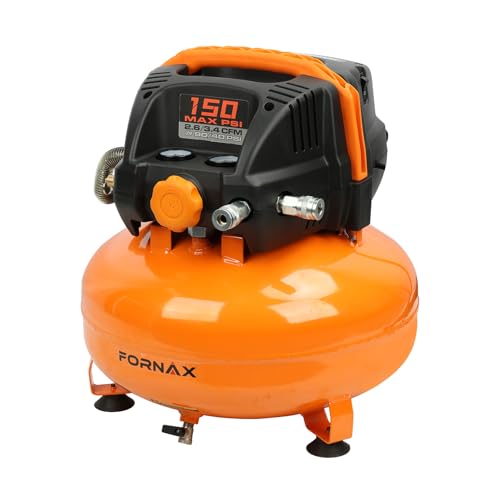 FORNAX 6-Gallon Pancake Air Compressor
|
8.4/10 | Buy | |
 ECOMAX 6-Gallon 175 PSI Portable Pancake Air
|
8.4/10 | Buy | |
 Metabo HPT EC914S 6-Gallon 200 PSI Pancake Air
|
8.3/10 | Buy | |
 CRAFTSMAN 6 Gallon 150 PSI Portable Oil-Free
|
8.1/10 | Buy |
Goodyear 6-Gallon 150 PSI Portable Oil-Free
The Goodyear 6-gallon pancake air compressor delivers 3 SCFM at 90 PSI and 150 max PSI powered by a reliable 1 HP induction motor. At 32 pounds with an oil-free pump, it provides dependable portable air for trim carpenters, DIY home projects, and garage tire inflation.
Pros
- Produces 3 SCFM at 90 PSI, offering solid airflow for sequential finish nailing and light framing tasks
- Equipped with a durable 1 HP induction motor for dependable and consistent pressure build-up
- Oil-free pump mechanism requires zero ongoing lubrication maintenance and prevents oil contamination in air lines
- Two clearly visible analog pressure gauges make monitoring regulated line pressure straightforward
- Compact 32-pound pancake design is easy to lift, load into vehicles, and store on shop shelves
Cons
- Airflow rating of 3 SCFM is not designed to support continuous rotary air tools like orbital sanders or paint sprayers
- Comes with a single 1/4-inch quick-connect coupler rather than dual outlets for running two tools simultaneously
- Sold as a bare compressor without an included air hose, tire inflator chuck, or pneumatic nail guns
BOSTITCH BTFP02012 6-Gallon Pancake Air Compressor
Delivering 2.6 SCFM at 90 PSI from a 6-gallon 150 max PSI tank, the Bostitch BTFP02012 provides reliable pneumatic output in a 29-pound portable design. It is an ideal match for DIY homeowners, finish carpenters, and punch-list contractors needing low-maintenance air power for trim nailers and inflation tasks.
Pros
- Delivers a steady 2.6 SCFM at 90 PSI with a 150 max PSI ceiling for sequential finish fastening
- Portable 29-pound build and balanced center handle simplify jobsite mobility and vehicle loading
- Dual universal couplers allow two users to run separate nailers without aftermarket splitters
- High-efficiency motor starts smoothly in cold conditions and on properly rated extension cords
Cons
- Airflow output of 2.6 SCFM is not suited for continuous high-demand tools like sanders or spray guns
- Operational sound level of 78.5 dBA is louder than ultra-quiet low-RPM dual-piston models
- Ships as a bare tool without an air hose, blow gun, or pneumatic finish nailers included
CRAFTSMAN 6-Gallon 150 PSI Portable Oil-Free
The CRAFTSMAN 6-Gallon Pancake Air Compressor delivers 2.6 SCFM at 90 PSI with a 150 PSI maximum tank pressure, providing dependable pneumatic power for trim nailing, tire inflation, and garage punch-list jobs. Built with a low-voltage startup motor and a manageable 30.8-pound frame, it suits DIY homeowners, finish carpenters, and mobile service technicians needing portable air supply.
Pros
- Factory dual quick-connect couplers allow two trim carpenters or nailers to connect to the manifold at the same time
- Low-voltage 1.0 HP motor starts reliably in colder weather and when running on standard 120V circuits
- Includes a 25-foot air hose out of the box so you can start working on trim or tires immediately
- Maintenance-free oil-free pump design keeps discharged air clean and eliminates the need for ongoing pump oil changes
Cons
- The 2.6 SCFM output at 90 PSI is insufficient for continuous-draw air tools such as HVLP paint sprayers, orbital sanders, or heavy pneumatic grinders
- Standard universal motor produces significant sound output that may require hearing protection when running indoors
- Manual drain valve requires regular reach-under access to purge moisture after every working session
ECOMAX 6-Gallon 150 PSI Portable Pancake Air
The ECOMAX 6-Gallon 150 PSI Pancake Air Compressor delivers portable, low-maintenance pneumatic power with its 1.5 HP oil-free pump, dual quick-connect couplers, and bundled 10-piece accessory kit. Featuring cold-weather starting support and a flip-up handle, it is an accessible choice for DIYers, trim carpenters, and garage tire maintenance.
Pros
- Comes with a 10-piece accessory kit including an air hose, tire chuck, and blow gun ready out of the box
- Dual quick-connect couplers enable two operators to run pneumatic lines simultaneously
- Oil-free pump design requires zero motor oil maintenance and prevents oil discharge into air lines
- Low-voltage and cold-weather startup capability helps ensure reliable motor turnover in chilly garages
- Flip-up carrying handle and built-in cord bracket simplify transport and tidy storage
Cons
- PVC air hose included in the kit can become stiff and difficult to manage in freezing temperatures
- Not intended for continuous high-demand air tools such as rotary sanders or automotive paint sprayers
- Standard universal motor noise level makes hearing protection advisable during indoor use
VEVOR 6-Gallon Portable Pancake Air Compressor
Delivering 2.3 CFM at 90 PSI with a 150 PSI maximum pressure and a 6-gallon tank, this VEVOR pancake compressor provides dependable air supply for intermittent finish nailing, tire inflation, and garage cleanup. Weighing under 29 pounds with dual quick couplers, it is an accessible, portable option for DIY homeowners and punch-list carpenters.
Pros
- Generous 6-gallon tank capacity paired with 150 PSI maximum pressure provides a reliable air reserve for intermittent trim nailing.
- Factory dual quick-connect couplers allow two hoses to remain connected without needing aftermarket splitters.
- Maintenance-free, oil-free 1.7 HP motor eliminates oil checks and prevents oil mist in discharge air lines.
- Manageable 28.97-pound carry weight and compact footprint make transport between the garage and work areas straightforward.
Cons
- Rated 2.3 CFM at 90 PSI is not designed for continuous high-demand air tools like rotary sanders, die grinders, or commercial sprayers.
- Specific operating decibel (dBA) ratings are not published by the manufacturer, so indoor sound levels may vary depending on the workspace.
- Bare-tool configuration does not include air hoses, fittings, or finish nailers out of the box.
Metabo HPT 6-Gallon Pancake Air Compressor Review
The Metabo HPT EC711S is a portable 6-gallon pancake air compressor delivering 2.8 CFM at 90 PSI with a 165 PSI tank ceiling and an operating sound level of 73 dB. With its quick 46-second recovery cycle and dual quick couplers, it is an excellent choice for finish carpenters, punch-list contractors, and DIYers running pneumatic nailers.
Pros
- 73 dB operational sound rating is substantially quieter than standard job-site pancake units
- 165 PSI maximum pressure provides ample air storage with a swift 46-second recovery cycle
- Two 1/4-inch universal quick couplers support multi-tool setups right out of the box
- Sturdy steel roll cage protects gauges and the manifold assembly against knocks and drops
- Oil-free 1.0 HP motor ensures low maintenance and reliable cold-weather motor startup
Cons
- At 38.5 lbs, it is slightly heavier than ultra-compact 1-to-3-gallon trim compressors
- Airflow of 2.8 CFM at 90 PSI is designed for intermittent fastening, not continuous rotary tools or paint sprayers
- Bare-tool configuration means air hoses and pneumatic fastening tools must be purchased separately
FORNAX 6-Gallon Pancake Air Compressor
The FORNAX 6-Gallon Pancake Air Compressor delivers 2.6 CFM at 90 PSI and up to 150 PSI of maximum pressure, featuring dual couplers and a lightweight 28.8-pound portable footprint. It is a practical pneumatic power source for DIY homeowners, finish carpenters, and garage hobbyists driving nailers or managing tire inflation.
Pros
- Dual quick-connect couplers allow two nailers to operate simultaneously without adding an external splitter manifold
- Generous 6-gallon air tank capacity with a 150 PSI maximum pressure ceiling provides a dependable air reserve
- Lightweight 28.8-pound profile simplifies one-handed carrying up stairs and transport into work vans
- Maintenance-free oil-free pump eliminates oil checks, oil changes, and mess around finished work surfaces
Cons
- Operating sound output rated at 95 dBA is loud and makes hearing protection necessary, especially in closed rooms
- Airflow output of 2.6 CFM at 90 PSI cannot support continuous-demand tools like sanders, grinders, or paint sprayers
- Supplied as a bare-tool compressor without an included air hose, tire inflator chuck, or pneumatic nailers
ECOMAX 6-Gallon 175 PSI Portable Pancake Air
The ECOMAX 6-Gallon Pancake Air Compressor delivers up to 175 PSI and 3 CFM at 90 PSI, providing dependable recovery and dual quick couplers for trim fastening and garage tasks. Weighing approximately 31.5 pounds and featuring cold-weather start capability, it suits DIY homeowners and punch-list contractors seeking a complete portable air setup.
Pros
- High 175 PSI maximum tank pressure provides substantial usable air volume in a compact 6-gallon footprint
- Rated 3 CFM at 90 PSI supports quick pressure recovery between fastening cycles and tire inflation tasks
- Dual quick-connect couplers support running two pneumatic hoses without adding aftermarket splitters
- Comes complete with a 25-foot hose and essential pneumatic accessories for immediate out-of-the-box utility
- Oil-free pump design ensures low ongoing maintenance with no oil levels to monitor or change
Cons
- Output of 3 CFM at 90 PSI is unsuited for continuous high-consumption air tools like sanders or grinders
- Included 25-foot PVC air hose can be stiff and retain tight coils in cold working environments
- Manufacturer does not publish an official dBA rating, and standard oil-free pancake pumps can be loud indoors
Metabo HPT EC914S 6-Gallon 200 PSI Pancake Air
The Metabo HPT EC914S delivers an impressive 200 PSI maximum pressure and 4 CFM at 90 PSI from a 6-gallon tank, giving trim carpenters and remodelers the air volume needed to drive multiple nailers simultaneously. At roughly 41 pounds, it successfully combines high-pressure air storage with practical job-site portability.
Pros
- High 200 PSI tank ceiling stores substantially more usable air than conventional 150 PSI pancake models
- Generous 4 CFM at 90 PSI airflow rating supports multi-tool operation and reduces nailer drive hesitation
- Manageable 41-pound carry weight offers better portability than heavier twin-stack compressor configurations
- Engineered by Metabo HPT to support both lightweight trim nailers and larger framing or roofing guns
Cons
- At 41 pounds, it is noticeably heavier to carry than minimalist 1-to-3 gallon trim-only compressors
- Tank volume and CFM output remain inadequate for continuous high-demand air tools like HVLP sprayers or sanders
- Ships as a bare-tool compressor without included air hoses, pneumatic fittings, or nail guns
CRAFTSMAN 6 Gallon 150 PSI Portable Oil-Free
The CRAFTSMAN 6-Gallon 150 PSI Oil-Free Pancake Air Compressor delivers 2.6 SCFM at 90 PSI via a 1.0 HP low-voltage start motor with factory dual quick couplers. Weighing 30.8 pounds, it provides dependable air delivery for finish carpenters, DIY remodelers, and garage maintenance tasks.
Pros
- Delivers 2.6 SCFM at 90 PSI with a 150 PSI maximum tank ceiling for dependable finish fastening.
- Dual quick couplers allow two pneumatic tools to remain connected at the same time without splitters.
- Oil-free pump design ensures clean air delivery and zero periodic pump oil maintenance.
- Low-voltage start 1.0 HP motor supports reliable startups on standard 120V household outlets.
- Manageable 30.8-pound weight and integrated carry handle provide practical one-person jobsite transport.
Cons
- Air delivery rate of 2.6 SCFM at 90 PSI is not designed for continuous high-demand tools like rotary sanders or paint sprayers.
- Standard oil-free electric motor design generates typical high-pitch operational sound during tank recharge cycles.
- Sold as a bare compressor unit without included air hoses, couplers, or pneumatic nailers.
Capabilities, Tool Compatibility, and Practical Limits of 6-Gallon Air Compressors
A 6-gallon air compressor occupies the sweet spot between compact inflators and stationary garage units. Understanding the exact mechanical capabilities of this tank size prevents costly mistakes on the job and keeps pneumatic tools operating at peak efficiency. These machines handle a wide spectrum of intermittent pneumatic tasks while remaining portable enough to carry between rooms or haul in a truck bed. Examining air delivery volume, working pressure thresholds, and tool consumption rates reveals exactly how far this versatile setup can go.
Core Pneumatic Capabilities and Air Delivery Ratings
Most 6-gallon electric compressors generate between 2.3 and 4.0 CFM at 90 PSI, backed by maximum tank pressures ranging from 150 to 200 PSI. This mechanical profile means the compressor excels at running tools that consume short bursts of air rather than a constant, unbroken stream. The six-gallon storage reservoir serves as a pressurized buffer, giving the electric motor time to rest between firing cycles. When tool consumption stays within that buffer, the compressor delivers consistent pressure without hesitation.
The distinction between continuous air consumption and intermittent cycling defines what this machine can realistically accomplish. Tools requiring sustained airflow will quickly exhaust six gallons of compressed air, pulling line pressure below useful thresholds. Conversely, intermittent tools give the pump adequate time to recover before the next cycle begins. Recognizing this balance allows you to tackle framing, finish carpentry, tire maintenance, and workshop cleaning with complete confidence.
Finish Carpentry, Trim Work, and Brad Nailing
Trim carpentry represents the ideal operating environment for a 6-gallon pancake air compressor. Operating an 18-gauge brad nailer or a 23-gauge pin nailer requires less than 0.5 CFM per fastener at standard operating pressures. Because these precision tools demand minimal air volume, a 6-gallon tank can fire dozens of nails before the electric motor even cycles on. You can install baseboards, window casings, crown molding, and custom cabinetry smoothly without waiting for pressure recovery.
Finish nailers driving 15-gauge or 16-gauge fasteners perform equally well on these portable platforms. Even when installing dense hardwood trim or solid door jambs, the compressor maintains sufficient regulated pressure to set fastener heads flush. Dual quick-connect couplers on many models also permit two trim carpenters to work simultaneously off a single tank. The pump easily keeps pace with two operators installing casing or trim at a normal professional rhythm.
Pneumatic narrow-crown staplers and upholstery fasteners also function effortlessly on a six-gallon system. These tools require rapid cycling during furniture repair, screening, or subfloor underlayment installation. Because the volume per shot remains exceptionally low, the tank buffer absorbs the fast actuation without noticeable line drop. For indoor woodworking and trim installations, a 6-gallon platform delivers nearly flawless utility.
Framing and Roofing Fastening Demands
Operating large-body nailers introduces heavier air demands that push closer to the compressor delivery limit. A standard 21-degree or 30-degree framing nailer consumes roughly 2 to 3 CFM when driven at a steady pace. A 6-gallon compressor can reliably drive full 3-1/2 inch framing nails into dimensional lumber during punch-out work, wall framing, and structural repairs. You will experience dependable countersinking when nailing studs, plates, and headers at a controlled cadence.
Production framing crews firing in rapid bump-fire mode will encounter the physical boundaries of a portable tank. When driving multiple fasteners per second on subflooring or shear wall sheathing, air volume drains faster than a 1 HP pump can replenish. You can explore how smaller reservoirs handle heavy fastening in our detailed guide on running nail guns on smaller portable tanks during residential construction. On a 6-gallon unit, brief pauses between nailing runs allow the pump to cut in and restore full pressure.
Pneumatic roofing nailers follow a similar operational pattern during shingle installation. For small roofing repairs, shed builds, or flashing work, the compressor operates comfortably without causing delays. However, reroofing large residential pitches at rapid speeds can outpace single-stage pump recovery. Modulating your fastening pace ensures that every nail drives to the proper depth without leaving high heads.
Vehicle Tire Maintenance and Pressure Adjustments
Inflating passenger vehicle tires, light truck tires, and trailer assemblies is one of the most common applications for a 6-gallon compressor. Because these tanks store air at 150 to 200 PSI, the pressure differential between the tank and a 35 PSI car tire allows rapid inflation. Topping off a tire that is low by five to ten pounds takes only a minute or two of connection time. The integrated regulator allows you to dial in precise line pressure to match tire chuck specifications.
Filling completely flat large-volume truck tires requires understanding the total cubic volume of stored air. A standard passenger tire holds several cubic feet of air at atmospheric pressure, which must be forced in through the valve stem. While the 6-gallon tank holds ample volume to fill a flat car tire, large off-road or commercial truck tires may cause the pump to cycle multiple times. Allowing the electric motor to run through its normal recovery cycles protects the internal components from thermal stress during heavy inflation tasks.
Small utility tires on lawn tractors, wheelbarrows, bicycles, and hand trucks require delicate pressure regulation. High-pressure tanks can overinflate small tubeless tires in a fraction of a second if the regulator is left wide open. Dialing the regulator down to 30 or 40 PSI prevents sudden over-pressurization and tire bead blowouts. Always pair your inflator with an accurate pressure gauge to ensure safe inflation levels.
Workshop Dust Evacuation and Cleaning Operations
Connecting a high-performance blow gun turns a 6-gallon compressor into an efficient workshop cleaning device. Blowing away sawdust from miter saws, clearing chips from drill presses, and dislodging grit from mechanical assemblies are straightforward tasks. The pressurized air stream easily reaches into tight recesses where shop vacuums and brushes cannot fit. Regulating the working pressure between 30 and 50 PSI provides effective clearing power while adhering to workshop safety practices.
Sustained, continuous blowing will deplete a six-gallon tank within thirty to forty-five seconds. Blow guns operate without restriction, drawing anywhere from 5 to 10 CFM when held wide open. As the stored volume leaves the tank, line pressure drops rapidly and forces the pump motor into continuous operation. Using short, controlled bursts instead of holding the trigger down maintains working pressure and extends pump life.
Light Automotive Maintenance and Mechanic Tools
Home mechanics frequently ask whether a 6-gallon compressor can power air tools for automotive repairs. The short answer depends entirely on the air consumption rate and duty cycle of the specific mechanic tool. Pneumatic ratchet wrenches and 3/8-inch impact wrenches operate successfully for intermittent fastener removal. You can break loose stubborn lug nuts, remove suspension bolts, or assemble mechanical components when working in short cycles.
Continuous automotive tools present a severe challenge for portable air systems. High-torque 1/2-inch impact wrenches, pneumatic air chisels, and cutoff tools consume significant volume under sustained load. While an impact gun can loosen five lug nuts on a wheel, running an air chisel continuously along a rusted seam will stall out within seconds. Home mechanics should plan short rest intervals to let the pressure switch cycle and rebuild full tank reserve.
Spray Finishing and Paint Application Realities
Paint spraying highlights the critical difference between tank capacity and continuous CFM delivery. Precision airbrushes and fine-detail touch-up spray guns consume relatively little air volume, typically between 1 and 2 CFM at 30 PSI. A 6-gallon unit easily supports scale modeling, leather dyeing, craft spraying, and small touch-up painting. The clean output from an oil-free pump prevents oil droplets from contaminating delicate painted surfaces.
Full-size High Volume Low Pressure (HVLP) spray guns tell a very different story. Standard automotive and woodworking HVLP guns require between 8 and 14 CFM at 40 PSI to atomize paint evenly across large panels. Because a 6-gallon compressor delivers roughly 3 to 4 CFM at 40 PSI, it cannot sustain an HVLP spray gun for more than a brief burst. The pressure drop causes paint sputtering, uneven atomization, and severe orange peel on your finished project.
High-Demand Continuous Tools to Avoid
Certain pneumatic tools simply cannot run effectively on a 6-gallon portable compressor under any circumstances. Dual-action orbital sanders, pneumatic die grinders, rotary cutoff wheels, and sandblasting cabinets require constant airflow. These tools consume between 6 and 15 CFM continuously, which drains a 6-gallon tank in less than twenty seconds. Attempting to run them forces the pump to run non-stop without ever catching up.
Running a small compressor under continuous CFM deficit causes severe mechanical consequences. The pump motor stays energized continuously, leading to excessive internal heat buildup and potential thermal overload shutdown. Furthermore, low working pressure causes rotary tools to stall against workpieces, rendering them ineffective. Users needing continuous grinding or heavy sanding should step up to stationary two-stage systems with larger reservoirs.
Operating Pressure Ratings and Usable Air Buffer
Maximum operating pressure plays a crucial role in determining how much work a six-gallon tank can deliver. Standard units operate at 150 PSI, while high-pressure designs reach 165, 175, or even 200 PSI. Compressing air to higher pressures packs more standard cubic feet of air into the exact same physical six-gallon shell. This denser air buffer extends tool run time before the pressure switch triggers motor cut-in.
The cut-in and cut-out thresholds dictate the active working pressure window of the compressor. On a 150 PSI model, the pump typically cuts in around 105 to 115 PSI and shuts off when reaching 150 PSI. High-pressure models operating up to 200 PSI maintain an elevated buffer, allowing large body nailers to drive flush even toward the bottom of the cycle. Quick recovery times between cut-in and cut-out ensure that operators experience minimal downtime on active jobsites.
Oil-Free Pump Mechanics and Noise Characteristics
Modern 6-gallon compressors almost universally utilize oil-free pump mechanisms featuring Teflon-coated cylinder sleeves. This design eliminates the need for routine oil level checks, sight-glass monitoring, and messy crankcase oil changes. Oil-free pumps allow the compressor to operate reliably on uneven surfaces and cold jobsites without risking oil starvation. To learn more about how pump mechanisms compare in durability, review our breakdown of oil-free versus oil-lubricated compressor pump designs for workshop environments.
Operational sound output varies considerably across different motor and pump configurations. Traditional high-RPM universal motors produce sound levels ranging from 78.5 to over 85 decibels, which can prove fatiguing in enclosed basements or garages. Newer low-noise models employ dual-piston configurations running at lower rotational speeds, lowering sound levels down to 73 dBA. Choosing a lower-decibel model significantly improves working comfort during interior trim and finish projects.
Electrical Circuit Demands and Safe Jobsite Power
Most 6-gallon compressors run on standard 120-volt household alternating current, drawing between 10 and 15 amps during operation. Electric motors feature high starting inrush current, which can occasionally trip sensitive 15-amp household circuit breakers, particularly in unheated garages. Motors equipped with low-voltage cold-weather start capability help mitigate this issue by easing motor startup under challenging electrical conditions. Always ensure that no other heavy appliances share the branch circuit when running the compressor.
Using undersized or excessively long extension cords creates substantial voltage drop that can overheat and damage the electric motor. When you need extra reach on a jobsite, the proper solution is connecting a longer air hose rather than stringing extension cords. A 50-foot or 100-foot 3/8-inch air hose delivers full working volume without degrading electrical supply to the pump. This setup protects the motor windings and preserves consistent cycle recovery times.
Daily Condensation Purging and Tank Longevity
Compensating for moisture accumulation is an essential maintenance task that every compressor owner must perform. Compressing ambient air generates heat and forces atmospheric moisture to condense along the interior steel walls of the tank. If left unaddressed, accumulated water reduces usable air capacity and causes internal rust that compromises tank integrity over time. Draining the tank at the end of every working day purges this moisture and extends the operating life of the equipment.
Modern tanks feature either threaded needle petcocks or accessible quarter-turn brass ball valves at the lowest point of the tank. To drain the unit safely, reduce tank pressure below 20 PSI, position a towel beneath the drain, and open the valve slowly. Water and residual air will exhaust rapidly through the valve port. Always wear eye protection and depressurize the system before storing the compressor to keep all components in peak working order.
Summary of Practical Workshop Utility
A 6-gallon air compressor delivers exceptional versatility when paired with the right pneumatic equipment. It serves as an indispensable tool for trim carpenters, DIY woodworkers, automotive enthusiasts, and homeowners tackling routine property maintenance. By respecting the boundary between intermittent fastener demands and continuous rotary air consumption, you can extract reliable performance from your machine for years to come. Investing in quality hoses, couplers, and regular tank maintenance guarantees dependable service whenever project needs arise.
About the author
Kenny Koehler is a power-tool specialist with more than a decade of hands-on evaluation experience and a science-based approach to product testing. His expertise in repeatable testing, tool performance, impact wrenches, and professional equipment brings a practical, data-focused perspective to compressor and pneumatic-tool comparisons.