
Will a 6 Gallon Air Compressor Run Air Tools? Practical Guide for 2026
Will a 6 gallon air compressor run air tools in your home workshop? Learn about CFM limits, tank recovery, and tool compatibility in October 2026.
 By Clint DeBoer
Updated October 7, 2026
By Clint DeBoer
Updated October 7, 2026

Pneumatic equipment relies heavily on consistent air volume and stable operating pressure to perform properly during demanding workshop tasks. Home mechanics and woodworkers frequently wonder whether a compact portable tank can handle their favorite pneumatic wrenches, nail guns, or paint sprayers. Deciding whether will a 6 gallon air compressor run air tools requires evaluating delivered airflow volume rather than just peak tank storage. Most portable six-gallon compressors deliver between 2.6 and 3.3 CFM at 90 PSI, which dictates exactly which pneumatic tools operate smoothly and which tools cause immediate motor stalling.
Understanding these mechanical thresholds prevents frustrating workshop slowdowns and protects small oil-free pumps from severe thermal overheating. Fasteners like brad nailers and finish nail guns draw intermittent bursts of air, while continuous tools like rotary sanders or spray guns consume massive amounts of continuous airflow. If you need assistance calculating pneumatic volume demands, consulting a detailed compressor CFM sizing guide helps match individual tool specifications with realistic pump output. Balancing tank recovery intervals with your intended workshop workload ensures you pick equipment that delivers reliable performance without tripping household circuit breakers.
| Award | Product | ACR Score About ACR ScoreThe ACR Score is our own rating from 0 to 10, based on performance, design and build, ease of use, and value. It reflects independent research and is never influenced by manufacturers, retailers, or affiliate commissions. Learn more › | |
|---|---|---|---|
| Best Overall |
BOSTITCH BTFP02012 6-Gallon Pancake Air Compressor
|
9.2/10 | Buy |
| Best Premium |
 CRAFTSMAN 6-Gallon 150 PSI Portable Oil-Free
|
8.9/10 | Buy |
| Best Budget |
 ECOMAX 6-Gallon Pancake Air Compressor - 150 PSI
|
8.8/10 | Buy |
 VEVOR 6.3 Gallon Portable Air Compressor
|
8.8/10 | Buy | |
| Best Value |
 ECOMAX 6-Gallon 150 PSI Portable Pancake Air
|
8.8/10 | Buy |
 Metabo HPT 6-Gallon Pancake Air Compressor Review
|
8.6/10 | Buy | |
 VEVOR 10-Gallon 2HP Air Compressor
|
8.6/10 | Buy | |
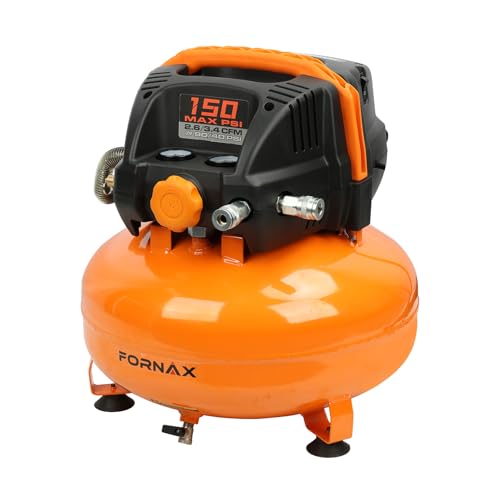 FORNAX 6-Gallon Pancake Air Compressor
|
8.4/10 | Buy | |
 ECOMAX 6-Gallon 175 PSI Portable Pancake Air
|
8.4/10 | Buy | |
 CRAFTSMAN 6 Gallon 150 PSI Portable Oil-Free
|
8.1/10 | Buy |
BOSTITCH BTFP02012 6-Gallon Pancake Air Compressor
Delivering 2.6 SCFM at 90 PSI from a 6-gallon 150 max PSI tank, the Bostitch BTFP02012 provides reliable pneumatic output in a 29-pound portable design. It is an ideal match for DIY homeowners, finish carpenters, and punch-list contractors needing low-maintenance air power for trim nailers and inflation tasks.
Pros
- Delivers a steady 2.6 SCFM at 90 PSI with a 150 max PSI ceiling for sequential finish fastening
- Portable 29-pound build and balanced center handle simplify jobsite mobility and vehicle loading
- Dual universal couplers allow two users to run separate nailers without aftermarket splitters
- High-efficiency motor starts smoothly in cold conditions and on properly rated extension cords
Cons
- Airflow output of 2.6 SCFM is not suited for continuous high-demand tools like sanders or spray guns
- Operational sound level of 78.5 dBA is louder than ultra-quiet low-RPM dual-piston models
- Ships as a bare tool without an air hose, blow gun, or pneumatic finish nailers included
CRAFTSMAN 6-Gallon 150 PSI Portable Oil-Free
The CRAFTSMAN 6-Gallon Pancake Air Compressor delivers 2.6 SCFM at 90 PSI with a 150 PSI maximum tank pressure, providing dependable pneumatic power for trim nailing, tire inflation, and garage punch-list jobs. Built with a low-voltage startup motor and a manageable 30.8-pound frame, it suits DIY homeowners, finish carpenters, and mobile service technicians needing portable air supply.
Pros
- Factory dual quick-connect couplers allow two trim carpenters or nailers to connect to the manifold at the same time
- Low-voltage 1.0 HP motor starts reliably in colder weather and when running on standard 120V circuits
- Includes a 25-foot air hose out of the box so you can start working on trim or tires immediately
- Maintenance-free oil-free pump design keeps discharged air clean and eliminates the need for ongoing pump oil changes
Cons
- The 2.6 SCFM output at 90 PSI is insufficient for continuous-draw air tools such as HVLP paint sprayers, orbital sanders, or heavy pneumatic grinders
- Standard universal motor produces significant sound output that may require hearing protection when running indoors
- Manual drain valve requires regular reach-under access to purge moisture after every working session
ECOMAX 6-Gallon Pancake Air Compressor - 150 PSI
Delivering 2.6 SCFM at 90 PSI from a 6-gallon tank reaching up to 150 PSI, the ECOMAX pancake air compressor balances reliable pneumatic output with a portable 27.6-pound frame. Powered by an oil-free UMC motor engineered for cold-weather starting and equipped with dual quick couplers, it is a practical air supply for trim carpenters, punch-list contractors, and home garage users.
Pros
- Delivers 2.6 SCFM at 90 PSI with a 150 PSI maximum pressure ceiling, well suited for finish carpentry and general garage chores
- Compact 27.6-pound design with a rubberized carry handle allows easy one-handed carrying up stairs and into work vans
- Dual universal quick couplers allow two air lines to connect simultaneously for multi-tool efficiency
- Oil-free UMC motor provides low-maintenance operation with reliable cold-weather and low-voltage starting capability
- Q235b alloy steel tank build and wide rubber feet offer solid jobsite stability
Cons
- Airflow rating of 2.6 SCFM at 90 PSI is not designed for continuous high-consumption air tools like rotary sanders, die grinders, or HVLP sprayers
- Bare-tool configuration does not include pneumatic hoses, tire chucks, or finish nailers in the package
- The manufacturer does not list an official decibel (dBA) sound rating, making standard hearing protection advisable during indoor use
VEVOR 6.3 Gallon Portable Air Compressor
Delivering 3.35 CFM at 90 PSI with a 1450W 2 HP oil-free motor and 6.3-gallon steel tank, this VEVOR compressor offers dependable air delivery for pneumatic nailing, tire care, and garage repairs. Dual intake silencers and built-in thermal protection make it a low-maintenance, practical option for home workshops and DIY mechanics.
Pros
- Generous 3.35 CFM output at 90 PSI readily handles common intermittent garage and workshop pneumatic tools.
- Dual silencer assemblies help dampen intake sound and keep airborne dust out of the pump cylinders.
- Maintenance-free oil-free pump eliminates crankcase oil level checks and oil-contaminated air lines.
- Rugged Q235B steel pressure vessel features triple-layer rust and wear protection.
- Integrated dual cooling fans and thermal overload shutoff protect the electric motor from heat strain.
Cons
- Maximum working pressure tops out at 116 PSI, which is lower than typical 135 to 175 PSI jobsite compressors.
- At 43 pounds, manual transport across stairs or jobsites requires noticeable physical effort.
- Continuous high-demand tools such as rotary sanders or large sprayers will outpace the pump during extended use.
ECOMAX 6-Gallon 150 PSI Portable Pancake Air
The ECOMAX 6-Gallon 150 PSI Pancake Air Compressor delivers portable, low-maintenance pneumatic power with its 1.5 HP oil-free pump, dual quick-connect couplers, and bundled 10-piece accessory kit. Featuring cold-weather starting support and a flip-up handle, it is an accessible choice for DIYers, trim carpenters, and garage tire maintenance.
Pros
- Comes with a 10-piece accessory kit including an air hose, tire chuck, and blow gun ready out of the box
- Dual quick-connect couplers enable two operators to run pneumatic lines simultaneously
- Oil-free pump design requires zero motor oil maintenance and prevents oil discharge into air lines
- Low-voltage and cold-weather startup capability helps ensure reliable motor turnover in chilly garages
- Flip-up carrying handle and built-in cord bracket simplify transport and tidy storage
Cons
- PVC air hose included in the kit can become stiff and difficult to manage in freezing temperatures
- Not intended for continuous high-demand air tools such as rotary sanders or automotive paint sprayers
- Standard universal motor noise level makes hearing protection advisable during indoor use
Metabo HPT 6-Gallon Pancake Air Compressor Review
The Metabo HPT EC711S is a portable 6-gallon pancake air compressor delivering 2.8 CFM at 90 PSI with a 165 PSI tank ceiling and an operating sound level of 73 dB. With its quick 46-second recovery cycle and dual quick couplers, it is an excellent choice for finish carpenters, punch-list contractors, and DIYers running pneumatic nailers.
Pros
- 73 dB operational sound rating is substantially quieter than standard job-site pancake units
- 165 PSI maximum pressure provides ample air storage with a swift 46-second recovery cycle
- Two 1/4-inch universal quick couplers support multi-tool setups right out of the box
- Sturdy steel roll cage protects gauges and the manifold assembly against knocks and drops
- Oil-free 1.0 HP motor ensures low maintenance and reliable cold-weather motor startup
Cons
- At 38.5 lbs, it is slightly heavier than ultra-compact 1-to-3-gallon trim compressors
- Airflow of 2.8 CFM at 90 PSI is designed for intermittent fastening, not continuous rotary tools or paint sprayers
- Bare-tool configuration means air hoses and pneumatic fastening tools must be purchased separately
VEVOR 10-Gallon 2HP Air Compressor
Built with a durable steel tank and an oil-free motor, this unit delivers 5.3 CFM at 90 PSI to power demanding air tools and spray guns. Its integrated mufflers and automatic safety shutoffs make it a low-maintenance choice for home workshops.
Pros
- Generates 5.3 CFM to power diverse pneumatic tools
- Oil-free design requires minimal ongoing maintenance
- Integrated silencer helps keep operation down to 78 dB
- Durable three-layer tank resists rust and wear
Cons
- Heavy at over 70 pounds to move around
- Maximum pressure caps at 125 PSI
- Bulky frame takes up significant floor space
FORNAX 6-Gallon Pancake Air Compressor
The FORNAX 6-Gallon Pancake Air Compressor delivers 2.6 CFM at 90 PSI and up to 150 PSI of maximum pressure, featuring dual couplers and a lightweight 28.8-pound portable footprint. It is a practical pneumatic power source for DIY homeowners, finish carpenters, and garage hobbyists driving nailers or managing tire inflation.
Pros
- Dual quick-connect couplers allow two nailers to operate simultaneously without adding an external splitter manifold
- Generous 6-gallon air tank capacity with a 150 PSI maximum pressure ceiling provides a dependable air reserve
- Lightweight 28.8-pound profile simplifies one-handed carrying up stairs and transport into work vans
- Maintenance-free oil-free pump eliminates oil checks, oil changes, and mess around finished work surfaces
Cons
- Operating sound output rated at 95 dBA is loud and makes hearing protection necessary, especially in closed rooms
- Airflow output of 2.6 CFM at 90 PSI cannot support continuous-demand tools like sanders, grinders, or paint sprayers
- Supplied as a bare-tool compressor without an included air hose, tire inflator chuck, or pneumatic nailers
ECOMAX 6-Gallon 175 PSI Portable Pancake Air
The ECOMAX 6-Gallon Pancake Air Compressor delivers up to 175 PSI and 3 CFM at 90 PSI, providing dependable recovery and dual quick couplers for trim fastening and garage tasks. Weighing approximately 31.5 pounds and featuring cold-weather start capability, it suits DIY homeowners and punch-list contractors seeking a complete portable air setup.
Pros
- High 175 PSI maximum tank pressure provides substantial usable air volume in a compact 6-gallon footprint
- Rated 3 CFM at 90 PSI supports quick pressure recovery between fastening cycles and tire inflation tasks
- Dual quick-connect couplers support running two pneumatic hoses without adding aftermarket splitters
- Comes complete with a 25-foot hose and essential pneumatic accessories for immediate out-of-the-box utility
- Oil-free pump design ensures low ongoing maintenance with no oil levels to monitor or change
Cons
- Output of 3 CFM at 90 PSI is unsuited for continuous high-consumption air tools like sanders or grinders
- Included 25-foot PVC air hose can be stiff and retain tight coils in cold working environments
- Manufacturer does not publish an official dBA rating, and standard oil-free pancake pumps can be loud indoors
CRAFTSMAN 6 Gallon 150 PSI Portable Oil-Free
The CRAFTSMAN 6-Gallon 150 PSI Oil-Free Pancake Air Compressor delivers 2.6 SCFM at 90 PSI via a 1.0 HP low-voltage start motor with factory dual quick couplers. Weighing 30.8 pounds, it provides dependable air delivery for finish carpenters, DIY remodelers, and garage maintenance tasks.
Pros
- Delivers 2.6 SCFM at 90 PSI with a 150 PSI maximum tank ceiling for dependable finish fastening.
- Dual quick couplers allow two pneumatic tools to remain connected at the same time without splitters.
- Oil-free pump design ensures clean air delivery and zero periodic pump oil maintenance.
- Low-voltage start 1.0 HP motor supports reliable startups on standard 120V household outlets.
- Manageable 30.8-pound weight and integrated carry handle provide practical one-person jobsite transport.
Cons
- Air delivery rate of 2.6 SCFM at 90 PSI is not designed for continuous high-demand tools like rotary sanders or paint sprayers.
- Standard oil-free electric motor design generates typical high-pitch operational sound during tank recharge cycles.
- Sold as a bare compressor unit without included air hoses, couplers, or pneumatic nailers.
Understanding Air Tool Performance on a 6 Gallon Air Compressor
Matching pneumatic tools to a portable compressor requires looking past tank gallon capacity and examining actual volume delivery. Many woodworkers and mechanics acquire a portable pancake unit expecting it to run an entire garage suite of air equipment. The realistic answer to whether will a 6 gallon air compressor run air tools is yes, provided those tools operate on intermittent cycles rather than continuous airflow. Understanding the boundary between single-cycle fasteners and continuous rotary air motors keeps you from stalling equipment during critical tasks.
The Short Answer: Intermittent Versus Continuous Air Tools
Every pneumatic tool falls into one of two operational categories based on how it consumes compressed air. Intermittent tools use short, contained pulses of pressurized air to complete a single mechanical stroke before pausing. Brad nailers, staplers, finish nailers, and tire chucks represent classic intermittent devices requiring minimal total volume per actuation. Because the tool pauses between cycles, a compact compressor has ample time to recover pressure before the next operation.
Continuous tools function differently because they spin an internal turbine or air motor without stopping. Rotary sanders, die grinders, needle scalers, and automotive paint spray guns demand an uninterrupted stream of air measured in cubic feet per minute. When you trigger a continuous air tool, it consumes compressed air faster than a small electric pump can generate new pressure. Within seconds, stored tank pressure drops below operating thresholds, leaving the tool starved of driving power.
Delivered CFM Versus Tank Storage Capacity
Air compressor marketing often highlights maximum tank pressure and tank volume while minimizing delivered airflow ratings. A six-gallon storage reservoir at 150 PSI holds a specific reserve volume of compressed air that acts like an energy buffer. However, true working power comes from pump output, which typically delivers 2.6 to 3.0 CFM at 90 PSI on portable electric models. If you want to understand how tank volume interacts with pneumatic consumption, reviewing an air compressor tank sizing guide clarifies these mechanical boundaries.
When a pneumatic tool consumes more volume than pump output ratings, the difference comes directly out of the tank buffer. For example, a small pneumatic impact wrench drawing 4.5 CFM at 90 PSI will run temporarily off the stored reserve in a six-gallon tank. Once that stored volume drops below the cut-in pressure threshold, the electric motor kicks on to rebuild pressure. If the tool remains running, line pressure plummets rapidly because the pump can only supply its baseline output of roughly 2.6 CFM.
Recognizing this relationship prevents misconceptions about what a larger tank actually does for pneumatic equipment. Increasing tank storage from three gallons to six gallons extends initial burst duration before pressure drops. It does not, however, alter the continuous air delivery generated by the electric motor and pump assembly. For continuous pneumatic operations, pump displacement and continuous motor power matter far more than static reservoir volume.
Air Tools That Work Exceptionally Well on Six Gallons
Woodworking and carpentry tools represent the ideal match for standard six-gallon pancake and portable horizontal compressors. Brad nailers firing 18-gauge wire brads consume a tiny fraction of a cubic foot of air per drive cycle. A standard six-gallon unit easily supports trim work, baseboard installation, and cabinet assembly without cycling the pump excessively. Pin nailers and narrow crown staplers operate with equal efficiency, allowing tradespeople to work briskly across interior jobsites.
Finish nailers handling 15-gauge and 16-gauge fasteners also perform reliably on portable six-gallon compressors. Framing nailers can operate effectively as well, provided the user drives nails at a measured, sequential pace rather than rapid bump-fire production. Installing framing studs, repairing deck rails, or building garden sheds rarely outpaces the recovery capacity of a quality six-gallon unit. Even inflation chucks, blow guns used in short clearing pulses, and pneumatic caulking guns function without performance drops.
Automotive and Intermittent Fastening Tools with Usable Limits
Automotive maintenance presents a mixed scenario where certain air tools work well only under strict operational discipline. A standard 1/2-inch pneumatic impact wrench typically requires between 4.0 and 5.0 CFM at 90 PSI for continuous operation. When breaking loose stubborn lug nuts during a tire rotation, you only trigger the impact wrench for three to five seconds per fastener. The six-gallon air buffer provides enough initial volume to break the nut loose before pressure deteriorates.
Air ratchets and pneumatic butterfly wrenches can also operate within short, controlled intervals for mechanical disassembly. The operator must pause between bolts to allow the electric motor to complete its recovery cycle from cut-in to cut-off pressure. Attempting to run an air ratchet continuously to remove dozens of fasteners on a transmission pan will quickly deplete the tank. Once tank pressure drops below 90 PSI, torque output falls significantly, slowing down your mechanical progress.
Tire inflation on passenger vehicles, light trucks, and lawn equipment represents another ideal intermittent automotive task. Topping off four car tires from 30 to 35 PSI consumes a modest air volume that a six-gallon compressor manages effortlessly. Seating beads on large truck tires or inflating completely flat high-volume tires requires patience and multiple motor recovery cycles. Managing these expectations ensures your automotive repairs proceed smoothly without overworking the compressor motor.
High-Demand Tools That Stall Small Compressors
Certain pneumatic tools should never be paired with a portable six-gallon compressor because their air demands exceed pump capabilities. Dual-action orbital sanders and high-speed rotary die grinders are notorious air hogs that demand between 8 and 14 CFM at 90 PSI. Connecting a random orbital sander to a six-gallon tank results in rapid pressure depletion within ten to fifteen seconds of contact with the workpiece. The sander bogs down, loses orbital oscillation, and leaves uneven sanding marks across the wood or automotive panel.
Automotive paint sprayers and HVLP spray guns present another absolute limitation for compact workshop compressors. High-volume, low-pressure spray guns require a continuous supply of clean, dry air at roughly 7 to 12 CFM to atomize paint properly. A six-gallon unit running an HVLP gun will suffer an immediate pressure drop, causing paint spattering, orange peel texture, and ruined finishes. For dedicated automotive bodywork and refinishing, woodworkers and mechanics must step up to a stationary workshop air compressor capable of delivering high continuous volume.
Pneumatic cut-off wheels, air chisels, needle scalers, and sandblasting cabinets also fall strictly outside the capabilities of portable six-gallon tanks. These tools rely on aggressive, continuous air velocity to cut steel, strip rust, or fracture masonry. Running them on a small compressor forces the electric motor to run non-stop without ever shutting off. This severe mismatch quickly leads to thermal overload shutdown and damages sensitive internal pump components.
Duty Cycle Realities and Oil-Free Pump Longevity
Most six-gallon portable compressors utilize oil-free universal motors paired with Teflon-coated piston rings and aluminum cylinders. Manufacturers design these compact pumps for portability and zero fluid maintenance rather than industrial endurance. Oil-free mechanisms generate substantial frictional heat during operation, which dissipates slowly through external aluminum cooling fins. Consequently, these units generally carry a 50 percent duty cycle rating, meaning the pump should only run half the time during any given working session.
Exceeding this duty cycle rating by forcing the compressor to power continuous air tools leads to accelerated mechanical wear. When the pump runs without pausing, cylinder temperatures climb rapidly, degrading Teflon piston seals and reed valves. Overheated pumps gradually lose their ability to build pressure efficiently, resulting in longer tank fill times and lower CFM output. In severe cases, the thermal overload protection switch activates, shutting down the motor to prevent catastrophic electrical winding failure.
Electrical Circuit Loads and Cold Weather Startups
Electric air compressors draw substantial electrical current when starting against head pressure inside the pump. A standard 1.0 to 1.5 horsepower motor on a six-gallon unit typically requires 10 to 14 running amps on a standard 120-volt household circuit. During initial startup, the electric motor experiences a brief inrush current spike that can approach 15 to 20 amps. Connecting the compressor to a circuit already shared with shop heaters, lighting, or power tools frequently trips household circuit breakers.
Cold workshop environments also place extra strain on compressor electric motors during winter mornings. Lower ambient temperatures stiffen internal seals, unloader valve diaphragms, and mechanical check valve springs. Many modern six-gallon units incorporate low-voltage cold-start valves designed to bypass head pressure until the motor gains momentum. To prevent electrical tripping in cold garages, plug the compressor directly into a dedicated 20-amp outlet and run longer air hoses instead of light-duty electrical extension cords.
Maximizing Airflow Efficiency Through Hoses and Regulators
Optimizing the air delivery path downstream of the tank allows you to extract maximum performance from a six-gallon compressor. Many factory combo kits package inexpensive 1/4-inch inner diameter PVC air hoses with restrictive brass fittings. A 1/4-inch hose causes noticeable dynamic pressure drop over lengths exceeding 25 feet, robbing tools of driving force. Upgrading to a 3/8-inch inner diameter hybrid polymer air hose reduces internal friction and delivers full tank pressure directly to your pneumatic tool.
Air pressure regulators and quick-connect couplers also impact downstream airflow and tool responsiveness. Setting your regulator to the exact pressure specified by the tool manufacturer prevents wasteful air consumption. Running a finish nailer at 110 PSI when it only requires 80 PSI drains the six-gallon tank significantly faster on every shot. High-flow brass couplers further minimize flow restriction, ensuring instantaneous pressure recovery right at the tool inlet.
Essential Moisture Purging and Tank Preservation
Compressing atmospheric air concentrates ambient moisture directly inside the steel storage tank on every pump cycle. As hot compressed air cools against the interior walls of the six-gallon cylinder, water vapor condenses into liquid at the tank bottom. If left unpurged, this standing water gradually reduces usable air storage volume, leaving less space for compressed air reserves. Over time, acidic condensation attacks raw internal steel, leading to structural corrosion, tank wall thinning, and potential tank failure.
Moisture accumulation also damages pneumatic tools by traveling through air lines and washing away vital internal tool lubricants. Water reaching pneumatic nailers causes internal O-rings to swell, seals to deteriorate, and driver pistons to corrode. In finishing applications, moisture specks ruin fresh paint jobs by creating blemishes and water spots on painted surfaces. Opening the bottom tank drain valve after every single work session purges collected water and keeps your pneumatic air supply dry.
Modern six-gallon compressors feature various drain valve designs ranging from recessed needle petcocks to accessible quarter-turn brass ball valves. Quarter-turn ball valves offer superior reliability because they open completely with a quick flick of the wrist and resist clogging from rust scale. When draining the tank, always reduce air pressure to approximately 10 to 20 PSI to purge moisture without damaging the valve seat. Depressurizing the tank completely before long-term storage prevents internal rust and extends equipment life for years.
Practical Workshop Takeaways for Sizing Air Equipment
A portable six-gallon air compressor remains one of the most versatile and convenient power tools for home garages and jobsites. It delivers outstanding performance for trim carpentry, framing repairs, tire inflation, and light-duty mechanical fastening tasks. Knowing realistic airflow boundaries prevents frustrating project delays and keeps you from buying tools that your compressor cannot physically power. If your projects involve intermittent nailers and occasional lug nut removal, a six-gallon setup provides excellent utility in a compact footprint.
When your ambitions expand toward continuous automotive sanding, metal grinding, or full-vehicle paint spraying, upgrading your air source becomes mandatory. Demanding tools require heavy-duty cast-iron pumps and large storage tanks capable of sustaining continuous airflow without overheating. Matching tool air consumption to compressor output ratings ensures your workshop equipment runs smoothly, safely, and efficiently. By respecting these pneumatic boundaries, your six-gallon compressor will remain a dependable partner for countless home improvement projects.
About the author
Clint DeBoer is an experienced tool-industry specialist with decades of involvement in technical media, hands-on product evaluation, and testing methodology. His focus on performance, practical usability, and data-driven comparisons makes his expertise highly relevant to professional air compressors, pneumatic tools, and workshop equipment.