
Best Stationary Air Compressor of 2026 for Workshop & Garage Use
Best Stationary Air Compressor guide for October 2026. Compare durable upright cast-iron pumps, high CFM airflow, and heavy-duty shop tanks.
 By Tom Scalisi
Updated October 7, 2026
By Tom Scalisi
Updated October 7, 2026

Air tool starvation ruins workshop productivity faster than nearly any other pneumatic hassle. High-demand tools like dual-action sanders, blast cabinets, and paint guns pull serious volume, leaving portable tanks gasping for pressure after just a few seconds. Selecting the best stationary air compressor delivers the continuous airflow and reserve storage needed so your equipment won’t stall out mid-pass. Upright cast-iron pumps paired with 60-gallon or 80-gallon air receivers stabilize shop lines, keeping pressure steady across long automotive restoration and woodworking jobs.
Finding the ideal workshop compressor means balancing running horsepower, delivered CFM at 90 PSI, and dedicated 240V circuit capacity. Many professional fabricators lean toward two-stage air compressors for high-pressure delivery up to 175 PSI, while smaller home garages often do great with high-flow single-stage units. Based on manufacturer specifications and real-world user feedback across brands like DEWALT, Campbell Hausfeld, and EMAX, paying attention to pump lubrication, ASME tank ratings, and duty cycle limits prevents costly headaches down the road. That extra tank volume means fewer recovery cycles, cooler pump operation, and dependable air for all your pneumatic tools.
| Award | Product | ACR Score About ACR ScoreThe ACR Score is our own rating from 0 to 10, based on performance, design and build, ease of use, and value. It reflects independent research and is never influenced by manufacturers, retailers, or affiliate commissions. Learn more › | |
|---|---|---|---|
| Best Overall |
DEWALT 60-Gallon Stationary Air Compressor
|
9.2/10 | Buy |
| Best Value |
 DEWALT 60-Gallon Stationary Vertical Air
|
9.2/10 | Buy |
| Best Premium |
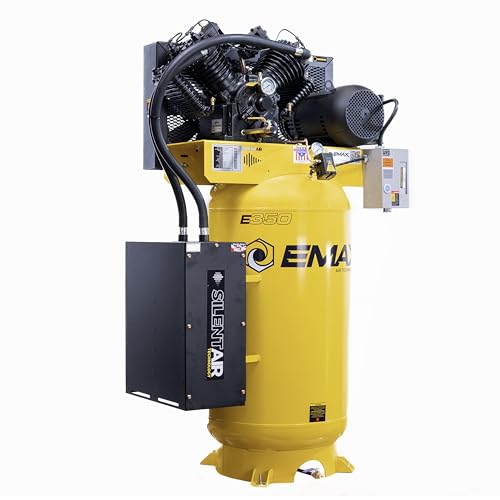 EMAX 80-Gallon Stationary Air Compressor
|
9.2/10 | Buy |
| Best Budget |
 Campbell Hausfeld 60-Gallon Air Compressor
|
8.9/10 | Buy |
 Campbell Hausfeld 80-Gallon Stationary Air
|
8.8/10 | Buy | |
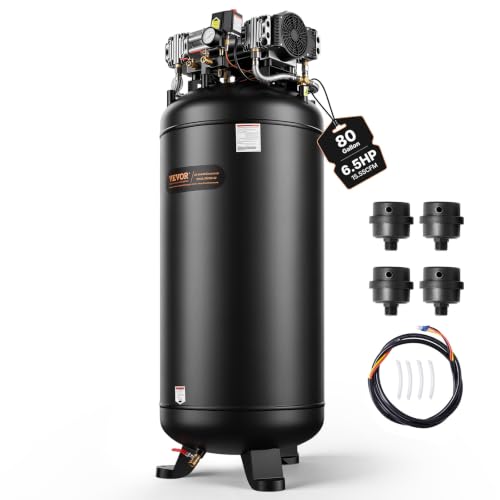 VEVOR 80-Gallon Stationary Air Compressor
|
8.1/10 | Buy | |
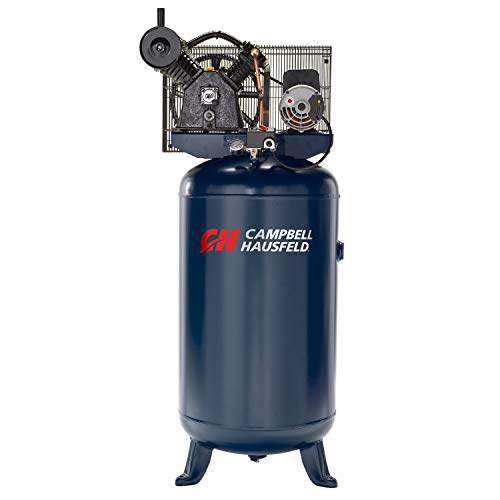 Campbell Hausfeld 80-Gallon 2-Stage Electric Air
|
8.0/10 | Buy | |
 DEWALT 60-Gallon Stationary Air Compressor
|
7.8/10 | Buy |
DEWALT 60-Gallon Stationary Air Compressor
The DEWALT DXCM602.COM is a heavy-duty 60-gallon vertical stationary air compressor engineered for dedicated workshops, featuring an oil-lubricated pump and a 3.7 HP motor delivering 11.5 CFM at 90 PSI up to 175 max PSI. Powered by 208V or 230V electrical service, it is an ideal stationary air source for mechanics, fabricators, and woodworkers running demanding pneumatic tools.
Pros
- High rated air output of 11.5 CFM at 90 PSI easily handles air-hungry continuous tools
- Durable oil-lubricated pump engineered for cooler operation and extended service life
- ASME-certified 60-gallon vertical steel pressure vessel ensures verified safety and high capacity
- Dual-voltage spread-volt motor simplifies integration into 208V or 230V electrical systems
Cons
- Stationary 200-pound footprint requires permanent shop placement and lacks mobility wheels
- Requires a dedicated 208V or 230V high-voltage circuit and cannot run on standard 120V household outlets
- Requires routine maintenance including oil level inspections and periodic pump oil changes
DEWALT 60-Gallon Stationary Vertical Air
The DEWALT DXCM603.COM is a heavy-duty 60-gallon vertical stationary air compressor delivering 14.6 CFM at 90 PSI and 175 max PSI. Driven by a 5 HP 240-volt induction motor on an ASME-certified tank, it provides the sustained air reserve needed for serious auto repair bays and busy woodworking shops.
Pros
- High air delivery rating of 14.6 CFM at 90 PSI powers demanding pneumatic tools with minimal pressure lag
- Generous 60-gallon ASME-certified steel tank provides substantial pressurized air storage up to 175 max PSI
- Vertical stationary footprint conserves floor space in crowded workshops and automotive service bays
- Heavy-duty 5 HP induction motor designed for dependable long-term operation on 240-volt workshop circuits
Cons
- Requires a dedicated 240-volt, 60 Hz AC electrical installation and hardwiring rather than standard 120V household outlets
- Tall 65-inch stationary vertical design is heavy and permanent, making it unsuitable for mobile or jobsite use
- High-pressure single-stage operation creates noticeable acoustic output and heat during extended pump recovery cycles
EMAX 80-Gallon Stationary Air Compressor
The EMAX 80-Gallon E350 stationary air compressor delivers 31 CFM using a 7.5 HP single-phase, two-stage pump paired with Silent Air technology that lowers sound by up to 50 percent. It is built for commercial workshops and auto garages needing high-volume air without overwhelming noise.
Pros
- Delivers a robust 31 CFM airflow to handle high-demand pneumatic equipment without stalling
- Silent Air technology lowers operating noise by up to 50 percent for a much quieter shop floor
- Pressure lubrication ensures dependable oil distribution across critical pump components
- Four-stage low-profile air filtration helps protect internal pump hardware from workshop dust
Cons
- Weighing 956 pounds, this massive stationary unit requires heavy equipment and dedicated space for delivery and placement
- The 7.5 HP single-phase motor requires dedicated electrical wiring suited for heavy workshop machinery
- Stationary design offers zero portability and must be anchored permanently in one work area
Campbell Hausfeld 60-Gallon Air Compressor
Built for demanding garage and workshop tasks, this stationary compressor combines a 3.7 HP motor with a two-stage cast-iron pump reaching 175 PSI. It provides steady airflow to support high-demand air tools like sprayers, grinders, and sanders.
Pros
- High 175 PSI maximum output pressure
- Durable cast-iron pump rated for longevity
- Large 60-gallon capacity supports sustained pneumatic tool use
- Vertical tank design saves workshop floor space
Cons
- Requires a dedicated 230V to 240V electrical connection
- Heavy 255-pound stationary build is difficult to move
Campbell Hausfeld 80-Gallon Stationary Air
Engineered for automotive repair shops and serious home garages, this stationary Campbell Hausfeld unit combines an 80-gallon ASME tank with a 5 HP motor delivering 16.0 CFM at 90 PSI. Its oil-lubricated cast-iron pump runs at a low 950 RPM, making it a dependable choice for continuous paint spraying, sanding, and air tool operation.
Pros
- Substantial 16.0 CFM delivery at 90 PSI easily powers continuous pneumatic tools like sanders and paint sprayers
- Heavy-duty cast-iron two-cylinder pump runs at a low 950 RPM for smoother operation and reduced thermal stress
- ASME-certified 80-gallon vertical tank maximizes air storage while minimizing workshop floor footprint
- Single-phase 208-230V motor includes overload protection and eliminates the need for an external magnetic starter
Cons
- Stationary footprint and substantial 460-pound weight require permanent shop placement and mechanical assistance during unloading
- Requires dedicated 208-230V single-phase electrical wiring and cannot run on standard 120V household outlets
- Maximum operating pressure caps at 140 PSI, which is lower than some two-stage compressors that reach 175 PSI
VEVOR 80-Gallon Stationary Air Compressor
The VEVOR 80-Gallon Stationary Air Compressor delivers an impressive 15.5 SCFM at 90 PSI with a maintenance-free 6.5 HP oil-free motor and 145 PSI maximum pressure. Operating on 220V single-phase power with an 86 dB sound profile, it provides dependable, high-volume air storage for serious woodworkers, commercial auto shops, and industrial facilities.
Pros
- High airflow rating of 15.5 SCFM at 90 PSI supports continuous and intermittent pneumatic tools alike
- Oil-free pump architecture eliminates messy oil changes and oil mist in downstream air lines
- Generous 80-gallon tank capacity creates an extensive pressurized air reserve for high-volume tasks
- Space-saving vertical tank footprint fits cleanly against shop walls and in dedicated utility corners
Cons
- The 86 dB sound output is relatively loud for tight, enclosed residential garages without hearing protection
- Heavy 264.6-pound stationary design requires dedicated equipment placement and appropriate transport planning
- Requires a 220V single-phase electrical connection, making it incompatible with standard 120V household outlets
Campbell Hausfeld 80-Gallon 2-Stage Electric Air
The Campbell Hausfeld XC802100 is an 80-gallon stationary shop compressor powered by a 5 HP 230V induction motor and a heavy-duty, oil-lubricated 2-stage cast-iron pump. Delivering 11.9 SCFM at 90 PSI up to a 175 PSI maximum shutoff, it is built for auto mechanics, fabricators, and dedicated workshops running air-hungry pneumatic tools.
Pros
- High-capacity air delivery of 11.9 SCFM at 90 PSI and 11.3 SCFM at 175 PSI
- Durable oil-lubricated cast-iron 2-stage pump rated for up to 10,000 hours of bearing life
- Vertical 80-gallon ASME-certified tank stores large air reserves without taking up excess floor space
- Robust 5 HP induction motor engineered for heavy-duty 230V single-phase workshop service
Cons
- Requires a dedicated 230V, 22-amp single-phase electrical supply and hardwired installation
- Heavy 326-pound stationary unit that requires dedicated mechanical equipment for positioning and anchoring
- Demands routine crankcase oil monitoring and regular oil changes unlike maintenance-free oil-free compressors
DEWALT 60-Gallon Stationary Air Compressor
The DEWALT 60-gallon vertical stationary air compressor pairs a 3.7 HP 240V electric motor with an oil-lubricated pump delivering 11.5 SCFM at 90 PSI and 155 max PSI. It provides substantial air reserves for workshop mechanics, auto hobbyists, and woodworkers operating demanding pneumatic tools.
Pros
- Substantial airflow rating of 11.5 SCFM at 90 PSI handles demanding pneumatic tools
- Generous 60-gallon vertical tank stores ample air reserves to reduce pump cycling
- Oil-lubricated pump design offers dependable mechanical durability for shop use
- Compact 24-inch by 24-inch footprint minimizes dedicated floor space in garages and workshops
Cons
- Stationary 239-pound design is not intended for jobsite mobility or easy transport
- Requires a dedicated 240V electrical connection, preventing use on standard 120V household outlets
- Oil-lubricated pump requires periodic oil level monitoring and scheduled maintenance
Frequently Asked Questions
What electrical circuit is required to run a stationary air compressor in a home garage?
A dedicated 208V to 240V single-phase circuit is almost always required. Most 60-gallon and 80-gallon models draw between 15 and 25 running amps, which standard 120V household outlets cannot safely supply. Hardwiring the motor or installing a dedicated 30-amp to 50-amp breaker protects against tripped breakers and provides sufficient starting torque during cold mornings.
What is the main difference between a single-stage and a two-stage stationary air compressor?
A two-stage compressor compresses air twice to achieve higher pressures up to 175 PSI, whereas a single-stage pump tops out around 135 to 155 PSI. Two-stage units run cooler and maintain higher CFM delivery under heavy loads, making them ideal for high-pressure pneumatic tools. Single-stage compressors generally cost less upfront and provide plenty of air volume for standard automotive impact wrenches and ratchets.
How much CFM at 90 PSI do you need for continuous tools like sanders and spray guns?
You generally need at least 10 to 15 CFM at 90 PSI for continuous air tools. Rotary sanders, die grinders, and HVLP spray guns consume air non-stop, which can quickly drain smaller tanks. Pairing an 80-gallon receiver with a motor delivering over 14 CFM prevents tool starvation and keeps line pressure stable throughout extended painting or sanding sessions.
How often should you drain condensation from a stationary compressor tank?
You should drain the receiver tank after every work session or at least once weekly. Compressing ambient air generates moisture that settles at the bottom of the steel cylinder, causing internal rust over time. Opening the bottom drain valve releases water buildup, preserves the structural integrity of your ASME certified tank, and prevents water droplets from ruining spray finishes or corroding air tools.
Why do most stationary workshop compressors use oil-lubricated cast-iron pumps?
Cast-iron oil-lubricated pumps dissipate friction and heat far more effectively than oil-free designs. This liquid lubrication allows the pump to sustain high duty cycles and achieve service lives reaching up to 10,000 hours with routine oil checks. While oil-free models require less routine maintenance, oil-lubricated pumps run noticeably quieter and withstand demanding industrial workloads.
Can you bolt a stationary air compressor directly to a concrete garage floor?
Yes, but installing heavy-duty vibration dampener pads beneath the feet is strongly recommended before anchoring. Direct metal-to-concrete contact amplifies operational resonance throughout the shop floor and can stress tank weld seams over time. Thick rubber isolation pads absorb pump vibration, reduce ambient room noise, and prevent concrete cracking around anchor bolts.
About the author
Tom Scalisi brings more than two decades of experience in construction, building maintenance, contracting, and hands-on tool use. His practical understanding of power tools, automotive work, repairs, and jobsite equipment helps readers evaluate compressors based on real workloads rather than specifications alone.