
Best Air Compressors Under $500 of 2026 for Garage Workshops
Power pneumatic tools efficiently using the Best Air Compressors Under $500 for October 2026 with high CFM airflow, rapid recovery, and rugged garage builds.
 By Bob Beacham
Updated October 7, 2026
By Bob Beacham
Updated October 7, 2026

Reliable Compressed Air for Home Workshops
Tripped circuit breakers on chilly mornings and deafening pump noise can grind any garage project to an immediate halt. Nobody wants to pause midway through driving framing nails or rotating vehicle tires just to wait on a sluggish motor struggling to rebuild line pressure. Balancing motor horsepower, tank capacity, and quiet operation often feels tricky on a strict shop budget. Based on our analysis of pump designs, CFM ratings at 90 PSI, and user feedback, securing the best air compressors under $500 lets you run demanding pneumatic tools without breaking the bank or blowing out household electrical circuits.
Modern mid-priced air delivery systems now offer impressive build quality, ranging from cast iron cylinders engineered for heavy-duty thermal endurance to low-decibel dual-piston motors running under 70 dBA. Whether your workspace requires a high-pressure hand-carry unit for trim carpentry or a high-capacity vertical steel tank for steady air tool use, the current market delivers serious performance. By paying close attention to continuous CFM output, usable storage pressure, and maintenance-free pump configurations, you can match your air equipment to real-world tasks with zero guesswork.
| Award | Product | ACR Score About ACR ScoreThe ACR Score is our own rating from 0 to 10, based on performance, design and build, ease of use, and value. It reflects independent research and is never influenced by manufacturers, retailers, or affiliate commissions. Learn more › | |
|---|---|---|---|
| Best Overall |
Makita MAC2400 2.5 HP Air Compressor
|
9.2/10 | Buy |
| Best Budget |
 Klutch 29-Gallon Portable Air Compressor - 2.5 HP
|
8.9/10 | Buy |
 DEWALT D55146 4.5-Gallon 225-PSI Wheeled
|
8.8/10 | Buy | |
| Best Premium |
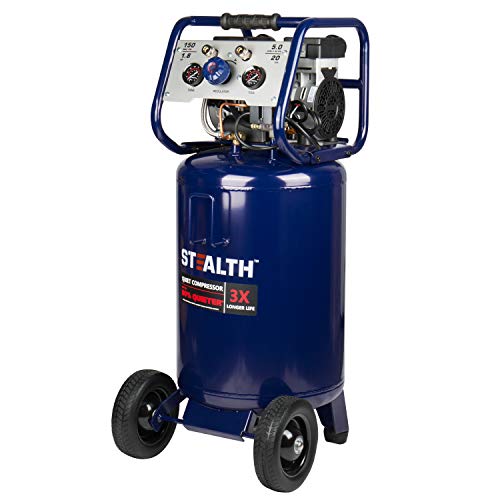 Stealth 20-Gallon 1.8 HP Air Compressor
|
7.8/10 | Buy |
Makita MAC2400 2.5 HP Air Compressor
Built for demanding jobsite tasks, this heavy-duty compressor pairs a rugged roll-cage frame with a low-RPM cast iron pump delivering 4.2 CFM at 90 PSI. Its low amp draw and cooler, oil-lubricated operation make it a dependable workhorse for contractors running pneumatic tools.
Pros
- Strong 4.2 CFM output at 90 PSI
- Protective roll-cage construction for jobsite durability
- Low 1,730 RPM pump runs quieter at 79 dB
- Low amp draw prevents tripped breakers at startup
Cons
- Oil-lubricated design requires routine oil level maintenance
- Substantial 20-inch footprint requires dedicated storage space
Klutch 29-Gallon Portable Air Compressor - 2.5 HP
The Klutch 29-Gallon Air Compressor pairs a 2.5 HP 120V motor with a 175 PSI maximum tank pressure and 5.1 CFM at 90 PSI, providing reliable air reserve for garage mechanics and serious DIY woodworkers. Its oil-free pump eliminates messy maintenance while large flat-free tires provide dependable mobility across busy workshop floors.
Pros
- Generous 29-gallon tank reserve coupled with high 175 PSI maximum storage pressure
- Solid airflow output delivering 5.1 CFM at 90 PSI on standard 120V power
- Maintenance-free oil-free pump design removes the hassle of oil checks and messy spills
- Durable flat-free wheels make maneuvering the 127-pound upright unit around the garage manageable
- Factory-installed brass quick-connect fitting allows easy one-handed hose connections
Cons
- Substantial 127-pound weight makes lifting the unit into a truck bed or up stairs a two-person job
- Oil-free direct pumps typically generate higher operational sound levels than slow-turning belt-drive compressors
- Continuous air-hungry tools like dual-action rotary sanders will outpace the 5.1 CFM pump delivery during extended sessions
DEWALT D55146 4.5-Gallon 225-PSI Wheeled
The DEWALT D55146 is a rugged 4.5-gallon portable compressor featuring an oil-free pump and 225-PSI maximum storage pressure for extended air reserve. Built with 10-inch non-flat tires and a protective metal console, it delivers dependable mobility and performance for trim carpenters, remodelers, and garage hobbyists.
Pros
- 225 PSI maximum tank storage provides significantly more usable compressed air than standard lower-pressure portable tanks
- 10-inch non-flat tires make rolling across jobsite debris, thresholds, and gravel paths smooth and dependable
- Protective metal console shields working pressure gauges and air controls against accidental jobsite impacts
- Oil-free pump allows clean transport in truck beds or car trunks without worrying about spilled crankcase oil
Cons
- Substantial 88-pound weight requires noticeable effort when lifting into high truck tailgates or carrying up staircases
- Oil-free pump operation naturally produces elevated sound levels inside small enclosed garages or occupied rooms
- Larger physical footprint takes up more floor space than compact pancake-style compressors
Stealth 20-Gallon 1.8 HP Air Compressor
Delivering 5 CFM at 90 PSI at an ultra-quiet 68 decibels, this oil-free machine is tailored for home garages and noise-sensitive workshops. Its generous 20-gallon tank supports high-demand pneumatic tools, though the 121-pound build limits effortless transport.
Pros
- Quiet 68-decibel sound output protects hearing
- Reliable 5 CFM delivery at 90 PSI
- Maintenance-free oil-free pump design
- Dual couplers streamline multi-tool setups
- Substantial 20-gallon tank capacity
Cons
- Hefty 121-pound weight hampers vehicle loading
- Tall 42-inch frame demands dedicated storage space
Frequently Asked Questions
Can the Best Air Compressors Under $500 of 2026 run continuous air tools like sanders?
Yes, units with larger storage tanks and higher airflow ratings can support intermittent sanding and painting. Compressors delivering around 5.0 to 5.1 CFM at 90 PSI from a 20-gallon or 29-gallon tank provide sufficient air volume for intermediate automotive tasks. Continuous rotary sanders still demand steady line pressure, so monitoring recovery cycles prevents air tool starvation.
What is the main difference between oil-lubricated and oil-free air compressors?
Oil-lubricated pumps feature durable cast iron cylinders designed for cooler running temperatures, while oil-free designs offer maintenance-free operation without oil changes. Oil-lubricated units, such as cast iron big bore configurations, often run cooler and last longer under frequent contractor use. Oil-free compressors eliminate oil spill risks and operate reliably in sub-freezing temperatures without cold-start hesitation.
Will these air compressors trip a standard 15-amp household circuit breaker?
No, most 120-volt models in this price class are engineered with low-amp draw motors to run safely on standard 15-amp household outlets. Motors pulling low startup amperage prevent nuisance breaker trips during cold morning starts in residential garages. For the best electrical reliability, avoid long extension cords and plug directly into a dedicated wall receptacle.
How quiet are ultra-quiet air compressors compared to standard workshop units?
Ultra-quiet compressors operate around 68 decibels, which is substantially quieter than standard jobsite units that frequently exceed 85 to 90 decibels. A sound output of 68 dBA lets you hold a regular conversation nearby without wearing hearing protection. This lower sound profile makes dual-piston silent motors ideal for attached residential garages and basement workshops.
Why is max tank pressure important when selecting a jobsite air compressor?
Higher storage pressure provides more usable air storage inside a compact tank footprint. Compressors storing air up to 175 PSI or 225 PSI hold significantly more compressed air than standard 150 PSI tanks of the same volume. This stored reserve allows finish nailers and impact wrenches to operate longer before the electric motor kicks on to recover.
How often should you drain moisture from an air compressor tank?
You should drain your compressor tank after every work session to prevent internal rust and moisture carryover into pneumatic tools. Compressed air naturally condenses water vapor against steel tank walls as air cools down. Opening the bottom drain valve releases accumulated water, protecting internal metal surfaces and extending total equipment lifespan.
About the author
Bob Beacham is an experienced tools and workshop writer with deep knowledge of power equipment, mechanical systems, and practical DIY applications. His coverage of air compressors, welding equipment, saws, and workshop tools helps translate technical specifications into useful guidance for homeowners and serious DIYers.