
Who Makes Husky Air Compressors? A Practical Guide
Who makes husky air compressors? Learn what the Husky name tells you, how to identify a model’s manufacturer, and what to check before buying in November 2026.
 By Clint DeBoer
Updated November 10, 2026


A compressor that carries a store brand can have a different manufacturer, parts source, or design from one model to the next. Who makes husky air compressors is therefore not always answered by a single factory name: Husky is Home Depot’s house brand, while the company that builds a particular compressor may depend on the model and production period. The name on the tank tells you the brand, but it may not identify the original equipment manufacturer.
If you’re trying to identify who built a compressor you already own, start with its model and serial labels, then check the manual and parts documentation. If you’re shopping, compare the specifications and service information for the exact unit rather than relying on the Husky name alone. Tank size, delivered air, maximum pressure, electrical requirements, and replacement-part availability are more useful for judging suitability than an assumed manufacturer. For tire inflation, our guide to inflating a tire with a compressor explains the practical basics.
| Award | Product | ACR Score About ACR ScoreThe ACR Score is our own rating from 0 to 10, based on performance, design and build, ease of use, and value. It reflects independent research and is never influenced by manufacturers, retailers, or affiliate commissions. Learn more › | |
|---|---|---|---|
| Best Overall |
CRAFTSMAN 12V Portable Tire Inflator with
|
9.2/10 | Buy |
| Best Premium |
 VEVOR 13-Gallon 2HP Quiet Air Compressor |
9.2/10 | Buy |
| Best Budget |
 DEWALT Cordless Tire Inflator Portable Air |
9.1/10 | Buy |
| Best Value |
 CRAFTSMAN 2-Gallon Portable Air Compressor |
9.1/10 | Buy |
 CRAFTSMAN 6-Gallon 150 PSI Portable Oil-Free |
8.9/10 | Buy | |
 ECOMAX 6-Gallon 150 PSI Portable Pancake Air |
8.8/10 | Buy | |
 VEVOR 2HP Oil-Free Air Compressor Motor |
8.4/10 | Buy | |
 DEWALT DWFP55130 2.5-Gallon 200 PSI Quiet Trim Air |
8.4/10 | Buy | |
 Klutch 20-Gallon Portable Air Compressor |
8.4/10 | Buy | |
 CARSUN Dual Power AC/DC Portable Tire Inflator |
8.3/10 | Buy |
CRAFTSMAN 12V Portable Tire Inflator with
The CRAFTSMAN 12V Portable Tire Inflator is an ultra-compact 1.9-pound roadside unit delivering up to 150 PSI with digital auto shut-off and built-in cord storage. Powered via a standard 12V car accessory plug, it offers fast tire top-offs and dependable emergency inflation without crowding trunk space.
Pros
- Weighs only 1.9 pounds for effortless glove box, under-seat, or trunk storage during road trips
- Digital auto shut-off prevents accidental over-inflation without requiring constant manual gauge monitoring
- Bright three-mode LED light provides critical illumination during nighttime roadside emergencies
- Comes fully equipped with multi-valve adapters, a replacement fuse, and a tailored carry pouch
Cons
- Requires a 12V DC vehicle accessory socket and does not include a 120V AC household outlet adapter
- Compact tankless pump is built strictly for tire inflation and cannot drive pneumatic nailers or air tools
- The 2.17-foot air hose length means the compressor must sit on the ground adjacent to the wheel valve stem
VEVOR 13-Gallon 2HP Quiet Air Compressor
Delivering 4.6 SCFM at 90 PSI with a quiet 66-decibel sound profile, this 13-gallon compressor suits home garages and workshops needing steady air supply without disruptive motor noise. Its oil-free 2HP motor fills the tank in under three minutes, while large rubber wheels help maneuver its substantial 71-pound frame.
Pros
- Quiet 66-decibel noise level during operation
- Oil-free motor design eliminates routine maintenance
- Fast air buildup in under three minutes
- Sturdy 7-inch rubber wheels assist transport
Cons
- Heavy 71-pound weight makes vehicle loading difficult
- Maximum 125 PSI ceiling limits high-pressure tools
DEWALT Cordless Tire Inflator Portable Air
This compact DEWALT portable tire inflator delivers up to 150 PSI with smart auto shut-off, powered by an internal rechargeable battery or an included 10-foot 12V car plug. It provides an efficient, pocket-sized solution for vehicle owners, cyclists, and DIYers wanting rapid roadside top-offs without hauling a bulky tank compressor.
Pros
- True cordless freedom with an internal rechargeable battery plus a 10-foot 12V DC vehicle plug backup
- Accurate digital pressure gauge with 5 smart presets and automatic shut-off to eliminate overinflation
- Ultra-compact handheld design weighing just 0.63 kg for easy storage in glove boxes or saddlebags
- Integrated LED work light and emergency USB power bank functionality for travel safety
- Generous accessory bundle backed by a 3-year limited warranty
Cons
- Engineered exclusively for high-pressure inflation rather than operating pneumatic air tools or nailers
- Does not include a 120V AC residential wall outlet power adapter
- Compact tankless pump requires periodic cooling breaks during heavy multi-tire inflation runs
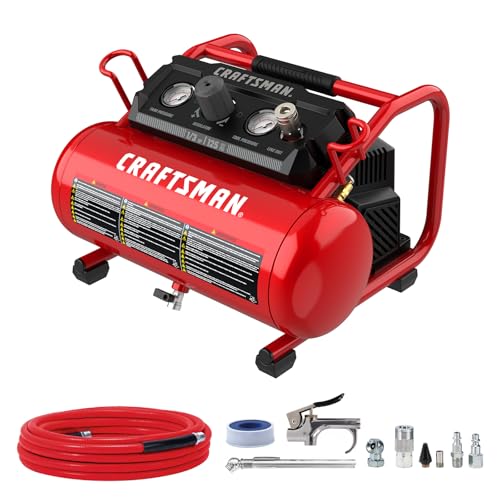
CRAFTSMAN 2-Gallon Portable Air Compressor
This CRAFTSMAN 2-gallon portable compressor package pairs a max 125 PSI oil-free pump with a versatile 10-piece pneumatic accessory kit using standard 1/4-inch NPT fittings. It is a practical, lightweight solution for DIYers and homeowners tackling tire inflation, air dusting, and light fastening.
Pros
- Complete out-of-the-box pneumatic package with air hose, blow gun, tire chuck, and 1/4-inch NPT quick-connect hardware
- Lightweight 19-pound carry weight makes moving between the garage, driveway, and workbench effortless
- Oil-free pump eliminates crankcase oil checks and prevents oil aerosol contamination in downstream air lines
- Dual quick couplings allow quick hookups without needing additional brass splitters
Cons
- Small 2-gallon receiver tank and 1/3 HP motor are limited to light-duty pneumatic tasks rather than continuous air-hungry tools
- The included starter air hose and accessories are entry-level components that high-volume shops may eventually want to upgrade
- Fittings utilize standard 1/4-inch auto profile plugs which require matching couplers if your shop uses alternate pneumatic profiles
CRAFTSMAN 6-Gallon 150 PSI Portable Oil-Free
The CRAFTSMAN 6-Gallon Pancake Air Compressor delivers 2.6 SCFM at 90 PSI with a 150 PSI maximum tank pressure, providing dependable pneumatic power for trim nailing, tire inflation, and garage punch-list jobs. Built with a low-voltage startup motor and a manageable 30.8-pound frame, it suits DIY homeowners, finish carpenters, and mobile service technicians needing portable air supply.
Pros
- Factory dual quick-connect couplers allow two trim carpenters or nailers to connect to the manifold at the same time
- Low-voltage 1.0 HP motor starts reliably in colder weather and when running on standard 120V circuits
- Includes a 25-foot air hose out of the box so you can start working on trim or tires immediately
- Maintenance-free oil-free pump design keeps discharged air clean and eliminates the need for ongoing pump oil changes
Cons
- The 2.6 SCFM output at 90 PSI is insufficient for continuous-draw air tools such as HVLP paint sprayers, orbital sanders, or heavy pneumatic grinders
- Standard universal motor produces significant sound output that may require hearing protection when running indoors
- Manual drain valve requires regular reach-under access to purge moisture after every working session
ECOMAX 6-Gallon 150 PSI Portable Pancake Air
The ECOMAX 6-Gallon 150 PSI Pancake Air Compressor delivers portable, low-maintenance pneumatic power with its 1.5 HP oil-free pump, dual quick-connect couplers, and bundled 10-piece accessory kit. Featuring cold-weather starting support and a flip-up handle, it is an accessible choice for DIYers, trim carpenters, and garage tire maintenance.
Pros
- Comes with a 10-piece accessory kit including an air hose, tire chuck, and blow gun ready out of the box
- Dual quick-connect couplers enable two operators to run pneumatic lines simultaneously
- Oil-free pump design requires zero motor oil maintenance and prevents oil discharge into air lines
- Low-voltage and cold-weather startup capability helps ensure reliable motor turnover in chilly garages
- Flip-up carrying handle and built-in cord bracket simplify transport and tidy storage
Cons
- PVC air hose included in the kit can become stiff and difficult to manage in freezing temperatures
- Not intended for continuous high-demand air tools such as rotary sanders or automotive paint sprayers
- Standard universal motor noise level makes hearing protection advisable during indoor use
VEVOR 2HP Oil-Free Air Compressor Motor
Delivering 5.2 CFM at 90 PSI with a 1680 RPM motor, this oil-free VEVOR pump head provides clean, low-maintenance air output for garage shops and pneumatic tools. Its cold-rolled steel build and dedicated cooling fans make it a dependable drop-in motor for woodworking, spray painting, and automotive repairs.
Pros
- Low-maintenance oil-free operation
- Generates 5.2 CFM at 90 PSI
- Sturdy steel and aluminum construction
- Effective cooling via built-in fans and heat sinks
Cons
- Heavier unit at over 36 pounds to install
- Single-stage design limits peak pressure to 145 PSI
- At 78 dB, operating volume is still noticeable indoors
DEWALT DWFP55130 2.5-Gallon 200 PSI Quiet Trim Air
The DEWALT DWFP55130 delivers a capable 3.0 SCFM at 90 PSI with a 200 max PSI 2.5-gallon tank, running at a quiet 71.5 dBA on an efficient 12-amp motor. It is an ideal pneumatic power source for trim carpenters, punch-list contractors, and DIYers working on residential circuits.
Pros
- Delivers 3.0 SCFM at 90 PSI with a high 200 max PSI ceiling for rapid pressure recovery during sequential fastening
- Quiet 71.5 dBA sound output makes indoor trim carpentry and remodeling far less disruptive to homeowners
- Low 12-amp draw reduces breaker trips when running on shared 15-amp household circuits
- Integrated roll cage and console protect critical components while supporting horizontal or vertical operation
- Dual quick couplers allow two trim carpenters to connect and work off a single compressor
Cons
- Bare-tool configuration means you must supply your own air hoses, couplers, and pneumatic nail guns
- At 36 pounds, it is heavier to haul up flights of stairs than ultra-compact 1-gallon finish compressors
- Air output of 3.0 SCFM is built for intermittent finish fastening and will not support continuous tools like rotary sanders or sprayers
Klutch 20-Gallon Portable Air Compressor
Featuring a 2.0 HP 120V motor and a 20-gallon tank, the Klutch portable air compressor delivers a rated 4.2 SCFM at 90 PSI for versatile workshop air. Its oil-free pump and wheeled design make it a dependable choice for garage mechanics, woodworkers, and serious DIYers needing steady air storage.
Pros
- Generous 20-gallon air storage capacity provides a substantial buffer for intermittent shop tools
- Delivers a listed 4.2 SCFM at 90 PSI, outperforming smaller pancake compressors for workshop chores
- Oil-free pump design eliminates messy oil changes and allows clean, upright transport
- Rugged rubber wheels and built-in ergonomic handle make moving the 90-pound frame manageable
- Integrated thermal overload protection helps prevent motor burnout during demanding cycles
Cons
- Substantial 90-pound weight makes lifting into truck beds or carrying up stairs difficult without assistance
- Oil-free motor configurations generally produce noticeable operating noise compared to low-RPM lubricated units
- At 4.2 SCFM at 90 PSI, high-draw continuous air tools like sanders or grinders will require recovery pauses
CARSUN Dual Power AC/DC Portable Tire Inflator
The CARSUN Dual Power Tire Inflator delivers up to 150 PSI of high-pressure air running from either a 110V household outlet or a 12V vehicle socket. With digital pressure presets, automatic shutoff, and a lightweight 2.1-pound frame, it is an ideal maintenance pump for passenger vehicles, bicycles, and household inflatables.
Pros
- Versatile dual-voltage operation works seamlessly in the home garage or on the road without requiring an external converter
- Accurate auto-shutoff mechanism protects tires from accidental over-pressurization during routine top-offs
- Compact 2.1-pound build packs away easily in car trunks, under vehicle seats, or on garage shelving
- Clear digital display allows fast switching across four standard pressure measurement units
Cons
- Requires a mandatory 10-minute cooldown period after every 15 minutes of continuous operation
- Manufacturer explicitly states it does not support heavy truck tires, tractor tires, or stand-up paddleboards (SUP)
- Tankless inflator design cannot run standard workshop pneumatic air tools like brad nailers or paint sprayers
Husky is a Home Depot house brand, not the name of one compressor factory. A house brand can use contract manufacturers, and the supplier may differ across product lines or change over time. That means a general answer naming one manufacturer for every Husky air compressor would be misleading. The particular model is the important clue.
Retailer ownership and factory production are separate roles. Home Depot sells products under the Husky name and may provide product support, while a supplier may design or assemble a given unit. A label, manual, warranty document, or parts listing may identify the responsible company for a specific model, but that information does not establish who built every compressor bearing the Husky brand.
Online discussions sometimes assign a familiar manufacturer to an entire brand based on similarities in appearance or specifications. Those clues can be suggestive, but they are not proof of a shared factory or interchangeable parts. Models can look alike while using different pumps, pressure switches, motors, tanks, or fittings. Treat a proposed OEM identification as unconfirmed unless the model’s documentation or manufacturer confirms it.
Brand, seller, and original manufacturer are not the same
The brand answers what name is marketed on the product. The seller indicates where it is sold, and the original equipment manufacturer, or OEM, refers to the company that made or assembled the product for the brand owner. Those roles may belong to different companies. A product can also involve multiple suppliers, with one company making the pump and another assembling or sourcing the complete compressor.
For a buyer, the practical question is often not the factory’s name by itself. The useful questions are whether the compressor’s output suits the intended tools, whether the warranty is clear, and whether service parts can be found. A manufacturer name can help with those questions, but it does not substitute for model-specific evidence. Avoid assuming that parts for a similarly shaped compressor will fit.
Why the answer can change between Husky models
Retail brands may source compact inflators, portable tank compressors, and larger shop units from different suppliers. Product lines also evolve: a later revision can have a new model number, revised components, or a different service arrangement. Even if two compressors share a tank size or advertised pressure, that does not prove they share an OEM or internal parts.
Production location alone is not a reliable way to identify a manufacturer. A country-of-origin statement can describe where substantial production occurred, but it may not name the factory or identify which company designed the unit. Likewise, a patent, certification, or generic component number may relate to one part rather than the complete compressor. Use these details as clues, not as a definitive answer.
How to Identify the Maker of a Specific Husky Compressor
Begin with the complete model number, not just the tank capacity or a short product nickname. Look for the data plate on the compressor and record the model and serial numbers exactly as printed. Photograph the label before contacting support, because small differences in letters, digits, or suffixes can point to different revisions. Do not remove or alter identification labels.
Next, locate the owner’s manual, warranty information, and parts diagram for that exact model. Check the cover, safety pages, warranty section, and contact information for a named manufacturer, importer, or service provider. The manual may identify the company responsible for support without explicitly naming the factory that assembled the compressor. Report what the document actually says rather than treating a service contact as confirmed OEM identity.
Use model-specific support and parts records
Contact the retailer or the support provider named in the manual and ask who manufactures the exact model. Include the model number and, if requested, the serial number and purchase period. Ask a direct question: does the company make the complete compressor, provide warranty service, or supply only selected parts? That distinction can prevent a support contact from being mistaken for the original manufacturer.
Parts records offer another useful cross-check. A parts diagram may identify the pump assembly, regulator, pressure switch, or replacement motor by a model-specific part number. If a component carries another company’s name, that may identify the component supplier rather than the maker of the full compressor. Confirm compatibility by the compressor’s complete model and revision, not by visual resemblance or a shared generic part description.
For an older unit, original documentation may be harder to find, and a current product page may describe a newer revision. Save the label photo and any manual or service response you locate. If the support provider cannot confirm the OEM, it is more accurate to say the manufacturer is not publicly identified for that model than to guess. That answer still helps buyers focus on verifiable service and performance details.
What Matters More Than the OEM Name When Buying
Knowing the factory can help with warranty and repair research, but it does not tell you whether a compressor can keep up with a tool. Compare delivered airflow at the pressure your tool needs, usually expressed in CFM or SCFM at a stated PSI. Maximum tank pressure is not an airflow rating, and tank capacity does not reveal how quickly the pump can replenish air during sustained use.
A compressor can store air in its tank and release it quickly for short bursts, but repeated tool use draws down that reserve. Intermittent tasks such as tire inflation or short nailing sequences differ from the sustained demand of many sanders and spray guns. Use the tool maker’s air-consumption specification and compare it with the compressor’s stated delivery at the relevant pressure. If the compressor’s output is lower than the tool’s ongoing demand, expect pauses or pressure decline rather than assuming a larger tank solves the mismatch.
Pressure ratings need the same careful reading. Maximum PSI describes a pressure limit for the compressor, not the pressure a tool must receive or the airflow available at that pressure. A regulator controls working pressure, but it cannot increase pump capacity. Select a unit whose listed air delivery and operating range suit the task, and follow the tool and compressor manufacturers’ instructions.
Tank size, portability, and intended workload
A compact tank may be convenient to carry and store, yet it provides a smaller air reserve than a larger tank. That can be fine for topping up tires, using blow-off accessories briefly, or operating intermittent fasteners, provided the unit’s output and instructions suit the job. Longer continuous draws can make a small compressor cycle frequently, so assess the pump’s rated delivery and any stated operating limitations before purchase.
Tank shape affects placement and handling as well as capacity. A pancake unit sits differently from a wheeled vertical or horizontal tank, and the available product specifications should state the actual configuration and weight. Consider whether the compressor must travel between a car, garage, and work area, or remain in a fixed workshop location. A portable design is useful only if its weight and handling are realistic for the person moving it.
Do not assume a stated horsepower figure tells the full story. Product listings do not always describe horsepower in the same way, and a number without clear context may not predict delivered airflow. Give greater weight to documented CFM or SCFM at a stated pressure, tank capacity, voltage, and the manufacturer’s operating guidance. If the listing leaves out a specification that matters to your tool, request clarification instead of filling in the gap with a guess.
Electrical supply and noise deserve a model-specific check
Check the nameplate and manual for the required voltage and circuit guidance before connecting a compressor. The information provided here does not establish the startup current or running amperage of any particular Husky model, so those values should not be inferred from tank size or horsepower marketing. Avoid overloading a shared circuit, and follow the manufacturer’s electrical instructions. If the listed requirements are unclear, ask the seller or service provider before purchase.
Noise is another specification to verify rather than assume from the brand or compressor style. A quiet-sounding product description is not enough to compare two units unless the manufacturer provides a sound rating and explains its measurement conditions. In an attached garage or indoor work area, a documented sound rating can help set expectations, but room surfaces and distance affect perceived noise. Use appropriate hearing protection when operating air equipment, especially in enclosed spaces.
Service, Warranty, and Comparing Alternatives
A confirmed OEM can be helpful when looking for technical support, but warranty responsibility and parts availability are more immediate ownership concerns. Read the warranty for coverage terms, exclusions, and the correct contact route. Ask whether service parts remain available for the exact model and whether the support provider can identify compatible replacements. A familiar manufacturer name does not guarantee that every component will be stocked or interchangeable.
Compare alternatives by model-specific specifications rather than brand reputation alone. The products shown in this guide span portable tire inflators and tank compressors, so they are not all substitutes for one another. For example, the listed CRAFTSMAN 6-gallon pancake compressor specifies 2.6 SCFM at 90 PSI and a maximum of 150 PSI, while the VEVOR 13-gallon unit lists 4.6 SCFM at 90 PSI and a maximum of 125 PSI. Those figures describe different capacities and pressure limits; they do not establish equivalent performance or suitability for every tool.
Brand names also do not make product categories interchangeable. A small 12-volt tire inflator is designed around portable inflation tasks, while a tank compressor stores a reserve of compressed air for other uses. Match the product category to the job, then check the pressure, airflow, power source, included fittings, and instructions. The listed DEWALT trim compressor, for instance, specifies a 2.5-gallon tank, 3.0 SCFM at 90 PSI, and 200 PSI maximum, which gives buyers concrete details to compare against their intended use.
If you are comparing portable units for garage tasks, our home mechanic compressor guide provides related context on matching compressor capacity to common workshop jobs.
For paint work, also consider air quality and the equipment manufacturer’s requirements. An oil-free pump may reduce the risk of oil entering the compressed air stream from the pump, but it does not remove moisture or contaminants from the air line. Use appropriate filtration and moisture-control equipment when the application requires it, and follow the spray gun and compressor instructions. Do not treat a compressor’s brand or pump label as a substitute for a suitable air-preparation setup.
Routine care affects service life regardless of who made the unit. Follow the manual for tank draining, storage, cleaning, and inspection, and depressurize the tank completely before servicing or transporting the compressor. Never bypass a safety relief valve or modify factory pressure controls. If the tank, electrical components, or pressure system appears damaged, stop using the compressor and consult the manufacturer or a qualified service provider.
A careful answer beats a confident guess
For a specific Husky compressor, the strongest identification comes from its exact model documentation or confirmation from the support provider. If those sources identify only the warranty contact and not the factory, keep that distinction clear. Avoid using an online comparison or similar-looking model as proof of who manufactured the unit. This is especially important when buying replacement parts, because an incorrect assumption can lead to incompatible components.
For a purchase decision, the OEM question is best treated as one part of a broader check. Verify airflow at working pressure, tank size, electrical requirements, sound information, warranty support, and model-specific parts access. The best fit depends on the task: intermittent inflation has different needs from sustained pneumatic tool use. Those measurable and documented details can support a sound decision even when the factory behind the Husky label is not disclosed.
In short, Husky is Home Depot’s brand, but the manufacturer of a particular compressor must be verified by model. Check the data plate and official documentation, then judge the unit by its supported specifications and service options. When reliable records do not name the factory, say so rather than assigning an OEM based on resemblance or rumor.
About the author
Clint DeBoer is an experienced tool-industry specialist with decades of involvement in technical media, hands-on product evaluation, and testing methodology. His focus on performance, practical usability, and data-driven comparisons makes his expertise highly relevant to professional air compressors, pneumatic tools, and workshop equipment.