
What to Look for in a Portable Air Compressor: 2026 Guide
Learn what to look for in a portable air compressor in October 2026, from pressure ratings and airflow to power sources and motor decibels.
 By Glenda Taylor
Updated October 7, 2026
By Glenda Taylor
Updated October 7, 2026

Maintaining proper air pressure in vehicle tires or running pneumatic tools on a remote jobsite requires reliable equipment that fits your physical space and power limitations. Choosing the wrong unit often leads to blown circuit breakers, frustratingly slow inflation times, or an oversized machine that is difficult to transport. Understanding what to look for in a portable air compressor ensures you select a model capable of delivering adequate pressure and airflow for your specific tasks. Whether you need a compact emergency inflator for your vehicle trunk or a pancake compressor for trim carpentry, key mechanical specifications dictate real-world capability.
Modern portable compressors balance power delivery, motor architecture, and storage volume in vastly different ways. Evaluating primary factors like maximum operating pressure, power supply options, noise levels, and automated shut-off features helps prevent costly purchasing mistakes. Reliable units from established toolmakers such as DEWALT, CRAFTSMAN, and AstroAI provide specialized configurations designed for roadside convenience or garage versatility. Identifying your specific pneumatic demands before buying guarantees that your compressor performs efficiently whenever you need compressed air.
| Award | Product | ACR Score About ACR ScoreThe ACR Score is our own rating from 0 to 10, based on performance, design and build, ease of use, and value. It reflects independent research and is never influenced by manufacturers, retailers, or affiliate commissions. Learn more › | |
|---|---|---|---|
| Best Overall |
DEWALT Cordless Tire Inflator Portable Air
|
9.1/10 | Buy |
 CRAFTSMAN Dual Power Tire Inflator
|
8.1/10 | Buy | |
| Best Budget |
 AstroAI L7 Cordless Tire Inflator Portable Air
|
8.0/10 | Buy |
DEWALT Cordless Tire Inflator Portable Air
This compact DEWALT portable tire inflator delivers up to 150 PSI with smart auto shut-off, powered by an internal rechargeable battery or an included 10-foot 12V car plug. It provides an efficient, pocket-sized solution for vehicle owners, cyclists, and DIYers wanting rapid roadside top-offs without hauling a bulky tank compressor.
Pros
- True cordless freedom with an internal rechargeable battery plus a 10-foot 12V DC vehicle plug backup
- Accurate digital pressure gauge with 5 smart presets and automatic shut-off to eliminate overinflation
- Ultra-compact handheld design weighing just 0.63 kg for easy storage in glove boxes or saddlebags
- Integrated LED work light and emergency USB power bank functionality for travel safety
- Generous accessory bundle backed by a 3-year limited warranty
Cons
- Engineered exclusively for high-pressure inflation rather than operating pneumatic air tools or nailers
- Does not include a 120V AC residential wall outlet power adapter
- Compact tankless pump requires periodic cooling breaks during heavy multi-tire inflation runs
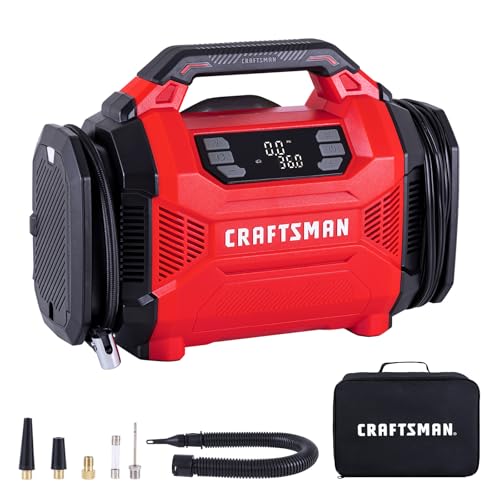
CRAFTSMAN Dual Power Tire Inflator
The CRAFTSMAN Dual Power Tire Inflator delivers versatile high-pressure air delivery up to 150 PSI using either a 120V AC home outlet or a 12V DC vehicle plug. Featuring digital auto shut-off presets and an integrated LED work light, it is an essential portable air solution for DIYers, garage mechanics, and road commuters.
Pros
- Dual 120V AC and 12V DC power inputs offer exceptional flexibility for both driveway maintenance and unexpected roadside flats
- Accurate digital pressure gauge with automatic shut-off prevents over-pressurizing vehicle and bicycle tires
- Capable of reaching 150 PSI, making it suitable for high-pressure road bike tires as well as passenger car tires
- Built-in LED work light enhances nighttime safety and visibility when working alongside highway traffic
- Complete package includes dedicated air hose, multiple nozzle adapters, spare fuse, and a zippered storage bag
Cons
- Tankless direct-drive mechanism is engineered for tire inflation and cannot power pneumatic air tools such as nailers or impact wrenches
- Takes longer to fill large volume leisure items like oversized air mattresses or rafts compared to dedicated high-volume blowers
- Lacks an onboard cordless tool battery dock, requiring access to an active 120V wall outlet or 12V vehicle socket
AstroAI L7 Cordless Tire Inflator Portable Air
The AstroAI L7 is a lightweight, handheld cordless air compressor delivering up to 150 PSI with an integrated 4000mAh rechargeable battery and precise auto-shutoff. It provides dependable, pocket-sized inflation performance for motorists, cyclists, and DIYers needing quick roadside tire top-offs.
Pros
- Weighs only 0.96 pounds for effortless storage in vehicle consoles, toolbags, or cycling packs
- High-speed digital sensor samples tire pressure at 200 times per second to prevent over-inflation
- Internal 4000mAh battery provides cordless freedom without tangling 12V cigarette lighter cords
- Versatile secondary utility as an emergency LED flashlight and portable USB power bank
Cons
- Not intended for heavy-duty truck tires or commercial tires larger than 25 inches in diameter
- Duty cycle requires allowing the unit to cool for 10 minutes after 15 minutes of continuous run time
- Tankless micro-compressor design cannot power workshop pneumatic air tools
Evaluating Core Features and Performance Metrics for Portable Air Compressors
Selecting the right portable compressor requires looking beyond raw peak numbers to evaluate how mechanical components function together under real working conditions. A machine built solely for quick emergency tire top-offs operates on entirely different engineering principles than a tank-based unit intended to drive framing nailers or impact wrenches. Matching the motor output, power input, pressure thresholds, and storage capacity to your regular applications prevents equipment failure and unnecessary downtime. By breaking down each critical specification, you can determine exactly which configuration fulfills your operational requirements.
Maximum Operating Pressure and Pressure Reserves
Maximum operating pressure, measured in pounds per square inch (PSI), indicates the absolute limit of air compression a pump can generate. Many compact tire inflators and portable jobsite compressors offer maximum ratings of 150 PSI, which is sufficient for vehicle tires, bicycle tires, and standard pneumatic nailers. Having a higher maximum rating allows small tanks to store a greater volume of compressed air relative to their physical dimensions. When air is stored at higher pressures, the system provides a useful reserve buffer before the motor must restart to replenish the tank.
However, maximum pressure alone does not reflect continuous working power. Operating pressure drops rapidly once a pneumatic tool draws air from the line or when filling high-volume truck tires. For high-pressure applications like road bicycle tires or heavy-duty trailer tires that operate between 80 and 110 PSI, a unit rated for 150 PSI provides the necessary overhead to complete inflation without stalling. Make sure the compressor you select comfortably exceeds the operating pressure requirement of your most demanding tool or tire.
Airflow Delivery and Cubic Feet per Minute
Airflow delivery is the single most important metric for operating air tools, yet it is often confused with static pressure. Airflow is measured in standard cubic feet per minute (SCFM), typically rated at standard working pressures of 90 PSI or 40 PSI. Intermittent-use tools like finish nailers and staplers consume minimal air per actuation and function well on lower airflow ratings. Conversely, continuous-demand tools like paint sprayers, rotary die grinders, and random orbital sanders require sustained airflow that small portable units cannot produce.
When evaluating a compressor, check the SCFM rating at the specific pressure your tools require rather than relying on displacement figures. A compact inflator designed primarily for tires might move relatively low volume slowly over several minutes, which is acceptable for roadside emergencies but unworkable for pneumatic construction tools. If your projects involve continuous air tools, you need a larger tank volume and a pump that delivers at least 1.5 times the tool’s required SCFM. For simple tire maintenance and sporting equipment, steady pressure output matters more than high volumetric flow.
Power Supply Flexibility: AC Outlets, 12V DC, and Cordless Batteries
The intended operating location largely dictates which power source makes the most practical sense for your compressor. Traditional workshop models rely on standard 120V alternating current (AC) household outlets, delivering steady electrical current suitable for prolonged operation. Roadside tire inflators frequently use 12V direct current (DC) adapters that plug directly into vehicle auxiliary sockets or connect straight to vehicle battery terminals. Dual-power models, such as the CRAFTSMAN Dual Power Tire Inflator with digital controls, bridge this gap by including both 120V AC and 12V DC power inputs for seamless garage and travel use.
Cordless lithium-ion battery technology has introduced complete mobility without tangled power cables or the need to park next to an electrical outlet. Modern handheld pumps, such as the AstroAI L7 Tire Inflator Portable Air unit, integrate internal rechargeable battery packs that provide quick inflation for bicycles, cars, and sports gear in remote settings. Other portable designs utilize hybrid power architecture, combining built-in rechargeable cells with 12V vehicle charging cords like the DEWALT Tire Inflator, Portable Air Compressor. When selecting a cordless model, consider charging times, battery capacity measured in milliamp-hours, and whether the unit can operate directly from vehicle power when the internal battery is depleted.
Motor Architecture and Sound Output Levels
Compressor noise is a major consideration, especially when working inside residential spaces, client homes, or attached garages. Traditional portable compressors often feature high-speed universal brush motors that produce loud noise levels exceeding 80 decibels. This intense operating sound causes rapid operator fatigue and can disrupt occupants in quiet residential areas. In contrast, low-RPM induction motors and modern dual-piston pump configurations run significantly quieter, often operating in the 60 to 70 decibel range.
Quiet operation is not just a comfort feature; it also indicates lower mechanical stress and lower operating temperatures. Slower-turning motors generate less internal friction, which directly extends component life for piston seals and valve assemblies. If you anticipate using your compressor indoors for finish carpentry, craft projects, or nighttime tire maintenance, paying attention to decibel ratings is critical. Look for units with enclosed motor housings, integrated cooling fans, and rubber vibration-isolation feet that dampen acoustic resonance against concrete floors.
Pressure Monitoring, Digital Gauges, and Automatic Shut-Off
Accurate pressure regulation is essential to prevent dangerous over-inflation of vehicle tires and delicate bicycle tubes. Analog mechanical dial gauges have largely been superseded on compact units by high-contrast digital displays that provide precise numerical readings. Advanced pressure sensors, such as the TrueGauge screen technology found on select portable inflators, sample pressure data hundreds of times per second to provide real-time accuracy. A bright backlit display is especially beneficial when checking tire pressures in poorly lit garages or along dark roadsides at night.
Automatic shut-off functionality takes the guesswork out of inflation by stopping the motor once target pressure is reached. Users can dial in a specific pressure threshold or select from pre-programmed modes for passenger cars, motorcycles, bicycles, or athletic balls. Once the set pressure is attained, the internal pressure switch cuts power to the pump immediately to protect the inflatable object from rupture. This hands-off capability allows you to focus on other tasks safely without constantly hovering over an analog needle.
Duty Cycle Limits and Thermal Management
The duty cycle of an air compressor defines the percentage of time the pump can safely operate within a given operational window. Most consumer-grade portable inflators and small oil-free units feature intermittent duty cycles, typically around 50 percent or less. For example, a compact tire pump may specify a maximum continuous run time of 15 minutes followed by a mandatory 10-minute cooling interval. Compressing air naturally generates significant heat, and compact motor housings must dissipate that thermal energy to avoid component breakdown.
Exceeding the specified duty cycle risks overheating the motor windings, melting internal Teflon piston rings, or triggering thermal overload switches. Units equipped with active cooling fans and aluminum cylinder heads manage operating temperatures much better during demanding multi-tire fill sequences. If you regularly air down four large truck tires for off-road driving or need to inflate commercial trailer tires, verify that the compressor possesses adequate thermal endurance. Choosing a compressor with built-in thermal overload protection ensures the motor automatically shuts down before catastrophic heat damage can occur.
Tank Configuration: Stored Volume vs. Tankless Inflators
For pneumatic tools, the presence and configuration of an air storage tank dictates workflow efficiency. Tankless inflators rely strictly on continuous pump displacement, making them ideal for tires but incapable of running impact wrenches or nail guns. Tank-equipped models generally range from 1 to 6 gallons, utilizing pancake, hot dog, or twin-stack cylindrical vessels. Pancake tanks provide a low center of gravity that resists tipping on uneven surfaces, while twin-stack tanks offer a compact footprint with sturdy roll-cage framing.
The tank acts as an energy accumulator, absorbing rapid surges in demand and allowing the tool to fire instantly at full regulated pressure. Larger tanks decrease the frequency of motor cycling, which protects the pressure switch and reduces wear on motor contacts. However, increased tank capacity directly adds physical bulk and weight, making the compressor harder to lift into truck beds or carry up stairwells. Evaluate whether your work genuinely requires stored air volume or if a direct-drive tankless inflator satisfies your routine maintenance requirements.
Pump Lubrication: Oil-Free vs. Oil-Lubricated Mechanics
Portable air compressors fall into two distinct mechanical categories regarding pump lubrication: oil-free systems and oil-lubricated cast-iron pumps. Oil-free compressors utilize permanently lubricated components, often featuring Teflon-coated piston rings and sealed precision bearings. These units require zero oil level monitoring, eliminate the risk of messy crankcase leaks during vehicle transport, and start reliably in freezing winter conditions. Because they can be stored horizontally or transported on their side without spilling lubricant, oil-free designs dominate the portable consumer market.
On the other hand, oil-lubricated pumps feature an oil reservoir and splash-lubricated crankshaft similar to a small internal combustion engine. These pumps run cooler and generally boast longer operational lifespans under heavy commercial workloads. However, they demand routine oil level checks, periodic oil changes, and must always remain upright during transport to avoid oil entering the air cylinder or spilling in your trunk. For occasional DIY tasks, mobile trim carpentry, and roadside tire care, maintenance-free oil-free pumps offer the greatest practical convenience.
Portability, Carry Ergonomics, and Protective Enclosures
Physical dimensions and carry weight dictate how easily a portable compressor integrates into your daily routine. Handheld cordless inflators often weigh under two pounds, slipping neatly into a glove box, backpack, or bike pannier. Larger jobsite compressors range from 20 to 60 pounds, demanding thoughtful handle placement and balanced center-of-gravity engineering for single-handed transport. A well-designed suitcase handle or ergonomic top grip prevents awkward wrist strain when maneuvering through tight hallways or loading equipment into a vehicle.
Jobsite environments also expose equipment to impacts, dust, and abrasive debris. Look for models housed in impact-resistant composite shells or surrounded by welded steel roll cages that shield sensitive pressure gauges, regulators, and brass fittings. Shrouded housings protect internal cooling fans and wiring from jobsite damage while keeping hot cylinder heads away from accidental hand contact. Rubberized bumpers and non-marking feet also prevent the compressor from sliding across slick truck beds or marring finished hardwood flooring.
Moisture Drainage and Pressure Vessel Longevity
Compressing ambient air inevitably squeezes atmospheric moisture out of suspension, causing water condensation to pool at the bottom of the pressure tank. If left unattended, this standing water triggers internal oxidation, corroding the steel tank walls and potentially compromising structural vessel integrity over time. Tank-equipped portable compressors feature a drain valve located at the lowest point of the tank to purge accumulated water. Regularly opening this valve after every work session is the single most critical maintenance task for extending tank life.
The design of the drain valve significantly impacts how easy this maintenance routine is to perform. Traditional screw-type petcock valves feature tiny knurled knobs that are stiff to turn, prone to clogging with rust particles, and painful to operate with cold fingers. In contrast, quarter-turn brass ball valves provide an effortless lever action that opens smoothly and discharges water and sediment instantly. When choosing a tank compressor, look for an accessible drain valve positioned where you can easily reach it without tipping the machine upside down.
Electrical Demands and Extension Cord Guidelines
Understanding electrical requirements is vital to avoid tripping residential circuit breakers or damaging the compressor motor during startup. Electric compressors experience a brief inrush of high amperage when starting against tank pressure, especially in cold garages where motor resistance is elevated. Connecting a compressor to a shared 15-amp household circuit already powering other appliances often results in nuisance breaker trips. Ensuring the unit operates on a dedicated outlet with an unloader valve that purges head pressure between cycles minimizes starting friction.
Using undersized or excessively long extension cords creates substantial voltage drop, which starves the electric motor and can cause thermal burnout. If you must extend your working reach, it is far safer to connect a longer air hose rather than a long electrical extension cord. When an extension cord is strictly necessary, choose a heavy-duty 12 AWG or 10 AWG cord rated to handle the motor’s full startup surge without significant voltage loss. Adhering to proper electrical practices protects the compressor motor windings and maintains steady air output.
Matching Compressor Architecture to Your Intended Tasks
The final step in selecting a portable air compressor is honestly assessing your primary use case and work environment. For automotive commuters and outdoor cyclists, ultra-compact battery or 12V DC inflators offer unbeatable convenience, pocket-sized storage, and automated shut-off precision. DIY woodworkers and finish carpenters benefit most from lightweight 1- to 3-gallon quiet compressors that operate unobtrusively inside living rooms without disturbing clients. Framing crews and roofing teams require larger 4- to 6-gallon tanks capable of rapid pressure recovery to keep pace with rapid nailer firing.
Prioritizing the right combination of power source, physical footprint, maximum pressure, and noise output ensures you invest in a machine that solves your daily problems rather than creating new hassles. Investing in quality components from reputable manufacturers gives you dependable service across years of routine maintenance and emergency use. By carefully reviewing these technical specifications before buying, you can confidently secure the ideal portable compressor for your garage, workshop, or vehicle.
About the author
Glenda Taylor has extensive experience in residential construction, remodeling, home improvement, and tool use. Her practical approach to equipment evaluation focuses on usability, performance, safety, and value—helping DIYers and workshop users make better-informed decisions about compressors and related tools.