
What Size Air Compressor for Car Tires: Practical Sizing Guide for 2026
Determine what size air compressor for car tires matches your vehicle in October 2026. Compare CFM ratings, PSI requirements, and tank options.
 By Glenda Taylor
Updated October 8, 2026
By Glenda Taylor
Updated October 8, 2026

Seasonal temperature drops frequently cause tire pressure monitoring systems to trigger warning lights right before a morning commute. Maintaining correct inflation protects tread life, maximizes fuel economy, and preserves vehicle handling under wet or icy road conditions. Determining what size air compressor for car tires is necessary depends on whether you need quick roadside emergency top-offs or a versatile pneumatic setup for your home garage. Drivers exploring vehicle air compressor costs often discover that compact 12-volt inflators and cordless battery pumps deliver plenty of capability for standard passenger vehicles.
Automotive tires require substantial air volume rather than extreme hydraulic pressure, making delivery rate more critical than high maximum storage capacity. A standard sedan tire generally operates between 30 and 36 PSI, meaning a dedicated high-pressure industrial machine is rarely required for routine inflation tasks. Understanding general air compressor sizing calculations helps vehicle owners balance cubic feet per minute output against portability and vehicle electrical limitations. Selecting an appropriate unit ensures rapid inflation without risking blown 12-volt fuses, tripped household circuit breakers, or unexpected pump overheating.
| Award | Product | ACR Score About ACR ScoreThe ACR Score is our own rating from 0 to 10, based on performance, design and build, ease of use, and value. It reflects independent research and is never influenced by manufacturers, retailers, or affiliate commissions. Learn more › | |
|---|---|---|---|
| Best Overall |
CRAFTSMAN Portable 12V Tire Inflator with
|
9.2/10 | Buy |
| Best Value |
 CRAFTSMAN Tire Inflator Portable Air Compressor
|
8.9/10 | Buy |
| Best Budget |
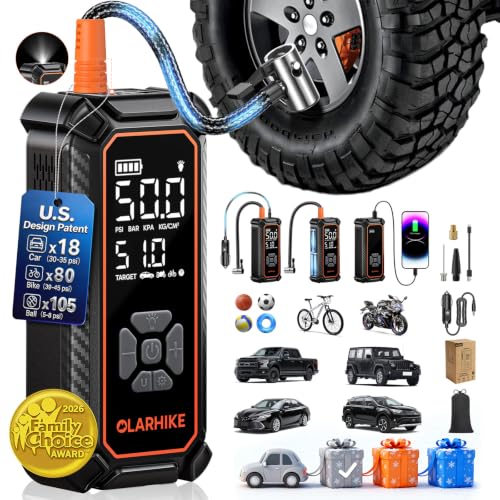 OlarHike Tire Inflator Portable Air
|
8.8/10 | Buy |
| Best Premium |
 GSPSCN 12V Heavy Duty Tire Inflator Metal
|
8.8/10 | Buy |
 Digital Air Compressor for Car Auto Pump
|
8.6/10 | Buy | |
 AstroAI AIRUN H Tire Inflator Portable Air
|
8.4/10 | Buy | |
 OlarHike 12000mAh Heavy Duty Tire Inflator
|
8.3/10 | Buy | |
 AstroAI Tire Inflator Portable Air Compressor
|
8.1/10 | Buy | |
 ETENWOLF VORTEX S6 Tire Inflator Portable Air
|
8.1/10 | Buy | |
 AstroAI L7 Tire Inflator Portable Air
|
8.0/10 | Buy |
Selecting the Right Air Compressor Size for Automotive Tires
Choosing an appropriate compressor size requires matching pneumatic airflow output and pressure capability to the physical volume of your vehicle tires. Most passenger cars and sedans operate comfortably with a small 12-volt direct-drive inflator or a compact portable compressor delivering at least 1 CFM at 30 PSI. Larger pickup trucks and off-road vehicles benefit from high-output dual-cylinder inflators or larger workshop tanks that prevent pump motor strain during extended inflation cycles. Clarifying your intended usage patterns ensures you select an inflator that balances inflation speed, electrical compatibility, and storage convenience.
Pressure Requirements Versus Air Volume in Vehicle Tires
Tire inflation is primarily a volume-driven pneumatic task rather than an extreme high-pressure operation. Passenger vehicles typically call for cold inflation pressures between 32 and 36 PSI, while light trucks and commercial vans may require 50 to 80 PSI depending on tire load ratings. Many portable compressors advertise maximum ratings of 150 or 160 PSI, but this peak threshold merely indicates internal cylinder structural tolerance before stalling. In practical daily operation, the critical measurement is how quickly the pump moves air against moderate tire backpressure rather than its ultimate shutoff limit.
Displacement volume determines how many minutes a compressor takes to inflate a tire from zero pressure or adjust daily pressure levels. A compact commuter tire holding roughly 10 gallons of air requires far less total volume than an oversized 31-inch all-terrain light truck tire. Because automotive tires hold large quantities of air at relatively low pressure, pumps with higher airflow rates complete top-offs noticeably faster. Sizing your compressor based on tire air volume rather than maximum pressure prevents purchasing an underpowered unit that struggles during seasonal adjustments.
Operating pressure also interacts directly with ambient temperatures across changing seasons. When cold weather sets in, tires routinely drop 1 to 2 PSI for every 10-degree dip in ambient temperature, creating frequent top-off demands. An undersized pump might add 2 PSI to a small sedan tire in under a minute, yet it can take several minutes to lift an SUV tire by the same margin. Matching the air pump to your vehicle profile ensures you have adequate pneumatic capability without generating excessive heat in the compressor cylinder.
Tankless Direct-Drive Inflators Versus Portable Garage Compressors
Drivers frequently deliberate between compact tankless inflators and traditional garage air compressors equipped with steel storage reservoirs. Direct-drive 12-volt tire inflators utilize small reciprocating pistons to pump air directly into the tire valve stem without intermediate tank storage. These units weigh between 1 and 5 pounds, making them exceptionally easy to store inside a trunk organizer, glove compartment, or under a passenger seat. While they lack the massive burst volume of a stored tank, modern dual-piston motors deliver steady airflow for routine tire maintenance.
Portable workshop compressors featuring 1-gallon to 6-gallon pancake or hot dog tanks offer a completely different mechanical approach. These stationary or semi-portable units pressurize an onboard receiver tank up to 135 or 150 PSI using a standard 120-volt household AC outlet. Once the tank is fully pressurized, you can inflate multiple tires in seconds using stored air without waiting for the pump motor to cycle. However, their heavy steel construction and 30-pound carry weight make them impractical for roadside emergencies away from home.
Hybrid and multi-power models bridge the gap between portable emergency inflators and residential garage air equipment. Select portable compressors now offer dual-power connectivity, operating on both 12-volt DC vehicle outlets and standard 120-volt household wall receptacles. Other modern units utilize high-capacity rechargeable lithium-ion battery packs, providing complete cordless convenience around the driveway. Choosing between these formats depends on whether you plan to maintain tires solely in your home garage or need portable security during extended highway road trips.
Airflow Rates and Realistic Inflation Speeds
Air delivery is officially measured in cubic feet per minute or liters per minute, and these figures dictate real-world inflation times. When comparing pump performance, understanding CFM versus SCFM airflow clarifies how temperature, atmospheric pressure, and backpressure influence actual delivery speed. A compact 12-volt tire pump typically delivers between 25 and 35 liters per minute at zero backpressure, which translates to roughly 0.9 to 1.2 CFM. Higher-capacity dual-cylinder metal inflators can deliver 42 to 70 liters per minute, effectively cutting working time in half.
Routine top-offs require significantly less airflow and motor run time than recovering a completely flat tire on the shoulder. Adding 5 PSI to a standard 195/65 R15 sedan tire usually takes less than 60 seconds with a 35 L/min motor, making seasonal adjustments fast and simple. In contrast, inflating the same tire from zero to 35 PSI can take between 3 and 5 minutes depending on pump displacement and cylinder cooling. Dual-cylinder models shorten this duration considerably, which is vital when operating in low-temperature or inclement weather.
Larger light truck tires, such as 245/70 R17 configurations, require high-volume airflow to inflate within reasonable timeframes. Single-cylinder micro pumps often struggle with these high-volume tires, generating significant friction heat before reaching desired operating pressure. Dual-cylinder direct-drive units engineered with heavy-duty metal connection rods provide the continuous displacement necessary to manage SUV and pickup volumes. Ensuring your compressor airflow matches your specific tire volume prevents motor strain and saves valuable time during routine checks.
Electrical Power Draw and Circuit Compatibility
Power supply compatibility represents an essential consideration when choosing an automotive air compressor. Standard vehicle 12-volt accessory ports, commonly referred to as cigarette lighter sockets, are typically wired through 10-amp or 15-amp vehicle fuses. Single-cylinder tire inflators rated around 120 watts draw approximately 10 amps, allowing safe continuous operation through the internal cabin outlet. Exceeding this amperage draw risks blowing the vehicle fuse, which can disable your power socket and interrupt inflation halfway through the job.
High-output dual-cylinder compressors draw considerably more electrical current to power their dual reciprocating pistons. Units producing 70 liters per minute or higher frequently draw 18 to 25 amps under full load, far exceeding cabin socket limits. Manufacturers supply these heavy-duty pumps with direct battery alligator clamps that attach directly to the vehicle battery terminals under the hood. Connecting directly to the battery bypasses thin vehicle dashboard wiring, providing clean high-amperage current and protecting vehicle electronic accessories.
Rechargeable battery-powered cordless inflators eliminate vehicle wiring limitations entirely by drawing power from internal lithium-ion cells. Battery packs ranging from 4000mAh up to 19200mAh provide enough electrical capacity to service multiple vehicle tires on a single charge. Many modern cordless compressors include USB-C bidirectional fast charging, allowing you to recharge the pump or power mobile devices during roadside stops. Keeping a cordless unit charged in your vehicle ensures rapid tire servicing without untangling power cables across wet pavement.
Digital Pressure Sensors and Automatic Shut-Off Precision
Precise pressure monitoring is vital for vehicle safety, braking stability, and balanced tire tread wear over time. Traditional analog dial gauges on air compressors are susceptible to mechanical needle bounce and calibration drift caused by vibration. Modern digital inflators incorporate advanced solid-state pressure sensors that read tire internal pressure multiple times per second with high accuracy. Clear backlit LCD screens display real-time pressure alongside user-selected target pressure, eliminating guesswork when working in dim garages or dark roadsides.
Automatic shut-off functionality represents one of the most practical advancements in contemporary tire inflator technology. Users simply set their desired target pressure using digital push-button controls and initiate the pump cycle. The microchip controller monitors internal line pressure and automatically cuts power to the motor once target pressure is achieved. This hands-free feature prevents dangerous tire over-inflation and allows users to step back from spinning drive components while the pump operates.
Unit versatility is another major benefit of modern digital control interfaces across automotive compressors. Drivers can easily switch readout units between PSI, BAR, KPA, and kilograms per square centimeter with a single button press. Memory recall functions retain your last preset pressure value, making weekly maintenance faster across all four vehicle wheels. Reliable digital pressure measurement eliminates the need to carry separate handheld mechanical pressure gauges during routine tire checks.
Duty Cycles, Thermal Protection, and Heat Dissipation
Compressing atmospheric air naturally generates substantial thermal energy inside the pump cylinder head and crankcase. Compact 12-volt direct-drive compressors have minimal metal mass for heat dissipation compared to large cast-iron workshop pumps. Most consumer tire inflators carry a 15-minute maximum continuous run rating, after which they require a 10-minute cool-down interval. Disregarding these duty cycle limits can cause piston seal degradation, cylinder wall scoring, or permanent motor failure from excessive heat buildup.
Intelligent thermal management systems protect modern inflators from premature failure under demanding operating conditions. Integrated temperature sensors and automatic thermal cutoff switches shut the motor down before heat reaches damaging thresholds. Advanced housing designs incorporate axial cooling fans and specialized ventilation channels to actively pull heat away from the motor coils. High-grade components like powder metallurgy gears and metal connecting rods provide structural durability against thermal expansion during extended runs.
Duty cycle demands differ significantly between passenger car maintenance and commercial vehicle servicing. While topping off four passenger car tires takes less than 5 minutes of total motor operation, inflating multiple large truck tires can push a small pump past its duty limit. Heavy-duty dual-cylinder compressors with dedicated finned heat sinks offer superior duty cycle ratings for larger tire volumes. Reviewing rated continuous run times ensures your compressor can finish servicing all four vehicle wheels without unexpected thermal shutdowns.
Hose Ergonomics, Quick-Connect Fittings, and Valve Attachment
Air hose ergonomics and power cord reach determine how effortlessly you can service all four vehicle tires. A compact car requires approximately 10 feet of cord reach from the dashboard power port to reach the rear wheels comfortably. Larger SUVs, crew-cab pickups, and long-wheelbase vans often require 11 to 15 feet of combined power cord and air hose length. Insufficient cord reach forces users to reposition the unit awkwardly or strain electrical connections, creating unnecessary wear on power plugs.
The connection mechanism between the air hose and tire valve stem significantly influences ease of use and inflation speed. Screw-on brass chucks provide a secure, airtight seal that prevents accidental disconnection under high operating pressure. However, unscrewing a threaded chuck can release a small burst of air, slightly dropping tire pressure upon removal. Quick-connect thumb-lock levers and twist-lock brass fittings allow instantaneous attachment and detachment with virtually zero air leakage.
Accessory versatility enhances compressor utility beyond standard automotive Schrader valve tire applications. Quality inflator packages include Presta valve adapters for performance bicycle tires, tapered nozzles for small recreational inflatables, and metal ball needles. Built-in storage compartments or durable fabric carry bags keep these accessories organized and prevent lost nozzles inside your vehicle trunk. Having a complete adapter assortment ensures your portable air pump handles sports gear and emergency roadside tire demands equally well.
Matching Compressor Size to Vehicle Types
Compact commuter cars and sedans equipped with 15-inch or 16-inch tires have modest pneumatic volume requirements. A lightweight cordless pump or single-cylinder 12-volt inflator producing 25 to 35 L/min handles routine pressure checks and roadside emergencies effectively. These compact units draw low electrical current, pack neatly into small trunk spaces, and provide rapid pressure adjustments without draining vehicle batteries. For standard daily driving, there is rarely a practical need to transport a larger, heavier compressor.
Midsize SUVs, crossovers, and minivans with 17-inch to 19-inch wheels carry noticeably higher tire air volume at comparable pressures. Dual-cylinder 12-volt units or high-capacity rechargeable compressors with 12000mAh to 19200mAh battery banks represent the ideal sizing tier for these vehicles. The expanded airflow capacity allows rapid top-offs across all four larger tires without triggering thermal protection delays. Additionally, dual-power AC and DC models offer great flexibility for homeowners wanting garage outlet operation alongside vehicle battery capability.
Full-size pickup trucks, commercial vans, utility trailers, and off-road vehicles demand heavy-duty pneumatic equipment. These applications feature large tire air volumes and higher working pressures that can quickly overwhelm consumer-grade mini inflators. Heavy-duty dual-cylinder metal compressors with battery terminal alligator clamps or 6-gallon garage tank systems deliver the airflow volume required for rapid truck inflation. Choosing an industrial-grade dual-piston model ensures reliable performance when airing up after off-road excursions or towing heavy equipment.
Selecting the right air compressor size ultimately centers on matching airflow rate and power convenience to your specific vehicle tires. Compact 12-volt and cordless direct-drive units provide unmatched roadside portability for daily commuters, while dual-cylinder and garage tank systems deliver the high airflow volume necessary for larger trucks. Verifying digital gauge accuracy, thermal duty cycles, and power cord reach ensures hassle-free operation whenever your tire pressure warning light illuminates. Equipping your vehicle with an appropriately sized inflator guarantees dependable tire safety, optimal tread life, and smooth performance on every journey.
About the author
Glenda Taylor has extensive experience in residential construction, remodeling, home improvement, and tool use. Her practical approach to equipment evaluation focuses on usability, performance, safety, and value—helping DIYers and workshop users make better-informed decisions about compressors and related tools.