
What Size Air Compressor Do I Need for Tires: Practical Guide for 2026
Learn %what size air compressor do i need for tires% in November 2026, comparing portable inflators and garage tank systems for cars, trucks, and SUVs.
 By Bob Beacham
Updated October 8, 2026


Low tire pressure indicators frequently trigger on chilly mornings when ambient temperatures drop, leaving drivers to calculate whether a compact roadside tool or a dedicated workshop compressor is necessary to restore proper inflation. Determining what size air compressor do i need for tires requires looking beyond maximum pressure ratings to evaluate how much physical air volume your vehicle tires hold. Passenger cars, crossovers, and heavy pickup trucks place vastly different demands on pneumatic equipment. While a passenger sedan needs only a modest volume of air to increase pressure from 30 to 35 PSI, large light-truck or commercial tires require significantly higher displacement to achieve safe operating levels.
Choosing the correct equipment prevents frustrating motor shutdowns, premature pump wear, and unexpected roadside delays. Compact direct-drive pumps excel at portability and trunk storage, whereas stationary or wheeled tank compressors provide rapid inflation alongside workshop versatility. When balancing inflation speed against tool flexibility, exploring our compressor value and sizing guide can help clarify whether a multi-purpose workshop unit makes more sense than a single-purpose 12V pump. Understanding how air volume, maximum pressure, and duty cycles intersect ensures you select an inflator that reliably handles your daily inflation tasks without overheating.
| Award | Product | ACR Score About ACR ScoreThe ACR Score is our own rating from 0 to 10, based on performance, design and build, ease of use, and value. It reflects independent research and is never influenced by manufacturers, retailers, or affiliate commissions. Learn more › | |
|---|---|---|---|
| Best Overall |
CRAFTSMAN 12V Portable Tire Inflator with
|
9.2/10 | Buy |
| Best Premium |
 DEWALT Cordless Tire Inflator Portable Air |
9.1/10 | Buy |
| Best Budget |
 AstroAI L7S 150 PSI Cordless Tire Inflator |
8.9/10 | Buy |
| Best Value |
 AstroAI Dual Power 110V/12V Tire Inflator |
8.9/10 | Buy |
 Craftsman 150 PSI Cordless Tire Inflator |
8.9/10 | Buy | |
 OlarHike Portable Tire Inflator Air Compressor |
8.8/10 | Buy | |
 CARSUN 12V DC Portable Tire Inflator |
8.6/10 | Buy | |
 AstroAI AIRUN H 12V DC Portable Air Compressor |
8.4/10 | Buy | |
 AstroAI Portable Tire Inflator Air Compressor |
8.1/10 | Buy | |
 CRAFTSMAN Dual Power Tire Inflator |
8.1/10 | Buy |
CRAFTSMAN 12V Portable Tire Inflator with
The CRAFTSMAN 12V Portable Tire Inflator is an ultra-compact 1.9-pound roadside unit delivering up to 150 PSI with digital auto shut-off and built-in cord storage. Powered via a standard 12V car accessory plug, it offers fast tire top-offs and dependable emergency inflation without crowding trunk space.
Pros
- Weighs only 1.9 pounds for effortless glove box, under-seat, or trunk storage during road trips
- Digital auto shut-off prevents accidental over-inflation without requiring constant manual gauge monitoring
- Bright three-mode LED light provides critical illumination during nighttime roadside emergencies
- Comes fully equipped with multi-valve adapters, a replacement fuse, and a tailored carry pouch
Cons
- Requires a 12V DC vehicle accessory socket and does not include a 120V AC household outlet adapter
- Compact tankless pump is built strictly for tire inflation and cannot drive pneumatic nailers or air tools
- The 2.17-foot air hose length means the compressor must sit on the ground adjacent to the wheel valve stem
DEWALT Cordless Tire Inflator Portable Air
This compact DEWALT portable tire inflator delivers up to 150 PSI with smart auto shut-off, powered by an internal rechargeable battery or an included 10-foot 12V car plug. It provides an efficient, pocket-sized solution for vehicle owners, cyclists, and DIYers wanting rapid roadside top-offs without hauling a bulky tank compressor.
Pros
- True cordless freedom with an internal rechargeable battery plus a 10-foot 12V DC vehicle plug backup
- Accurate digital pressure gauge with 5 smart presets and automatic shut-off to eliminate overinflation
- Ultra-compact handheld design weighing just 0.63 kg for easy storage in glove boxes or saddlebags
- Integrated LED work light and emergency USB power bank functionality for travel safety
- Generous accessory bundle backed by a 3-year limited warranty
Cons
- Engineered exclusively for high-pressure inflation rather than operating pneumatic air tools or nailers
- Does not include a 120V AC residential wall outlet power adapter
- Compact tankless pump requires periodic cooling breaks during heavy multi-tire inflation runs
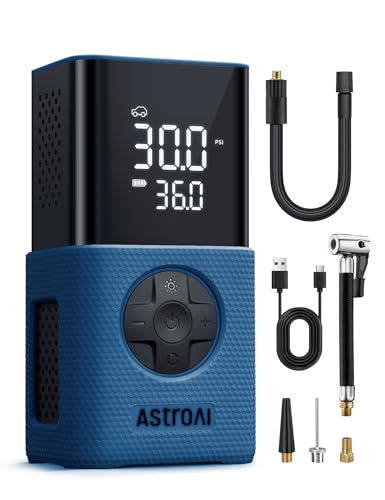
AstroAI L7S 150 PSI Cordless Tire Inflator
Weighing barely a pound, the AstroAI L7S delivers portable inflation up to 150 PSI alongside a shock-absorbing silicone sleeve and power bank utility. Five smart presets and automatic shut-off make it a practical roadside companion for passenger cars, bicycles, and sports gear.
Pros
- Pocketable design weighing just 1.01 pounds
- Protective silicone sleeve dampens vibration and drops
- Hands-free operation with automatic shut-off
- Built-in power bank charges mobile devices
- Clear digital display with five smart presets
Cons
- Incompatible with heavy-duty truck and RV tires
- Not suitable for off-road vehicle tires or trailers
AstroAI Dual Power 110V/12V Tire Inflator
Versatile dual-power support lets this lightweight inflator run from either a garage wall outlet or a vehicle cigarette lighter. An automatic shutoff and onboard cord storage make routine tire top-offs straightforward for any driver.
Pros
- Flexible dual AC and DC power options
- Automatic shutoff prevents over-inflation
- Compact and lightweight at 2.2 pounds
- Integrated cord and nozzle storage
Cons
- Requires a 10-minute cooldown after 15 minutes of runtime
- Must be plugged into a power source to operate
Craftsman 150 PSI Cordless Tire Inflator
Built for roadside emergencies and quick top-ups, this compact 1.28-pound Craftsman inflator combines a 6000mAh rechargeable battery with a 12V DC car adapter. Its real-time digital gauge and automatic shut-off make tire maintenance straightforward for daily commuters and road trippers.
Pros
- Operates cordlessly or via 12V car socket
- Automatic shut-off prevents accidental over-inflation
- Clear digital display shows live pressure readings
- Doubles as an emergency light and power bank
- Lightweight and easy to store in vehicles
Cons
- USB output port is limited to 5V/1A
- Battery runtime is tailored primarily for tire top-ups
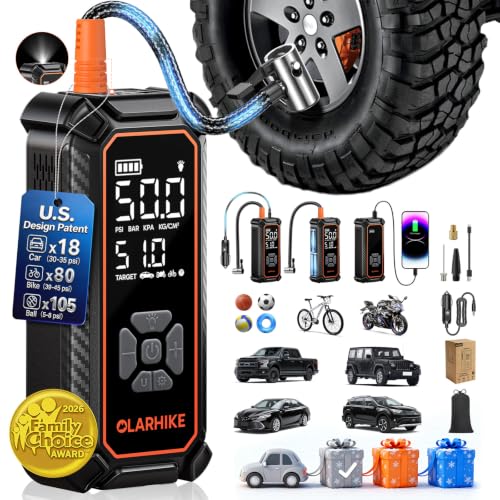
OlarHike Portable Tire Inflator Air Compressor
The OlarHike Portable Tire Inflator combines dual-power versatility via a 12V DC vehicle plug or built-in rechargeable battery with an automatic shut-off digital display. It provides dependable roadside tire top-offs and inflation for passenger cars, crossovers, motorcycles, and bicycles.
Pros
- Dual-power design allows cordless field operation or continuous power through any standard vehicle 12V DC port
- Automatic shut-off technology stops the motor precisely at preset pressure to prevent over-inflation
- Integrated 6000mAh battery reserve doubles as an emergency phone charger and includes an LED work light
- Pocket-sized footprint weighs well under two pounds for convenient transport in center consoles or backpacks
Cons
- Maximum vehicle pressure rating of 51 PSI is not suitable for heavy-duty commercial trucks, RVs, or high-pressure trailer tires
- Compact tankless inflator mechanism cannot power workshop pneumatic tools such as nail guns or air ratchets
- Recharging requires a standard 5V 2A or 5V 3A adapter and is not compatible with high-wattage fast chargers
CARSUN 12V DC Portable Tire Inflator
The CARSUN 12V DC portable tire inflator delivers a listed 35 L/min airflow with automatic digital shut-off up to 150 PSI. It is an ideal, budget-friendly roadside emergency pump for passenger car owners, cyclists, and weekend campers.
Pros
- Automatic shut-off prevents accidental tire over-inflation by cutting power at the preset target pressure
- Lightweight 1.9-pound frame and compact dimensions fit neatly into vehicle trunks or roadside emergency kits
- Capable 35 L/min air volume airs up standard passenger tires quickly during routine seasonal pressure top-offs
- Bright integrated LED lighting assists with safe valve connection along dark roadways and unlit driveways
- Four included adapter nozzles expand utility across bicycles, sporting balls, and recreational air mattresses
Cons
- Powered exclusively via 12V DC vehicle sockets and does not include a 120V AC household electrical plug
- Manufacturer explicitly notes the unit is not suitable for heavy commercial trucks or large motor lorries
- Tankless high-pressure inflator design is not engineered to operate pneumatic workshop air tools
AstroAI AIRUN H 12V DC Portable Air Compressor
The AstroAI AIRUN H is a compact 12V DC tire inflator delivering up to 35 L/min airflow with automatic shut-off and digital pressure presets. It is an ideal portable emergency compressor for drivers, commuters, and garage hobbyists seeking fast tire top-offs.
Pros
- Automatic shut-off stops pumping reliably once target PSI is reached
- High-airflow 120W motor provides rapid top-offs for daily driver tires
- Long 9.84-foot power cord reaches all passenger vehicle wheels with ease
- Bright built-in LED flashlight and backlit display assist during night repairs
- Lightweight 2.2-pound form factor stores neatly in glove boxes and trunks
Cons
- Requires a 12V DC vehicle outlet and does not include a 120V AC household plug
- Mandates a 10-minute cool-down interval after 15 minutes of continuous operation
- Not intended for high-volume inflatables like large pool floats or air mattresses
AstroAI Portable Tire Inflator Air Compressor
The AstroAI Dual Power Tire Inflator combines a 12V DC vehicle plug and 120V AC household cord, delivering up to 150 PSI for car tires and a 350 L/min high-volume mode for rafts and mattresses. It is a dependable, compact choice for garage mechanics, road-trippers, and homeowners wanting versatile inflation without needing a bulky air tank.
Pros
- Dual 12V DC and 120V AC power cords offer genuine versatility for garage benches, driveways, and roadside emergencies
- Two dedicated inflation modes handle high-pressure tires up to 150 PSI as well as high-volume camping gear at 350 L/min
- Digital auto-shutoff stops pumping once target pressure is reached, preventing accidental over-inflation
- Integrated cord and air hose storage compartments maintain a clean, compact footprint in vehicle trunks
- Dual metal motor build provides reliable output with up to 15 minutes of continuous run time per cycle
Cons
- Not designed to support heavy-duty commercial truck tires or high-volume commercial vehicle applications
- Requires a mandatory 10-minute cooling rest after 15 minutes of continuous high-pressure pumping
- Tankless electric inflator design cannot drive pneumatic air tools such as brad nailers or impact wrenches
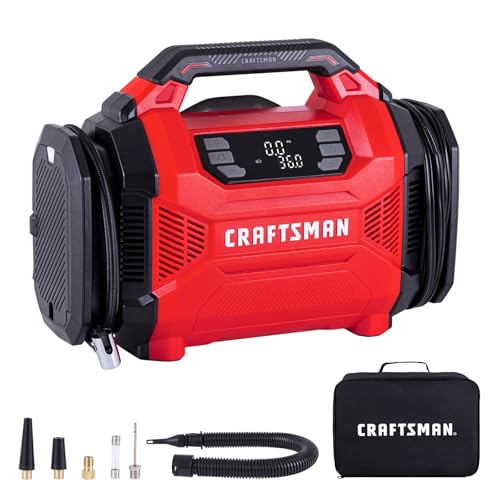
CRAFTSMAN Dual Power Tire Inflator
The CRAFTSMAN Dual Power Tire Inflator delivers versatile high-pressure air delivery up to 150 PSI using either a 120V AC home outlet or a 12V DC vehicle plug. Featuring digital auto shut-off presets and an integrated LED work light, it is an essential portable air solution for DIYers, garage mechanics, and road commuters.
Pros
- Dual 120V AC and 12V DC power inputs offer exceptional flexibility for both driveway maintenance and unexpected roadside flats
- Accurate digital pressure gauge with automatic shut-off prevents over-pressurizing vehicle and bicycle tires
- Capable of reaching 150 PSI, making it suitable for high-pressure road bike tires as well as passenger car tires
- Built-in LED work light enhances nighttime safety and visibility when working alongside highway traffic
- Complete package includes dedicated air hose, multiple nozzle adapters, spare fuse, and a zippered storage bag
Cons
- Tankless direct-drive mechanism is engineered for tire inflation and cannot power pneumatic air tools such as nailers or impact wrenches
- Takes longer to fill large volume leisure items like oversized air mattresses or rafts compared to dedicated high-volume blowers
- Lacks an onboard cordless tool battery dock, requiring access to an active 120V wall outlet or 12V vehicle socket
Sizing an Air Compressor for Tires: Pressure, Volume, and Practical Performance
Standard passenger cars, compact crossovers, and family sedans require an air compressor capable of delivering between 100 and 150 PSI with an airflow rate of roughly 0.5 to 1.2 CFM (approximately 25 to 35 liters per minute). Most passenger vehicle tires operate at recommended cold inflation pressures between 30 and 36 PSI, meaning a compact 12V DC direct-drive inflator or cordless handheld pump can complete a routine top-off in just a few minutes. Heavy-duty trucks, commercial trailers, and recreational vehicles operate at much higher working pressures between 65 and 110 PSI while holding vast internal air cavities. Sizing your compressor accurately requires matching pump output to the specific tire dimensions you plan to maintain.
Tire Cavity Volume Versus Pressure: Understanding the Core Physics
Tire inflation involves two distinct pneumatic measurements that dictate how equipment performs: working pressure (measured in PSI) and air delivery volume (measured in CFM or liters per minute). Maximum pressure indicates the peak resistance the pump mechanism can overcome before stalling. In contrast, airflow volume indicates how much physical air the compressor moves into the tire cavity during a given timeframe. High maximum pressure ratings do not necessarily translate into rapid inflation if the pump displacement is small.
A compact portable pump rated at 150 PSI can easily generate enough force to fill a bicycle tire to 60 PSI because the tire cavity contains a very small volume of air. However, filling an empty 33-inch all-terrain light-truck tire requires displacing thousands of cubic inches of atmospheric air into a pressurized container. When a low-volume pump tackles a large tire cavity, the electric motor must cycle continuously for extended periods to generate that volume. This distinction explains why small emergency inflators take several minutes to raise a large tire by five PSI, even though the pump pressure rating far exceeds the tire specification.
Understanding this balance helps drivers avoid purchasing underpowered equipment for heavy vehicles. Passenger cars with standard tire sizes like 195/65 R15 have modest internal air volumes, making direct-drive mini pumps an ideal match. Light commercial vehicles, trailers, and large SUVs feature wide section widths and taller sidewalls that multiply internal capacity. For these larger vehicles, prioritizing airflow delivery over headline pressure numbers ensures faster top-offs and reduces strain on the internal motor.
Compact 12V DC and Battery-Powered Inflators for Routine Passenger Vehicle Care
Direct-drive portable inflators represent the most common solution for everyday drivers maintaining sedans, minivans, and small SUVs. Products from brands such as CRAFTSMAN, DEWALT, AstroAI, and OlarHike utilize compact electric motors connected to small-diameter reciprocating pistons. These units typically plug into a standard 12V vehicle cigarette lighter socket or run on integrated rechargeable lithium battery packs ranging from 4000mAh to 6000mAh capacity. Because they do not feature heavy steel storage tanks, their total carry weight remains between one and three pounds.
Manufacturer specifications for these portable units show they deliver airflow rates around 35 liters per minute under optimal conditions. For a standard 195/65 R15 tire, raising inflation pressure from 30 to 36 PSI takes roughly 45 to 90 seconds. Topping off all four tires during seasonal temperature transitions generally requires less than five minutes of total runtime. The cordless capability of battery-powered models eliminates the hassle of untangling long power cables across wet pavement or reaching around vehicle bumpers.
Compact inflators offer remarkable convenience, but their small motor assemblies feature limited thermal mass. While they easily manage routine top-offs on passenger vehicles, they are not designed to inflate large commercial truck tires from completely flat states. Drivers whose primary requirement is regular vehicle maintenance, road trip preparedness, and emergency roadside security will find that a well-built 12V or cordless mini compressor satisfies every requirement without occupying valuable cargo space.
Dual-Power Compressors: Blending Home Garage Convenience and Travel Mobility
Dual-power air compressors bridge the functional gap between dedicated garage workshop equipment and portable travel inflators. Units such as dual-voltage models from AstroAI and CRAFTSMAN include internal power converters that accept both 12V DC car accessory plugs and standard 110V/120V AC household wall outlets. This flexible design allows users to perform pre-trip pressure adjustments in the home driveway using household current without turning on the vehicle ignition.
Running a compressor on household AC power preserves the vehicle battery during multi-tire top-offs and eliminates the risk of blowing a 12V automotive accessory fuse. When travel demands require packing light, the unit stows neatly in the trunk where its 12V DC cord remains available for unexpected highway emergencies. Dual-power compressors often incorporate distinct inflation modes, such as a high-pressure mode for vehicle tires and a high-flow mode capable of moving up to 350 liters per minute for low-pressure inflatables.
Home mechanics managing several family vehicles benefit greatly from this dual-input versatility. Connecting to an outdoor garage outlet allows steady, uninterrupted operation without running car engines in enclosed spaces. If your routine tire maintenance takes place primarily at home but you still desire portable protection during cross-country road trips, a dual-power compressor provides a balanced setup.
Workshop Tank Compressors: When You Need Reservoir Capacity
Pancake, hot dog, and vertical shop compressors equipped with pressurized air tanks operate on a fundamentally different principle than tankless portable inflators. Instead of pumping ambient air directly into the tire through a small piston, a tank compressor pre-charges a steel reservoir to 135 to 175 PSI. When you attach the air chuck to the tire valve stem, the stored volume discharges instantly, providing rapid airflow that direct-drive mini pumps cannot replicate.
A compact one to six-gallon pancake compressor delivering 2.0 to 2.6 CFM at 90 PSI fills an empty passenger tire in seconds rather than minutes. More importantly, stored tank volume is strictly necessary if you ever need to seat a tire bead on a rim after replacing a tire or installing a repair plug. Seating a tubeless bead requires an explosive initial surge of airflow to push the rubber sidewall outward against the wheel rim before air escapes past the unsealed bead seat. Tankless inflators lack the burst capacity to seat stubborn beads.
Garages that service commercial trucks, utility trailers, or off-road vehicles frequently pair inflation duties with pneumatic tool operation. In such environments, reviewing dedicated garage storage tanks demonstrates how larger air reserves support air impact wrenches and tire bead seaters alongside rapid multi-vehicle inflation. For dedicated home mechanics who already own pneumatic equipment, utilizing a shop compressor with an accurate tire pressure chuck represents the fastest and most durable approach.
Managing Compressor Duty Cycles and Thermal Limits
Every air compressor generates significant heat as atmospheric air is compressed inside the mechanical cylinder. Small portable inflators utilize oil-free PTFE piston rings running inside aluminum cylinder sleeves, which heat up quickly under continuous operation. Manufacturer guidelines for compact direct-drive pumps regularly specify a maximum continuous run time of 15 minutes, followed by a mandatory 10-minute cooling interval before resuming inflation.
Exceeding duty cycle recommendations accelerates internal wear on mechanical seals, softens connecting rod bearings, and can trigger internal thermal overload cut-off switches. Advanced models incorporate engineered thermal dissipation systems, such as axial cooling fan blades, ventilated gear housings, and shock-resistant silicone sleeves designed to channel radiant heat away from critical internal components. Allowing adequate cool-down intervals protects internal motor windings from heat damage when inflating multiple large tires in sequence.
Thermal management is equally important when operating larger shop compressors, where heat buildup condenses atmospheric moisture inside the storage reservoir. In high-humidity climates, rapid temperature drops within air lines can cause water accumulation that affects inflation equipment. Reviewing our air compressor moisture troubleshooting guide illustrates how proper tank draining and condensation management preserve air lines, pressure regulators, and tire pressure gauges over years of dependable service.
Pressure Sensor Accuracy, Digital Displays, and Auto Shut-Off Controls
Maintaining accurate tire pressure is essential for vehicle handling, wet-weather braking, and even tire tread wear. Under-inflating a tire by just five PSI increases rolling resistance and accelerates shoulder wear, while over-inflation reduces the tire contact patch and creates a harsh ride. Modern digital inflators eliminate guesswork by incorporating high-precision electronic pressure sensors coupled with automated cut-off mechanisms.
Digital auto shut-off systems allow the operator to pre-select a target pressure in PSI, BAR, KPA, or kg/cm² using tactile control buttons. Once the compressor reaches the exact programmed threshold, an internal relay switch disengages the motor automatically. This hands-free operation prevents accidental over-inflation, which can occur rapidly on small tires when using high-pressure workshop lines without a regulator. Integrated memory recall functions store your preferred vehicle settings between uses, speeding up monthly pressure checks.
Accurate readings require checking tires when they are cold, meaning the vehicle has been parked for at least three hours or driven less than one mile at moderate speed. Driving causes friction that heats the trapped air inside the tire, temporarily raising internal pressure by three to five PSI. High-contrast backlit LCD screens ensure clear visibility during predawn roadside checks or inside dimly lit garages, helping drivers confirm target cold pressures with complete confidence.
Electrical Demands, Fuse Protection, and Battery Upkeep
Portable 12V air compressors pull substantial electrical current from vehicle accessory circuits, generally drawing between 10 and 14 amps under heavy compression loads. Most passenger vehicles protect their 12V auxiliary sockets with a 15-amp fuse. To avoid blowing vehicle fuses, always start the vehicle engine before switching on a 12V corded compressor, as the alternator stabilizes electrical voltage and provides steady current to the pump motor.
Rechargeable cordless inflators eliminate vehicle socket strain entirely, utilizing multi-cell lithium battery packs that deliver independent high-current discharge. Maintaining these battery systems requires mindful seasonal storage habits. Leaving lithium-powered equipment inside a car trunk during sub-freezing winter weather causes chemical slowdown that temporarily limits runtime, while excessive summer interior heat degrades long-term cell capacity. Storing your portable inflator in an insulated glove compartment or bringing it indoors between trips preserves optimal battery health.
When recharging battery-powered models via USB-C ports, using high-quality 5V adapters with 2A or 3A ratings ensures complete cell saturation without thermal stress. Cordless models equipped with secondary USB output ports also function as emergency power banks, providing secondary utility for charging mobile devices during unexpected roadside delays. Keeping power cords neatly stored in integrated housing compartments prevents insulation fraying and ensures ready operation during emergencies.
Vehicle Sizing Guide: Matching Compressor Specifications to Tire Types
Selecting the best compressor for your setup comes down to categorizing your vehicles by tire size, volume, and pressure targets. Compact and mid-size sedans running standard passenger tires (such as 185/65 R15 to 225/50 R17) require 30 to 35 PSI. For these vehicles, a lightweight 12V DC or cordless inflator delivering 25 to 35 liters per minute represents the perfect balance of compact storage, quick setup, and reliable top-off performance.
Mid-size SUVs, crossovers, and half-ton pickup trucks utilize larger tires (such as 235/65 R17 to 275/65 R18) running at 35 to 45 PSI. These tires contain nearly double the internal air volume of compact car tires. Dual-power compressors or heavy-duty 12V inflators featuring larger metal motor housings handle this extra volume efficiently, raising pressure by five PSI in two minutes or less without overtaxing internal cooling systems.
Three-quarter-ton and one-ton heavy-duty trucks, fifth-wheel trailers, and motorhomes operate on load range E or commercial tires requiring 65 to 110 PSI. For these demanding applications, handheld direct-drive pumps struggle with both volume and head pressure. Owners of commercial-grade towing setups should rely on high-output 12V continuous-duty compressors with direct battery clamps or a dedicated 3-gallon to 6-gallon garage tank compressor rated for at least 150 PSI working pressure.
Practical Takeaway for Reliable Tire Maintenance
Matching your air compressor to your vehicle tires eliminates guesswork and guarantees you are never stranded with an under-inflated tire. For routine passenger car upkeep and mobile peace of mind, a compact 12V or cordless digital inflator rated for 150 PSI delivers the ideal mix of convenience, automatic shut-off safety, and effortless storage. If you maintain multiple vehicles at home or need burst airflow to seat tire beads, a dual-power unit or a dedicated workshop tank compressor provides the additional volume reserve your workspace requires.
About the author
Bob Beacham is an experienced tools and workshop writer with deep knowledge of power equipment, mechanical systems, and practical DIY applications. His coverage of air compressors, welding equipment, saws, and workshop tools helps translate technical specifications into useful guidance for homeowners and serious DIYers.