
What Is the Best Small Air Compressor: A Practical Guide for 2026
Learn what is the best small air compressor options for vehicle tires and light pneumatic tools in November 2026, covering airflow, power, and duty cycles.
 By Bob Beacham
Updated October 8, 2026


Balancing trunk portability against usable pneumatic air delivery is a familiar challenge for drivers, woodworkers, and DIY hobbyists alike. When investigating What Is The Best Small Air Compressor, buyers frequently discover a wide divide between handheld digital tire inflators and compact tank-equipped compressors. Miniature 12-volt and battery pumps provide immediate convenience for emergency vehicle tires and sporting goods, while stationary or portable tank units handle air tools and workshop cleanup.
Evaluating your daily air requirements helps prevent performance bottlenecks such as motor overheating, sluggish inflation, or line pressure drop. Checking specifications like delivered airflow volume, maximum operating pressure, and thermal duty cycle ratings ensures you choose equipment suited to your specific tasks. Our compressor pressure output guide explains how pressure ratings interact with typical garage and roadside chores. Reviewing these mechanical distinctions makes it simple to match compact air power to your everyday needs.
| Award | Product | ACR Score About ACR ScoreThe ACR Score is our own rating from 0 to 10, based on performance, design and build, ease of use, and value. It reflects independent research and is never influenced by manufacturers, retailers, or affiliate commissions. Learn more › | |
|---|---|---|---|
| Best Overall |
CRAFTSMAN 12V Portable Tire Inflator with
|
9.2/10 | Buy |
| Best Budget |
 JASTIND Industrial Air Blow Gun Kit |
8.8/10 | Buy |
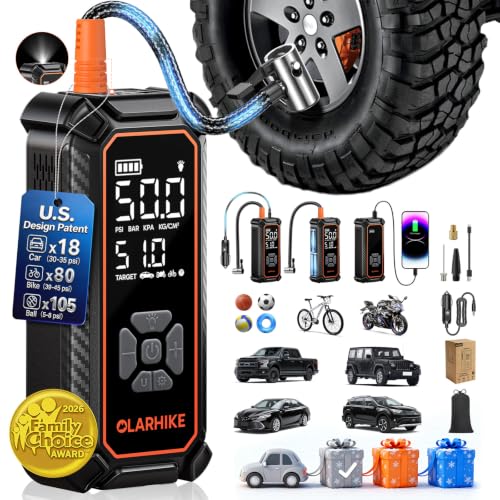 OlarHike Portable Tire Inflator Air Compressor |
8.8/10 | Buy | |
| Best Value |
 Hafuloky Cordless Tire Inflator Portable Air |
8.6/10 | Buy |
| Best Premium |
 LEZZYRUCK 18V Cordless Air Compressor for Makita |
8.6/10 | Buy |
 VEVOR 5HP 56HZ Air Compressor Motor |
8.6/10 | Buy | |
 AstroAI AIRUN H 12V DC Portable Air Compressor |
8.4/10 | Buy | |
 OlarHike 12000mAh Cordless Tire Inflator |
8.3/10 | Buy | |
 AstroAI L7 Cordless Tire Inflator Portable Air |
8.0/10 | Buy | |
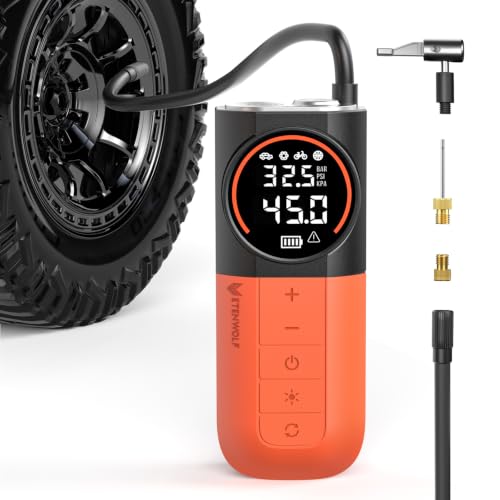 ETENWOLF S1 Cordless Tire Inflator Portable Air |
8.0/10 | Buy |
CRAFTSMAN 12V Portable Tire Inflator with
The CRAFTSMAN 12V Portable Tire Inflator is an ultra-compact 1.9-pound roadside unit delivering up to 150 PSI with digital auto shut-off and built-in cord storage. Powered via a standard 12V car accessory plug, it offers fast tire top-offs and dependable emergency inflation without crowding trunk space.
Pros
- Weighs only 1.9 pounds for effortless glove box, under-seat, or trunk storage during road trips
- Digital auto shut-off prevents accidental over-inflation without requiring constant manual gauge monitoring
- Bright three-mode LED light provides critical illumination during nighttime roadside emergencies
- Comes fully equipped with multi-valve adapters, a replacement fuse, and a tailored carry pouch
Cons
- Requires a 12V DC vehicle accessory socket and does not include a 120V AC household outlet adapter
- Compact tankless pump is built strictly for tire inflation and cannot drive pneumatic nailers or air tools
- The 2.17-foot air hose length means the compressor must sit on the ground adjacent to the wheel valve stem
JASTIND Industrial Air Blow Gun Kit
The JASTIND Industrial Air Blow Gun delivers powerful workshop blow-off performance with a durable chromed zinc alloy body, an adjustable brass airflow nozzle, and two protective-tipped extensions. It is an affordable, metal-built pneumatic accessory ideal for DIYers, mechanics, and woodworkers needing versatile cleanup reach.
Pros
- Solid all-metal zinc alloy and copper construction resists cracking compared to plastic blow guns
- Adjustable brass nozzle provides convenient airflow throttling right at the tool tip
- Protective rubber tips on extension wands help prevent scratching delicate finishes and sensitive components
- Integrated top hook makes bench and wall storage simple and accessible
Cons
- Does not state OSHA safety relief bypass compliance, so line pressure should be regulated safely before use
- All-metal zinc alloy body can transfer cold to the hand during extended continuous blowing sessions
- Specific quick coupler interchange style is not detailed in specifications, requiring fit verification for some shop air lines
OlarHike Portable Tire Inflator Air Compressor
The OlarHike Portable Tire Inflator combines dual-power versatility via a 12V DC vehicle plug or built-in rechargeable battery with an automatic shut-off digital display. It provides dependable roadside tire top-offs and inflation for passenger cars, crossovers, motorcycles, and bicycles.
Pros
- Dual-power design allows cordless field operation or continuous power through any standard vehicle 12V DC port
- Automatic shut-off technology stops the motor precisely at preset pressure to prevent over-inflation
- Integrated 6000mAh battery reserve doubles as an emergency phone charger and includes an LED work light
- Pocket-sized footprint weighs well under two pounds for convenient transport in center consoles or backpacks
Cons
- Maximum vehicle pressure rating of 51 PSI is not suitable for heavy-duty commercial trucks, RVs, or high-pressure trailer tires
- Compact tankless inflator mechanism cannot power workshop pneumatic tools such as nail guns or air ratchets
- Recharging requires a standard 5V 2A or 5V 3A adapter and is not compatible with high-wattage fast chargers
Hafuloky Cordless Tire Inflator Portable Air
The Hafuloky Cordless Tire Inflator delivers up to 150 PSI with a listed 36 L/min airflow rate, featuring intelligent auto shut-off and a dual-readout digital gauge. It provides dependable roadside inflation and garage convenience for vehicle owners, cyclists, and weekend DIYers.
Pros
- Smart automatic shut-off stops airflow immediately when preset pressure is reached to help prevent over-inflation
- Dual-display digital gauge shows real-time tire pressure alongside preset target values for clear monitoring
- Compact, tankless handheld footprint stows easily in car trunks, glove boxes, or motorcycle saddlebags
- Multifunctional design includes a manual pressure deflation button, high-brightness LED light, and emergency power bank
Cons
- Tankless inflator design is limited to tires and inflatables, unable to run pneumatic air tools like nailers or impact wrenches
- Exact battery amp-hour capacity and recharge duration are not specified in the product data
- Air delivery rate is geared for topping off tires rather than seating heavy truck beads or running continuous airflow
LEZZYRUCK 18V Cordless Air Compressor for Makita
Powered by Makita 18V LXT batteries, the LEZZYRUCK cordless air compressor delivers up to 116 PSI with a 1.6-gallon tank and a featherlight 12.6-pound build. Featuring an oil-free pump and 2800 RPM brushless motor, it provides a convenient grab-and-go solution for punch-list trim work, brad nailing, and mobile tire maintenance.
Pros
- Operates cord-free on existing Makita 18V LXT lithium-ion tool batteries
- Ultra-light 12.6-pound carry weight ensures effortless one-handed jobsite portability
- Pure copper brushless motor and oil-free pump minimize long-term mechanical maintenance
- Includes an air hose in the package for quick out-of-the-box pneumatic hookup
Cons
- Sold as a bare tool, requiring separate purchase of Makita 18V batteries and charger
- Requires high-capacity packs (4.0Ah or greater) to prevent battery overload shutoffs under heavy compression cycles
- 116 maximum PSI and 1.6-gallon tank are suited strictly for intermittent light duty rather than continuous air-hungry tools
VEVOR 5HP 56HZ Air Compressor Motor
Built for heavy-duty shop machinery, this single-phase motor delivers 5 horsepower at 3450 RPM with reversible rotation capability. Its open drip-proof steel casing makes it well suited for clean indoor workshop installations running on 230-volt power.
Pros
- Reversible dual-rotation wiring capability
- Sturdy rolled steel casing with CSA certification
- Standard 56HZ frame with 7/8-inch shaft
- High-output 5 horsepower performance at 3450 RPM
Cons
- Requires a dedicated 60-amp circuit breaker
- Open drip-proof design is limited to dry environments
- Relatively heavy unit weighing over 40 pounds
AstroAI AIRUN H 12V DC Portable Air Compressor
The AstroAI AIRUN H is a compact 12V DC tire inflator delivering up to 35 L/min airflow with automatic shut-off and digital pressure presets. It is an ideal portable emergency compressor for drivers, commuters, and garage hobbyists seeking fast tire top-offs.
Pros
- Automatic shut-off stops pumping reliably once target PSI is reached
- High-airflow 120W motor provides rapid top-offs for daily driver tires
- Long 9.84-foot power cord reaches all passenger vehicle wheels with ease
- Bright built-in LED flashlight and backlit display assist during night repairs
- Lightweight 2.2-pound form factor stores neatly in glove boxes and trunks
Cons
- Requires a 12V DC vehicle outlet and does not include a 120V AC household plug
- Mandates a 10-minute cool-down interval after 15 minutes of continuous operation
- Not intended for high-volume inflatables like large pool floats or air mattresses
OlarHike 12000mAh Cordless Tire Inflator
The OlarHike Heavy Duty Tire Inflator is a compact 3.2-pound mobile air compressor featuring a twin-cylinder motor, integrated 12,000mAh battery, and 12V DC vehicle adapter. It provides rapid roadside inflation with auto-shutoff convenience, making it a dependable emergency tool for drivers, mechanics, and off-roaders.
Pros
- Twin-cylinder pump configuration delivers faster inflation times than typical single-piston mini inflators
- True dual-power flexibility prevents downtime by running via battery or vehicle 12V DC outlet
- Compact, lightweight 3.2-pound body offers exceptional portability without eating up cargo space
- 45W USB-C Power Delivery port provides practical utility beyond tire maintenance
- Auto-stop feature eliminates pressure guessing and prevents dangerous over-inflation
Cons
- Tankless mobile design is strictly intended for inflation and cannot operate continuous-draw pneumatic air tools
- Extended continuous runtime on large truck or RV tires will cause heat buildup that requires brief cool-down intervals
- Does not include a standard 120V AC household wall plug for direct residential outlet use
AstroAI L7 Cordless Tire Inflator Portable Air
The AstroAI L7 is a lightweight, handheld cordless air compressor delivering up to 150 PSI with an integrated 4000mAh rechargeable battery and precise auto-shutoff. It provides dependable, pocket-sized inflation performance for motorists, cyclists, and DIYers needing quick roadside tire top-offs.
Pros
- Weighs only 0.96 pounds for effortless storage in vehicle consoles, toolbags, or cycling packs
- High-speed digital sensor samples tire pressure at 200 times per second to prevent over-inflation
- Internal 4000mAh battery provides cordless freedom without tangling 12V cigarette lighter cords
- Versatile secondary utility as an emergency LED flashlight and portable USB power bank
Cons
- Not intended for heavy-duty truck tires or commercial tires larger than 25 inches in diameter
- Duty cycle requires allowing the unit to cool for 10 minutes after 15 minutes of continuous run time
- Tankless micro-compressor design cannot power workshop pneumatic air tools
ETENWOLF S1 Cordless Tire Inflator Portable Air
The ETENWOLF S1 is a lightweight, handheld cordless tire inflator delivering up to 160 PSI and 20L/min airflow powered by an integrated 5200mAh rechargeable battery. It features an automatic shutoff sensor, digital pressure presets, and built-in hose storage, making it ideal for car owners, cyclists, and DIYers wanting hassle-free tire maintenance without dragging cords or heavy tanks.
Pros
- Delivers up to 160 PSI with 20L/min airflow for rapid tire top-offs and sports equipment inflation
- Cordless design powered by an internal 5200mAh battery eliminates dragging extension cords or 12V vehicle cables
- Digital auto-shutoff mechanism prevents accidental over-pressurization once target PSI is reached
- Neat onboard storage channels keep the flexible air hose, needle, and Presta adapter secure and organized
- Extremely portable at approximately 1.34 pounds, easily fitting in a glove box, tool bag, or backpack
Cons
- Tankless design produces 20L/min airflow, making it unsuitable for pneumatic nailers, air ratchets, or paint sprayers
- Relies on internal battery recharging rather than continuous 120V AC wall power for non-stop workshop duty
- No listed decibel rating, though compact handheld reciprocating pumps produce noticeable high-frequency motor buzz
Defining the Best Small Air Compressor for Modern Tasks
Determining what is the best small air compressor requires matching pump mechanics, airflow volume, and power delivery to your specific pneumatic applications. The compact compressor market spans an expansive range of equipment, from pocket-sized cordless inflators weighing under one pound to tank-equipped jobsite compressors. Understanding how these mechanical configurations differ allows you to select a reliable machine that performs efficiently without motor strain or thermal shutdowns.
Many buyers mistakenly purchase a micro 12-volt pump expecting it to operate pneumatic workshop tools, while others buy bulky six-gallon units when an emergency tire pump is all they need. Physical motor displacement, air storage volume, and duty cycle limits establish strict mechanical boundaries for every compact compressor. Recognizing these operational boundaries ensures that your chosen equipment delivers consistent air pressure whenever tasks arise.
Handheld Digital Tire Inflators Versus Small Tank Compressors
Handheld digital tire inflators and small tank-equipped compressors serve fundamentally different pneumatic functions despite both producing pressurized air. A tankless digital pump uses a miniature reciprocating piston assembly driven by a compact electric motor to deliver airflow straight through an inflation hose. Because these devices lack a storage reservoir to accumulate pressurized air, the motor must run continuously throughout the inflation process. This direct-drive setup delivers high operating pressure at relatively modest volumetric flow rates, which is ideal for vehicle tires and sports gear.
In contrast, a small tank compressor pairs an electric motor and pump cylinder with an integrated storage vessel, such as a 1.6-gallon steel tank. The motor and pump assembly pressurizes the tank until reaching a preset cut-out limit, at which point the pressure switch turns the motor off. Connected pneumatic accessories draw stored pressurized air directly from the tank rather than relying on real-time motor output. When firing fasteners or clearing debris with an industrial air blow gun, this stored air volume prevents sudden pressure drops.
Selecting between these two form factors depends primarily on how much portability and storage flexibility your routine tasks demand. A handheld inflator weighing between one and two pounds fits easily inside a vehicle glove compartment, center console, or bicycle bag. A tank-equipped compressor weighing over twelve pounds requires dedicated floor space but offers the pneumatic versatility needed for finish carpentry and general shop chores. Choosing the right design prevents users from expecting continuous workshop performance from an ultra-compact roadside inflator.
Airflow Delivery, Working Pressure, and Pneumatic Tool Requirements
Delivered airflow volume dictates which pneumatic tasks an air compressor can realistically sustain. Miniature cordless pumps and 12-volt inflators generally deliver between 20 and 36 liters per minute, which is well-suited for raising tire pressure incrementally. While these compact pumps frequently advertise maximum pressure ratings reaching 150 or 160 PSI, high pressure does not indicate large volumetric air delivery. High pressure enables a pump to seat high-pressure bicycle tires, but limited airflow restricts the unit from powering pneumatic shop tools.
Pneumatic fastening tools, such as light-duty brad nailers and pin nailers, require brief bursts of pressurized volume rather than continuous air flow. A portable tank compressor operating at 116 maximum PSI can easily operate finish nailers because each actuation consumes only a small volume of stored air. If you plan to tackle larger construction projects, our compressor sizing guide for nailers explains why heavy framing tools demand higher airflow and larger tank reserves. Attempting to run any nail gun on a tankless inflator is mechanically impossible due to the lack of instantaneous volume.
Continuous-demand tools, including rotary sanders, paint sprayers, and die grinders, require sustained volumetric airflow that small compressors cannot generate. Even using a brass industrial blow gun with an adjustable airflow nozzle requires reasonable expectations when connected to a compact tank. A 1.6-gallon air reserve supplies several seconds of high-velocity blowing before tank pressure drops to the cut-in threshold. Once cut-in occurs, the operator must pause briefly while the pump recharges the vessel to maintain effective blowing velocity.
Power Architecture: 12V DC, Internal Lithium Cells, and Power Tool Batteries
The power architecture of a small compressor heavily influences its runtime, field versatility, and overall convenience. Traditional automotive inflators rely on a 12-volt direct current plug that connects into a standard vehicle auxiliary power outlet. These units often feature power cords approaching ten feet in length, allowing drivers to reach all four vehicle tires without relocating the power connection. The main benefit of a 12-volt wired pump is continuous power availability, assuming the vehicle electrical system remains operational.
Cordless lithium-ion inflators offer total mobility by utilizing internal rechargeable battery packs ranging from 4,000 to 12,000 milliamp-hours. These portable designs eliminate trailing cables across driveways while frequently providing secondary emergency features such as USB power bank ports and multi-mode LED work lights. Many modern inflators feature hybrid dual-power modes, allowing users to run cordlessly on internal batteries or switch to 12-volt vehicle power if the cells run low. This hybrid capability provides excellent reassurance during remote road trips or extended outdoor excursions.
Jobsite-oriented compact compressors expand power flexibility further by accepting interchangeable 18-volt power tool batteries, such as slide-on contractor battery packs. Units engineered for Makita 18-volt batteries leverage multi-amp-hour power packs to drive brushless motors and oil-free pumps on remote jobsites. Equipment manufacturers recommend using battery packs rated at 4.0 ampere-hours or higher to prevent premature overload shutdowns under sustained compression loads. This battery platform compatibility allows hobbyists and contractors to utilize existing power packs without investing in proprietary charging systems.
Motor Engineering, Duty Cycles, and Heat Management
Electric motors inside compact air compressors operate under demanding mechanical conditions that produce substantial friction and compression heat. Advanced brushless motors spinning around 2,800 RPM deliver greater efficiency, lower operating noise, and reduced electrical resistance compared to traditional brushed designs. Eliminating carbon brushes minimizes internal heat buildup, allowing electrical current to translate directly into mechanical pump torque. This motor efficiency extends the working lifespan of the compressor during frequent cycling.
Because compact enclosures surround the electric motor and pump cylinder in tight spaces, thermal dissipation is vital to system survival. Many digital inflators integrate internal cooling fans, heat sinks, and ventilated exterior housings to disperse heat generated during continuous compression. Manufacturer specifications often include automated thermal protection routines that stop motor operation after fifteen minutes of continuous use. When thermal protection activates, the compressor requires a cooling rest period, typically around ten minutes, before resuming inflation tasks.
Exceeding rated duty cycles or bypassing thermal rest periods can cause piston seal breakdown, melted valve components, or blown circuit fuses. Standard 12-volt vehicle plugs typically incorporate 15-amp protective fuses to shield automotive wiring harnesses from high startup current spikes. Operating small compressors within their specified duty limits protects internal Teflon piston seals and compression sleeves. Giving compact pumps adequate recovery intervals ensures dependable performance across hundreds of inflation cycles.
Noise Reduction and Acoustic Profiles in Enclosed Workspaces
Running an air compressor inside an attached garage, vehicle interior, or residential driveway frequently exposes users to sharp acoustic noise. Traditional high-speed universal motors and open pump designs often generate sound levels exceeding 80 decibels under load. These elevated decibel levels cause operator ear fatigue, disturb family members, and prevent normal conversation while the pump runs. Modern compact compressor engineering places significant emphasis on acoustic reduction housings to minimize harsh sound output.
Recent developments in acoustic noise reduction technology bring operating sound levels down toward 40 to 60 decibels on select compact models. Pure copper brushless motors contribute significantly to these quieter sound profiles by dampening mechanical vibration and gear whine. Furthermore, thick rubber isolator feet on tank-equipped units prevent pump vibrations from amplifying across wooden workbenches or concrete shop floors. A quieter operating profile turns a disruptive power tool into a manageable home appliance that can run without creating excessive disturbance.
Acoustic performance is especially important when operating an inflator inside a vehicle cabin during bad weather or in a quiet neighborhood. Handheld pumps equipped with balanced counterweights and sound-absorbing structures allow users to monitor pressure gauges comfortably without ear protection. In home workshops, reduced operating noise makes it easier to detect air leaks, monitor regulator settings, and hear target pressure alerts. Choosing a low-noise compressor ensures comfortable operation across both indoor and outdoor settings.
Air Storage Reservoirs, Recovery Speed, and Line Regulation
The addition of an air tank fundamentally changes how a small compressor provides pneumatic power to connected tools. A storage reservoir acts as an energy buffer, holding compressed air at high pressure until released through an adjustable line regulator. In a 1.6-gallon portable unit, the pump fills the vessel up to its maximum cut-out pressure before shutting down completely. This stored air volume prevents the immediate pressure drop that occurs when running tools directly off a tankless pump cylinder.
Recovery speed refers to the time required for the compressor pump to recharge the tank from its cut-in threshold back up to cut-out pressure. When using tools that consume air in steady bursts, such as an adjustable blow gun or a finish stapler, tank pressure drops steadily. A properly matched motor and pump assembly recovers this air volume quickly, minimizing downtime on the jobsite or in the shop. In situations where workshops require expanded volume without purchasing bulky stationary equipment, connecting dual air compressors can link small tanks together to increase available pneumatic reserve.
Integrated pressure regulators and output gauges allow operators to set precise line pressures tailored to specific pneumatic tools. While the internal storage tank may store air at 116 PSI, a finish brad nailer or blow gun may only require 70 to 90 PSI for clean operation. Regulating output pressure prevents tool damage, reduces air consumption, and stabilizes fastener drive depth across every cycle. Maintaining consistent regulated pressure ensures dependable results whether fastening decorative trim or clearing fine dust.
Essential Safety Features and Long-Term Maintenance Practices
Digital pressure sensors and automatic shut-off systems provide crucial safety protection on modern small air compressors. Digital sensors collect air pressure readings continuously during inflation, displaying real-time pressure alongside preset target values on backlit screens. When the connected tire or sporting item reaches the target pressure, the system cuts power to the pump automatically. This automatic shut-off feature prevents hazardous over-inflation, eliminates manual gauge checking, and ensures safe operation for novice users.
Routine maintenance requirements differ significantly between tankless digital inflators and tank-equipped shop compressors. Tankless inflators require minimal mechanical upkeep beyond keeping intake ventilation ports clear of dust and properly coiling the air hose after use. Tank-equipped compressors, however, accumulate water condensation inside the air tank as moisture separates from compressed air during cycling. Opening the tank drain valve after every work session expels pooled moisture, preventing internal corrosion and protecting pneumatic tools from wet air.
Regular maintenance should also include inspecting flexible air lines, threaded brass fittings, and quick-connect couplers for signs of wear or leakage. Checking quick-disconnect couplings and ensuring safety relief valves operate freely prevents unexpected pressure drops and mechanical malfunctions. Operators should always depressurize the air reservoir completely before storing a tank compressor or transporting it in a vehicle. Following these practical maintenance routines ensures that your compact compressor remains safe, dependable, and ready for service whenever needed.
Matching Small Compressor Designs to Your Real-World Tasks
Finding the ideal compact air compressor ultimately comes down to matching mechanical capabilities to your most frequent projects. If your primary needs involve roadside emergency preparedness, routine tire top-offs, and recreational sports gear, a handheld cordless inflator is the most sensible choice. Prioritize models offering hybrid dual-power connectivity, rapid flow rates around 35 liters per minute, and accurate auto shut-off digital gauges. These lightweight units provide maximum portability, convenient storage, and effortless pressure monitoring without unnecessary bulk.
If your workload includes finish carpentry, pneumatic fastening, or running an air blow gun for workshop cleanup, choose a portable tank compressor instead. Models featuring brushless motors, oil-free pumps, and compatibility with 18-volt power tool batteries provide the air storage necessary for true pneumatic tools. An oil-free design eliminates messy lubricant checks while allowing clean transport in car trunks without leaking oil onto upholstery. Aligning your airflow volume, operating pressure, and portability requirements with the right compressor architecture ensures dependable pneumatic performance for every project.
About the author
Bob Beacham is an experienced tools and workshop writer with deep knowledge of power equipment, mechanical systems, and practical DIY applications. His coverage of air compressors, welding equipment, saws, and workshop tools helps translate technical specifications into useful guidance for homeowners and serious DIYers.