
What Is an Air Compressor Tank? A Practical Guide
What is an air compressor tank, and how does it store usable air? Learn tank capacity, pressure, compressor differences, and care for November 2026.
 By Clint DeBoer
Updated November 10, 2026


A tank gives a compressor a reserve of compressed air, but its gallon rating doesn’t tell the whole story. A small tank can support brief bursts from a nailer, while a tool that draws air continuously may use that reserve quickly and leave the pump struggling to keep up. Understanding what is an air compressor tank helps you distinguish stored air from the compressor’s ongoing air production.
The products listed here include standalone storage tanks as well as complete compressors with tanks, so check which type you’re considering before comparing specifications. For context on portable equipment and shop connections, see our portable compressors for air tools guide and air hose selection guide. Tank capacity, maximum pressure, delivered CFM, and the demands of your tools all matter, but each describes a different part of the system.
| Award | Product | ACR Score About ACR ScoreThe ACR Score is our own rating from 0 to 10, based on performance, design and build, ease of use, and value. It reflects independent research and is never influenced by manufacturers, retailers, or affiliate commissions. Learn more › | |
|---|---|---|---|
| Best Overall |
VEVOR 13-Gallon 2HP Quiet Air Compressor
|
9.2/10 | Buy |
| Best Budget |
 MaxWorks 51010 5-Gallon Portable Air Tank |
8.8/10 | Buy |
 ECOMAX 3-Gallon Portable Pancake Air Compressor |
8.8/10 | Buy | |
| Best Value |
 ECOMAX 6-Gallon 150 PSI Portable Pancake Air |
8.8/10 | Buy |
 Stealth 10-Gallon Portable High-Pressure Auxiliary |
8.6/10 | Buy | |
| Best Premium |
 Generic 13.2-Gallon 1.5HP Air Compressor |
8.1/10 | Buy |
 FOMIUZY 580 Air Compressor Kit, 5-Gal Tank |
8.1/10 | Buy | |
 Limodot 5-Gallon Quiet Portable Air Compressor |
8.0/10 | Buy | |
 FORNAX 6-Gallon Pancake Air Compressor: 150 PSI |
7.8/10 | Buy |
VEVOR 13-Gallon 2HP Quiet Air Compressor
Delivering 4.6 SCFM at 90 PSI with a quiet 66-decibel sound profile, this 13-gallon compressor suits home garages and workshops needing steady air supply without disruptive motor noise. Its oil-free 2HP motor fills the tank in under three minutes, while large rubber wheels help maneuver its substantial 71-pound frame.
Pros
- Quiet 66-decibel noise level during operation
- Oil-free motor design eliminates routine maintenance
- Fast air buildup in under three minutes
- Sturdy 7-inch rubber wheels assist transport
Cons
- Heavy 71-pound weight makes vehicle loading difficult
- Maximum 125 PSI ceiling limits high-pressure tools
MaxWorks 51010 5-Gallon Portable Air Tank
Designed for remote tire top-offs and portable pneumatic tasks, this 5-gallon tank delivers up to 140 PSI without requiring an immediate electrical outlet. Its built-in carry handle and pre-attached industrial hose make off-grid inflation jobs quick and straightforward.
Pros
- Lightweight 14.3-pound build with integrated handle
- Clear gauge displays both PSI and MPa
- Comes equipped with hose and tire chuck
- Built-in 140 PSI safety relief valve
Cons
- Short 3.3-foot hose offers limited reach
- Requires an external air source to refill
ECOMAX 3-Gallon Portable Pancake Air Compressor
Delivering 0.6 SCFM at 90 PSI with a 110 max PSI 3-gallon tank, this ultra-lightweight 16.3-pound pancake compressor is built for light-duty DIY tasks and tire inflation. It provides a convenient, low-maintenance air source complete with an 11-piece accessory kit for homeowners and hobbyists.
Pros
- Extremely lightweight at only 16.3 pounds with a balanced flip-up carry handle for easy mobility
- Generous 11-piece accessory pack provides immediate utility for tire filling, blow-off tasks, and air connections
- Oil-free pump design ensures simple, maintenance-free operation for casual home users
- Dual quick-connect couplers allow flexible setups without needing aftermarket splitters
Cons
- Rated airflow delivery of 0.6 SCFM at 90 PSI is strictly limited to intermittent fastening and inflation
- Maximum pressure threshold of 110 PSI provides less air reserve than larger 150-165 PSI contractor compressors
- Not suitable for continuous high-demand air tools like paint sprayers, sanders, or heavy impact wrenches
ECOMAX 6-Gallon 150 PSI Portable Pancake Air
The ECOMAX 6-Gallon 150 PSI Pancake Air Compressor delivers portable, low-maintenance pneumatic power with its 1.5 HP oil-free pump, dual quick-connect couplers, and bundled 10-piece accessory kit. Featuring cold-weather starting support and a flip-up handle, it is an accessible choice for DIYers, trim carpenters, and garage tire maintenance.
Pros
- Comes with a 10-piece accessory kit including an air hose, tire chuck, and blow gun ready out of the box
- Dual quick-connect couplers enable two operators to run pneumatic lines simultaneously
- Oil-free pump design requires zero motor oil maintenance and prevents oil discharge into air lines
- Low-voltage and cold-weather startup capability helps ensure reliable motor turnover in chilly garages
- Flip-up carrying handle and built-in cord bracket simplify transport and tidy storage
Cons
- PVC air hose included in the kit can become stiff and difficult to manage in freezing temperatures
- Not intended for continuous high-demand air tools such as rotary sanders or automotive paint sprayers
- Standard universal motor noise level makes hearing protection advisable during indoor use
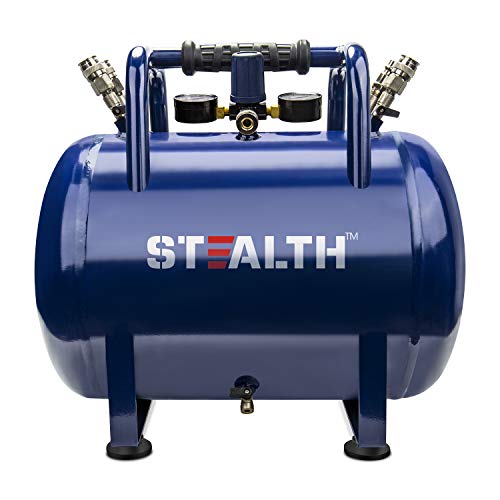
Stealth 10-Gallon Portable High-Pressure Auxiliary
The Stealth SAA-110T is a heavy-duty 10-gallon auxiliary air storage tank rated up to 225 PSI, featuring dual upward-facing pressure gauges and multiple quick-connect couplers for operating pneumatic tools remotely. It is an ideal portable air reserve for mobile technicians, garage DIYers, and contractors who need portable compressed air without dragging out an electrical cord or a noisy compressor.
Pros
- High 225 PSI maximum pressure rating stores significantly more usable air volume than typical 125 to 150 PSI auxiliary tanks
- Upward-facing dual pressure gauges make checking tank reserve and output pressure quick and readable from above
- Multiple quick-connect output ports allow connecting multiple pneumatic tools or tire inflators at the same time
- Integrally welded construction paired with a dedicated bottom drain valve supports long-term tank durability
- Cushioned carry handle and non-slip base bracket provide stable footing and manageable portability around the garage or jobsite
Cons
- Weighs approximately 40.8 pounds empty, which becomes relatively heavy when carrying across larger jobsites by hand
- Auxiliary air storage vessel only, requiring an external air compressor to fill and recharge the tank
- Manufacturer specifications do not identify the exact coupler interchange profile or port thread standard
Generic 13.2-Gallon 1.5HP Air Compressor
Built for garage workshops and residential projects, this 13.2-gallon compressor pairs a maximum 115 PSI output with an impressively quiet 70dB noise profile. Its oil-free pump and wheeled frame provide reliable air delivery for DIY tasks and carpentry without demanding regular mechanical upkeep.
Pros
- Quiet 70dB operation suits residential workshops
- Zero-maintenance oil-free pump system
- Built-in wheels and handle aid mobility
- Durable steel tank construction
Cons
- Heavy 72-pound weight makes manual lifting difficult
- Maximum 115 PSI is modest for heavy-duty tools
FOMIUZY 580 Air Compressor Kit, 5-Gal Tank
Designed for air ride suspension overhauls, this FOMIUZY system pairs dual 580 compressors with a 5-gallon tank to supply steady pneumatic pressure up to 180 PSI. It delivers a comprehensive hardware bundle suitable for drivers needing reliable load leveling and ride height adjustment.
Pros
- Complete kit with dual compressors and tank
- Corrosion resistant finish protects against rust
- Pre-wired relays and pressure switch included
- High 180 PSI maximum operating pressure
- Protected by a lifetime replacement warranty
Cons
- Large 5-gallon tank requires substantial mounting room
- Comprehensive hardware bundle requires involved installation
Limodot 5-Gallon Quiet Portable Air Compressor
The Limodot 5-Gallon Quiet Air Compressor delivers 2.8 CFM at 90 PSI with an operating noise level of just 68 dB, making it a great match for indoor trim work, tire maintenance, and home workshops. With an 80-second full tank fill time, an oil-free pump, and an included 13-piece accessory kit, this wheeled unit offers solid utility for DIYers seeking quiet performance without routine oil changes.
Pros
- Quiet 68 dB operational sound level suitable for indoor spaces and attached garages
- Strong airflow rating of 2.8 CFM at 90 PSI with rapid 25-second recovery duration
- Maintenance-free oil-free pump ensures hassle-free operation and easy vehicle transport
- Integrated wheel assembly improves mobility around the shop, garage, and jobsite
- Bundled package includes a 25-foot air hose and a 13-piece starter accessory collection
Cons
- Continuous air-hungry tools like rotary sanders or spray equipment will quickly exceed the 2.8 CFM output
- Included PVC air hose can be stiff and prone to kinking in cold garage environments compared to hybrid polymer hoses
- At 5 gallons with a wheeled frame, it has a larger storage footprint than compact pancake or twin-stack trim compressors
FORNAX 6-Gallon Pancake Air Compressor: 150 PSI
The FORNAX 6-gallon pancake air compressor delivers 2.6 CFM at 90 PSI and 150 max PSI with dual couplers and an oil-free pump, weighing in at an easy-to-carry 28.8 pounds. It is a practical setup for DIY homeowners and finish carpenters tackling trim nailing, tire inflation, and workshop blow-off tasks.
Pros
- Dual quick-connect couplers support running two pneumatic nailers simultaneously
- Solid airflow delivery with 2.6 CFM at 90 PSI and 3.4 CFM at 40 PSI
- Manageable 28.8-pound portable weight simplifies one-handed transport
- Maintenance-free oil-free pump eliminates messy oil checks and changes
- Comes with a 14-piece accessory kit for out-of-the-box pneumatic utility
Cons
- High operating noise level rated at 95 dBA makes hearing protection mandatory, especially indoors
- Limited CFM output is unsuitable for continuous-demand air tools like HVLP paint sprayers or orbital sanders
- Fast-spinning 3,550 RPM motor generates noticeable vibration during recharge cycles
What an air compressor tank does and how to choose its role
An air compressor tank is a pressure-rated vessel that stores compressed air produced by a pump. The stored air is available to the outlet as the pressure regulator and tool use allow, while the compressor pump replenishes the supply. In ordinary conversation, “air tank” can mean the receiver attached to a compressor or a separate portable storage tank that has no compressor of its own. That distinction is central to understanding the options in this product list.
Stored air is not the same as continuous air production
A tank provides a buffer, not an unlimited supply. Once a tool draws air, tank pressure falls; the pump then runs to restore pressure if the system’s switch calls for it. A larger tank can provide a longer reserve for short bursts, but it doesn’t increase the pump’s rated airflow or make an undersized pump suitable for a continuous-demand tool.
That difference explains why a compressor may operate a brad nailer acceptably yet struggle with a tool that runs steadily. A nailer uses air in short actuations followed by pauses, giving the pump time to recover. A spray gun, die grinder, or sander may draw air for longer stretches, so matching the compressor’s delivered CFM at the required pressure matters more than relying on tank gallons alone.
Check the tool maker’s air-consumption specification and compare it with the compressor’s listed output at a comparable PSI. The product data here provides some useful examples: the Limodot compressor lists 2.8 CFM at 90 PSI, while the ECOMAX 3-gallon model lists 0.6 SCFM at 90 PSI. Those are specific listed figures, not a basis for assuming that every product in the list has similar output.
Tank gallons and PSI describe different limits
Gallons describe nominal tank capacity, while PSI describes pressure. Neither figure alone specifies how long a tool can run. Actual usable air depends on starting pressure, the regulator setting, the pressure range the system allows before the pump restarts, tool demand, and the compressor’s rate of replenishment.
Maximum pressure should be treated as a manufacturer limit, not a suggested adjustment target. For example, the listed MaxWorks portable tank is rated to a maximum of 140 PSI, and the Stealth standalone tank lists a maximum of 225 PSI. Those ratings do not mean the tanks contain identical usable air, nor do they establish how much air a particular tool will receive at its working pressure.
Tank pressure and regulated outlet pressure also have separate jobs. The tank gauge indicates stored pressure, while a regulator sets downstream working pressure for an attached tool. Use the tool’s specified pressure and the equipment instructions, and don’t exceed the lowest rated limit in the connected system.
Standalone storage tank or compressor with a receiver?
A standalone air tank stores compressed air supplied by another source. It can be useful when a portable reserve is the goal, but it cannot refill itself because it has no compressor pump. The MaxWorks 5-gallon tank includes a hose and gauge, and the 10-gallon Stealth tank lists multiple quick-connect couplers. The Stealth product description explicitly notes that it is an air tank, not a compressor.
A compressor with a receiver combines the pump, motor, controls, and storage vessel in one unit. Options in this list include pancake compressors with 3- or 6-gallon tanks, a quiet 5-gallon compressor, and larger wheeled units. A complete unit can produce air on site, but you still need to match its output and intended use to the tool rather than treating tank size as the only performance measure.
The FOMIUZY listing is a vehicle air-suspension system kit that includes a 5-gallon tank, compressors, hoses, valves, relays, and a pressure switch. That is a different use case from a general-purpose shop receiver or portable inflation tank. Buyers should confirm that a specialized kit’s components and installation requirements suit their vehicle and intended system before purchase.
Matching the air reserve to the work
For intermittent tasks, a compact receiver may provide a useful reserve between pump cycles. Tire inflation, brief blow-off work, and occasional fastening are examples of tasks where air is drawn in bursts, although the specific compressor still needs adequate pressure and airflow. A portable tank can also carry stored air to a location where running a compressor is inconvenient, provided it is filled using equipment designed for the tank’s rating.
Continuous-use work calls for a closer look at delivered CFM and pump recovery. If a tool draws air faster than the pump can supply it, the tank pressure declines and the tool may lose performance as pressure falls. Raising the tank’s maximum PSI does not solve an airflow shortfall; it only changes the pressure limit and may not provide the flow the tool needs.
For help thinking through tool demand and air delivery, our portable compressor tank guide offers related context. Compare the tool’s specified CFM and PSI with the compressor’s published output, and allow for differences in how manufacturers state air delivery. If the product information doesn’t provide a relevant CFM figure, don’t assume the tank’s gallon rating fills that gap.
Accessories and couplers can also affect practical setup. The ECOMAX 6-gallon pancake listing includes dual quick couplers and an accessory kit, while the FORNAX 6-gallon pancake lists two couplers and 2.6 CFM at 90 PSI. Multiple couplers can provide connection points, but they don’t multiply the pump’s air capacity; simultaneous tool use still draws from the same supply.
Oil-free designs, noise, and portability are separate considerations
Several complete compressors in the supplied listings use oil-free pumps. That design avoids routine pump-oil checks and changes associated with oil-lubricated compressors, but it does not mean the entire system needs no care. Tank moisture, hose connections, filters, and manufacturer-specified service tasks still deserve attention.
Noise ratings can matter in a home garage or indoor work area, but use the supplied figure for the particular model rather than generalizing across the category. The VEVOR 13-gallon compressor lists 66 dB, the Limodot 5-gallon model lists 68 dB, and another 13.2-gallon unit lists 70 dB. The FORNAX listing states 95 dB, illustrating why noise should be checked model by model.
Tank capacity and portability involve tradeoffs too. The ECOMAX 3-gallon compressor is listed at 16.3 pounds, whereas its 6-gallon counterpart is listed at 34.17 pounds; the VEVOR 13-gallon compressor has wheels. These stated details may help buyers think about carrying, storage, and moving equipment, but they do not establish a product’s balance or ease of handling in every setting.
Moisture, gauges, and safe tank ownership
Compressing air can leave moisture inside the receiver, so tank drainage is an important part of routine ownership. Follow the compressor or tank manual for drainage frequency and the approved process. Before servicing fittings or transporting equipment, depressurize the tank completely as directed by the manufacturer; wear suitable eye protection, and use hearing protection while operating air equipment.
Don’t remove, block, or adjust a safety relief valve, and don’t exceed the tank’s marked pressure rating. If a tank is damaged, badly corroded, or leaking, stop using it and consult the manufacturer or a qualified service provider about appropriate next steps. A pressure vessel is not a component to repair by improvising a patch or welding.
Gauges and regulators help make the system easier to monitor, but a gauge reading is only useful if you know whether it represents tank pressure or regulated outlet pressure. The ECOMAX listings describe dual gauges, and the Stealth tank listing specifies gauges for tank and output pressure. Check the instructions to identify each gauge and set outlet pressure according to the connected tool’s requirements.
Electrical supply and operating limits belong in the same planning conversation. The supplied information does not state voltage, running amperage, startup current, or duty-cycle ratings for most of these options, so those details should be confirmed in the product manual or nameplate before use. Avoid assuming that a household circuit or extension cord will suit a compressor simply because its tank is portable.
A practical way to interpret tank specifications
Start by deciding whether you need a storage tank alone or a compressor that can make air where you work. Then identify the tool’s required PSI and air consumption, paying special attention to whether its use is intermittent or continuous. Compare those needs with the compressor’s published CFM at the relevant pressure, and treat the tank size as reserve capacity rather than a substitute for pump output.
Next, check the maximum pressure and the connections, gauges, and regulator arrangement. Consider whether a listed noise rating, oil-free pump, accessory kit, carry weight, or wheel setup fits your workspace and routine. If a key specification is missing, contact the seller or manufacturer rather than inferring it from the tank’s appearance or gallon rating.
The concise answer is that an air compressor tank stores compressed air for use between pump cycles, while the compressor determines how that reserve is replenished. Choose based on the tank’s rated capacity and pressure, the pump’s supported air-delivery information, and the demands of the task. Treat the manual and tank markings as the authority for safe operation, maintenance, and pressure limits.
About the author
Clint DeBoer is an experienced tool-industry specialist with decades of involvement in technical media, hands-on product evaluation, and testing methodology. His focus on performance, practical usability, and data-driven comparisons makes his expertise highly relevant to professional air compressors, pneumatic tools, and workshop equipment.