
What Is a Central Air Compressor: A Practical Guide
What is a central air compressor? Learn how centralized shop air works, how to size its supply, and what the listed equipment can and cannot do in November 2026.
 By Kenny Koehler
Updated November 10, 2026


A shop can have several air tools and work areas, but carrying one portable compressor between them gets old quickly. A centralized system keeps the compressor in a fixed location and routes compressed air through piping or hoses to one or more points of use. Understanding that setup helps separate a true central air installation from the portable inflators and standalone compressors included in the products below.
What is a central air compressor? Usually, it means a stationary compressor serving a workshop or garage through a distribution system. It is not the same thing as a central air-conditioning system, and it is not a special compressor type by itself. The products in this list range from tire inflators and portable units to a larger tank compressor and pressure-switch replacements, so buyers should match the item to the job rather than assume every product is a complete central air system.
Start with the tools that will run and their air demand, then consider tank capacity, power supply, noise, and the location of the compressor. A centralized layout can make air available at convenient points, but it cannot make an undersized pump deliver more air than it produces. For an individual tire-filling task, this guide to inflating tires with a compressor covers a different, portable use case. A home garage setup may also benefit from considering compressor options for a home mechanic.
| Award | Product | ACR Score About ACR ScoreThe ACR Score is our own rating from 0 to 10, based on performance, design and build, ease of use, and value. It reflects independent research and is never influenced by manufacturers, retailers, or affiliate commissions. Learn more › | |
|---|---|---|---|
| Best Overall |
VEVOR 13-Gallon 2HP Quiet Air Compressor
|
9.2/10 | Buy |
| Best Value |
 CRAFTSMAN 2-Gallon Portable Air Compressor |
9.1/10 | Buy |
| Best Budget |
 Wadoy 4-Way Air Compressor Pressure Switch |
8.9/10 | Buy |
 AstroAI Cordless Tire Inflator 160 PSI |
8.8/10 | Buy | |
| Best Premium |
 VEVOR 20-Gallon 4HP Air Compressor |
8.8/10 | Buy |
 Heywood 90-120 PSI 240V Pressure Switch |
8.6/10 | Buy | |
 VIAIR 88P 12V Portable Air Compressor |
8.4/10 | Buy | |
 DEWALT DWFP55130 2.5-Gallon 200 PSI Quiet Trim Air |
8.4/10 | Buy | |
 Klutch 20-Gallon Portable Air Compressor |
8.4/10 | Buy | |
 CARSUN Dual Power AC/DC Portable Tire Inflator |
8.3/10 | Buy |
VEVOR 13-Gallon 2HP Quiet Air Compressor
Delivering 4.6 SCFM at 90 PSI with a quiet 66-decibel sound profile, this 13-gallon compressor suits home garages and workshops needing steady air supply without disruptive motor noise. Its oil-free 2HP motor fills the tank in under three minutes, while large rubber wheels help maneuver its substantial 71-pound frame.
Pros
- Quiet 66-decibel noise level during operation
- Oil-free motor design eliminates routine maintenance
- Fast air buildup in under three minutes
- Sturdy 7-inch rubber wheels assist transport
Cons
- Heavy 71-pound weight makes vehicle loading difficult
- Maximum 125 PSI ceiling limits high-pressure tools
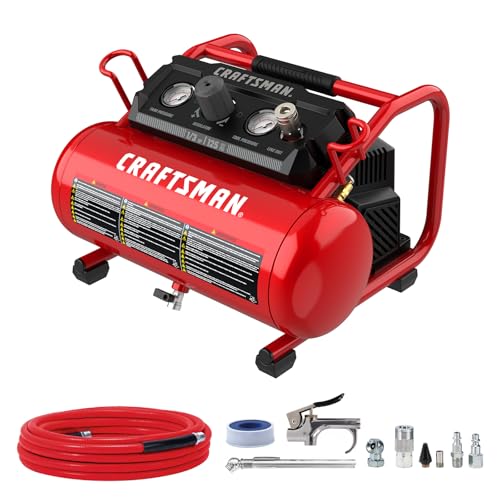
CRAFTSMAN 2-Gallon Portable Air Compressor
This CRAFTSMAN 2-gallon portable compressor package pairs a max 125 PSI oil-free pump with a versatile 10-piece pneumatic accessory kit using standard 1/4-inch NPT fittings. It is a practical, lightweight solution for DIYers and homeowners tackling tire inflation, air dusting, and light fastening.
Pros
- Complete out-of-the-box pneumatic package with air hose, blow gun, tire chuck, and 1/4-inch NPT quick-connect hardware
- Lightweight 19-pound carry weight makes moving between the garage, driveway, and workbench effortless
- Oil-free pump eliminates crankcase oil checks and prevents oil aerosol contamination in downstream air lines
- Dual quick couplings allow quick hookups without needing additional brass splitters
Cons
- Small 2-gallon receiver tank and 1/3 HP motor are limited to light-duty pneumatic tasks rather than continuous air-hungry tools
- The included starter air hose and accessories are entry-level components that high-volume shops may eventually want to upgrade
- Fittings utilize standard 1/4-inch auto profile plugs which require matching couplers if your shop uses alternate pneumatic profiles
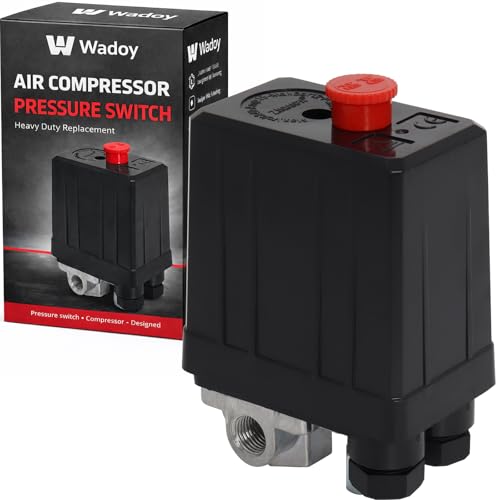
Wadoy 4-Way Air Compressor Pressure Switch
Designed as an aftermarket fix for small compressors, this Wadoy four-port valve automatically cycles air pressure between 90 and 120 PSI. Its metal build provides a practical way to restore reliable pressure control without replacing the entire machine.
Pros
- Durable metal construction
- Four ports accommodate gauges and relief valves
- Simple red auto control knob
- Economical alternative to buying a new compressor
Cons
- Non-OEM aftermarket replacement part
- Relief valves and gauges sold separately
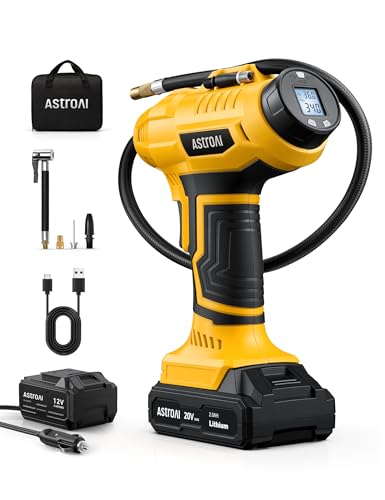
AstroAI Cordless Tire Inflator 160 PSI
The AstroAI Cordless Tire Inflator is a compact 160 PSI handheld air compressor featuring dual power via a 20V rechargeable battery and a 12V DC car adapter. Delivering digital auto shut-off and up to 20 minutes of continuous runtime, it is an ideal emergency tool for garage mechanics, commuters, and road-trippers.
Pros
- Dual-power versatility allows cordless battery operation at home or 12V DC vehicle plug-in on the road
- Reaches up to 160 PSI with automatic shut-off to prevent accidental tire over-pressurization
- Compact 2.54-pound footprint provides effortless trunk or glove-box storage for emergency readiness
- Backlit digital LCD screen provides clear readouts in PSI, BAR, and KPA units
- Integrated front LED light illuminates tire valve stems during dark roadside emergencies
Cons
- Includes a USB-C charging cable but requires an external USB power block to recharge the battery
- Designed specifically for tire and sports inflation rather than driving pneumatic workshop air tools
- Continuous runtime is limited to 20 minutes before requiring a cool-down pause
VEVOR 20-Gallon 4HP Air Compressor
Built with a 20-gallon steel tank and a 4HP oil-free motor, this compressor delivers a capable 10.6 CFM at 90 PSI for demanding pneumatic tools. Integrated sound-dampening mufflers keep operation around 78 dB, making it a solid choice for home garages and auto repair shops.
Pros
- High 10.6 CFM airflow easily runs demanding tools
- Maintenance-free oil-free motor design
- Relatively quiet 78 dB sound level for workshops
- Built-in automatic thermal and pressure overload protection
Cons
- Heavy footprint weighing over 134 pounds
- Requires a dedicated 220V electrical outlet
- Maximum working pressure capped at 125 PSI
Heywood 90-120 PSI 240V Pressure Switch
Designed as an aftermarket replacement for miniature air compressors, this switch automates power control within a 90 to 120 PSI range. It features a visible red on-off knob to simplify operation and manage motor runtime efficiently.
Pros
- Automates shut-off between 90 and 120 PSI
- Compact form factor fits miniature compressor setups
- Straightforward installation with manual control knob
- Direct aftermarket replacement for OEM switch units
Cons
- Non-OEM aftermarket replacement part
- Limited strictly to 240V electrical configurations
- Designed specifically for miniature compressor models
VIAIR 88P 12V Portable Air Compressor
Designed for passenger cars and light trucks with tires up to 33 inches, the VIAIR 88P delivers dependable 120 PSI output directly from a vehicle battery. Its generous 26-foot total reach, built-in gauge, and integrated work light make it a practical emergency companion for road trips and camping.
Pros
- Solid 1.47 CFM flow rate provides brisk inflation
- Generous 26-foot reach easily accesses all four tires
- Built-in LED work light aids dark roadside repairs
- Compact body weighs under five pounds for convenient storage
Cons
- Requires direct battery connection instead of standard 12V outlet
- Limited to a 25-minute duty cycle before cooling
- Not designed for tires larger than 33 inches
DEWALT DWFP55130 2.5-Gallon 200 PSI Quiet Trim Air
The DEWALT DWFP55130 delivers a capable 3.0 SCFM at 90 PSI with a 200 max PSI 2.5-gallon tank, running at a quiet 71.5 dBA on an efficient 12-amp motor. It is an ideal pneumatic power source for trim carpenters, punch-list contractors, and DIYers working on residential circuits.
Pros
- Delivers 3.0 SCFM at 90 PSI with a high 200 max PSI ceiling for rapid pressure recovery during sequential fastening
- Quiet 71.5 dBA sound output makes indoor trim carpentry and remodeling far less disruptive to homeowners
- Low 12-amp draw reduces breaker trips when running on shared 15-amp household circuits
- Integrated roll cage and console protect critical components while supporting horizontal or vertical operation
- Dual quick couplers allow two trim carpenters to connect and work off a single compressor
Cons
- Bare-tool configuration means you must supply your own air hoses, couplers, and pneumatic nail guns
- At 36 pounds, it is heavier to haul up flights of stairs than ultra-compact 1-gallon finish compressors
- Air output of 3.0 SCFM is built for intermittent finish fastening and will not support continuous tools like rotary sanders or sprayers
Klutch 20-Gallon Portable Air Compressor
Featuring a 2.0 HP 120V motor and a 20-gallon tank, the Klutch portable air compressor delivers a rated 4.2 SCFM at 90 PSI for versatile workshop air. Its oil-free pump and wheeled design make it a dependable choice for garage mechanics, woodworkers, and serious DIYers needing steady air storage.
Pros
- Generous 20-gallon air storage capacity provides a substantial buffer for intermittent shop tools
- Delivers a listed 4.2 SCFM at 90 PSI, outperforming smaller pancake compressors for workshop chores
- Oil-free pump design eliminates messy oil changes and allows clean, upright transport
- Rugged rubber wheels and built-in ergonomic handle make moving the 90-pound frame manageable
- Integrated thermal overload protection helps prevent motor burnout during demanding cycles
Cons
- Substantial 90-pound weight makes lifting into truck beds or carrying up stairs difficult without assistance
- Oil-free motor configurations generally produce noticeable operating noise compared to low-RPM lubricated units
- At 4.2 SCFM at 90 PSI, high-draw continuous air tools like sanders or grinders will require recovery pauses
CARSUN Dual Power AC/DC Portable Tire Inflator
The CARSUN Dual Power Tire Inflator delivers up to 150 PSI of high-pressure air running from either a 110V household outlet or a 12V vehicle socket. With digital pressure presets, automatic shutoff, and a lightweight 2.1-pound frame, it is an ideal maintenance pump for passenger vehicles, bicycles, and household inflatables.
Pros
- Versatile dual-voltage operation works seamlessly in the home garage or on the road without requiring an external converter
- Accurate auto-shutoff mechanism protects tires from accidental over-pressurization during routine top-offs
- Compact 2.1-pound build packs away easily in car trunks, under vehicle seats, or on garage shelving
- Clear digital display allows fast switching across four standard pressure measurement units
Cons
- Requires a mandatory 10-minute cooldown period after every 15 minutes of continuous operation
- Manufacturer explicitly states it does not support heavy truck tires, tractor tires, or stand-up paddleboards (SUP)
- Tankless inflator design cannot run standard workshop pneumatic air tools like brad nailers or paint sprayers
How a Central Air Compressor System Works
A centralized compressed-air setup places the compressor in a chosen location and carries air from its tank or outlet to work areas through a distribution network. The compressor creates and stores compressed air; the piping or hose carries it; and regulators, couplers, and any appropriate air treatment help prepare it for the tool. In ordinary workshop use, “central” describes the arrangement, not a unique pump design or a guarantee of a particular pressure or airflow.
Central compressed air is not central air conditioning
The phrase can cause confusion because central air commonly refers to building cooling. A central air compressor instead supplies compressed air for pneumatic equipment, such as nailers, blow guns, and compatible automotive tools. These are different systems with different functions, components, and installation needs. A compressor feeding a fixed workshop line is not an air conditioner, even if both systems serve a building.
The distinction matters when searching for equipment or planning an installation. A small 12-volt tire inflator is intended for inflation tasks, not to supply a piped workshop network. A portable tank compressor may serve occasional tools at a workbench, while a stationary unit is more naturally suited to a fixed supply arrangement, provided its output and power requirements fit the planned use. The word “central” alone does not tell you whether the compressor can meet a tool’s demand.
Follow the air from the pump to the tool
In a basic arrangement, the pump compresses incoming air and stores it in a receiver tank. A pressure switch controls compressor cycling within its designed operating range, while a regulator sets usable outlet pressure for the connected application. From there, air passes through a hose or fixed line and a coupler before reaching the tool. Every restriction, leak, or poorly matched component can affect the supply available at the tool.
A tank provides a reserve, but it is not the same as continuous production. If a tool consumes air faster than the pump can replenish it, tank pressure falls and the compressor cycles more often. A larger tank can increase the reserve available for short bursts, but it does not change the pump’s underlying air-delivery rate. That distinction is central to deciding whether a compressor works for a short nailing cycle or a longer air-consuming task.
Size supply around tool demand, not tank size alone
Start by checking the tool maker’s required pressure and air consumption, then compare those figures with the compressor’s stated delivered airflow at the relevant pressure. CFM or SCFM figures only make sense when their measurement conditions and pressure are understood. A maximum PSI rating describes a pressure limit, not how much air the pump can deliver at that pressure. The product information supplied here lists airflow for some models, but it does not provide a complete specification for every compressor.
Intermittent tools and continuous-use tools place different demands on a system. A nailer typically draws air in short bursts, leaving time for the tank to recover between operations. A sander or spray gun may draw air for longer periods, so sustained pump output and the tool’s specified air requirement matter more than a large-looking tank. Do not assume that a compressor is suitable for a particular tool just because its maximum PSI exceeds the tool’s pressure setting.
For multiple work points, consider whether users may operate tools simultaneously. Their combined demand can exceed what the compressor or a single outlet can supply, even if each tool works adequately by itself. Allowing for a reasonable operating margin can reduce the risk of pressure sag, but the needed margin depends on actual tool requirements and usage. Verify compressor delivery and tool consumption from their manufacturers’ specifications instead of estimating from horsepower labels or tank volume.
Line length and fittings also affect delivery. Long runs, small internal passages, restrictive couplers, and multiple connections can contribute to pressure loss while air is flowing. A pressure gauge at the compressor may therefore show a different value from the pressure available at a tool under load. If the application is sensitive to pressure, measure or verify pressure at the point of use using suitable equipment and follow the manufacturers’ operating instructions.
Distribution layout changes convenience and maintenance
A fixed line can reduce the need to drag a compressor or long loose hose around a garage. It also lets a workshop place connection points near benches or service bays. The layout should suit the work area, with accessible outlets and components that can be inspected or serviced. The compressor’s tank drain and controls should remain reachable rather than being boxed into an inconvenient corner.
Compressed air cools as it moves through a system, and moisture can collect in a tank or downstream equipment. A distribution plan should account for moisture management and any filtration or separation needed for the application. Paint finishing, for example, has different air-quality concerns from tire inflation, but the supplied product details do not establish that any listed compressor includes a complete filtration or drying system. Select air treatment based on the tool and finish requirements, and follow the equipment manufacturers’ guidance.
Any permanent compressed-air piping needs to be suitable for the pressure, compressor, and intended use. Do not select plumbing materials or fittings based only on appearance or convenience. Use components rated and approved for compressed-air service, and consult applicable product instructions and local requirements. If the installation involves uncertain materials, structural changes, or a complex multi-outlet system, a qualified installer can help avoid an unsafe or unsuitable layout.
What the listed compressor options can tell you
The products here are not all central-system compressors. The VEVOR 20-gallon model is listed with a 4 HP oil-free motor, 10.6 CFM at 90 PSI, and a maximum pressure of 125 PSI. Those specifications make it a more substantial workshop-oriented option than a small tire inflator, but the product details do not establish that it is a stationary central-system package or provide installation guidance. Buyers still need to confirm voltage compatibility and air demand for their intended tools.
The VEVOR 13-gallon compressor is listed with a 2 HP motor, 4.6 SCFM at 90 PSI, and 125 PSI maximum pressure. It may suit some garage and DIY tasks, but compare its listed airflow with the tools’ requirements before expecting sustained operation. The Klutch 20-gallon model lists 4.2 SCFM at 90 PSI and an oil-free pump. The larger tank can hold a useful reserve, yet its listed delivery remains the more relevant figure for tools that draw air continuously.
The DEWALT trim compressor is a smaller portable option with a 2.5-gallon tank, 3.0 SCFM at 90 PSI, and a listed maximum of 200 PSI. Its product details describe dual couplers for supporting two nailers, but that does not mean it can sustain any two tools under all conditions. Actual suitability depends on tool consumption, operating pattern, and the compressor’s recovery behavior. The supplied information does not state a tank recovery time, so do not infer one from maximum pressure.
Other entries serve quite different roles. The VIAIR 88P, AstroAI cordless inflator, and CARSUN AC/DC inflator are primarily portable inflation products, while the CRAFTSMAN 2-gallon compressor is a compact portable unit. The Wadoy and Heywood items are replacement pressure switches, not compressors. A replacement switch must match the compressor’s electrical and mechanical requirements; the listed product descriptions are not enough to verify compatibility with every machine.
Noise may matter if the compressor sits near living space or a shared work area. The VEVOR 13-gallon listing states 66 dB, the 20-gallon VEVOR listing states 78 dB, and the DEWALT trim compressor lists 71.5 dBA. Treat these as manufacturer-provided figures, not a guarantee of the sound level at your listening position or in your room. Placement, enclosure, surfaces, and operating conditions can influence perceived noise, and any enclosure must not obstruct ventilation or violate manufacturer instructions.
Power, pressure controls, and safe operation
Before buying a compressor for a fixed installation, confirm its voltage and electrical requirements from the product label and manual. The VEVOR 20-gallon listing specifies 220 V, 60 Hz, so it should not be treated as a standard plug-in replacement for a 120 V unit. The listed descriptions for some other products do not give complete circuit or startup-current details. Avoid guessing about breaker suitability, and have electrical work assessed by a qualified person when the supply or installation is uncertain.
A pressure switch starts and stops the motor according to tank pressure, and the Wadoy switch listing describes a 90 to 120 PSI range for that replacement part. That range is not a universal setting for compressors, nor does it prove the switch fits a particular machine. Pressure switches have electrical ratings and connection requirements that must match the compressor. Do not alter factory cut-in or cut-out settings or bypass pressure controls and safety devices.
Condensation can accumulate inside a receiver tank during normal operation. Follow the compressor manual for tank draining, inspection, and service intervals, and depressurize the equipment as directed before servicing or moving it. Never remove fittings or work on a pressurized tank. Keep the safety relief valve and thermal protections functional, and do not bypass them; wear suitable eye and hearing protection when operating compressed-air equipment.
Regulators and gauges also have distinct jobs. The tank gauge indicates stored pressure, while a regulated outlet gauge indicates the set pressure downstream, though actual tool pressure can drop during airflow. Set pressure according to the connected tool’s instructions rather than increasing it to compensate for a supply problem. If a tool still performs poorly, inspect the system for leaks, restrictive fittings, insufficient compressor output, and an unsuitable hose or regulator instead of exceeding the tool’s stated limit.
Decide whether a fixed system is worth installing
A centralized layout makes the most sense when the compressor will serve repeat work locations and the convenience of fixed outlets outweighs installation effort. Occasional inflation or short projects may be easier to handle with a portable compressor and hose. A workshop that runs air-consuming tools regularly needs a careful output assessment, because a distribution system improves access but does not increase pump capacity. The right choice depends on actual use, available power, noise tolerance, and space.
For a home garage, a portable tank unit can be a practical intermediate step if its airflow meets the intended intermittent tasks. A stationary compressor may be more suitable where the operator wants permanent air points and has confirmed the electrical and installation requirements. If the planned work includes continuous sanding or spraying, compare the tool’s specified air consumption with compressor delivery at operating pressure before investing in piping. A larger tank alone is not a reliable substitute for adequate airflow.
Central air is best understood as a compressor plus a deliberately designed distribution system, not as a particular product category. Verify airflow at the working pressure, confirm power and pressure compatibility, and plan for safe access to controls and tank maintenance. The listed products include useful options for several individual jobs, but only a compressor whose specifications match the intended demand should serve as the core of a fixed shop supply.
Avoid buying by PSI or tank gallons alone. The decisive question is whether the compressor can deliver enough air for the tools you expect to run, through a layout suited to your workspace and electrical supply. Once that is established, portability, noise, maintenance, and outlet placement can guide the final choice.
About the author
Kenny Koehler is a power-tool specialist with more than a decade of hands-on evaluation experience and a science-based approach to product testing. His expertise in repeatable testing, tool performance, impact wrenches, and professional equipment brings a practical, data-focused perspective to compressor and pneumatic-tool comparisons.