
How to Stop Water in Air Compressor: Practical Guide for 2026
Learn how to stop water in air compressor using tank drains, inline filters, and desiccant dryers to protect pneumatic tools in November 2026.
 By Glenda Taylor
Updated October 8, 2026


Moisture spraying out of an air tool or sputtering through a paint nozzle ruins workpieces and quickly corrodes expensive pneumatic equipment. Ambient air naturally carries water vapor, and compressing that air concentrates humidity inside the receiver tank where it cools into liquid. Learning how to stop water in air compressor is essential for any workshop owner, automotive hobbyist, or contractor running pneumatic tools. By setting up proper drainage and targeted filtration, air tool users can protect internal valves and keep air lines dry.
Receiver tanks collect moisture during every compression cycle, creating a breeding ground for internal rust and line contamination. Relying solely on small factory petcocks often leads to neglected maintenance, while demanding jobs like automotive spray painting or plasma cutting require specialized inline moisture traps. Finding the right combination of automatic tank drains, mechanical water separators, and desiccant dryers provides a reliable defense against liquid buildup. Taking control of moisture helps tools last longer and keeps regulated air delivery consistent across every project.
| Award | Product | ACR Score About ACR ScoreThe ACR Score is our own rating from 0 to 10, based on performance, design and build, ease of use, and value. It reflects independent research and is never influenced by manufacturers, retailers, or affiliate commissions. Learn more › | |
|---|---|---|---|
| Best Overall |
DAIERTEK 1/2" NPT 3-Stage Air Dryer
|
9.1/10 | Buy |
| Best Value |
 LNCHKA 1/4-Inch NPT Air Compressor Water Separator |
8.9/10 | Buy |
 LE LEMATEC 1/4" NPT Inline Air Dryer |
8.9/10 | Buy | |
| Best Budget |
 YELUN Brass RV Winterizing Blowout Kit |
8.4/10 | Buy |
| Best Premium |
 SUNROAD Automatic Electronic Air Compressor Tank |
8.3/10 | Buy |
 Hromee AW2000-02 1/4-Inch Filter Regulator |
8.1/10 | Buy | |
 LitOrange Brass Blow Out Adapter (2-Pack) |
8.0/10 | Buy | |
 Hotusi 1/4" BSP Air Filter Regulator |
7.8/10 | Buy |
DAIERTEK 1/2" NPT 3-Stage Air Dryer
Designed for moisture-critical tasks like spray painting and plasma cutting, this 3-stage filtration unit combines particulate, coalescing, and desiccant drying with integrated pressure regulation. Durable metal bowls and color-changing media make routine monitoring straightforward in workshop setups.
Pros
- Comprehensive three-stage filtration delivers dry, clean air
- Durable metal bowl construction for workshop environments
- Color-changing desiccant beads simplify maintenance tracking
- Generous bundle includes spare filters and fittings
Cons
- Requires vertical mounting for proper auto-drain operation
- Desiccant media requires regular maintenance and replacement
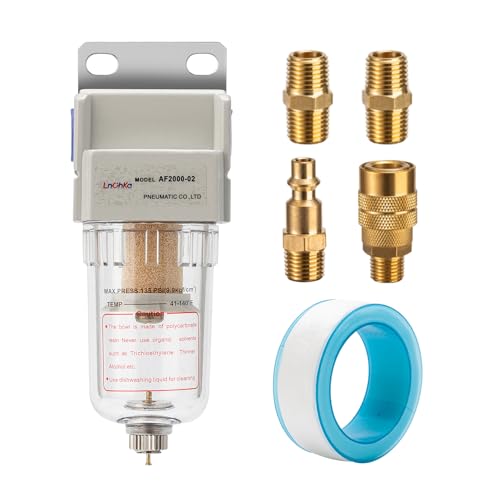
LNCHKA 1/4-Inch NPT Air Compressor Water Separator
The LNCHKA 1/4-inch NPT air line filter is a compact moisture separator engineered to trap condensation and particulates using a durable 5-micron brass element. Supporting up to 145 PSI and an 18 SCFM flow rate, it is an effective, budget-friendly addition for DIYers and home garage mechanics looking to protect pneumatic tools from water damage.
Pros
- Durable 5-micron porous brass filter element resists corrosion better than paper or plastic cartridges
- Generous 18 SCFM flow capacity easily accommodates common DIY and small-shop pneumatic tools
- Includes brass quick-connect fittings, bracket, and Teflon tape for straightforward installation out of the box
- Transparent polycarbonate bowl provides effortless visual inspection of fluid buildup
Cons
- Polycarbonate bowl can be vulnerable to cracking if exposed to harsh synthetic solvents or chemical fumes
- Manual drain requires proactive monitoring and regular physical purging to prevent water re-entry into the line
- 1/4-inch NPT port size and 18 SCFM rating are not suitable for large multi-operator industrial airline networks
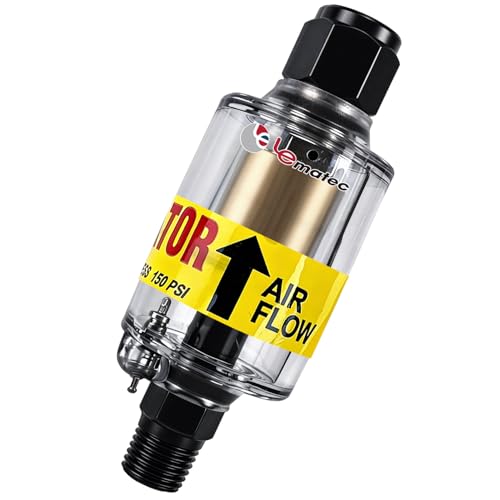
LE LEMATEC 1/4" NPT Inline Air Dryer
Built for spray painting and plasma cutting setups, this compact inline separator captures oil and moisture down to 1 micron across a 2-150 PSI range. Its standard 1/4-inch NPT threading and built-in check valve help protect downstream pneumatic equipment from contamination.
Pros
- Filters oil and moisture down to 1 micron
- Wide operating range from 2 to 150 PSI
- Integrated one-way valve prevents backflow
- Standard 1/4-inch NPT fitting
- Extremely lightweight and compact profile
Cons
- Requires adapters for larger air line sizes
- Drain requires manual clearing and maintenance
YELUN Brass RV Winterizing Blowout Kit
The YELUN RV Winterizing Blowout Kit uses durable brass fittings to purge water from RV lines, sprinkler systems, and outdoor faucets before freezing weather hits. Equipped with standard 1/4-inch compressor plugs, 3/4-inch hose threads, and an integrated ball valve, it provides a straightforward method for controlled blowout winterization.
Pros
- Sturdy brass construction resists corrosion
- Built-in ball valve simplifies air regulation
- Standard fittings match most garden hoses and compressors
- Includes two adapters for versatile male and female connections
Cons
- Requires a compatible air compressor to operate
- Requires manual pressure regulation to protect plumbing
SUNROAD Automatic Electronic Air Compressor Tank
The SUNROAD Automatic Electronic Tank Drain Kit automates compressor moisture maintenance by purging water and oily sludge on an adjustable 0.5-50 minute cycle. Powered by standard 110V-120V current and equipped with an inline isolation ball valve and strainer, it is an essential upgrade for garage mechanics and woodworkers seeking to protect their pressure vessels from internal rust.
Pros
- Automates daily tank draining with easily adjustable cycle interval and purge duration dials
- Built-in ball valve and strainer allow quick isolation and screen cleanout without emptying the air system
- Supplied with a flexible braided stainless steel discharge tube and multiple brass plumbing adapters
- Plugs into standard 110V-120V household wall outlets with an IP65 rated timer enclosure
Cons
- Requires an accessible 110V-120V electrical outlet positioned near the bottom of the compressor tank
- Sudden discharge bursts create a sharp air hiss that can be startling in quiet, enclosed home garages
- Minimum operating ambient temperature of 32°F means condensation can freeze in unheated winter shops
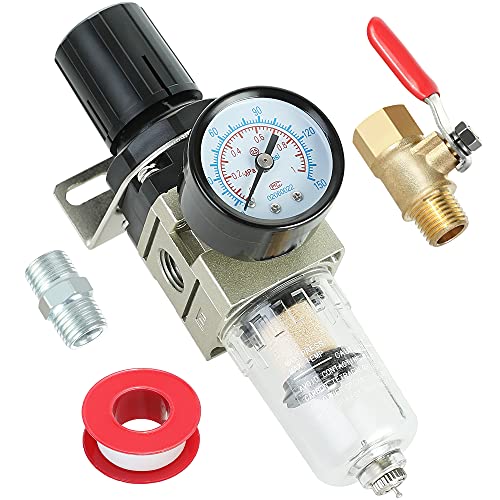
Hromee AW2000-02 1/4-Inch Filter Regulator
Designed for compact workspaces, this piggyback system integrates moisture filtration and pressure regulation into a single unit. Its brass filter element helps protect pneumatic tools from water and debris, while the included bracket and shutoff valve simplify setup.
Pros
- Durable brass filter element resists wear over time
- Dual-unit gauge provides clear pressure readings
- Compact piggyback design suits space-constrained setups
- Includes shutoff valve, bracket, and seal tape
Cons
- Requires manual operation to drain collected fluids
- Pressure capacity is capped at 150 PSI
LitOrange Brass Blow Out Adapter (2-Pack)
Machined from lead-free brass, this adapter pair connects standard air compressors to outdoor faucets and irrigation systems to blow out standing water. It offers an easy, durable winterizing solution for homeowners, RV travelers, and boat owners.
Pros
- Durable, lead-free brass construction
- Compact design fits confined plumbing areas
- Standard 3/4-inch hose and 1/4-inch air compressor fit
- Convenient two-pack bundle
Cons
- Requires a compatible external air compressor to operate
- Requires eye protection and caution during pressure blowout
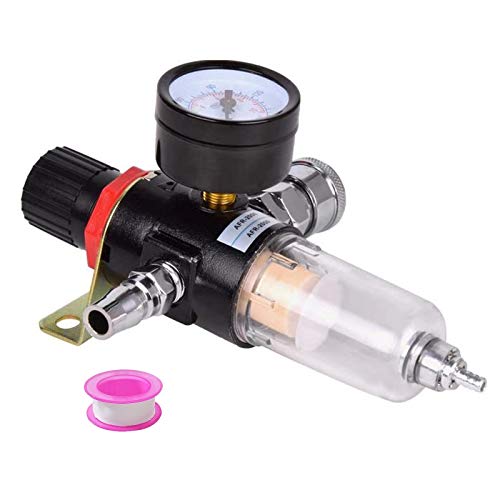
Hotusi 1/4" BSP Air Filter Regulator
Built for pneumatic equipment, this compact Hotusi unit integrates moisture filtration, lubrication, and pressure regulation into a single setup. It maintains stable air delivery between 30 and 120 PSI to protect pneumatic tools from particulates and excess pressure.
Pros
- Combines filtration, regulation, and lubrication
- Lightweight design at roughly 0.71 pounds
- Maintains stable output pressure during fluctuations
- Filters fine debris to safeguard downstream tools
Cons
- Restricted to 1/4-inch BSP connection sizes
- Maximum pressure ceiling is limited to 130 PSI
If this topic is part of a bigger decision, how to regrip golf clubs with air compressor is a useful related read.
Effective Methods to Eliminate Water in Compressed Air Systems
Compressed air systems inherently produce water as a natural consequence of air compression and thermal cooling. When a compressor pump pulls in ambient air, it ingests invisible water vapor along with atmospheric gases. Compressing that volume into a fraction of its original space drastically increases air temperature while reducing its capacity to hold vapor once it cools. Knowing how to stop water in air compressor requires looking at the entire pneumatic path from the tank base to the quick-connect tool coupler.
The Mechanics of Condensation in Compressed Air Lines
Atmospheric air contains a variable percentage of relative humidity influenced by local weather and ambient garage temperatures. When an electric compressor pump draws in atmospheric air, it packs that air into a confined steel or cast-iron receiver tank. The mechanical friction and heat of compression warm the air significantly, holding moisture in a gaseous state temporarily. As that hot air strikes the cooler walls of the storage tank, it rapidly cools past its dew point.
Once compressed air drops below its dew point, water vapor condenses into liquid droplets that gather along the bottom of the tank. If this accumulated water remains unpurged, subsequent air cycles pick up droplets and push them directly down the air delivery hose. In unconditioned shops or humid summer months, a standard compressor can produce several ounces of liquid during an afternoon of heavy use. This pooling liquid reduces usable tank volume, accelerates internal rust, and travels downstream into sensitive air tools.
Water traveling through pneumatic supply lines presents serious operational hazards for tools and equipment. Moisture washes away lubricating oils in air nailers, impact wrenches, and rotary die grinders, causing premature mechanical wear. For applications like plasma cutting and spray finishing, even microscopic water droplets cause sputtering arcs, blistering paint, and surface fish-eyes. Managing this moisture requires a layered approach that starts inside the receiver tank and extends along the piping layout.
Receiver Tank Drainage and Automated Solenoid Valves
Every air compressor tank includes a drain port located at its lowest gravitational point to purge settled condensation. Basic compressors typically feature a small threaded brass thumb petcock that requires manual turning after every work session. Many operators neglect these petcocks because they are hard to reach, stiff to turn, or prone to splashing rusty sludge across garage floors. Skipping daily draining allows acidic water to sit against bare steel, which gradually thins the tank walls and creates structural weaknesses.
Upgrading to an automated solution eliminates human error and ensures receiver tanks remain dry throughout continuous operation. An automatic electronic tank drain kit, such as the timer-controlled SUNROAD valve, opens periodically to discharge water automatically. These valves allow operators to set custom cycle times, such as adjusting the off interval from 0.5 to 50 minutes and the discharge pulse from 0.5 to 10 seconds. Powered by standard 110V to 120V household current, an electronic valve vents accumulated sludge even during intense production sessions.
Reliable automatic drainage also requires sediment protection to prevent debris from jamming the solenoid valve mechanism. Systems that incorporate an integrated ball valve and inline strainer capture loose rust scale before it reaches the delicate valve seat. Flexible braided steel discharge tubes direct the purged water safely into an external catch basin or floor drain without mess. Depressurizing the tank fully before installing any replacement drain valve ensures safe thread engagement and leak-free operation.
Mechanical Water Separators and Particulate Filters
Even with an automated tank drain, air leaving the receiver remains saturated with moisture vapor and fine mist. Mechanical water separators install directly onto the air discharge port or along hardline piping to trap bulk liquid. These units use internal swirl vanes to spin incoming air at high velocity, throwing heavy water droplets and oil mist outward against the filter bowl wall. The liquid runs down into a sump quiet zone where a baffle prevents it from re-entering the primary airstream.
Centrifugal moisture filters rely on porous filter elements to capture solid particulates while allowing air to pass. Many compact separators utilize cleanable 5-micron brass elements, such as those found in LNCHKA and Hromee modular filter regulator combinations. Sintered brass filters resist corrosion, withstand high operating temperatures, and provide far longer service life than disposable fiber discs. These filters capture scale, pipe debris, and liquid droplets, functioning reliably at operating pressures up to 145 or 150 PSI.
Filter bowls are typically constructed from transparent polycarbonate or reinforced aluminum alloy with sight glasses for easy monitoring. Polycarbonate bowls allow quick visual inspection of collected water, but they must be shielded from harsh chemical solvents that cause plastic crazing. Manual push-button drains or twist valves at the bottom of the bowl let operators discharge trapped liquid with a quick press. For high-volume setups, installing a dedicated shut-off ball valve upstream makes bowl cleaning and element servicing fast and straightforward.
Coalescing Filtration for Oil Aerosols and Fine Moisture
Standard 5-micron particulate filters excel at capturing bulk liquid droplets, but they cannot stop fine sub-micron aerosols. Lubricated piston compressors naturally discharge microscopic oil vapor past their piston rings along with atmospheric water vapor. When clean air is essential, a dedicated coalescing filter provides the next critical layer of moisture and oil separation. These specialized filters force compressed air through dense borosilicate microfiber mats that trap microscopic aerosols through diffusion and interception.
High-efficiency coalescing elements capture particles down to 0.01 microns, achieving filtration efficiencies up to 99.98 percent for oil and water aerosols. As sub-micron droplets collide within the fibrous matrix, they merge into larger drops that fall gravitationally into the filter bowl. Because coalescing filters can clog quickly if exposed to heavy rust or scale, they must always be installed downstream of a coarse 5-micron pre-filter. This sequential arrangement preserves the life of the fine coalescing core and maintains steady airflow without excessive pressure drop.
Multi-stage filtration packages combine particulate filtration, coalescing separation, and pressure regulation in a single rigid manifold. Advanced 1/2-inch NPT units featuring dual stages provide the flow capacity needed for demanding pneumatic setups without restricting SCFM delivery. A locking regulator knob on the assembly maintains stable working pressure between 0 and 240 PSI, preventing pressure creep during heavy tool cycling. Built-in differential pressure indicators alert operators when internal filter elements become saturated and require replacement.
For more on a connected point, our page on fortress vs husky air compressor goes into it separately.
Desiccant Drying for Paint Spraying and Plasma Cutting
Mechanical separators and coalescing filters remove liquid water, but they cannot alter the relative humidity of the air or eliminate water vapor. In moisture-critical tasks like automotive paint spraying, sandblasting, and CNC plasma cutting, warm vapor that escapes filters will cool inside the tool and condense onto workpieces. Achieving true dry air requires passing the compressed airstream through a chemical desiccant dryer. Desiccant dryers utilize porous silica gel beads or molecular sieves that physically adsorb gaseous water molecules from the passing air.
Desiccant systems typically use color-changing indicator beads that transition from deep blue to light pink as they absorb moisture. This color change provides immediate visual confirmation of desiccant saturation, letting operators know exactly when the media requires baking or replacement. The DAIERTEK three-stage dryer assembly positions the desiccant chamber as the final stage, right after the 5-micron particulate filter and 0.01-micron coalescing filter. Protecting the desiccant beads from liquid water and compressor oil ensures maximum adsorption capacity and extends media lifespan.
For mobile setups or single-tool protection, compact inline desiccant dryers provide a lightweight point-of-use defense. Units like the LE LEMATEC inline dryer equip 1/4-inch NPT connections and a 1-micron reusable element directly at the inlet of paint spray guns or plasma torches. These inline separators operate across wide pressure ranges, often handling from 2 up to 150 PSI while maintaining an internal one-way valve to prevent backflow. Placing a lightweight inline filter directly at the tool ensures that any condensation forming inside long hoses is stopped before reaching the nozzle.
Air Distribution Plumbing and Drop Leg Architecture
Installing filters immediately adjacent to the compressor pump is a common mistake that leads to wet air downstream. Air exiting the compressor pump head is intensely hot, holding water vapor in an invisible gaseous state that passes straight through mechanical filters. To capture moisture effectively, compressed air must have sufficient distance to cool down before it encounters filtration equipment. Running at least twenty to twenty-five feet of metal or rigid piping between the compressor tank and the first filter allows the air to cool and condense into separable liquid.
Plumbing an efficient workshop air distribution system requires incorporating slope and vertical drop legs into the pipe run. Main overhead air headers should slope gently downward toward a dedicated drain leg at the far end of the shop. Air takeoffs feeding individual workstations must always rise out of the top of the main header before curving down toward the floor. This upward loop prevents liquid water sliding along the bottom of the pipe from entering tool drop lines.
Each vertical workstation drop should terminate in a dedicated moisture drop leg that extends several inches below the regulator connection. Gravity pulls condensed water past the tool outlet into the bottom of the drop leg, where a manual ball valve or automatic drain purges it safely. Copper, black iron, and specialized aluminum piping systems promote rapid heat dissipation through their metal walls, encouraging early condensation inside the drop legs. Avoiding flexible PVC pipe is critical, as PVC can shatter dangerously under high pneumatic pressure.
Using Regulated Air to Purge Water Lines and Sprinklers
Controlling water involves not only keeping moisture out of air lines, but also using clean compressed air to remove water from plumbing systems. Underground sprinkler systems, garden hoses, RV water systems, and seasonal cabin pipes are vulnerable to severe freeze damage if water remains trapped over winter. Applying regulated compressed air through dedicated blowout fittings clears standing water quickly and completely. Heavy-duty brass blowout adapters, such as YELUN and LitOrange kits, connect standard 1/4-inch compressor quick-connect plugs to 3/4-inch garden hose threads on exterior spigots or plumbing manifolds.
Blowing out water lines requires careful air pressure control to protect delicate plastic plumbing and irrigation valves from rupture. Regulating the compressor output down to 30 to 50 PSI prevents damage to RV water lines and plastic sprinkler heads while providing ample volume to push out standing pools. Solid brass adapters with integrated shut-off ball valves give operators complete manual control over the air blast, allowing controlled intermittent purging. Wearing eye protection and keeping line pressure low ensures safe operation during seasonal plumbing maintenance.
System Verification and Routine Filter Maintenance
Maintaining a completely dry compressed air system requires consistent inspection and preventative care across all components. Operators should establish a daily routine of purging the main tank drain valve and checking all filter bowl sight glasses for accumulated liquid. If an automatic electronic drain is installed, pressing its manual test button confirms that the internal solenoid clicks cleanly and discharges freely. Inspecting the drain strainer periodically ensures pipe scale has not accumulated to choke off discharge flow.
Filter elements require periodic cleaning or replacement depending on the volume of air consumed and shop environmental conditions. Sintered brass filter elements can be removed, soaked in a mild cleaning solvent, and blown clean with reverse compressed air to restore full flow capacity. Coalescing micro-filters must be replaced when their differential pressure indicator enters the warning zone or after manufacturer-recommended service hours. Desiccant beads should be inspected weekly; once the blue beads turn pink, they must be baked in an oven or swapped out for fresh media.
Verifying air dryness at the point of use can be accomplished with a simple mirror or clean cardboard test before beginning sensitive projects. Holding a clean surface several inches from an open air blowgun for thirty seconds will reveal any escaping moisture or oil mist. If droplets appear, check the upstream desiccant saturation, verify that drop legs are drained, and ensure the air has cooled adequately before filtration. Following these disciplined maintenance habits guarantees dry, dependable air that protects tools, preserves finishes, and extends compressor life.
Implementing a layered approach to moisture management transforms any compressed air system into a clean, reliable power source. By pairing regular tank drainage with mechanical separation, coalescing filters, and point-of-use desiccant dryers, operators eliminate water before it reaches delicate pneumatic tools. Taking time to optimize piping layouts and maintain filter elements ensures peak performance and prevents costly moisture damage across every project.
Readers working through this often check chicago pneumatic cps 110 kd8 towable air compressor aftercooler water separator next.
About the author
Glenda Taylor has extensive experience in residential construction, remodeling, home improvement, and tool use. Her practical approach to equipment evaluation focuses on usability, performance, safety, and value—helping DIYers and workshop users make better-informed decisions about compressors and related tools.